The top Audible Magic alternatives in 2026 are InCyan, ACRCloud, Pex (Vobile), and AudD, with each one fitting a different job: protection, broadcast monitoring, UGC claims, or self-serve API use.
I found a clear split in this market: some tools identify audio, while others help you find misuse and act on it. Across the four options reviewed on September 25, 2026, the main factors were match resilience (30%), protection coverage (30%), format coverage (20%), and evidence/reporting (20%).
If you want the short version:
- InCyan is the best pick for end-to-end catalog protection
- ACRCloud fits music recognition and broadcast monitoring
- Pex (Vobile) works best for social platform discovery and claims
- AudD is the easiest choice for developers who want public pricing and API access
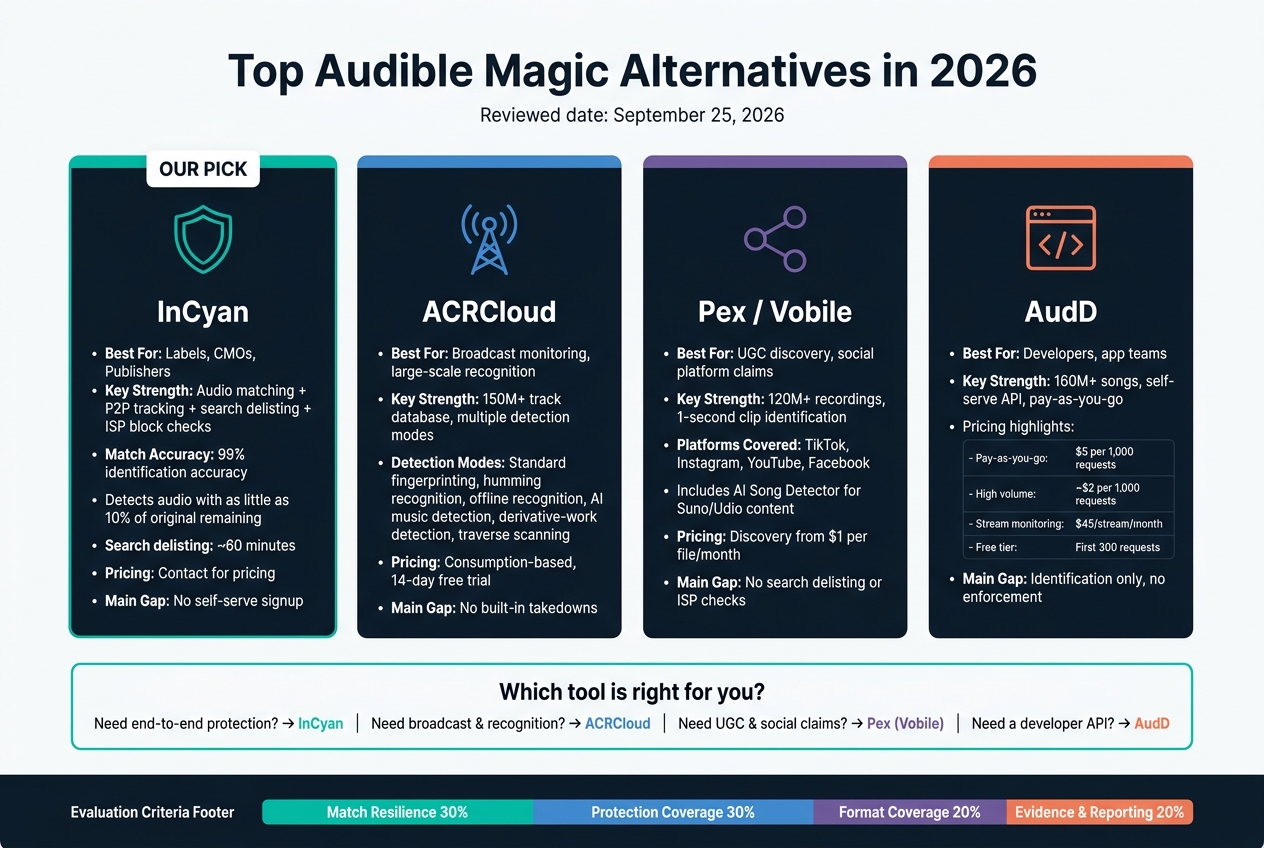
Audible Magic Alternatives 2026: Side-by-Side Comparison
Quick Comparison
| Tool | Best for | Main strength | Main gap |
|---|---|---|---|
| InCyan | Rights holders | Audio matching plus delisting, P2P tracking, and ISP block checks | No self-serve signup |
| ACRCloud | Broadcast and large-scale recognition | 150M+ track database and multiple detection modes | No built-in takedowns |
| Pex (Vobile) | UGC and social claims | Matches short or edited clips and links them to claim workflows | No search delisting or ISP checks |
| AudD | Developers and app teams | 160M+ songs, self-serve API, and pay-as-you-go pricing | Focused on ID, not removal |
I’ll break down who each tool is for, where each one falls short, and which one I’d pick based on what you need after a match is found.
sbb-itb-738ac1e
1. InCyan
Our Pick
InCyan takes the top spot because it doesn’t stop at identification. It also helps with enforcement. In one platform, InCyan brings together audio fingerprinting, P2P monitoring, search delisting, and ISP-block verification. That means rights holders can go from detection to action without bouncing between different tools.
It starts with resilient matching. The big difference is Idem: it reaches 99% identification accuracy and can still detect tracks when only 10% of the original audio remains [4]. Speed changes, background noise, and AI edits aren’t enough to reliably hide infringement. After that, TorrentWatch shows where the content is moving across P2P networks, Indago removes infringing URLs from search results – usually within 60 minutes [4] – and BlockWatch checks whether ISPs are following court-ordered blocks.
That gives legal and rights teams something they can actually use: detection, proof, and removal in the same place. The platform is trusted by the BPI, RIAA, IRMA, and the BRIT Awards. It’s a strong fit for record labels, CMOs, publishers, and legal teams that need evidence-grade reporting. You can see more on InCyan’s Music & Recording solution page.
Limitations: there’s no instant self-serve signup. Onboarding starts with a consultation. So if you need a consumer-facing song-ID API or immediate developer access, this probably isn’t the right fit.
| Best for | Labels, CMOs, and publishers protecting their own catalogs end to end |
| Pricing | Contact for pricing |
| Key differentiator | Recognition + P2P discovery + search delisting + ISP compliance in one platform |
| Main limit | Enterprise onboarding only; not a self-serve song-ID API |
Use it when you need detection, proof, and removal in one system. Skip it if you want consumer song-ID features or self-serve API access.
2. ACRCloud
If you only need recognition and monitoring, ACRCloud is probably the closest match. It works best for teams handling music recognition at scale and broadcast monitoring, not takedowns. Its reference database covers more than 150 million tracks[1].
Where ACRCloud stands out is its range of recognition modes. It supports standard fingerprinting, humming recognition, offline recognition, AI music detection, derivative-work detection, and traverse scanning[1][5]. In plain English, that gives teams more than one way to identify audio depending on the use case. A radio monitoring setup doesn’t always need the same workflow as a mobile app or an internal review tool.
It also fits radio and TV monitoring well, with low-latency live-stream analysis across the Americas, Europe, and Asia Pacific[1]. That’s handy for things like airplay logs and compliance checks.
You can feed uploads or live streams into the API, then use the returned IDs for logging, reporting, or internal review.
| Best for | Large-scale music recognition, broadcast monitoring, and developer integrations |
| Pricing | Consumption-based; 14-day free trial available[5] |
| Key differentiator | 150M+ track database with AI music detection, humming recognition, and offline matching |
| Main limit | No built-in takedown or search-level enforcement; video support is not detailed |
Skip this if your main goal is finding and removing infringing content across P2P networks or search engines. ACRCloud returns IDs such as ISRC and UPC, but you still need to build the enforcement side on your own.
3. Pex (Vobile)
Pex now operates as the Vobile Music Team. It sits in the middle ground between plain recognition and full-on protection. You get content ID, social discovery, and AI-track detection, all tied to royalty-claim workflows [2].
Its ACR tech can identify clips as short as one second. It can also match heavily changed versions, including speed and pitch shifts, mashups, multi-track mixes, and noisy recordings [2]. The reference registry covers 120 million+ recordings [2].
The lineup includes Search, the AI Song Detector for AI-made tracks from Suno and Udio, and Discovery for TikTok, Instagram, YouTube, and Facebook [2]. So if you need more than basic song ID, Pex starts to make sense. It connects recognition to social discovery and claim handling in one place.
Use it for:
- UGC claim matching
- Catalog monitoring across TikTok, Instagram, YouTube, and Facebook
- Royalty-claim workflows
| Best for | Rights holders and platforms using UGC discovery and royalty-claiming workflows |
| Pricing | Discovery from $1 per file per month; other products via sales [2] |
| Key differentiator | 120M+ recording registry, one-second identification, and AI Song Detector for Suno/Udio content [2] |
| Main limit | No search-delisting or ISP-blocking oversight; best used inside the Vobile ecosystem [2] |
How it fits your workflow: Search identifies a track and returns metadata. Discovery then shows where that content is appearing across social platforms and sends those matches into a review queue for claim decisions. The AI Song Detector flags fully synthetic tracks so they don’t slip through untagged. Put together, these three products take a rights team from ID to claim without leaving the platform.
Skip this if you want an independent vendor outside the Vobile group, need built-in search delisting, or require ISP-blocking compliance oversight. Pex is strong at identification and UGC discovery, but enforcement past that is not part of its stated feature set.
If you need a lighter, developer-first API instead, the next option is built for that use case.
4. AudD
AudD is the leanest pick in this group if your main job is recognition. It fits developers and media teams that want self-serve song ID and metadata lookup without going through a sales process. Pricing is public, the database covers 160 million songs, and its proprietary neural-network fingerprinting is built to deal with noise, compression, and speed changes [3].
The standard endpoint processes about 12 seconds of audio per request [3]. For app features and live-stream monitoring, that setup makes sense. But if you’re scanning full tracks or DJ mixes, that cap starts to bite. In those cases, AudD’s enterprise endpoint chunks files server-side and charges per 12-second chunk processed [3].
That’s the part to watch when you plan API usage and stream-monitoring spend. A small clip is one thing. A long mix is a different ballgame.
| Service | Price |
|---|---|
| File recognition (pay-as-you-go) | $5 per 1,000 requests [3] |
| File recognition (high volume) | ~$2 per 1,000 requests [3] |
| Stream monitoring (AudD database) | $45 per stream / month [3] |
| Stream monitoring (custom catalog) | $25 per stream / month [3] |
| Free tier | First 300 requests, no credit card [3] |
The tradeoff is scope. AudD stays focused on identification. It does not include an enforcement layer. You get metadata like artist, title, ISRC, and UPC, which can help with takedown work [3]. But it doesn’t offer native takedowns, P2P discovery, search delisting, or ISP reporting.
Skip this if you need full-length file matching on the standard plan, evidence-grade reporting for ISP notices, automated takedowns, or visibility into P2P networks. It’s a tool for ID and stream monitoring, not enforcement.
Pros and cons by use case
Now that each tool is defined, this table shows where each one fits best.
| Tool | Rights Holders (Catalog Protection) | Platforms (Upload Screening) | Broadcasters (Airplay Monitoring) | Developers (App Embedding) |
|---|---|---|---|---|
| InCyan | Best for – P2P discovery, search delisting, and ISP enforcement [4] | Limited – focused on external piracy, not UGC screening [4] | Fits when legal-grade evidence is needed [4] | Skip – enterprise onboarding only [4] |
| ACRCloud | Limited – recognition and monitoring, not enforcement [1] | Fits when – derivative works detection is needed [1] | Best for – broadcast monitoring and music recognition [1] | Fits when – developer API access is the priority [1] |
| Pex (Vobile) | Fits when – identification ties to Vobile’s registry and workflows [2] | Best for – UGC discovery across TikTok, Instagram, and YouTube [2] | Fits when – CMO-focused usage reporting is needed [2] | Skip – sales-led onboarding [2] |
| AudD | Skip – recognition and stream monitoring only, not enforcement [3] | Best for – enterprise endpoint scans full files with timestamps [3] | Best for – real-time stream recognition via webhooks [3] | Best for – public pricing, simple auth, and broad SDK support [3] |
In plain English, InCyan is the strongest pick when the job is protection, not just identification. It’s built for finding piracy in the wild and backing action like delisting or ISP enforcement [4].
ACRCloud and AudD make more sense when recognition is the main task and enforcement happens somewhere else. That could mean broadcast tracking, stream monitoring, detecting unauthorized sampling, or app-level music ID [1][3].
Pex (Vobile) fits teams that want identification linked to Vobile’s registry and workflow stack. That matters most for groups working heavily across UGC platforms like TikTok, Instagram, and YouTube [2].
If two tools still seem close, the next section turns that short list into a final choice.
Which tool should you choose?
The right choice comes down to one thing: what needs to happen after the match is found.
| If your priority is… | Choose | Why |
|---|---|---|
| End-to-end protection | InCyan | P2P monitoring, search delisting in about 60 minutes, and ISP enforcement [4] |
| Developer-first API integration | AudD | Self-serve onboarding, public pay-as-you-go pricing, and stream monitoring [3] |
| Social media and UGC rights | Pex (Vobile) | Discovery across TikTok, Instagram, and YouTube [2] |
| Music recognition and broadcast monitoring | ACRCloud | Humming recognition, AI-generated music detection, and broadcast monitoring [1] |
| Existing upload-screening workflow | Audible Magic | Best for platforms already integrated and meeting compliance needs |
Here’s the plain-English version: protection tools tell you where content is being used and help you act on it. Recognition tools stop at identification.
Choose InCyan when detection needs to turn straight into proof and takedown.
If your upload-screening setup is already in place and doing the job, the baseline may still be enough. Stay with Audible Magic if your compliance needs end at identification.
If all you need is recognition, go with ACRCloud or AudD. If you need UGC discovery and claims across social platforms, Pex is the better fit.
FAQs
What is automated content recognition (ACR) and how does audio fingerprinting work
Automated content recognition (ACR) identifies a song by matching its audio fingerprint to a reference database.
InCyan goes a step further and ties ACR to rights protection. It fingerprints your catalog, monitors P2P networks, torrents, and search results for matches, generates evidence, delists infringing results in about 60 minutes, and supports ISP blocking compliance.
By contrast, ACRCloud, Pex/Vobile, and AudD lean more toward recognition than enforcement.
What’s the difference between content recognition and content protection
Content recognition identifies a song or recording by matching it to a reference database. Tools like ACRCloud, Pex (now Vobile), and AudD focus on that step.
Content protection goes further: finding unauthorized use, documenting it, and helping remove or enforce against it.
Can audio fingerprinting detect tracks altered with AI stem removal or voice cloning
Sometimes – but it depends on how well the matching system holds up. AI edits like stem removal or voice cloning can change a track enough to weaken exact-match fingerprints.
That’s why this category is shifting. ACRCloud highlights AI music detection, and Pex (Vobile) offers AI Song Detector.
Do I need a separate tool for video and image infringement
Not always. InCyan uses multimodal matching across audio, video, images, and text, so rights holders may not need a separate tool for each format.
Its focus goes past recognition alone. It also covers discovery and protection, with features like P2P tracking, search delisting, and evidence-based enforcement workflows.
What evidence do ISPs and courts expect for music piracy enforcement
They usually want proof they can act on, not just a song match.
That means showing where the content appears and backing up steps like:
- P2P monitoring
- search-level delisting
- ISP blocking compliance
InCyan is built around that broader workflow. It pairs audio fingerprinting with discovery and enforcement.
By contrast, ACRCloud, Pex (Vobile), and AudD are framed here as recognition-first tools.
Is Audible Magic still a good choice in 2026
Yes – for upload screening and song recognition.
If you also need discovery and enforcement, InCyan is built for that. It fingerprints your catalog, monitors P2P activity, supports evidence-based reporting, delists search links, and helps verify ISP blocking compliance.
The other tools here lean more toward recognition: ACRCloud, Pex/Vobile, and AudD.