Blockchain timestamps can help you prove when a file existed, but they do not prove that you made it or own the rights.
If I had to sum up the 2026 view in a few lines, it would be this:
- Blockchain is good for proof of existence
- It can help show file integrity and version history
- It does not replace U.S. copyright registration
- Courts may accept it as support, not as stand-alone ownership proof
- The file, metadata, contracts, and publication trail still matter
That’s the main takeaway for any business that publishes online. A SHA-256 hash on-chain can show that a file existed in that exact form at a given time. But if I want a claim to hold up later, I still need a clean record around it: who made the work, when it was published, what changed, and what rights were assigned.
A few 2025–2026 signals back this up. In March 2025, a court in Marseille accepted blockchain timestamps in a copyright dispute, but only as support alongside other records. In 2026, reporting from China pointed to blockchain systems used to check certificate records and reduce tampering. So the pattern is clear: blockchain evidence is being used more often, but it works best as one part of the file, not the whole file.
What I’d do is simple:
- Hash the original file locally
- Put only the checksum on-chain
- Save the certificate and transaction record
- Keep the exact original file unchanged
- Store metadata, source URLs, and version notes
- Pair the timestamp with contracts and registration when needed
Bottom line: blockchain helps with time, integrity, and history. It does not settle authorship or ownership by itself.
What Blockchain Can and Cannot Prove
Blockchain-based timestamps can be strong evidence. But it only supports a narrow set of claims.
What It Can Prove: Existence, Integrity, and Version History
When a hash is recorded on-chain, it shows that a file existed in that exact form at a specific point in time. It can also help confirm later whether the file changed.
If that same work is timestamped again and again, you get a version trail over time. ScoreDetect, for example, offers a Revisions Timeline that captures sequential blockchain transactions for a file, making it possible to demonstrate the development of a work over time [1]. That’s useful evidence. But it only proves what the record shows.
What It Cannot Prove Alone: Authorship, Originality, and Registered Rights
This is where people often get mixed up. A timestamp can show that a file was uploaded or recorded at a certain moment. It does not prove who made it, whether it was original, or who owns the rights.
In U.S. practice, three gaps matter most:
- Authorship: The record points to an account or wallet, not verified creation.
- Originality: A hash cannot show independent creation or copying.
- Copyright registration: Blockchain does not replace formal copyright registration.
How far that kind of evidence goes depends on whether a court, agency, or other institution accepts it.
sbb-itb-738ac1e
Legal and Evidentiary Recognition in 2026
Court and Institutional Acceptance Trends
That distinction now matters in court.
In 2026, blockchain records are treated much like other forms of digital evidence. Courts and IP bodies may admit them, but only when they’re authenticated and backed by relevance, reliability, and chain-of-custody proof. Judges are more familiar with this type of record than they were a few years ago, but that doesn’t mean a blockchain entry gets automatic weight. On its own, it usually isn’t enough. To carry real persuasive force, it still needs support from other records.
Key 2025 to 2026 Developments to Track
In March 2025, the Tribunal judiciaire de Marseille admitted blockchain timestamps in a copyright dispute over fashion designs. The court treated the timestamps as corroborating evidence, alongside publication records and trademarks – not as standalone proof of ownership [3][4][5][6].
In China, 2026 reporting described a blockchain-based copyright prosecution platform built to verify certificate authenticity and reduce tampering [7].
Across the U.S., France, China, and international IP discussions, the pattern is pretty clear: blockchain evidence is getting easier to use, but it still works best as support for a claim, not as sole proof of ownership.
So the practical issue has shifted. It’s no longer just about whether blockchain records can be used. It’s about whether you can later authenticate them without a mess. That puts the spotlight on process discipline: the value comes from how the hash is created, stored, and later verified.
A Practical Workflow for Copyright Verification
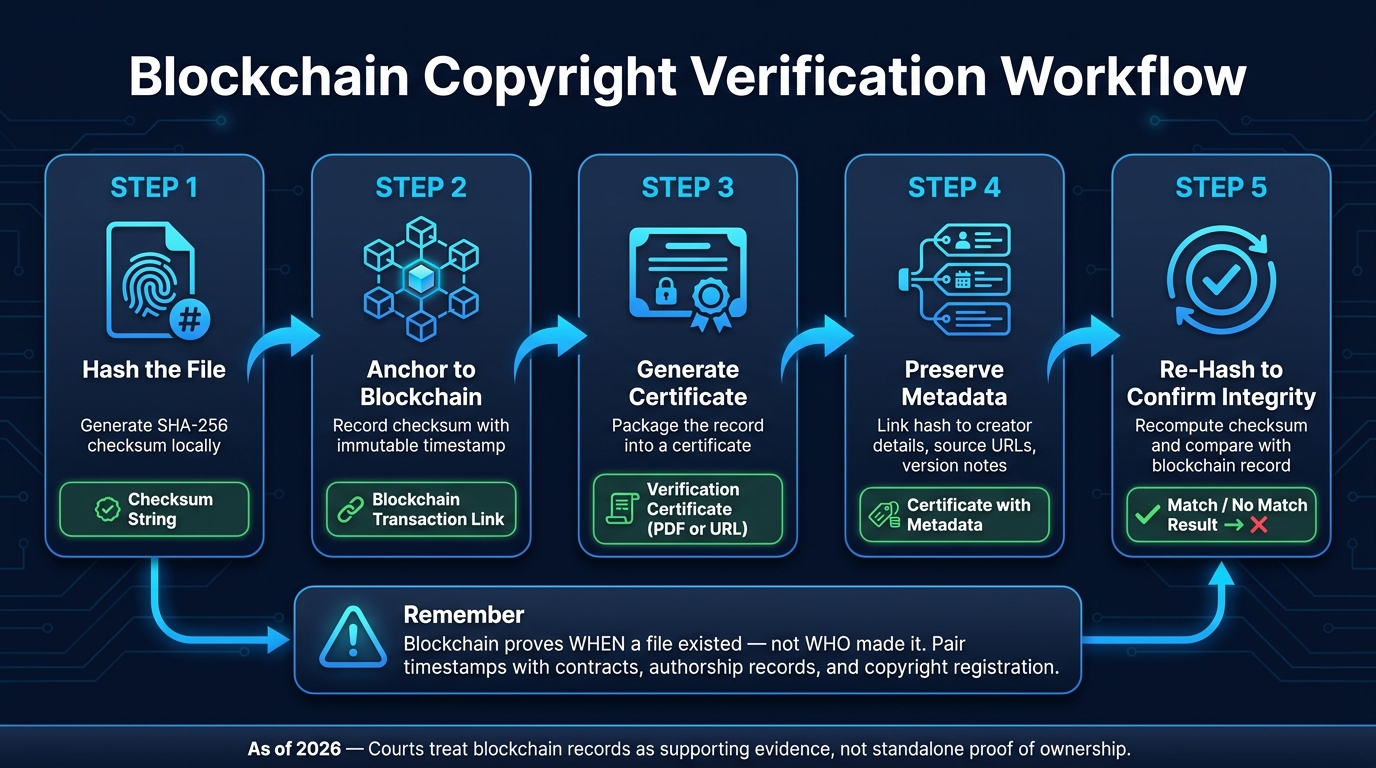
Blockchain Copyright Verification Workflow: 5 Steps to Protect Your Content
From File Hashing to Later Verification
The legal weight of a blockchain record comes down to the nuts and bolts: how the file is hashed, how that hash is stored, and how someone checks it later. This is the day-to-day process behind the evidentiary standard discussed above.
Start by generating a SHA-256 checksum locally. Then anchor only the checksum to the blockchain.
That keeps the evidence simple, repeatable, and easier to defend.
| Step | Purpose | Output |
|---|---|---|
| 1. Hash the file | Generate a SHA-256 hash locally | Checksum string |
| 2. Anchor to blockchain | Record the checksum with an immutable timestamp | Blockchain transaction link |
| 3. Generate certificate | Package the record into a certificate | Verification certificate (PDF or URL) |
| 4. Preserve metadata | Link the hash to creator details, source URLs, version notes, and related records | Certificate with metadata |
| 5. Re-hash to confirm integrity | Recompute the checksum and compare it with the blockchain record | Match/no match result |
That’s the whole point of this workflow: build a record that can be checked again later, without confusion.
When you re-hash the file, you can confirm whether anything changed. If the checksum matches, the file’s integrity holds up. If it doesn’t, the file was altered.
Keep the exact original file. Even a small metadata change can break the match. It also helps to store a file manifest with the asset ID, title, format, owner, hash, and certificate IDs. That way, when you need the right version, you’re not digging through folders and guessing.
Where ScoreDetect Fits In for Teams That Need Simple Implementation
Teams that don’t want to build custom infrastructure can automate this process.
ScoreDetect, a product of InCyan, captures the SHA-256 checksum, anchors it to the blockchain, and generates a verification certificate with the hash and blockchain transaction link. It also supports API, WordPress, and Zapier across more than 6,000 web apps, which makes setup much easier for many teams [1].
Certificates can be exported as PDFs for offline storage. Formal Recognition Certificates also add a letter for authorities and organizations.
Conclusion: What Businesses Should Use Blockchain For in 2026
The practical question isn’t whether to use blockchain. It’s what job it should do.
Blockchain is a proof system, not copyright registration. It can show that a file existed at a certain time and that the file hasn’t changed since. That’s useful, but on its own, it isn’t enough. To turn a timestamp into proof you can actually use, pair blockchain with contracts, authorship records, version history, and copyright registration.
As of 2026, French legal analysis still treats blockchain records as case-by-case evidence, not automatic proof [2].
That puts recordkeeping on the same level as timestamping. If the original file, metadata, and contract trail aren’t kept, the blockchain record can fall apart.
ScoreDetect, by InCyan, can automate checksum capture and blockchain timestamping inside a publishing workflow.
The best workflow is simple:
- Timestamp the asset
- Preserve the evidence
- Keep blockchain in support of the broader ownership record
FAQs
Can blockchain prove I own a copyright?
Blockchain can give you tamper-proof proof of authorship and creation time by putting a content checksum on a decentralized ledger. That gives you a clear record of who made what, and when.
But here’s the catch: blockchain alone can’t scan the web for infringement. It proves origin. It doesn’t do the hunting.
In 2026, stronger copyright protection comes from pairing blockchain proof with AI-driven fingerprinting. ScoreDetect, a product of InCyan, anchors content checksums to the blockchain so you have verifiable provenance.
Do I still need U.S. copyright registration?
Yes. In 2026, blockchain-based copyright verification mostly gives you immutable proof of authorship and creation time. It does not handle full registration or active web monitoring.
Tools like ScoreDetect, a product of InCyan, record a cryptographic checksum on an immutable ledger. That creates a tamper-proof timestamp and ownership record without storing the file itself.
What records should I keep with a blockchain timestamp?
Keep records that support authorship and creation time. In 2026, blockchain copyright verification is used mostly to create immutable proof, not to monitor the web in active ways.
ScoreDetect, a product of InCyan, records a content checksum and timestamp on the blockchain without storing the actual asset. Inside InCyan’s ecosystem, this can help with detection, takedowns, and legal evidence.