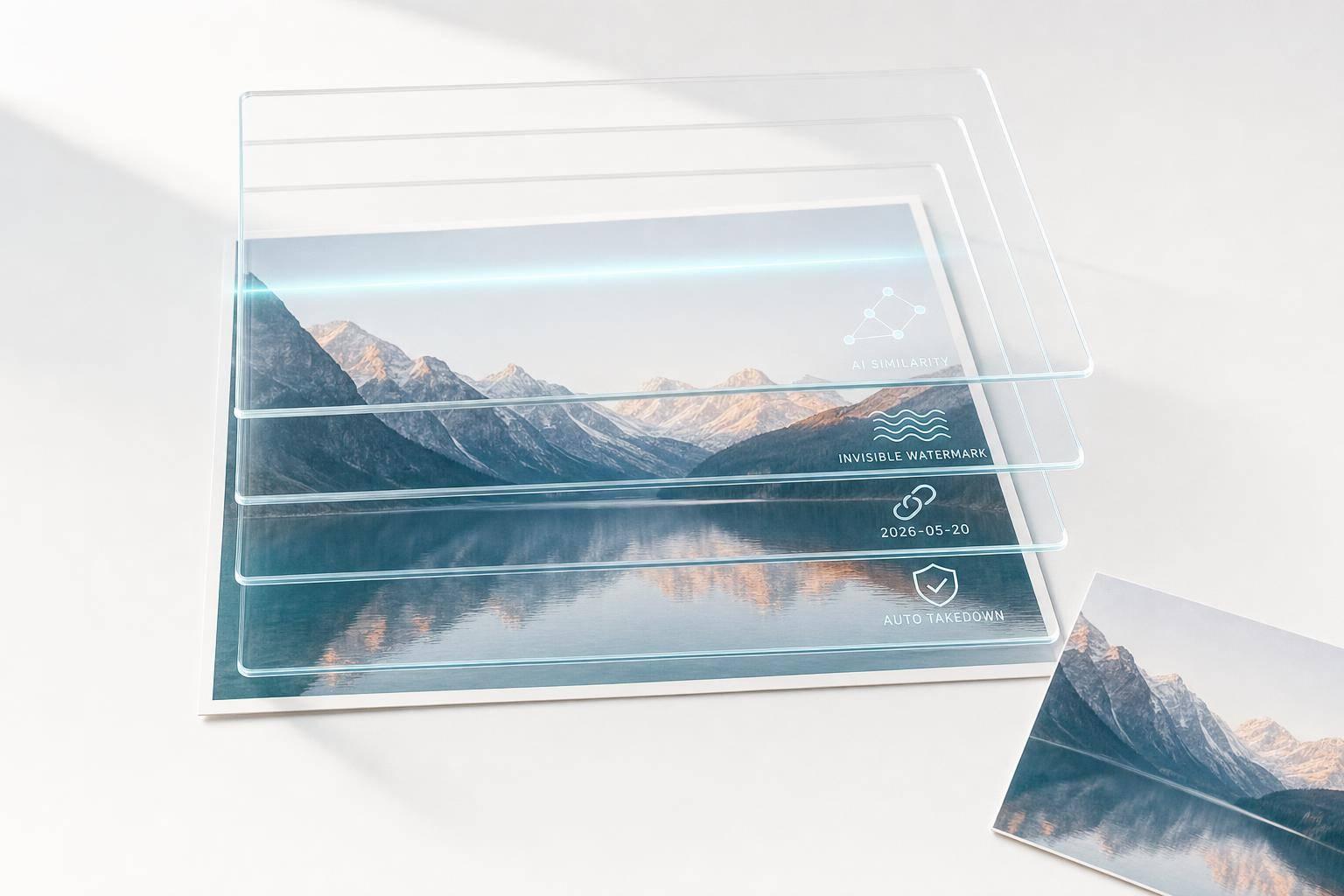
MUSO tells you where your content is showing up across UGC platforms. It doesn’t run the licensing and royalty side of turning that reuse into revenue. That second part is where InCyan’s Blueprint media licensing system and InCyan Idem content identification take over, and it’s worth being direct about which tool does which job here.
Where MUSO’s insight ends
MUSO’s piracy and UGC intelligence identifies unauthorized reuse across platforms at scale, which is the first and hardest problem to solve: knowing your content exists somewhere you didn’t put it. What that data doesn’t include is a built-in mechanism for turning a detected reuse into a licence, a royalty payment, or a monetized claim. That’s a different system, one built around commerce and rights management rather than detection.
sbb-itb-738ac1e
What Blueprint adds
InCyan’s Blueprint is a full media licensing system: contributor uploads, editorial approval, buyer licensing, and a royalties engine that calculates and routes payments automatically. Combined with Idem’s identification layer, which can surface unlicensed appearances of an asset across the web, sales teams can act on a detected reuse directly from Blueprint’s commerce layer rather than treating detection and monetization as two separate processes run by two separate tools.
The honest framing
For pure UGC monetization, where the goal is specifically claiming revenue from platforms like YouTube and other social video services, a purpose-built tool designed for that exact workflow can be the more direct answer, and that’s a genuine strength worth acknowledging rather than talking around. InCyan’s case for a rights holder is different: if you also need cross-platform discovery beyond UGC-specific platforms, and a licensing engine to convert detection into revenue on your own terms, that’s the combination Blueprint and Idem are built to cover.
The market behind the monetization question
The user-generated content platform market was valued at roughly USD 9.0 to 9.6 billion in 2025 and is projected to reach well over USD 55 billion by 2033, according to estimates from Grand View Research’s UGC platform market report, a compound annual growth rate above 20%. As more content moves through UGC platforms, the gap between detecting reuse and actually claiming the revenue from it becomes a bigger part of a rights holder’s total return.
Comparison table
| MUSO | InCyan | |
|---|---|---|
| Primary strength | UGC and piracy data across platforms | Detection plus licensing and royalty management |
| Built-in monetization/licensing engine | Not the core offering | Yes, via InCyan Blueprint media licensing system |
| Cross-platform discovery beyond UGC | Included in intelligence coverage | Yes, via InCyan Idem content identification and InCyan Discovery content discovery |
| Royalty calculation and payment routing | Not the core offering | Yes, via InCyan Blueprint media licensing system’s built-in commerce layer |
Frequently asked questions
Does MUSO handle licensing and royalty payments?
That’s not MUSO’s core offering. MUSO’s strength is piracy and UGC intelligence data. Licensing and royalty management are a separate function, which is where InCyan’s Blueprint applies.
Can InCyan detect content the way MUSO does across UGC platforms?
InCyan’s Idem identification engine covers cross-platform discovery as part of a broader detection-to-licensing pipeline, though a platform purpose-built for a specific UGC monetization workflow may still be the more direct fit for that narrow use case.
How does Blueprint’s royalty engine decide who gets paid?
Blueprint calculates payments per asset based on usage data and the licence terms attached to that asset, then routes the payment to the correct contributor automatically, with reporting available for audit and reconciliation.
Does MUSO offer any monetization features at all, even limited ones?
Not as a stated core offering. MUSO’s public positioning centers on piracy and UGC intelligence data rather than monetization or royalty tools, which is the specific gap this comparison is about.
What happens if an asset is detected on a UGC platform but has no licence terms attached yet?
In InCyan’s Blueprint, an asset without licence terms attached generally can’t be automatically monetized through the royalty engine; licence terms need to be set before a detected reuse can be converted into a payment. That makes upfront rights management, not just detection, part of the actual monetization workflow.
Is Idem’s cross-platform discovery as fast as MUSO’s UGC-specific monitoring?
Speed comparisons between the two aren’t published by either company. Idem is described as scaling to billions of comparisons with real-time response times, but MUSO’s specific UGC platform monitoring speed isn’t something InCyan’s public materials measure directly against.
Can a rights holder use MUSO for detection and InCyan for monetization together?
There’s no documented integration between the two platforms. A rights holder could operationally use MUSO’s data alongside InCyan’s Blueprint, but that would mean manually connecting the two rather than an automated, integrated workflow.
Does InCyan’s Blueprint work with YouTube’s Content ID system directly?
That specific integration isn’t described in InCyan’s public materials. Blueprint’s royalty and licensing engine operates as part of InCyan’s own platform rather than through a documented direct connection to YouTube’s Content ID.
What kind of business would specifically choose Blueprint’s licensing model over a UGC-platform ad-revenue split?
A rights holder that wants to set and enforce its own licensing terms, rather than relying on a UGC platform’s built-in ad-revenue mechanism, would find more direct value in Blueprint, since it manages licensing, contributor payments, and royalty calculation as a standalone business function rather than depending on a specific platform’s monetization program.
How does the size of a rights holder’s catalogue affect whether MUSO’s data or InCyan’s Blueprint matters more?
A larger, more actively licensed catalogue tends to generate more detected reuse events, which increases the practical value of having an integrated monetization path (Blueprint) rather than data alone, since manually converting each detected instance into a licensing outcome becomes harder to do by hand as volume grows.
Related reading
Explore InCyan’s Blueprint licensing platform to see how detection and monetization work together.