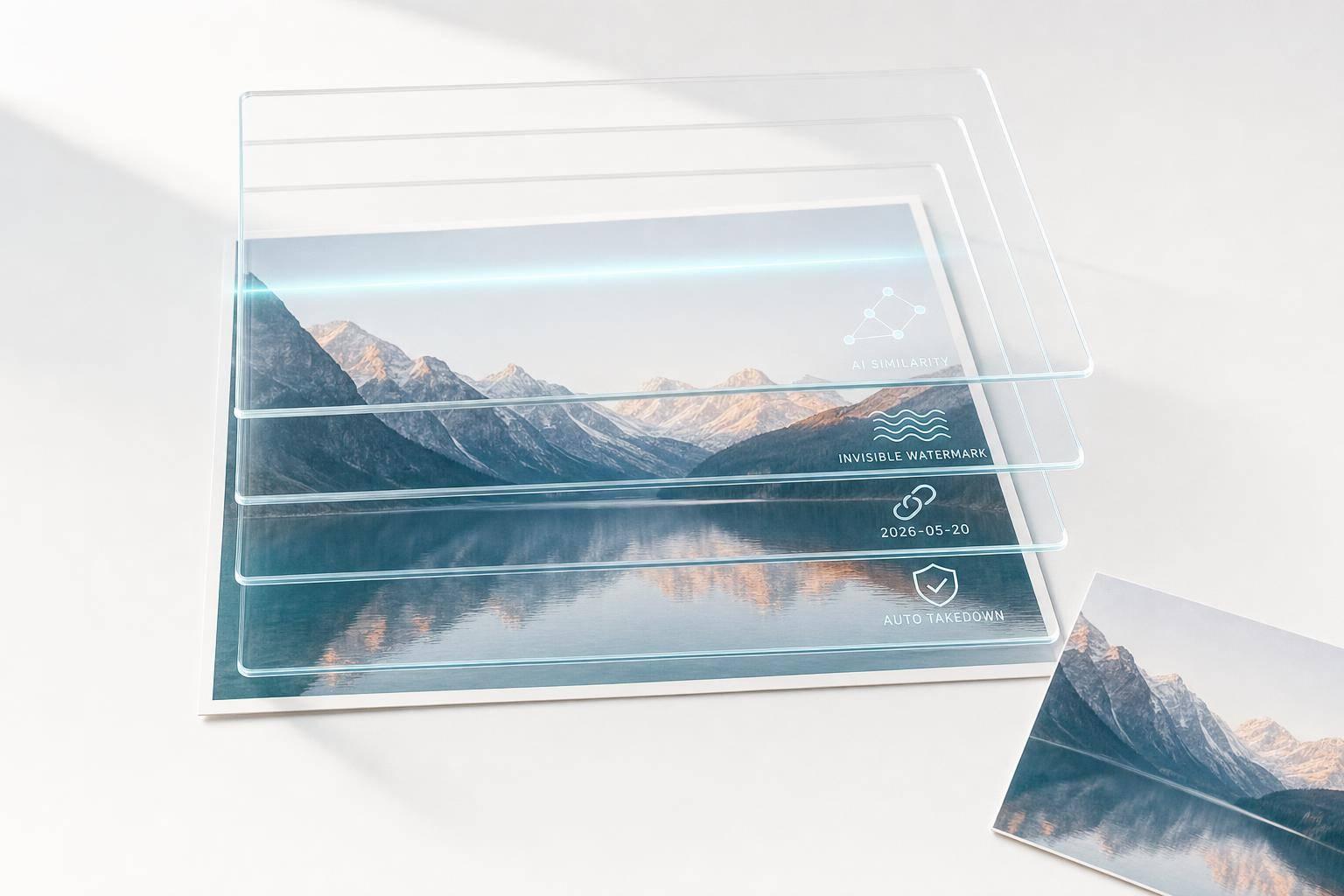
For an individual photographer or small studio with a photo-only catalogue, ImageRights’ recovery-fee model is a reasonable InCyan alternative. For a catalogue spanning video, audio, or text alongside images, or one large enough that enforcement speed matters more than a per-case recovery fee, that’s where InCyan’s platform covers more ground.
Quick decision guide
- Choose ImageRights if: your catalogue is photographs only, and case-by-case recovery on a fee basis fits your volume.
- Choose InCyan if: your catalogue spans multiple content types, or infringement volume is high enough that fast, automated enforcement matters more than per-case recovery.
sbb-itb-738ac1e
At a glance
| ImageRights | InCyan | |
|---|---|---|
| Asset types | Images only | Images, video, audio, and text |
| Pricing model | Recovery-fee based | Enterprise licensing |
| Enforcement speed | Case-by-case recovery process | Roughly 60 minutes via InCyan Indago search delisting |
Piracy remains a real financial problem behind this decision: online piracy cost the U.S. entertainment industry an estimated $73 billion in lost revenue in 2023, with streaming piracy alone accounting for $14.2 billion of that, up 12% from 2021, according to the Motion Picture Association’s reported figures, summarized by CyberNews. The larger and more actively licensed a catalogue is, the more that macro trend shows up as recovery cases.
Frequently asked questions
Does ImageRights help with video or text content, not just photos?
No, ImageRights is built specifically for photographs, similar to other photographer-focused recovery services.
How is ImageRights different from Pixsy, if they both use a recovery-fee model?
Both operate on a similar photographer-focused, recovery-oriented model for images specifically. Specific differences in fee structure, detection methodology, or geographic coverage between the two would need to be confirmed directly with each company, since InCyan’s materials don’t compare them to each other.
What’s the actual cost difference between ImageRights and InCyan for a mid-sized catalogue?
Neither company publishes a pricing calculator, so a mid-sized catalogue’s actual cost under each model depends on running the same break-even math described in the Pixsy pricing comparison: estimate infringement volume and recovery value under a contingency model, then compare to a quoted InCyan enterprise rate.
Can a photographer use ImageRights for some images and InCyan for others?
There’s no technical or documented reason this couldn’t happen operationally, though it would mean managing two separate systems and workflows rather than one integrated platform.
Does ImageRights offer any form of proactive watermarking, or only after-the-fact detection?
That capability isn’t detailed in the sources reviewed for this comparison. Recovery-fee services in this category are generally oriented around detecting existing infringement rather than embedding preventive watermarks, which is a different service entirely from what InCyan’s Tectus invisible watermarking and InCyan ProofChain blockchain-anchored watermarking provide.
Is ImageRights or InCyan better suited for a photographer just starting to worry about image theft?
For someone new to the problem with a modest catalogue, a no-upfront-cost recovery service like ImageRights is generally the lower-risk starting point, since InCyan’s enterprise platform is scoped for considerably larger catalogues and use cases.
Does InCyan’s Indago search delisting work for images specifically, or only for other content types?
Indago’s search-delisting capability applies to whatever content type has been detected as infringing, images included, provided the underlying detection has already confirmed the match through InCyan Idem content identification.
If my catalogue grows past what ImageRights handles well, what’s the actual signal to switch?
The clearest signals are infringement volume outpacing what a per-case recovery model handles efficiently, the catalogue expanding into video, audio, or text alongside images, or licensing at scale becoming part of the business, all covered in more depth on the main Pixsy comparison page, which applies the same reasoning to recovery-fee, photo-only services generally.
Does ImageRights provide any kind of dashboard or reporting for tracking case status?
That level of platform detail isn’t described in the sources reviewed for this comparison and would be a question for ImageRights’ own current product materials.
Would a museum or archive with a large historical photo collection be better served by ImageRights or InCyan?
That depends heavily on whether the collection is actively licensed for commercial use (which points toward InCyan’s Blueprint media licensing system and Idem combination) or primarily monitored for unauthorized reuse on an occasional basis (which fits ImageRights’ recovery-focused model more naturally).
Related reading
- InCyan vs. ImageRights for Image Monitoring and Recovery
- InCyan vs. Pixsy: Which One Scales Past a Single Photographer?
See how InCyan’s Idem covers images, video, audio, and text in one platform.