Pick Vobile for large-library matching across many channels, Irdeto for live-stream tracing and response, and InCyan for a modular setup that blends matching, watermarking, search removal, torrent checks, and provenance records.
I see three clear buying paths here: scale, live-event response, and proof chain. The article compares 8 criteria: channel coverage, match accuracy, resistance to edits, source tracing, evidence quality, takedown workflow, live-event fit, and deployment model.
If you only need the short version, here it is:
- Vobile leans on fingerprint matching for large video catalogs.
- Irdeto centers on watermark tracing plus managed response.
- InCyan splits discovery, tracing, search removal, torrent checks, and provenance into separate modules.
- The main test is simple: how fast can you find a copy, prove the match, and act on it?
Quick Comparison
| Criteria | Vobile | Irdeto | InCyan |
|---|---|---|---|
| Best fit | Large catalog monitoring | Live sports and premium OTT | Modular enforcement stack |
| Main method | Fingerprinting | Detection + forensic watermarking | Multimodal matching + watermarking + provenance |
| Edit resistance | Built for cropped, rotated, blurred, and re-encoded copies | Ask for workflow-specific test data | Claims matching with as little as 10% of original content |
| Source tracing | Secondary layer | Core part of offer | Available through watermarking and provenance |
| Evidence | URLs, timestamps, screenshots | Verified findings plus reporting | Ask what exports and retention are included |
| Response flow | Notices and channel actions | Notices, de-indexing, blocking, stream disruption | Search de-indexing; confirm other takedown paths |
| Live-event fit | Check latency and event support | Strongest live-event fit | Test per module on event day |
| Deployment | Reference files and notice setup | Stream or app watermark integration | Module-by-module setup |
I’d use this article to narrow the shortlist fast, then pressure-test each vendor with your own clips, your target regions, and hard service-level terms in writing.
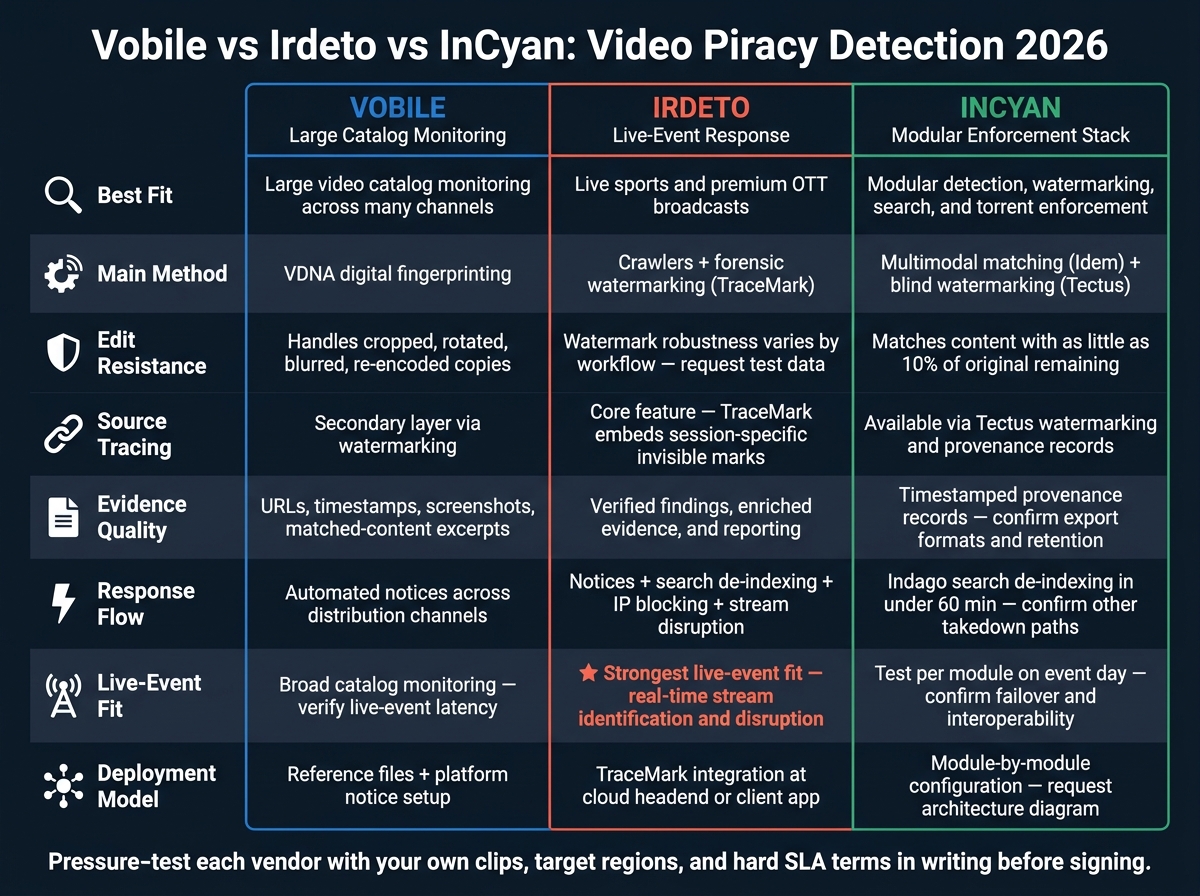
Vobile vs Irdeto vs InCyan: Video Piracy Detection Comparison 2026
Vendor breakdown: Vobile, Irdeto, and InCyan
Vobile: fingerprint-based monitoring for large video catalogs
Vobile’s main edge is scale. Its VDNA technology monitors reference content across video-sharing sites, search engines, P2P networks, mobile apps, and live streams.[8][13]
That matters if you’re dealing with a big video library and lots of copies floating around online. VDNA is built to keep working even when files have been heavily changed. That includes cropped, color-adjusted, rotated, blurred, inverted, or otherwise modified versions.[8][13]
When Vobile finds a match, it gathers evidence like URLs, timestamps, and screenshots to back takedown notices and, on supported platforms, ad-revenue claims.[13] It also adds digital piracy solutions with watermarking for source tracing.[10][12]
In plain terms, Vobile is a fit for teams that want high-volume recognition first, with tracing as a second layer.
Irdeto: managed detection, forensic watermarking, and live piracy response
Irdeto takes a broader managed-service route. Its Online Piracy Detection service covers websites, social media, apps, search engines, and P2P networks.[3]
Once a suspected match is found, the workflow doesn’t stop at detection. Human analysts can validate the match, TraceMark can trace the leak source, and the response layer can handle notices, search de-indexing, payment disruption, and investigations.[2][4][9]
This setup stands out for live and time-sensitive content. Irdeto says its live-piracy offering identifies and stops pirate streams in real time, with watermark extraction built to identify a leak source in seconds.[5][11]
So if Vobile leans toward recognition at scale, Irdeto leans toward detection plus managed response. That can be a better match for teams that don’t just want alerts – they want help acting on them.
InCyan: modular detection, watermarking, search enforcement, and provenance
InCyan goes in a different direction. Instead of pushing one big stack, it lets teams combine only the parts they need.
Here’s how that breaks down:
- Idem is the multimodal matching layer. It’s designed to identify video content even when only 10% of the original asset remains, including mobile edits, memes, cropping, and heavy compression.
- Tectus provides invisible blind watermarking for video, giving rights holders a non-visible way to support ownership proof and leak tracing.
- Indago handles search enforcement by de-indexing unauthorized links from search results in under 60 minutes.[7]
- TorrentWatch monitors the BitTorrent ecosystem for rapid, real-time infringement detection across P2P channels.
InCyan also includes timestamped provenance records.[7]
That modular setup can make sense when a team wants separate tools for discovery, attribution, and enforcement instead of one bundled service. Those differences tee up the side-by-side comparison below.
sbb-itb-738ac1e
Feature comparison table and procurement questions
Side-by-side feature and workflow comparison
The big gaps here come down to how each vendor finds content, how well it documents the match, and what happens next after detection. Use the table to cut down your shortlist. Then check the contract line by line to make sure the promised workflow is actually part of the deal.
| Capability | Vobile | Irdeto | InCyan |
|---|---|---|---|
| How it detects | VDNA digital fingerprinting; watermarking as a supplementary layer | Crawlers, fingerprinting, and forensic watermarking through TraceMark | Idem multimodal matching; confirm whether deployment uses fingerprinting, multimodal matching, or both |
| How it proves | URLs, timestamps, screenshots, matched-content excerpts, and evidence archives | Analysis, verification, evidence enrichment, and reporting | Confirm whether downloadable provenance records, retention periods, and export formats are included |
| How it responds | Automated notices targeting main distribution channels | Verification, notices, search de-indexing, IP blocking, and stream disruption | Indago handles search de-indexing; confirm whether broader takedown is managed, API-driven, or partner-run |
| Modified-video resilience | VDNA is designed to match cropped, color-adjusted, rotated, and re-encoded copies | Watermark robustness depends on the protected workflow and transformation conditions; request test results | Ask for transformation-level benchmark data on heavily modified copies |
| Watermarking | Supports watermark recognition alongside VDNA to help retrace origin | TraceMark embeds unique invisible marks into live or delivered streams | Tectus blind watermarking for video; verify codec resilience and source-attribution detail |
| Social platform coverage | Social media included in VideoTracker scope | Social media included, with fingerprinting applied post-detection | Confirm which social platforms are natively monitored versus partner-dependent |
| P2P & torrent monitoring | P2P networks included in VideoTracker scope | P2P networks included in Online Piracy Detection | TorrentWatch designed for BitTorrent monitoring; confirm indexing depth |
| Live-event suitability | Broad catalog monitoring; verify live-event latency and real-time response inclusion | Strongest fit for live events; TraceMark supports live and on-demand content, and the live-piracy service is designed to identify and stop pirate streams in real time | Evaluate against an event-day test; confirm failover and module interoperability |
| Key implementation prerequisite | Reference files for fingerprint generation; platform accounts and notice templates | TraceMark integration at a cloud headend or client app; watermark insertion before distribution | Separate configuration per module; request an architecture diagram and implementation plan |
That comparison only helps if the contract lines up with the day-to-day workflow. A polished demo can look great. The signed terms are what tell you what you’ll get when a problem hits at 2:00 a.m. on a live event night.
Questions to ask before signing a contract
Use these questions to turn feature claims into contract language.
| Vendor | Strength | Ask before you sign |
|---|---|---|
| Vobile | Broad fingerprint-based monitoring across websites, search, social, P2P, live, streaming, direct-download, and mobile-app environments | Does our plan cover priority regions, private torrent communities, and live events – and what are the defined detection and takedown service levels? |
| Irdeto | Managed monitoring, TraceMark forensic watermarking, source tracing, and enforcement | Which TraceMark integration model, watermark extraction process, monitoring coverage, enforcement staffing, and response-time commitments are included versus sold separately? |
| InCyan | Modular coverage across recognition, watermarking, search enforcement, and P2P monitoring | Which modules are production-ready in our target territories, which channels are native, and what independent accuracy, latency, evidence retention, provenance, and takedown results can be demonstrated? |
Three checks apply to every vendor:
- Request a litigation-ready evidence export and confirm that a second analyst can independently reproduce the finding from the package alone.
- Set measurable service levels – precision, recall, maximum alert latency, notice turnaround, and removal follow-up – instead of accepting feature descriptions as promises.
- Clarify data ownership: who holds the fingerprints, watermark keys, evidence records, and derived analytics if you switch vendors.
For live events, get specific. Ask for median detection time, verification time, and notice submission time under peak load and outside U.S. business hours.
The Forensic Watermarking System Hollywood Uses to Catch Pirates
Which platform fits which anti-piracy strategy in 2026
These fit statements turn a feature comparison into a buying call: scale, speed, or proof.
Choose Vobile for catalog-scale recognition and monitoring
Choose Vobile when your main problem is large-catalog monitoring across many distribution channels. The key factor here is scale. Vobile’s main strength is breadth: it goes after the channels spreading infringing copies, which can help speed up shutdowns across several distribution points at once.[1]
This setup is a strong fit when unauthorized copies have been re-encoded, cropped, reformatted, or reposted without an embedded watermark. Before you commit, test it with your own content under messy, high-risk conditions, including:
- screen recordings
- dubbed versions
- cropped vertical video
- low-resolution re-encodes
That kind of testing gives you a clearer read on how the system performs when piracy doesn’t look clean or predictable.
Choose Irdeto for live streams, source tracing, and managed response
For live sports, premium OTT channels, and high-value broadcasts, the key factor is live-event speed. TraceMark embeds a session-specific invisible watermark that ties leaks back to a distributor or viewer session.[4] When a leaked copy appears, that watermark can support enforcement, account action, or prosecution.[4][9]
What sets Irdeto apart is that it brings monitoring, watermark extraction, source attribution, and enforcement into one managed response. That can cut the time between detection and action in a way a monitoring-only workflow usually can’t.
During procurement, ask for hard numbers and direct answers on:
- time from first detection to validated alert
- escalation and takedown timing
- coverage during peak events
- regional response capabilities
- service-level commitments for nights, weekends, and major live broadcasts[14]
In live broadcasting, those details matter. A vendor may look strong in a demo, but the real test is what happens in the middle of a major event when every minute counts.
Choose InCyan for modular coverage across detection, provenance records, and enforcement
Choose InCyan when you want modular coverage across matching, watermarking, search removal, and torrent monitoring. The key factor here is modular proof and enforcement. That model matters because it lets rights holders add only the layers they need instead of buying into one bundled stack.
Idem is especially useful when content has been heavily altered, because it can still match material even when only a small part of the original remains. Tectus adds invisible watermarking for source attribution. Indago helps remove unauthorized listings from search results fast. Put together, this modular setup works well for teams dealing with search, torrents, and heavily altered copies.
When you scope the deployment, break it down by territory and module. Ask which parts are production-ready in your target regions, what evidence each module produces, and how the workflow moves from detection to action.
That makes InCyan the strongest fit for teams that need to combine detection with evidence and enforcement across different piracy channels.
Conclusion: Match your choice to detection method, speed, and proof requirements
After looking at detection methods and response workflows, the buying call boils down to one thing: which operating model matches your enforcement needs.
Vobile makes sense when the main issue is scale – spotting unauthorized copies of a large video catalog across many platforms and channels.[1] Irdeto is the better fit when speed and attribution matter most, especially for live sports and premium broadcasts, where a leaked stream has to be traced and disrupted during the event, not hours later.[5][6] InCyan is the fit when you want a modular setup that combines detection, watermarking, search enforcement, torrent monitoring, and provenance records.
These options point to three different ways to run enforcement:
- Broad recognition
- Forensic attribution
- Modular enforcement with proof
That choice should rest on coverage, speed, and evidentiary strength. Those are the factors that decide whether enforcement does more than look good on paper – whether it actually protects revenue.
Before you sign anything, pressure-test the metrics that shape day-to-day performance: detection accuracy under realistic attack conditions, mean time from detection to takedown, evidence completeness for disputes or litigation, and automation scope. If a vendor makes performance claims, ask for the method, baseline data, and test results. No proof, no confidence.
At the end of the day, the decision comes back to three things: your detection method, how fast you need to act, and how much proof you need behind enforcement. Get those answers first, and the right platform becomes much easier to pick.
FAQs
How should I test these platforms with my own content?
Start by defining your goals and success metrics. Then build a prioritized inventory of your assets. After that, map your discovery sources across websites, social media, and peer-to-peer networks.
Next, have your technical teams set up API integrations and data schemas so assets, usage data, and evidence artifacts connect cleanly. A pilot launch around week 9 of a 90-day rollout gives the team time to fine-tune confidence thresholds using results from actual use.
What proof should I require before trusting a match?
Require a complete incident record that ties detection to clear proof of ownership. Before you take action, confirm that you have a ScoreDetect verification certificate that includes the asset’s SHA-256 hash, registration date, copyright owner’s name, and blockchain transaction ID.
For added proof, make sure the match is supported by Idem match reports, Tectus watermark logs, and ScoreDetect ownership records. Move forward only when the video, audio, and metadata signals all line up, which helps cut down on false positives.
Which option is best if I need live response and source tracing?
For live response and source tracing, the best setup is a layered system that uses video fingerprinting and forensic watermarking together.
Fingerprinting helps you spot stolen live streams in about 5 seconds. Watermarking then helps trace the leak back to a specific user, session, or device.
Put simply: one tells you what content is being shared, and the other tells you where it came from.