Piracy traffic hit 229.4 billion visits in 2023, and the U.S. made up 13.8% of global TV piracy site visits. If you run a media company, the main question is simple: Do you need fast proof and DMCA workflows, or do you need a larger system for search, BitTorrent, and ISP checks?
Here’s the short answer:
- ScoreDetect fits teams that want ownership proof, invisible watermarking, web monitoring, and automated takedowns without a big setup.
- InCyan’s enterprise stack fits larger media groups that need de-indexing, BitTorrent tracking, ISP-layer checks, and deeper matching across many channels.
- The comparison comes down to four things: proof of ownership, discovery, evidence, and takedown speed.
- The tools cover key media types, including video, audio, images, documents, and mixed media.
- Pricing is only listed for ScoreDetect, starting at $11.31/month with annual billing and a 7-day free trial.
If I had to simplify it even more: ScoreDetect is the easier starting point for small to mid-sized teams. InCyan is the better fit for large-scale enforcement across more sources.
Quick Comparison
| Tool | Best for | Main strengths | Main limit |
|---|---|---|---|
| ScoreDetect | Independent creators, publishers, mid-sized media teams | Blockchain timestamping, invisible watermarking, AI-based discovery, automated DMCA notices | Less focused on ISP-layer analysis and deep enterprise workflows |
| InCyan enterprise stack | Broadcasters, studios, streaming platforms, music rights groups | Watermarking, provenance checks, search de-indexing, BitTorrent monitoring, ISP visibility, partial-match detection | More setup, more resources, and a larger budget |
So if you need a plain-English takeaway before reading the full piece, it’s this: pick ScoreDetect for fast proof and lighter enforcement work; pick InCyan for scale, channel depth, and large rights portfolios.
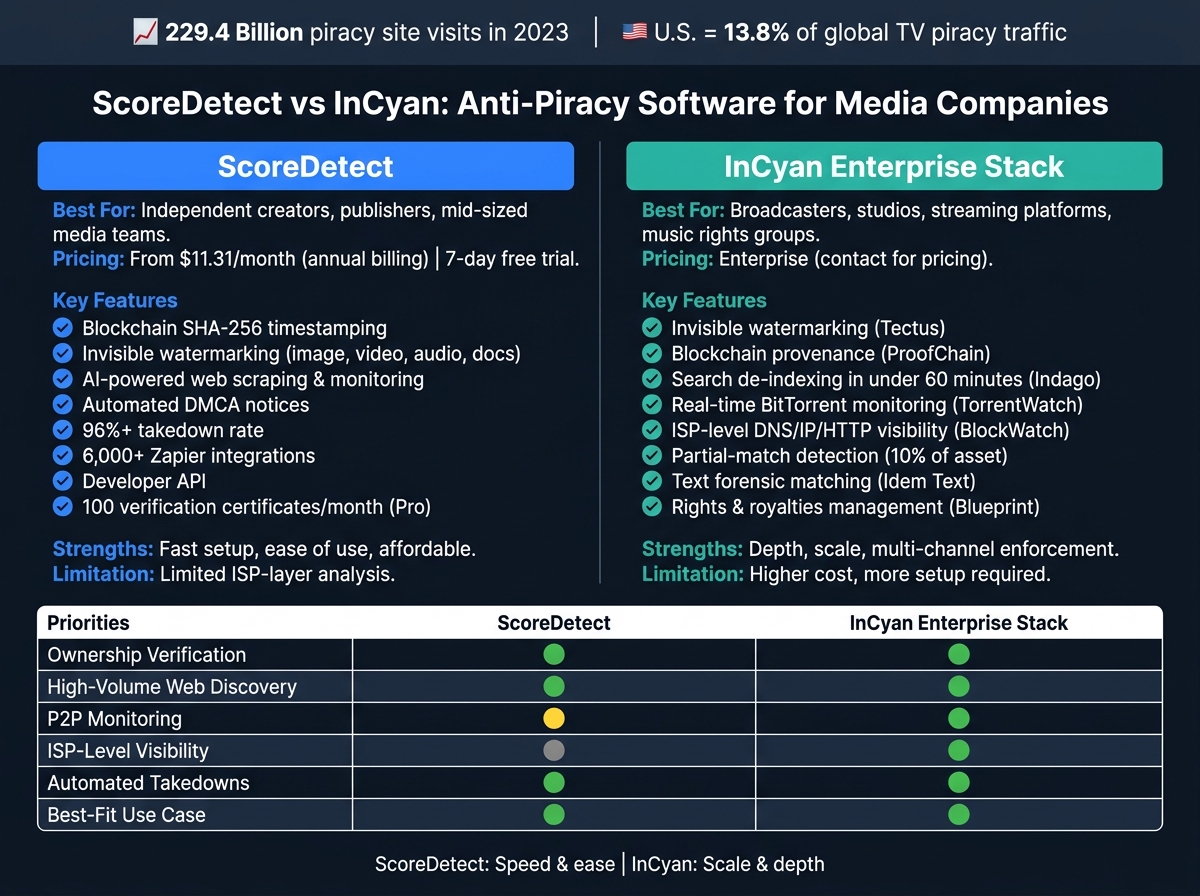
ScoreDetect vs InCyan: Anti-Piracy Software Comparison for Media Companies
Counterspy: The Next Generation Anti-Piracy Solution
sbb-itb-738ac1e
1. ScoreDetect
ScoreDetect focuses on blockchain vs traditional timestamping. When you register content, it creates a SHA-256 checksum and writes it to a public blockchain. You then get a Verification Certificate that includes the transaction URL, your copyright owner name, registration date, and file details.
If you need a more formal paper trail, ScoreDetect can also issue a Formal Recognition Certificate. This comes with an official letter for authorities and organizations that explains the timestamping method and the ownership claim. That record can help with verification, tracing, and enforcement.
Protection and Verification
ScoreDetect offers enterprise invisible watermarking for images, video, audio, and documents. This helps trace leaked files back to the source and adds protection for pre-release content.
Discovery and Monitoring
The enterprise plan also includes 24/7 content and brand monitoring, with targeted web scraping built to get past common blocking measures. Those alerts then feed into enforcement work.
Evidence and Enforcement
Once assets are registered, ScoreDetect can compare infringing material against those records and produce quantified evidence of unauthorized use for DMCA notices and legal filings. Its automated delisting notices have a 96%+ takedown rate.[1]
Content and Workflow Coverage
ScoreDetect supports images, video, audio, and documents. The Pro plan starts at $11.31 per month with annual billing, includes a 7-day free trial, and comes with 100 verification certificates per month.[1]
For teams, ScoreDetect also fits into existing workflows through Zapier integrations with 6,000+ apps and a developer API.
2. InCyan enterprise protection stack for media assets
At enterprise scale, InCyan turns ScoreDetect into a four-part protection stack: Discovery, Identification, Prevention, and Insights. Each part lines up with a different job in the enforcement process, from finding misuse to proving ownership.
Protection and Verification
Tectus adds invisible watermarking for images, video, and audio. The watermark holds up through resizing, transcoding, and format changes. ProofChain ties each asset to a blockchain record of origin and ownership. If a disputed copy shows up, rights teams can check the watermark against that record in seconds. That gives them machine-verifiable evidence for DMCA notices, ISP escalations, or court proceedings[2][3].
Discovery and Monitoring
The discovery layer is built to tell public sources apart from gated repositories.
- Indago handles search de-indexing and can remove unauthorized links in under 60 minutes[4].
- TorrentWatch monitors the BitTorrent ecosystem in real time.
- BlockWatch adds ISP-level visibility by testing DNS, IP, and HTTP/HTTPS layers, which helps teams tell the difference between a true block and a site outage.
Evidence and Enforcement
Idem matches assets against a database of images, video, and audio. It can detect ownership even when only 10% of the original asset remains. That matters when files are cropped, compressed, remixed, or only partly copied.
Idem Text does fast, forensic matching for text-based assets against a secure enterprise database. Put together, these workflows help teams build evidence and issue takedown notices at scale. The platform has also helped BPI remove over one billion illegal links from Google and Bing, backing large-scale music takedowns[4].
Content and Workflow Coverage
The suite covers movies, episodic TV, sports, news, images, audio, and documents. Blueprint brings rights, royalties, and content protection into one enterprise system. InCyan Business Intelligence and Insights adds automated reporting on asset visibility in digital news, so rights holders can make data-backed licensing decisions. The most important pillar depends on the job in front of you: discovery, proof, or takedown speed.
Pros and cons by anti-piracy priority
This section maps each platform to the four enforcement priorities from the Introduction: ownership proof, discovery, evidence, and takedown speed.
ScoreDetect is built for fast setup and checksum-only registration, with automated enforcement that consistently hits a 96% takedown rate. Its AI scraping finds unauthorized content across websites, social media, streaming services, and P2P networks. That makes it a strong fit for teams that want to move fast without a heavy setup. The tradeoff is simple: if your team needs deeper ISP monitoring or more specialized enterprise workflows, you may need a larger stack.
InCyan’s enterprise stack fits organizations running enforcement at scale, such as major broadcasters, studios, or music rights groups. It uses specialized modules for provenance, search de-indexing, BitTorrent monitoring, and ISP-level visibility. The tradeoff is the extra lift that comes with it: more resources, more integration work, and a bigger budget.
| Priority | ScoreDetect | InCyan Enterprise Stack |
|---|---|---|
| Ownership verification | Blockchain checksums; no raw files stored | Invisible watermarking plus blockchain provenance; API-based validation |
| High-volume web discovery | AI scraping; 95% success rate | Search-enforcement workflows; de-index links in under 60 minutes |
| Multimodal matching | AI pattern recognition for video, audio, images, and documents | Detects ownership when only 10% of the original asset remains |
| P2P monitoring | Scans P2P file-sharing networks | Real-time BitTorrent monitoring |
| ISP-level visibility | Not a core focus | Tests DNS, IP, and HTTP/HTTPS layers to distinguish blocks from outages |
| Automated takedowns | Automated DMCA notices; 96% takedown rate | Integrated workflows for large-scale enforcement |
| Best-fit use case | Independent creators, niche publishers, mid-sized media companies | Large studios, broadcasters, major streaming platforms, music rights organizations |
In plain English, ScoreDetect leans toward speed and ease of use. InCyan’s enterprise stack leans toward depth and scale. The next section turns those differences into practical fit by media team type and enforcement need.
Which solution fits your media protection needs
Use the four priorities above – ownership proof, discovery, evidence, and takedown speed – to pick the right setup based on scale and rights complexity.
If you’re an independent creator, digital publisher, niche rights holder, or social-first publisher, ScoreDetect is often the better fit when your main need is ownership proof, moderate-volume discovery, and automated takedowns without building a dedicated anti-piracy team. At $11.31/month with annual billing, it can protect more assets without adding headcount.
For large broadcasters, streaming platforms, labels, and multi-brand media companies dealing with constant infringement across streaming, social, IPTV, and P2P channels, an enterprise protection stack is usually the better call.
Use the table below to match common media-team needs to the right fit:
| Priority | Better fit |
|---|---|
| Ownership proof for DMCA and licensing disputes | ScoreDetect |
| Tracing leaks to specific licensees | ScoreDetect |
| Moderate-volume web and social media monitoring | ScoreDetect |
| Always-on, high-volume streaming and video monitoring | InCyan enterprise stack |
| Multi-territory enforcement with legal escalation | InCyan enterprise stack |
| ISP-level and P2P network monitoring at scale | InCyan enterprise stack |
Before you commit, pressure-test the choice with a few simple questions:
- Volume: Dozens or thousands per month?
- Channels: Web, social, ISPs, P2P, IPTV, or just ownership proof?
- Rights complexity: Multiple rights holders or time-windowed distribution?
- Evidence needs: A simple evidence package or a litigation-ready chain of custody?
A practical way to start is with ScoreDetect for ownership proof and moderate-volume takedowns. If infringement volume grows or rights management gets more complicated, that’s usually the point where an enterprise stack starts to make sense.
FAQs
How does invisible watermarking help prove content ownership?
Invisible watermarking helps prove ownership by placing hidden, hard-to-detect markers inside digital media files like videos, audio, and images.
These markers can stay in place even after resizing, re-encoding, compression, or cropping. Think of them like a hidden serial number. They help verify where a file came from and can support legal ownership claims when used alongside other forensic evidence and blockchain-based timestamps.
When do media companies need ISP and P2P piracy monitoring?
Media companies need ISP and P2P piracy monitoring as soon as piracy starts to look active and likely to spread – not after takedowns have already gone out.
For P2P, that means continuous monitoring of torrent and peer networks. The goal is simple: spot unauthorized distribution fast and gather enforcement evidence before the content pops back up somewhere else. Piracy moves fast, and once a file starts circulating, it can spread like spilled ink.
For ISP issues, the same logic applies. Ongoing checks help confirm that blocking is actually being enforced, not just ordered on paper.
What evidence should anti-piracy software collect for DMCA notices?
For a DMCA notice, include your contact details, a physical or electronic signature, and a statement under penalty of perjury that you believe the content is unauthorized.
Your software should also collect proof that shows both the copyrighted work and where the infringement appears. That usually includes supporting artifacts like screenshots, HTML snapshots, media clips, protocol logs, watermarking data, ownership timestamps, and AI match reports.