Publishers lose money when copied work spreads online, and the fix is simple to state: mark it, find it, prove it, and remove it. In one often-cited estimate, U.S. book publishers lost $315 million a year to e-book piracy, and publishing piracy sites drew 66.4 billion visits in 2024.
If I had to boil this article down to the few points that matter most, it would be this:
- I use invisible watermarking to trace where a leaked file came from
- I use blockchain timestamping to show when a version existed
- I use monitoring and matching tools to find copied, reposted, or edited material
- I use verification and takedown workflows to turn matches into removal requests with proof
This is not about one tool doing everything. It is about using a connected process for articles, e-books, PDFs, images, video, audio, and back-catalog assets. Watermarks help link a leaked copy to a source. Timestamp records help show first publication and version history. Detection tools help spot reposts, screenshots, excerpts, and edited media. Then evidence packets and DMCA notices help move from a suspected match to action.
Here’s the short version:
| Tool | What I use it for | Main limit |
|---|---|---|
| Invisible watermarking | Trace leak sources in files sent to partners, buyers, or reviewers | It does not stop copying |
| Blockchain timestamping | Show that a file version existed at a certain time | It does not find copied files |
| Matching and monitoring | Find duplicate, partial, or changed copies online | Raw matches still need review |
| Verification and takedowns | Build proof and send removal requests | Weak records can slow action |
The core idea is straightforward: protection works best as a workflow, not a one-off step.
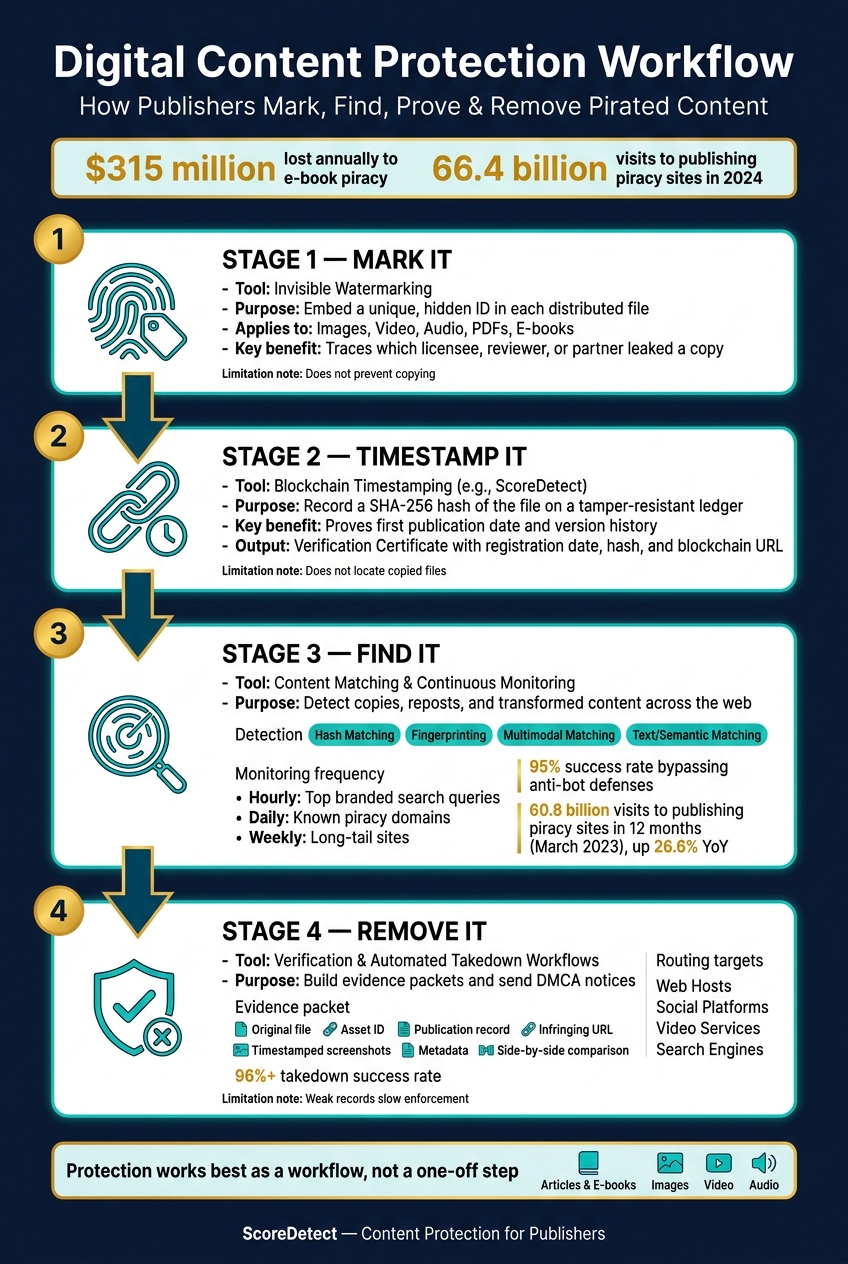
Digital Content Protection Workflow: Mark, Find, Prove & Remove
5 Free Tools and Tips to Protect Your Website Content from Plagiarism
sbb-itb-738ac1e
Content protection tools that prevent and trace unauthorized use
Once ownership signals are in place, the next job is traceability. Two tools do most of the work here: invisible watermarking and blockchain timestamping. They do different things, but together they answer the two questions that matter in enforcement: who owns this and where did this copy come from?
Invisible watermarking for images, video, audio, and documents
Invisible watermarking keeps the user experience intact while embedding a detector-readable signal in images, video, audio, PDFs, and e-books.
Its main job is forensic attribution. Say a textbook publisher sends advance chapter PDFs to licensees or syndication partners. Each file can carry a different distributor ID. If a pre-release copy later shows up on a piracy site, that embedded ID can point back to the source, even if someone changed the filename and stripped visible metadata. HarperCollins has used invisible watermarking to embed per-transaction marks in EPUB, PDF, and MOBI files, which lets it trace leaks without storing personally identifiable information inside the watermark itself [1].
Static watermarking has a big flaw: it can’t tell you which recipient leaked the file. That’s why dynamic watermarking matters. Each copy gets its own mark tied to a licensee, reviewer, or distribution channel, so if a file leaks, you have a direct path for enforcement.
Here’s where invisible watermarking helps most, and where it can fall short:
| File Type | What It Can Prove | Key Limitations |
|---|---|---|
| Images | Source licensee or distribution channel for a leaked copy | May weaken after heavy cropping or aggressive recompression |
| Video | Which subscriber account, partner, or platform was the leak source | Can be weakened by re-encoding, cropping, or other transformations |
| Audio | Link between an unauthorized file and a specific distributor or release | Can be disrupted by heavy audio processing or format conversion |
| PDFs / E-books | Which reviewer, retailer, or client copy was redistributed | Print-and-rescan cycles can strip or damage the embedded signal |
Watermarking does not stop copying. It’s not a lock. It’s a tracking layer. Every distributed copy becomes a traceable artifact, which changes the accountability math for partners and bad actors alike. And when a dispute starts, that trace can give rights holders evidence they can use.
Blockchain timestamping and ownership records
Watermarking traces distribution. Timestamping proves when a version existed.
ScoreDetect does this by computing a cryptographic checksum, specifically a SHA-256 hash, of the content and recording that hash on a tamper-resistant blockchain ledger. The file itself never goes on-chain. Because even a tiny change creates a different hash, a later match between a file’s current hash and the on-chain record shows that the content existed in that exact form at or before the recorded timestamp. ScoreDetect then issues a Verification Certificate with the registration date, copyright owner name, SHA-256 hash, public blockchain URL, and version information, ready for download, print, and legal use.
This is useful for proving first publication and version history. For example, a news outlet can timestamp both its first draft and its final published piece. If a competing site later posts something suspiciously similar, the outlet can show, with on-chain records, that its newsroom wrote and finalized the work earlier. The same approach helps with plagiarism claims, misattribution fights, and derivative-work disputes.
ScoreDetect’s WordPress plugin handles this automatically for article publishers. Each time a post is published or updated, the plugin captures a checksum and creates a new on-chain record. For teams with bigger asset libraries, the developer API and Zapier integrations can plug timestamping into an existing CMS, DAM, or export workflow at points like:
- accepted drafts
- pre-publication layouts
- final versions
- post-publication corrections
The smart setup is broad timestamping with selective watermarking. Register drafts and final versions of high-value content at publication. Add dynamic watermarks when sending those assets to licensees, syndication partners, or social channels. If an unauthorized copy appears, the timestamp helps show who registered the work first, and the watermark shows which copy leaked and where it came from. Once assets are marked and timestamped, the next move is finding copies, reposts, and altered versions across the web.
Detection tools for finding copies, reposts, and transformed content
Watermarks and timestamps help prove ownership. But they don’t tell you where stolen copies have already spread.
And that gap matters. MUSO recorded 60.8 billion visits to publishing piracy websites in the 12 months ending March 31, 2023, a 26.6% year-over-year increase[2]. For most teams, manual searching just can’t keep up.
Content recognition and matching across media types
The hard part of detection is simple: people who steal content rarely repost it as-is.
Images get cropped and recompressed. Video clips get trimmed, subtitled, and uploaded again. Articles get paraphrased, rearranged, or split into excerpts. If your system only finds exact duplicates, it’ll miss a big share of actual infringement.
That’s why publishers need layered matching. Different asset types need different ways to match, and different edits call for different checks.
| Method | How It Works | Best For | Handles Transformations? |
|---|---|---|---|
| Hash matching | Compares cryptographic or perceptual hashes of files | Exact or near-exact duplicate images and documents | Perceptual hashes can tolerate minor compression; cryptographic hashes fail after even small edits |
| Fingerprinting | Builds content-aware signatures from audio spectrograms, visual keypoints, or text patterns | Edited or clipped audio, video, and other media | Yes – detects cropped, re-encoded, or partially used content |
| Multimodal matching | Combines visual, audio, and text signals in a shared model | Screenshots, memes, and mixed-media reposts | Yes – can match a screenshot of a paywalled article to its original HTML page |
| Text matching | Uses exact-string, fuzzy, and semantic similarity checks | Articles, book excerpts, captions, and academic papers | Yes – advanced semantic models can catch paraphrasing and reordered paragraphs |
A smart detection stack usually starts with fast hash checks to catch the obvious stuff. From there, it can move up to fingerprinting or multimodal matching when a result looks promising or the asset matters more.
That second layer costs more, so it makes sense to use it where the stakes are higher. Top subscription drivers and premium content deserve closer attention. A huge catalog doesn’t need the same depth on every single asset.
Targeted web scraping and continuous monitoring
Once matching flags likely copies, monitoring tells you where they showed up.
Broad web crawling pulls in a mountain of noise. Targeted monitoring is more useful because it focuses on the places where infringement tends to happen: top search results for branded article titles, known piracy domains, social platforms, file-sharing pages, and content farms that repost subscription material.
ScoreDetect’s monitoring works as the detection and triage layer inside a larger enforcement flow. Its web scraping achieves a 95% success rate at avoiding common anti-bot defenses, which matters because many high-risk piracy sites are also the most aggressive about blocking crawlers. Continuous scans produce structured outputs – URLs, timestamps, nearby page context, and embedded media metadata – and send them straight into a case queue. That lets teams judge severity and respond fast instead of digging through raw data.
Monitoring frequency should match the level of risk. In practice, that often looks like this:
- Hourly checks for top-branded search queries
- Daily scans for known piracy domains
- Weekly sweeps for long-tail sites
Alert thresholds matter too. Filtering by confidence score and content volume helps cut down on alert fatigue without letting major infringements slide by. Historical detection logs also help over time. They can show repeat offender domains, recurring uploaders, or titles that draw a lot more piracy than others, which gives teams a clearer basis for enforcement decisions. Once monitoring surfaces confirmed matches, move to proof-based verification and removal.
Verification and removal tools that support enforcement
Use the monitoring queue to sort likely infringement from licensed or approved use. Before sending any notice, confirm that the use is unauthorized and make sure you have proof to support it.
Proof-based infringement verification
After detection, verify the match before you send a notice. Not every match is actionable. Some uses are licensed, syndicated, or fair use. If you skip this step, you risk over-enforcement, which can strain partner relationships and trigger counterclaims.[7][9]
Create one evidence packet for each case. Include:
- The original file
- Internal asset ID
- Publication record
- Infringing URL
- Timestamped screenshots
- Metadata
- A side-by-side comparison
Printed captures that show the URL and date can be easier to authenticate than screenshots.
Before you escalate, check the match against your internal rights records. Confirm whether a license exists for that territory, format, and platform. Send licensed, borderline, or fair use claims to human review.
Automated takedown and delisting workflows
Only verified cases should move into notice generation. Once verification is done, the notice stage should be standardized and fast.
Move quickly with a complete DMCA notice. Each notice needs the work ID, infringing URLs, contact details, a good-faith statement, an accuracy-and-authority statement, and a signature.[3][4][5][6][8] Clear section labels can help platforms process notices faster.
Routing matters. Web hosts, content platforms, and search engines all use different intake paths. Hosts often rely on abuse contacts and need file-level URLs. Platforms like social networks and video services usually offer rights-holder portals that accept direct links, asset IDs, and comparison screenshots. Search engine delisting requests are separate from host takedowns and go through their own copyright-removal forms.
ScoreDetect’s automated notice generation helps teams route these requests at scale, producing structured notices that consistently achieve over a 96% takedown rate. Log every notice, response, and removal confirmation so the audit trail stays intact.
Conclusion: Building a practical protection stack for revenue and rights
No single tool covers every gap. The most practical move is to use a connected stack that cuts piracy risk across the full workflow. That works because each tool handles a different part of the same job.
Invisible watermarking helps trace leaks. Blockchain timestamps help prove first publication help prove first publication. Monitoring helps find copied content fast. Automated takedowns turn checked cases into removal requests. Put together, these controls cut losses and build stronger enforcement records.
The upside is direct: less revenue leakage, stronger dispute records, and faster enforcement. Even small improvements in detection and takedown speed can bring back meaningful revenue across a catalog.
Start with your highest-value titles, then expand coverage as the catalog grows. ScoreDetect’s Enterprise plan brings watermarking, 24/7 monitoring, and automated delisting notices into one workflow for scaled enforcement. Once that stack is in place, the next job is keeping it up to date.
Treat protection as an active process. Piracy tactics shift. Platforms shift too. Regular process reviews help keep enforcement effective.
FAQs
Which assets should I protect first?
Start by mapping your content workflows with your product, legal, security, and operations teams. The goal is simple: figure out which assets are most exposed and focus on high-value assets first.
From there, use a clear workflow. Register your original source assets, apply invisible watermarking with Tectus before distribution, and use ScoreDetect to create blockchain-backed, time-stamped ownership records.
Can watermarking still work after edits?
Yes. Invisible watermarking is built to hold up through many common edits and file changes.
The reason is simple: the ownership signal is embedded in a file’s frequency components, not just in raw pixels or sample data. So it can stay in place even after cropping, resizing, color changes, re-encoding, heavy compression, or metadata removal.
What proof do I need for a takedown?
You need a legally defensible evidence package with a clear chain of custody. That means showing what was found, when it was found, how it was accessed, and who handled the evidence afterward.
Include proof of detection and ownership, such as:
- Screenshots
- HTML snapshots
- Media samples
- Protocol logs that show when and how the content was accessed
You’ll also need proof of ownership and creation timing. Invisible watermarking, blockchain-based timestamps, and cryptographic records like SHA-256 checksums can help verify authorship and back DMCA-related actions.