The best platform for copyright infringement detection in 2026 is the one that finds copied files, logs proof, and sends takedowns in one workflow; for most teams here, that means an end-to-end copyright tool instead of a counterfeit monitor.
If I strip this down to the part that matters, here’s the takeaway: copyright detection and counterfeit monitoring solve different problems. One looks for copied images, video, audio, documents, and text. The other looks for fake goods, trademark misuse, and seller abuse. If you use the wrong type of tool, you can miss copied work even if your brand monitoring is solid.
Here’s what I’d focus on from the start:
- Proof of ownership: timestamps, hashes, certificates, and invisible watermarking
- Match quality: can it find edited, cropped, compressed, or paraphrased copies?
- Discovery: does it find copies across the web, search, or torrent networks?
- Enforcement: can it help with DMCA notices, delisting, or de-indexing?
- Speed and proof records: this matters when notices need clean support
A few points stand out fast:
- One platform in the list reports 96%+ takedown success
- One matching tool says it can detect copies with only 10% of the source left
- One search-cleanup tool says it can de-index links in under 60 minutes
- Torrent monitoring matters because BitTorrent file sharing still moves content at scale, with the EU citing 3.7 billion music-track downloads over a 12-month period
How Are Copyright Violations Detected On The Internet?
Understanding these mechanisms is the first step toward implementing effective copyright infringement solutions for digital content.
sbb-itb-738ac1e
Quick Comparison
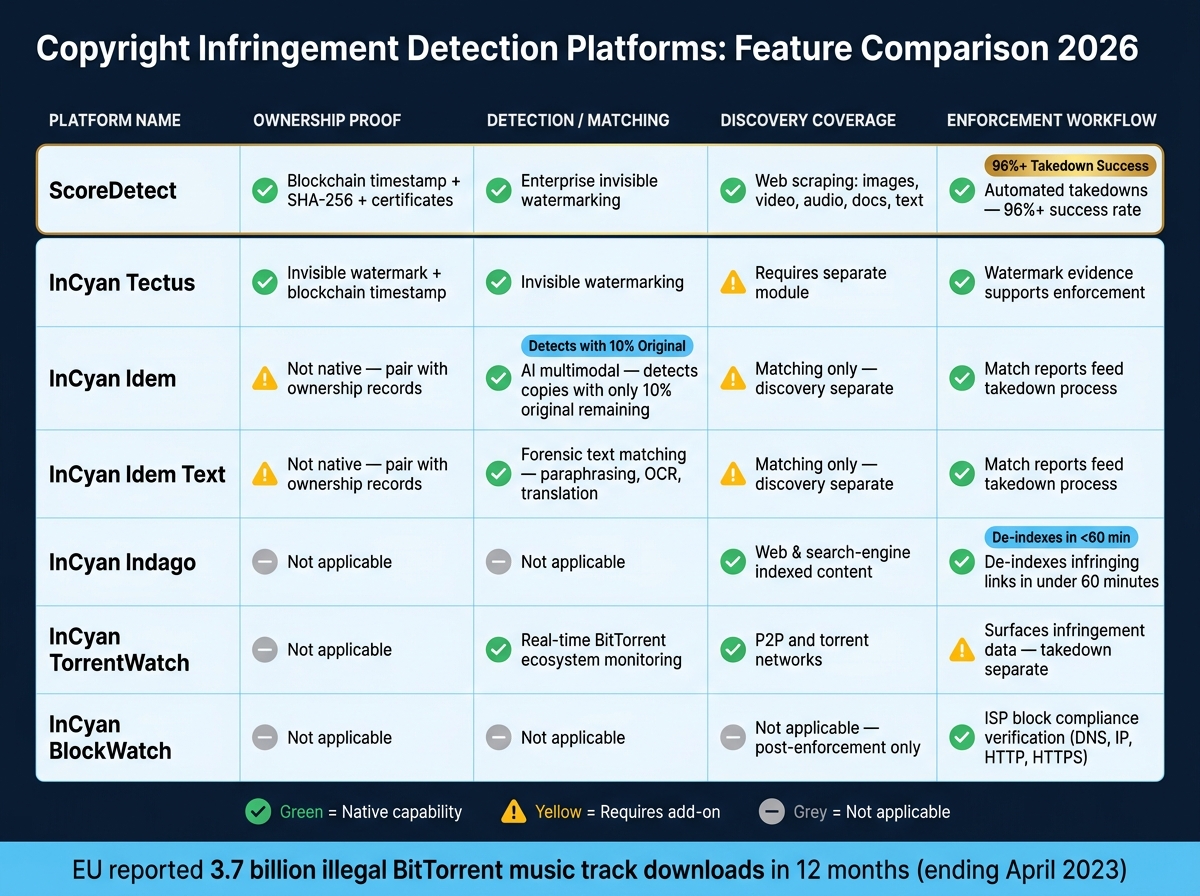
Copyright Infringement Detection Platforms Compared: Features & Best Use Cases 2026
| Platform | Best for | Main gap |
|---|---|---|
| ScoreDetect | Proof, monitoring, and takedowns in one flow | Top features sit on Enterprise |
| InCyan Tectus | Invisible watermarking for e-books before release | Needs other tools for discovery and notices |
| InCyan Idem | Finding edited image, video, and audio copies | Does not find source URLs by itself |
| InCyan Idem Text | Finding copied or rewritten text | Text only |
| InCyan Indago | Search-result de-indexing | Does not stop host-level access |
| InCyan TorrentWatch | BitTorrent piracy monitoring | Notices are separate |
| InCyan BlockWatch | ISP block checks | Not a detection tool |
So if you’re comparing platforms, I’d judge them on proof, matching, discovery, and enforcement – not on brand-protection claims that target fake products instead of copied media.
1. ScoreDetect
ScoreDetect works best for copyright teams that want proof, discovery, and takedown steps in one flow.
Ownership Proof
ScoreDetect records a blockchain timestamp and SHA-256 checksum to create tamper-evident ownership proof without storing the file on a third-party server. It also provides Verification and Formal Recognition Certificates as PDFs.[4][5]
Detection Resilience
The Pro plan centers on ownership certificates. The Enterprise plan adds invisible watermarking for images, video, audio, and documents.[4][5]
Once ownership is set, the next job is finding unauthorized copies at scale.
Discovery Coverage
Enterprise adds targeted web scraping built to reach content behind common bot protections. It also includes an Analyze workflow for matching discovered content and measuring unauthorized use.[4]
Enforcement Workflow
After infringing copies are matched, the platform turns those findings into notices.
When infringement is confirmed, ScoreDetect generates automated takedown notices and reports a 96%+ takedown success rate.[4] Check which features come with your plan, especially monitoring, watermarking, notices, and API access.[4][5]
2. InCyan Tectus
InCyan Tectus is an invisible watermarking tool made to help prove ownership and provenance for digital assets across images, video, and audio.
Ownership Proof
Tectus embeds an invisible watermark, hashes ownership, licensing, and provenance data, and time-stamps it on a blockchain.[7] That record is then used as the basis for enforcement.
Detection Resilience
There doesn’t appear to be any independent validation in the cited sources for watermark strength, false positives, or courtroom admissibility. So any resilience claims should be treated as vendor-reported. For rights teams, that’s a clear operational risk when they need to rely on Tectus in live infringement disputes.
Discovery Coverage
InCyan says its scraping can reach protected pages with a 95% success rate when bypassing anti-bot protections.[6] The source doesn’t explain how that test was run, so the 95% figure should also be treated as vendor-reported. After copies are found, the workflow shifts to notice and delisting.
Enforcement Workflow
InCyan describes Tectus as a system for providing evidence of unauthorized use, targeted web scraping, and automated delisting workflows.[6]
3. InCyan Idem
InCyan Idem is an AI-powered content identification platform for images, video, audio, and text. It fingerprints reference assets and checks suspected copies against them.[9]
Match Evidence
Idem’s match report can link a suspected file to a registered reference asset. But fingerprint matching algorithms, by themselves, doesn’t prove legal ownership.[9]
That’s why the match report should sit alongside dated source files and registration records. Think of Idem as the matching layer in your evidence package, not a replacement for formal ownership records.
Detection Resilience
Idem is built to keep working even when just 10% of the original content is still present after edits or transformation.[9] That covers cropped or filtered images, edited video, compressed or re-encoded audio, and paraphrased or translated text.[9][10]
For rights holders dealing with social media reposts, edited graphics, or short video clips, that matters a lot. A post doesn’t have to be a perfect copy to trigger a match.
Discovery Coverage
Idem handles matching, not source discovery. Idem matches content; discovery comes from a separate monitoring layer.[8]
In plain terms, Idem can tell you whether a suspected file matches your asset, but it doesn’t automatically find that file for you. Before you buy, confirm whether your Idem subscription includes source discovery or whether you need a separate InCyan service to feed suspected content into the workflow.
Enforcement Workflow
Once Idem confirms a match, the next step is enforcement. The output is a structured match report that links the reference asset to the suspected copy.
Your evidence package should include:
- The URL
- The captured file
- The detection date
- The fingerprint result
- The original asset
- Ownership documentation
Also, verify takedown automation directly with InCyan before purchase. The available product details do not list an Idem-specific SLA or success rate.[9]
4. InCyan Idem Text
When the target is written material, the text layer matters more than image, audio, or video matching. InCyan Idem Text is built for that job. It’s a text-matching platform made to spot copied written material at scale, with a tight focus on articles, scripts, captions, and documents.
Ownership Proof
For copied articles, scripts, captions, and documents, match results need to be part of a proof package. Idem Text match results can support a copyright claim, but they do not prove ownership on their own. You still need dated source files, publication timestamps, and registration records.
Detection Resilience
InCyan says Idem Text can detect paraphrased, translated, and reformatted text, not just exact matches.[9] That sounds useful, but this is where your own testing matters. Run checks on your corpus, your languages, and your file types before you roll it out at scale.
A simple point, but an important one: match quality only helps if the source database includes the places you care about.
Discovery Coverage
Text infringement detection only works when the platform checks the places where copied writing actually shows up. Idem Text matches against InCyan’s database, but the full source list is not publicly disclosed. Before you buy, confirm the covered sources, platforms, file types, and languages.
Once a match appears, the work shifts from detection to evidence review and notice prep.
Enforcement Workflow
Treat the similarity score as a lead, not proof. Check how much text overlaps, whether the copied material includes distinctive phrasing, structure, or sequence, the source date, and whether any license or lawful exception applies before filing.
Keep a clear record of:
- The original text and the suspected copy
- The matched passages
- The URL
- The detection date
- The enforcement decision note
5. InCyan Indago
After a match is confirmed, Indago handles search-result cleanup. It focuses on de-indexing infringing content that search engines have already indexed, which cuts search-driven access to unauthorized copies. InCyan says Indago can de-index links in under 60 minutes.[8]
Use separate rights records before filing a delisting request.
Indago only affects indexed search results. It does not stop a host, server, or file-sharing source from serving the content. That makes it a fit for publishers, studios, and rights teams that need search-result removal.
Enforcement Workflow
Before filing, confirm rights-holder details, time-stamped evidence, repeatable DMCA documentation, and legal review. Also verify the match and rule out licensed use before sending the request.
No independently verified pricing, customer-count, recall, or response-time data was found.
Before buying, ask for:
- Supported search engines
- Response times
- Success rates
- Audit fields
- DMCA handling
- Escalation rules
- Integrations
- Pricing model
- Treatment of licensed uses
For copies shared outside search, use separate torrent and blocking tools for those channels.
6. InCyan TorrentWatch
TorrentWatch is built for one job: finding content that never shows up in web indexes and spreads through BitTorrent instead. While Indago focuses on search-result de-indexing, TorrentWatch watches the BitTorrent ecosystem – trackers, magnet links, info hashes, and live peer swarms – to spot unauthorized redistribution at the P2P layer.
That makes it a fit for studios, publishers, music companies, and software or game developers whose files land on torrent sites. This P2P monitoring is equally vital for protecting copyrighted scientific visuals and technical diagrams that often leak into academic sharing networks. It does not handle web-hosted copies, social media reposts, or ISP-blocked sites by itself. For those, you’d need other tools, such as Indago or BlockWatch. Put simply, TorrentWatch covers the copies that never surface in search.
Torrent activity can shift in a hurry, so timing matters. If a file starts moving through a swarm, the evidence needs to be preserved before that swarm changes. Rights holders also need an ownership record that existed before the infringing upload. InCyan’s evidence guidance says an evidence package should include an RFC 3161 timestamp, SHA-256 hash, source URL/IP, screenshots, and metadata.[11] Without that chain of custody, the alert should be treated as a lead – not proof.
There’s also a data gap worth noting. For TorrentWatch, no audited detection rates, false-positive rates, or average time-to-detection figures are available in public sources. That matters because torrent monitoring deals with a different kind of problem than web or social monitoring. The European Commission reported that users illegally downloaded 3.7 billion individual music tracks through BitTorrent during the 12 months ending April 2023.[3] Still, swarm size should be used only to rank alerts. It is not a precise download count.
When a TorrentWatch alert fires, the goal is simple: lock down the record while it’s still intact. Keep:
- The info hash
- The magnet or tracker reference
- The first-seen timestamp
- Observed swarm data
- Captured metadata
- A copy of the relevant torrent or sample, if legally permitted
It also helps to log the notice date, recipient, response, removal status, repeat appearances, and any unresolved mirrors. Those fields make it easier to judge whether an alert is ready for action or still needs review.
Before buying, ask direct questions about tracker and index coverage, average time from upload to alert, how false positives are handled, escalation paths for repeat infringers, and pricing. Pricing is not publicly disclosed.
7. InCyan BlockWatch
After detection and takedown, BlockWatch checks whether ISP blocking is actually being enforced. It’s a post-enforcement tool, not a copy-detection tool. In plain terms, it tests whether ISP blocks on known infringing sites are active and complete.
Detection Resilience
BlockWatch compares blocked and non-blocked control connections across DNS, IP, HTTP, and HTTPS. That helps it spot partial or mixed blocking results instead of treating them like full blocks. No independent accuracy data is public [1][2]. So its main role is checking ongoing compliance after a blocking order is in place.
Discovery Coverage
BlockWatch does not find copied content. It only verifies block enforcement after a site has already been identified as infringing.
Enforcement Workflow
Once a blocking order is active, BlockWatch checks ISP compliance and whether the block is still working across protocols.
Pricing is not publicly disclosed.
Feature Comparison and Pros and Cons
This section breaks the workflow into four practical jobs: proof, matching, discovery, and enforcement. The goal is simple: pick the tool that fits the asset type and the stage where you need help.
The summary below turns the product-by-product details into a faster decision guide.
Feature Matrix
| Platform | Ownership Proof | Detection Resilience | Discovery Coverage | Enforcement Workflow |
|---|---|---|---|---|
| ScoreDetect | Native (blockchain timestamping, verifiable certificates) | Native (digital watermarking) | Web surfaces; images, video, audio, docs, text (enterprise scraping) | Native (automated delisting notices; 96%+ success rate) |
| InCyan Tectus | Native (invisible watermarking plus blockchain timestamping) | Native (invisible watermarking) | Requires separate InCyan module | Watermark evidence supports enforcement; takedown not built in |
| InCyan Idem | Not native; pair with ownership records | Native (AI multimodal matching; detects heavily modified copies) | Matching only; discovery requires another module | Match results feed into takedown process |
| InCyan Idem Text | Not native; pair with ownership records | Native (forensic text matching; handles paraphrasing, OCR, translation) | Matching only; discovery requires another module | Match results feed into takedown process |
| InCyan Indago | Not applicable | Not applicable | Web and search-engine indexed content | Native (de-indexing and delisting at the search layer; under 60 minutes) |
| InCyan TorrentWatch | Not applicable | Native (real-time BitTorrent ecosystem monitoring) | P2P and torrent networks | Surfaces infringement data; takedown is separate |
| InCyan BlockWatch | Not applicable | Not applicable | Not applicable | Native (ISP block compliance verification) |
Pros and Cons
All InCyan product pricing – Tectus, Idem, Idem Text, Indago, TorrentWatch, and BlockWatch – is sales-led, with no public rates listed. ScoreDetect Enterprise pricing is custom as well.
| Platform | Strength | Tradeoff | Best-Fit Use Case |
|---|---|---|---|
| ScoreDetect | Covers ownership proof, detection, and takedown in one product | Advanced features require the Enterprise plan | Publishers, studios, and rights teams needing a single integrated solution |
| InCyan Tectus | Traceable invisible watermark embedded before distribution | Discovery and takedown require additional InCyan products | Rights teams embedding ownership into assets before release |
| InCyan Idem | Detects heavily modified copies across image, video, and audio | Not a standalone enforcement tool | Studios and agencies with large catalogs needing resilient content matching |
| InCyan Idem Text | Catches paraphrased, translated, or OCR-processed text that exact-search tools miss [9] | Text-only coverage; needs pairing for ownership proof and enforcement | Publishers, academics, and news organizations protecting written content |
| InCyan Indago | Removes infringing links from search results in under 60 minutes | Does not cover P2P or ISP blocking | Rights teams prioritizing fast de-indexing of infringing search results |
| InCyan TorrentWatch | Real-time alerts across the BitTorrent ecosystem | Takedown actions require a separate workflow | Film studios, music labels, and software publishers fighting P2P piracy |
| InCyan BlockWatch | Multi-layer ISP block compliance testing (DNS, IP, HTTP, HTTPS) | Post-enforcement only; no content detection capability | Legal and compliance teams verifying that court-ordered ISP blocks are holding |
The final verdict below ranks the best fit by copyright need.
Final Verdict: Best Platform by Copyright Protection Need
There isn’t one platform that fits every copyright job. When you look at the proof, matching, discovery, and enforcement framework above, the main tradeoff is simple: end-to-end workflow coverage vs. single-purpose tools.
ScoreDetect stands out when you need ownership proof, detection, and automated takedowns in one place. ScoreDetect Enterprise brings proof, discovery, and automated takedowns together in a single workflow.
The specialist platforms are more narrow by design. Each one handles a specific stage, like watermarking, matching, search de-indexing, P2P monitoring, or block verification. The table below makes those differences easy to scan.
| Rights-team scenario | Most appropriate platform | Why |
|---|---|---|
| Need proof of ownership plus takedown in one workflow | ScoreDetect | Blockchain timestamping, invisible watermarking, and 96%+ takedown success in a single platform |
| Embedding traceable watermarks before asset distribution | InCyan Tectus | Invisible blind watermarking for pre-distribution protection |
| Detecting modified or cropped images, video, and audio | InCyan Idem | AI multimodal matching detects content when only 10% of the original remains |
| Catching copied, paraphrased, or translated text | InCyan Idem Text | Forensic text matching handles OCR, paraphrasing, and translation |
| Fast removal of infringing links from search results | InCyan Indago | De-indexes infringing links in under 60 minutes |
| Monitoring piracy across the BitTorrent ecosystem | InCyan TorrentWatch | Real-time BitTorrent monitoring |
| Verifying court-ordered ISP blocks are enforced | InCyan BlockWatch | Multi-layer DNS, IP, HTTP, and HTTPS compliance testing |
If your team wants one system that covers the full chain, ScoreDetect is the strongest fit here. If your process is more specialized, the InCyan tools make more sense when you need one job done well and don’t need the rest bundled in.
FAQs
How do I choose between proof, detection, and takedown features?
Don’t pick one and ignore the others. They work best as one connected workflow.
Use proof before content goes live so you can show ownership and timing from day one. Then use detection to watch for unauthorized copies after publication. Once you confirm there’s a match, move to takedowns with verified evidence for DMCA notices or de-indexing.
- Proof: establish ownership and timing
- Detection: monitor for unauthorized copies
- Takedown: use verified evidence for DMCA notices or de-indexing
What evidence do I need before sending a DMCA notice?
Before sending a DMCA notice, collect proof that shows you own the work and that someone copied it without permission.
You’ll want to gather:
- Ownership proof: timestamp certificates, SHA-256 hashes, or invisible watermarks
- Detection details: the infringing location plus timestamped screenshots or HTML snapshots
- Verification data: the original file and a side-by-side match comparison
- Case documentation: good-faith and accuracy statements, contact details, and the work ID
This step matters. A DMCA notice shouldn’t be sent on a hunch. It needs clear records that tie the original work to you and show where the copied version appears.
Always review the use before filing. Make sure it’s unauthorized and not fair use or covered by a license.
Can one platform cover web, search, and torrent piracy?
Yes. Platforms like InCyan’s enterprise stack use connected modules to manage these channels in one workflow.
- Indago: search discovery and de-indexing
- TorrentWatch: BitTorrent monitoring
- BlockWatch: ISP-level visibility across DNS, IP, and HTTP/HTTPS
That setup lets rights holders handle discovery, evidence collection, and enforcement across web, search, and torrent piracy at the same time.