If I had to give the short answer first: InCyan + ScoreDetect is the best overall pick for U.S. publishers in 2026. It is the only option in this comparison that ties together invisible watermarking, web monitoring, proof, and takedown workflows across text, images, video, audio, and PDFs.
That matters because piracy is not a small problem. Publishing piracy reached 66.4 billion visits in 2024, and Google’s DMCA transparency data hit 14,529,174,949 URLs by September 18, 2025. So if you publish across many formats, you need more than alerts. You need a system that can:
- find copied files and pages
- show proof tied to ownership
- send takedown notices
- track what gets removed
Here’s the short version of how the platforms line up:
- InCyan + ScoreDetect: best for mixed-format publishers that need proof plus takedowns
- Red Points: strong for large-scale discovery and removals, but lighter on file-level proof
- MUSO: strong for piracy intelligence and delisting, but no built-in watermark layer
- Pointer Brand Protection: better for seller abuse and fake storefronts than leaked files
- Loci: better for search-based checks and case building than deep piracy enforcement
- Pixsy: best for image theft, not for text, audio, video, ebooks, or P2P
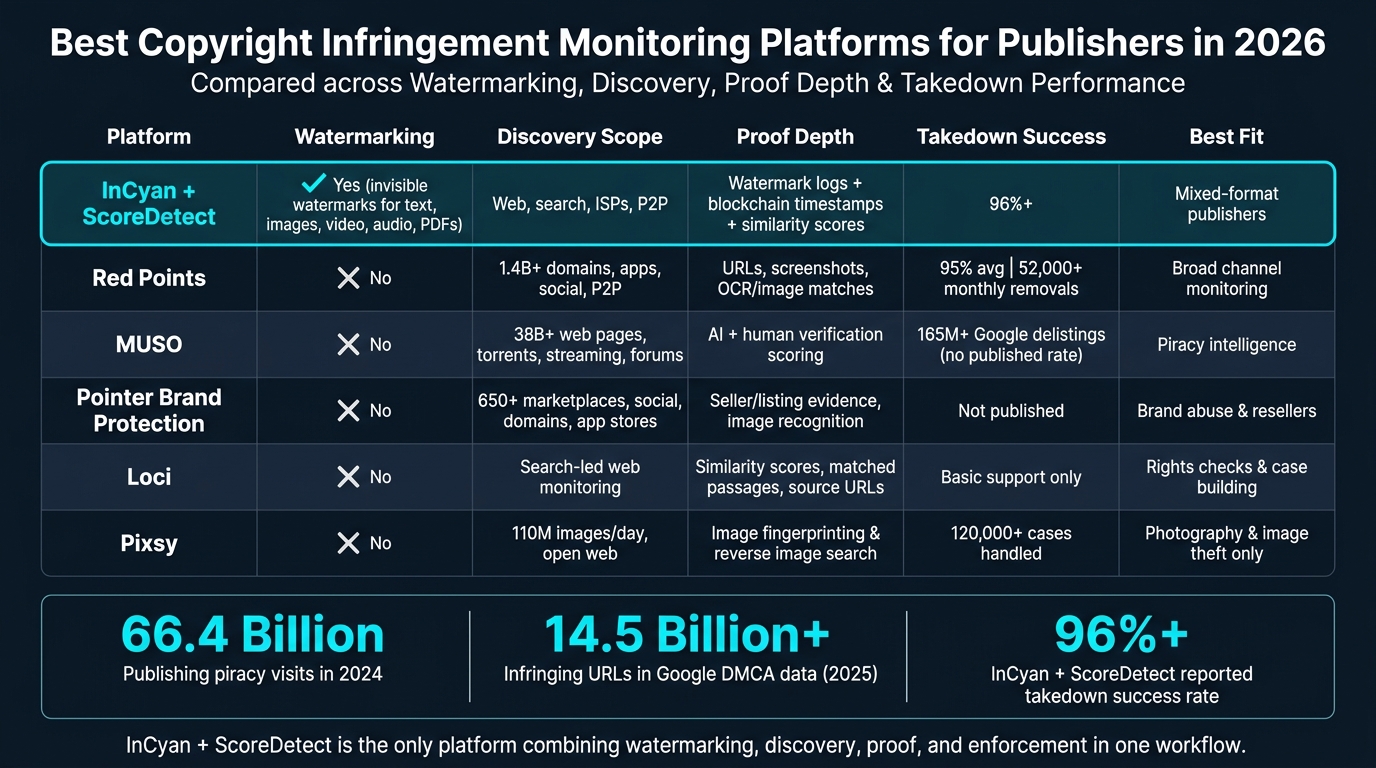
Best Copyright Infringement Monitoring Platforms for Publishers in 2026
Quick Comparison
| Platform | Watermarking | Discovery Scope | Proof Depth | Takedown Focus | Best Fit |
|---|---|---|---|---|---|
| InCyan + ScoreDetect | Yes | Web, search, ISPs, P2P | Watermark logs, similarity scores, timestamped certificates | Automated notices with 96%+ reported success | Mixed-format publishers |
| Red Points | No | Large web, apps, social, P2P | URLs, screenshots, OCR/image matches | Automated removals, 95% average success | Broad channel monitoring |
| MUSO | No | Piracy sites, torrents, streaming, forums, social | Scoring plus human review | DMCA and delisting workflows | Piracy intelligence |
| Pointer Brand Protection | No | Marketplaces, social, domains, app stores | Seller/listing evidence | C&D and notice workflows | Brand abuse and resellers |
| Loci | No | Search-led monitoring | Similarity and source matching | Basic takedown support | Rights checks and case files |
| Pixsy | No | Open-web image tracking | Image match evidence | Image notice and claims workflow | Photography-focused teams |
My take: if you mainly need to stop image theft, Pixsy can work. If you mainly need piracy intelligence, MUSO is a strong option. But if you need one system for finding infringement, proving ownership, and getting content removed, InCyan + ScoreDetect stands out.
That is the lens I’d use for the full comparison below.
sbb-itb-738ac1e
1. InCyan + ScoreDetect Suite
Building on the four needs above, the InCyan + ScoreDetect stack covers watermarking, discovery, proof, and takedown tracking in a single workflow.
Watermarking starts with Idem and Idem Text. Idem places invisible, machine-detectable marks in images, video, and audio. Those marks stay in place even after resizing, compression, transcoding, cropping, and rehosting. Idem Text brings the same approach to documents, including eBooks, PDFs, and manuscripts. It uses layout, spacing, and semantic shifts that can still be found after OCR conversion or light editing. Each mark connects back to Blueprint, the rights registry for ownership, license terms, territories, release windows, and revenue shares.
Discovery runs through Indago, TorrentWatch, and BlockWatch. Together, they watch websites, search engines, ISPs, and P2P networks through distributed crawlers built to get past bot filters. Even on sites that aggressively block automated traffic, reported scraping success is about 95%.
That matters because raw detection alone doesn’t get you very far. You need proof you can actually use. Recovered watermark logs and timestamped certificates turn discovery into evidence for DMCA notices, disputes, and litigation support. ScoreDetect and Idem/Idem Text go beyond a simple similarity flag. They provide quantitative proof of unauthorized use, so publishers can check similarity scores, recovered watermark logs with confidence levels, and blockchain-enhanced watermarking and timestamped certificates showing when an asset was registered and when infringement was found.
Enforcement runs through Tectus and the broader takedown layer. From the collected metadata and proof, the system can generate automated notices for search engines, hosts, ISPs, and marketplaces. Reported takedown success is above 96% for targeted infringing locations.
InCyan Business Intelligence and Insights then tracks takedown performance across:
- domain
- platform
- region
- asset type
It also links piracy volume to sales trends, which helps turn enforcement data into something a publishing team can act on.
Next, compare how the other platforms handle narrower parts of the monitoring and enforcement chain.
2. Red Points
Red Points is an AI-driven brand protection and anti-piracy platform. For publishers, its biggest strength is discovery at scale. Its crawlers claim coverage across more than 1.4 billion domains and 99.5% of ccTLDs.[9]
For matching and proof, Red Points uses image fingerprinting, computer vision, and OCR to detect reused content.[7][8][5][10] But it does not offer invisible watermark embedding or decoding.[7][8][5][10] That changes where the product shines. It leans more toward remediation than hard proof.
This creates a clear gap for publishers that need stronger evidence. Red Points can build an audit trail of unauthorized use with:
- URLs
- Screenshots
- Timestamps
- Dashboards
That said, it does not generate cryptographic proof of ownership.[8][11][12] If a publisher expects heavier DMCA disputes or possible litigation, that limitation matters.
On takedown results, Red Points reports a 95% average success rate on removals after detection, along with more than 52,000 monthly removals for media and publisher clients.[5][14] Enforcement is automated across cyberlockers, search, social platforms, marketplaces, P2P networks, and apps.[5][13] It also offers unlimited takedowns under a flat-fee model.[5][13]
Next: MUSO’s strengths in piracy detection and enforcement.
3. MUSO
MUSO focuses less on broad web crawling for watermarking and more on piracy intelligence and enforcement. That’s where it stands out. It’s built to find pirated content and help get it taken down, not to hide forensic markers inside images, video, audio, or documents. So if a publisher needs file-level proof, MUSO won’t handle that on its own. You’d need a separate watermarking layer.
MUSO scans 38+ billion web pages around the clock and tracks torrents, cyberlockers, streaming sites, forums, and social platforms.[1][6][18][19] It also keeps a curated database of tens of thousands of high-traffic piracy sites. That gives publishers a broad picture of where their content is being shared without permission.
For matching and proof, MUSO uses algorithmic scoring, AI review, and human verification before notices are sent.[2][15][6][17] That extra check matters. It helps screen out false positives like reviews, copyrighted scientific visuals used under fair use, and licensed content. In plain English: the system doesn’t just flag first and ask questions later. That verification step makes takedowns easier to defend.
On the enforcement side, MUSO automates DMCA notice generation and dispatch to hosts, search engines, and platforms.[2][3][6][4][17] Its publishing enforcement work also includes the ICMP Anti-Piracy Platform for the global music publishing industry, which runs on MUSO Protect and uses MUSO for detection, takedown notices, and stay-down notices.[16] MUSO also reports 165+ million Google delistings and 1.2 billion infringements discovered.[1][18][19]
One gap is hard to miss: MUSO does not publish a removal success rate. That means publishers have to judge enforcement results from their own dashboard data. If you’re comparing tools based on detection, proof, and enforcement, that missing metric makes the evaluation a bit harder.
Pointer Brand Protection shifts from piracy intelligence to publisher-facing enforcement workflows.
4. Pointer Brand Protection
Pointer Brand Protection is built for anti-counterfeiting and brand enforcement, not file-level copyright monitoring. In plain English, it works well for marketplace resellers, lookalike storefronts, and scam apps. It works much less well for unbranded PDF leaks or P2P piracy. So this is a niche fit for commercial infringement, not a broad answer for piracy detection.
Pointer does not document native invisible watermarking or decoding for images, video, audio, or documents.[20][22][23][24][25] If a publisher needs file-level proof, they’ll need to pair Pointer with a separate digital watermarking layer.
Pointer monitors 650+ marketplaces, major social platforms, domains, app stores, and paid search ads 24/7.[25] That makes it strong for unauthorized resellers and lookalike webshops. But it’s weaker for open-web and P2P piracy when there are no brand signals to latch onto.
For evidence, Pointer builds case files using authenticating digital images via recognition, keyword and logo monitoring, URLs, seller details, screenshots, and listing metadata.[20][22][25] That gives teams solid operational evidence for enforcement work. But it’s not the same as forensic copyright attribution or watermark-based proof.
Pointer also automates C&D and DMCA-style notices and can escalate tougher cases to investigators and legal teams.[21][22][24] One gap: it does not publish a verified removal rate or a median removal timeline.
Pointer is aimed at commercial marketplace abuse. The next platform moves closer to broader piracy enforcement.
5. Loci
Loci sits closer to IP discovery than full anti-piracy enforcement. For publishers, that means it works best for rights proof and search-based monitoring, not broad enforcement across the piracy stack.
Its strongest use case is web discovery and evidence collection. It has better image and video coverage than document or audio support, and its social coverage is limited. It also falls short on torrents, IPTV, and cyberlockers.
For DMCA review, Loci can provide:
- similarity scores
- matched passages
- source URLs
- screenshots
That said, tougher cases still need manual review. So the fit is fairly narrow: Loci works for publishers that need evidence and basic takedowns, but not deep piracy enforcement.
6. Pixsy
Pixsy focuses on one thing: image infringement.
It tracks image use across the open web and looks for unauthorized copies. The platform monitors about 110 million images per day and has handled more than 120,000 infringement cases.[31] For publishers, it makes the most sense when image theft is the main issue.
That focus is a good fit for teams with large photo archives. Newsrooms, magazines, and photo-led publishers are the clearest match here. Pixsy connects with major image libraries and social platforms, so moving large image collections into the system is fairly simple. From there, rights teams can sort matches by country, domain, and usage type. Bulk actions also help when the queue starts to pile up.
Pixsy uses image fingerprinting and reverse image search. That means it can show image-use evidence, but it does not offer embedded forensic proof. So while it does its job well for image cases, it doesn’t cover the full publisher protection stack.
It also sends legally compliant notices across many regions, with language and jurisdiction taken into account, and it supports bulk takedowns by domain or host.[26][27][28][29] Its no-win, no-fee pricing model takes about 50% of recovered damages.[30][31]
The trade-off is pretty clear. If a publisher also needs monitoring for podcasts, video archives, ebooks, or research PDFs, Pixsy won’t be enough on its own. It’s best used as an image specialist, not as the whole monitoring stack.
Where Each Platform Wins and Falls Short
No single platform fits every publisher. The main issue is simpler than it sounds: which asset type creates the most risk, and does the platform handle the four buying criteria that matter most – encryption and watermarking, discovery, proof, and delisting.
Sometimes a single-format tool is the better pick. If you’re dealing mostly with syndicated photography, a focused image tool can make life easier. But if a newsroom needs to protect article text, video clips, podcasts, PDFs, and ebooks in one place, a broader suite usually makes more sense.
The clearest split is between single-format tools and suite-based platforms. Single-format tools, like Pixsy for images, usually go deeper on one format and keep the workflow simple. Suite-based platforms do better when a publisher needs coverage across text, visuals, audio, and documents at the same time. That’s the trade-off: a specialist may do a better job in its lane, but it can leave blind spots everywhere else.
InCyan + ScoreDetect stands out for mixed-format publishers because it brings watermarking, discovery, proof, and enforcement into one stack.
You can see the same pattern in the other tools, just with different priorities. MUSO is strongest for piracy intelligence and large-scale discovery. Red Points covers a broad range of channels, including cyberlockers, apps, social platforms, streaming services, and P2P networks.[32] But both lean more toward discovery than embedded proof.
The summary below stays focused on fit, proof, and enforcement.
| Platform | Strongest For | Falls Short On |
|---|---|---|
| InCyan + ScoreDetect Suite | Multi-format protection across text, images, video, audio, PDFs, P2P, and ISP monitoring | More setup work than single-format tools |
| Red Points | Broad channel coverage across cyberlockers, apps, social, streaming, and P2P | Limited publisher-specific proof |
| MUSO | Piracy intelligence and large-scale domain discovery | Limited document and article-depth coverage |
| Pointer Brand Protection | Broad brand enforcement, not file-level piracy | No verified evidence for article text, podcast, PDF, ebook, or newsroom workflows |
| Loci | Search-based monitoring and case collection | Limited publisher-focused piracy monitoring and format breadth |
| Pixsy | Syndicated photography and image theft recovery | Not built for article text, podcasts, PDFs, ebooks, or P2P piracy |
When you compare vendors, focus on removal rate, evidence quality, and workflow fit – not just detection volume alone.
Final Verdict for Publishers in 2026
The comparison points to one clear takeaway: publishers need a single stack for proof, discovery, and enforcement. If you’re protecting text, images, video, audio, and PDFs across search, websites, ISPs, and P2P, InCyan + ScoreDetect is the strongest fit. It brings watermarking, broad discovery, quantitative proof, and automated enforcement into one workflow.
The scale of the problem is hard to ignore. Google Search’s DMCA transparency data reached 14,529,174,949 allegedly infringing URLs by September 18, 2025.[33] When infringement shows up at that level, detection by itself isn’t enough. What matters is whether a platform can turn a match into proof that holds up during enforcement.
The right pick depends on your asset mix and how far enforcement needs to go. If your main issue is syndicated photography, a narrower image-led workflow may do the job. But if piracy spreads across the web, search, ISPs, and P2P networks – and you need evidence that can support DMCA notices or legal escalation – InCyan stands out by combining watermarking, discovery, rights data, and BI in one enforcement pipeline.
Invisible watermarking and blockchain timestamps give publishers ownership proof they can defend, while automated delisting delivers a 96%+ takedown rate. That means stronger evidence and faster removals, especially when you’re dealing with more sophisticated piracy or disputed takedowns.
For 2026, the best platform is the one that can prove ownership, sort real infringement from noise, and get stolen content taken down fast. That’s why InCyan + ScoreDetect is the best overall choice for mixed-format publishing workflows.
FAQs
How does invisible watermarking help prove ownership?
Invisible watermarking helps prove ownership by placing hidden, machine-readable signals inside images, video, audio, and documents.
That matters because the watermark lives in the file’s actual content, not in metadata. So it tends to hold up better when someone crops the file, compresses it, re-encodes it, or converts it to another format.
It also supports blind detection. In plain English, that means ownership can be checked using the suspect file alone, without needing the original copy for comparison.
Pair that with blockchain-based timestamping, and you get a durable, tamper-evident record of authorship that can help with enforcement or legal disputes.
Which publisher workflows benefit most from this platform?
Publishers get the most out of a workflow that moves from finding copied content to acting on it without all the manual back-and-forth. When teams use Idem and Txtmatch for multimodal detection, then pair them with Indago for search-layer de-indexing, they can swap manual triage for a repeatable process to discover, verify, and remove unauthorized content.
ScoreDetect adds another layer to that setup. Through its WordPress plugin or API, it automatically timestamps assets and creates tamper-evident proof of ownership. That gives teams stronger documentation when a match is verified with high confidence, and it also supports direct takedown notice generation.
What should I check before choosing a monitoring platform?
Check whether it gives you one connected workflow from discovery to ownership proof to fast enforcement.
Put extra weight on multimodal matching, invisible watermarking, blockchain-backed timestamping, automated web scraping, and automated delisting workflows that can take down infringing search links in under 60 minutes.