I recommend a service with tested live-stream detection, leak tracing, and U.S. takedowns for streaming protection in 2026 – not a plan that only records when files existed.
In this comparison, I’d choose ScoreDetect Enterprise with confirmed InCyan services for live events and premium catalogs – but only after a successful U.S. pilot. ScoreDetect Pro fits file records and certificate exports at $12.00/month, or $11.31/month billed annually; it does not provide continuous piracy monitoring.
Quick Comparison
| Buying factor | Enterprise / InCyan | Pro |
|---|---|---|
| Detection | Advertised live and VOD monitoring; test coverage and timing | No continuous monitoring |
| Leak tracing | Invisible watermarking and content matching; verify attribution | File checksums and timestamps, not leak tracing |
| U.S. enforcement | Confirm notice filing, escalation, and removal times | Certificates support documentation; confirm filing support |
| Integrations | Test your encoder, DRM, player, and CDN | API, WordPress, and Zapier for record workflows |
| Price | Custom quote; confirm all fees | Listed annual rate includes 100 monthly certificates |
My buying rule: <u>measure removals, not just notices</u>. The reported 95% crawl-access figure is not detection accuracy, and watermarking does not replace DRM.
Next, I’ll compare coverage, tracing, evidence handling, and total cost so you can judge what each plan actually does.
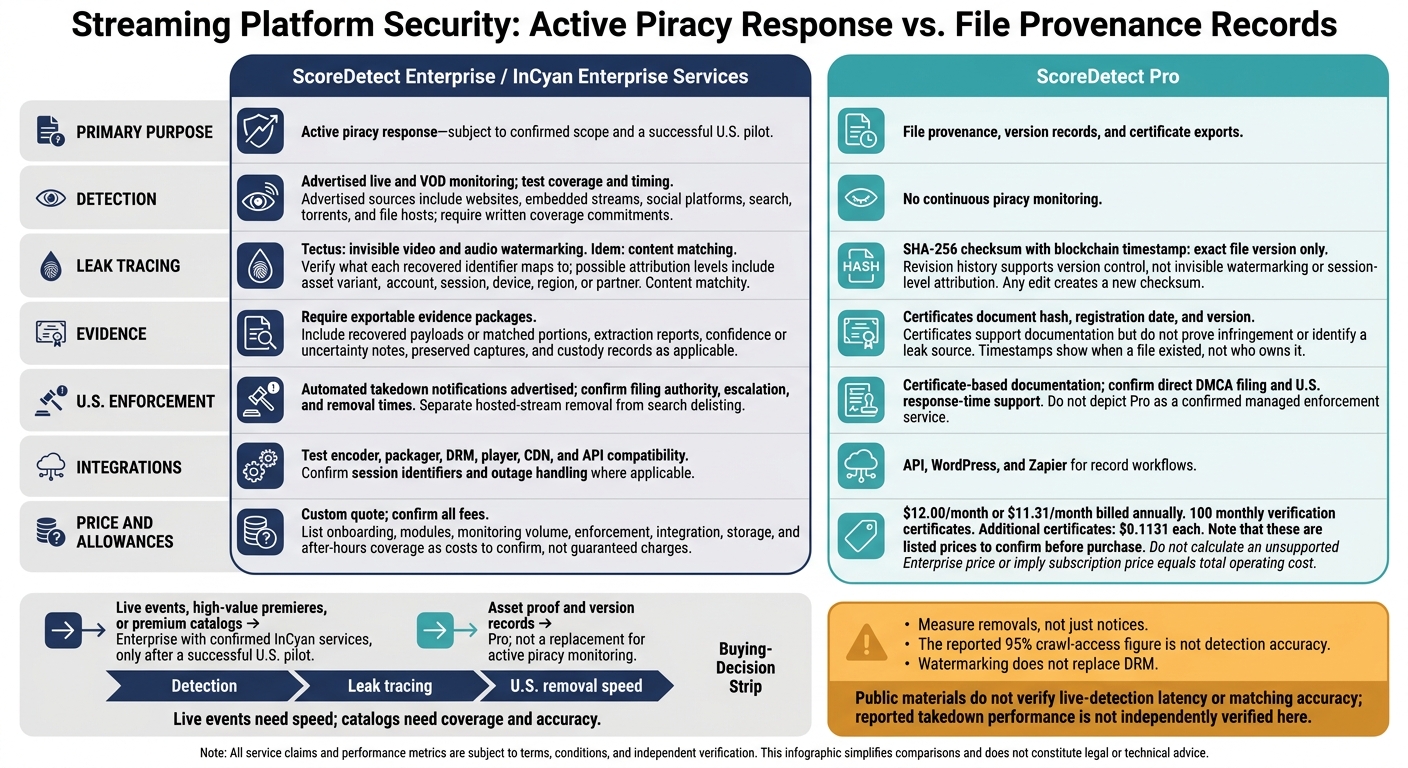
Streaming Anti-Piracy in 2026: Enterprise vs. Pro
1. ScoreDetect Enterprise / InCyan Enterprise Services
List every included module in the contract.[4] Then judge the offer on three buying tests: detection, leak tracing, and U.S. removal speed.
Live and VOD Detection
Detection comes first: can the service find live streams and VOD copies fast enough to matter? InCyan describes a machine-learning workflow that detects and reports infringement.[5][6]
Require separate coverage commitments for live streams and VOD. Each should specify monitored sites, scan cadence, and discovery-to-confirmation time. Test matching with cropped, re-encoded, and partial copies of your own titles. Public materials do not verify live-detection latency or matching accuracy.
Watermarking and Leak Attribution
For the advertised invisible video and audio watermarking, specify the service, payload, and attribution level – in plain terms, which source it can identify.[1] During onboarding, require embedding and extraction tests across your encoding pipeline. Also require a documented link between each recovered watermark, the leak source, and the evidence.
US Enforcement and Costs
Once a leak is found and traced, removal speed becomes the final test. Enterprise includes automated takedown notifications, but a notice is not a removal.[1] Require a U.S. DMCA workflow that covers rights authorization, evidence capture, notice tracking, and escalation.
Treat search delisting and removal of the hosted stream as separate tasks. Any reported success rate should state its timeframe, denominator, and unresolved cases.
For live or premium titles, put response time ahead of headline price. Request an itemized quote covering onboarding, modules, monitoring volume, and enforcement. Define response times and escalation contacts for the success manager and 24/7/365 support.[1] Confirm whether that coverage includes active analyst review and notice preparation during live events – or technical support alone.
sbb-itb-738ac1e
2. ScoreDetect Pro
Enterprise handles active piracy response. ScoreDetect Pro focuses on version and ownership records: registering, verifying, and documenting assets.
Provenance and Version Control
ScoreDetect Pro timestamps approved assets and proves when a file version existed. It does not monitor unauthorized streams or trace leak sources. Use its 100 monthly verification certificates for masters, episodes, promos, and delivery packages.[1]
Watermarking and Leak Attribution
A matching checksum confirms that a file hasn’t changed. Any edit creates a new checksum. Pro’s revision history supports version control, not invisible watermarking or session-level attribution.
For teams focused on catalog proof, connecting tools matters more than live monitoring. Connect the API to ingest so approved masters are certified when finalized. Use the WordPress plugin for publishing and Zapier for alerts, tickets, and logs. Store each asset’s checksum, version, registration date, and public certificate details in your rights-management records.
US Enforcement and Costs
Export certificates as PDFs for licensing, legal, or DMCA files. These certificates support enforcement documentation, but they don’t prove infringement or identify a leak source. Confirm in writing whether DMCA submission and U.S. response-time support are included.
ScoreDetect Pro starts at $11.31 per month when billed annually, with additional certificates listed at $0.1131 each.[1] The plan covers provenance records and certificate-based documentation – not continuous detection, session-level attribution, fast U.S. takedowns, or forensic watermark extraction.
Live and VOD Monitoring: Coverage, Accuracy, and Timing
Coverage matters only if the service finds leaks in time to act.
ScoreDetect Enterprise / InCyan Enterprise Services advertises monitoring across websites, embedded streams, social platforms, search, torrents, and file hosts. Ask for a written coverage matrix that details each source type and access condition.
Live events need speed; catalogs need coverage and accuracy. Use this table to compare coverage claims with measured results.
| Option | Monitoring scope | Public proof | Pilot test | Best-fit content |
|---|---|---|---|---|
| Enterprise: live | Advertised web and streaming coverage; confirm scope for each event | Provider claims; no independent latency data in the source material | Measure discovery and removal during controlled events | Time-sensitive programming, subject to pilot results |
| Enterprise: VOD | Advertised web, social, search, torrent, and file-host coverage | Provider claims; no independent false-positive or takedown data | Test detection across sources, formats, and territories | Movies and episode catalogs that need active monitoring |
| ScoreDetect Pro | Records only; no continuous piracy monitoring | Timestamping and certificate records, not continuous monitoring | Verify registration and evidence export | Asset proof and version records, not piracy detection |
Next, test alert speed and classification accuracy for both live and catalog content. The 95% figure refers to reported crawl access – not detection accuracy. Ask for the denominator, sample size, territories, test period, sample rules, and audit status. Measure recall, precision, and false-positive rate separately.
Run a controlled pilot using licensed samples and controlled mock-piracy samples across formats, territories, and platforms. Assign each item its own identifier and record its URL, release timestamp, content type, platform, territory, and expected status. Check whether the service discovers it, classifies it correctly, collects evidence, and escalates it. Request details on crawl frequency, geographic vantage points, and how the service handles embeds, login barriers, and renamed restreams.
Detection must produce evidence in time to support removal in the United States. Record the first verified alert, then log crawl, validation, notice, acknowledgment, and removal timestamps separately for live and VOD.
Watermarking and Leak Tracing: Proof and Integration
Once a service detects a leak, check whether it can trace the source well enough to support action in the United States. Use watermarking to see whether the leak points to a session, an account, or only a file copy. InCyan’s Tectus provides invisible watermarking; Idem matches content. Neither prevents screen capture, camera re-recording, or copying. Pro timestamps prove that a file existed – not who owns it or who leaked it.
| Option | Protection mechanism | What it can identify | Available evidence | Required proof before purchase |
|---|---|---|---|---|
| Enterprise / InCyan Tectus | Invisible watermark | Asset variant, account, session, device, region, or partner | Recovered payload, extraction report, confidence level, and uncertainty notes | Recovery tests on transformed clips; encoder, packager, DRM, player, CDN, and API compatibility |
| Enterprise / InCyan Idem | Video, audio, and image matching | Content matches, not viewer identity | Matched portions, captures, downloaded samples, and exportable reports | Tests on altered, shortened, and re-encoded clips; authentication, alerts, access controls, and retention |
| ScoreDetect Pro | SHA-256 checksum with blockchain timestamp | Exact file version only | Certificate with hash, registration date, version, and blockchain and ledger links | Independent hash and timestamp verification; API workflow, export controls, retention, and original-file preservation |
Attribution matters only when the extracted result connects to preserved logs and a usable evidence record. Ask for a redacted extraction report showing what the recovered identifier maps to. Keep account and access logs for the investigation.[8][9]
Test the service in your own pipeline. Public performance claims here are unverified. Measure detection rate, false positives, processing time, minimum sample duration, and recovery success. Test transcoding, bitrate reduction, resizing, cropping, overlays, audio replacement, screen capture, camera recording, and short clips.
Run those tests through your actual encoder, packager, DRM, player, and CDN path. Confirm where watermark insertion happens, whether each session gets its own identifier, and how the service handles encoder, CDN, or identity-service outages.[8][9]
Before signing, verify SSO, MFA, scoped API tokens, role-based access, administrator logs, and export restrictions. Check that alerts include the case ID, source URL, matched content interval, confidence or match status, and links to preserved evidence. Set retention periods for captures, session mappings, certificates, and audit trails. Require legal holds and documented deletion procedures.
Tracing helps only if you can package the result as admissible evidence. Require an exportable evidence package – not just a dashboard result. Record the collector, collection method, storage location, and every custody transfer.[7][10]
US Enforcement, Costs, and Recommendations
Once you trace attribution, the next step is acting on the leak in the U.S. Watermark recovery matters only if it supports a usable enforcement action. Report removals, disables, and delistings separately, and confirm who has authority to file notices directly and escalate cases.
Following a DMCA notice template ensures all legal requirements are met. A valid DMCA notice needs a signature, identification of the copyrighted work, the location of the infringing material, contact details, a good-faith statement, and a perjury statement.[12][13] Verify recipients through the Copyright Office’s DMCA Designated Agent Directory. Before submitting, review licenses, partner permissions, and fair use considerations.[13]
Track repeat uploads by account, domain, channel, or uploader. Keep notice, response, and decision logs for disputes, renewals, audits, and litigation, following counsel’s retention and privacy rules. U.S. safe-harbor rules require a reasonably implemented repeat-infringer policy.[11] A valid counter-notice can lead to material being restored in 10–14 business days unless the sender files suit.[12][14]
The reported takedown rate is not independently verified here. Run a controlled U.S. pilot that separates live cases from VOD cases. Measure detection, evidence-package completion, notice submission, host removal, delisting, reappearance, repeat-upload response, and counter-notice handling. Also measure median and 95th-percentile action times.
The comparison below separates enforcement services from record-only support.
| Option | U.S. enforcement support | Listed price | Additional operating costs | Pros | Cons | Required confirmation |
|---|---|---|---|---|---|---|
| ScoreDetect Pro | Supports notice preparation and ownership-record management; confirm direct filing and escalation authority | $12/month monthly or $11.31/month billed annually | Internal legal review, manual notices, evidence storage, escalation | Low entry cost; useful for record keeping | Not yet confirmed as a managed enforcement service | Current price, included channels, direct filing, evidence retention, permitted-use workflow, counter-notice handling, and support hours |
| ScoreDetect Enterprise / InCyan Enterprise Services | Quote-based service to assess for managed monitoring, notice preparation, escalation, and integrations | Quote-based | Onboarding, integration, legal review, custom reporting, storage, after-hours coverage, and possible per-volume or per-channel fees | Better fit for higher-value live programming and larger catalogs | Capabilities and performance must be shown | Written scope, U.S. channel coverage, service levels, InCyan service inclusions, repeat-infringer workflow, audit evidence, counter-notice process, and total fees |
Choose based on content risk and total operating budget, not subscription price alone. Match the service to your risk level, then test its performance in a U.S. pilot.
| Platform profile | Recommended option | Rationale and conditions |
|---|---|---|
| Small or midsize platform with frequent live events or high-value premieres | Enterprise, only after a successful U.S. pilot | Choose it if measured removal times on your actual channels justify the total cost of protecting time-sensitive releases. |
| Large platform with high-value sports, premium series, or simultaneous live and VOD distribution | Enterprise with confirmed InCyan services | Choose it if independently measured pilot results support contractual coverage, response times, and evidence-handling requirements for high-value content. |
| Any platform that already uses DRM, tokenized playback, access controls, or forensic security | Use monitoring to supplement DRM and access controls. | Add Enterprise monitoring if a U.S. pilot shows effective detection and enforcement against external redistribution. |
FAQs
How can I measure the revenue saved by anti-piracy protection?
Set success metrics that match your operations goals, and require measurable vendor commitments during procurement [1]. Track discovery rates, true-positive rates, average detection-to-takedown time, sustained suppression, and repeat-infringer rates [2].
Feed these metrics into your security operations center to measure how well enforcement works [1]. Ask for itemized, reproducible evidence exports to check vendor performance under realistic attack conditions – not just claims on paper [1][3][2].
What results should justify upgrading to ScoreDetect Enterprise?
ScoreDetect Enterprise makes sense when you need more than standard ownership proof and moderate-volume monitoring. That includes 24/7 content and brand monitoring or invisible watermarking that traces leaks to specific sources [2][1].
Consider upgrading when there’s too much infringement to handle manually, or when high-volume streaming, P2P, or IPTV channels call for specialized workflows and automated enforcement [1].
How can I trace leaks without compromising viewer privacy?
Use session-based forensic watermarking at the distribution layer to add a distinct, invisible identifier to each viewer’s stream. Link that identifier to your internal database so you can trace leaked copies to a session or account without exposing personal data you don’t need to share. Keep subscriber records separate from public-facing enforcement.
Follow a security operations center playbook to revoke subscriber tokens within five minutes of a confirmed leak.