I’d choose integrated fingerprinting and watermarking for studio workflows, notice-led monitoring for post-release piracy, and separate modules for teams that need watermarking, matching, torrent discovery, or search delisting.
My shortlist is Vobile for studio integrations, MUSO for discovery and notices, and InCyan for module-based protection. As of October 10, 2026, the supplied materials describe vendor claims – not independently tested results. Before signing, I’d request a 30-day pilot and a 12-month quote in U.S. dollars, including setup, processing, review, and enforcement fees.
Quick Comparison
| Criteria | Vobile | MUSO | InCyan |
|---|---|---|---|
| Detection and coverage | Fingerprinting across web, streaming, downloads, and P2P | Discovery across streaming, torrents, downloads, and search | Matching, torrent discovery, and search tools; streaming coverage unconfirmed |
| Leak attribution | Watermark tracing; recipient workflow needs testing | Recipient tracing unconfirmed | Tectus watermarking; recipient tracing needs testing |
| Enforcement and reporting | Notices and evidence records described; duties and exports need confirmation | Paid Protect offers notices, removal tracking, and dashboards | Search delisting and blocking reports; file removal unconfirmed |
| Setup and cost | Integration work and custom quote | Film onboarding and tier eligibility need confirmation | Module integration and separate enterprise quote |
I’d judge each provider by confirmed outcomes, not feature counts: leak attribution, detection time, false positives, removal time, and repeat links. <u>Search delisting does not remove the file</u>, and timestamp certificates do not prove ownership on their own.
Here’s how I’d compare the three against your release schedule, territories, and budget.
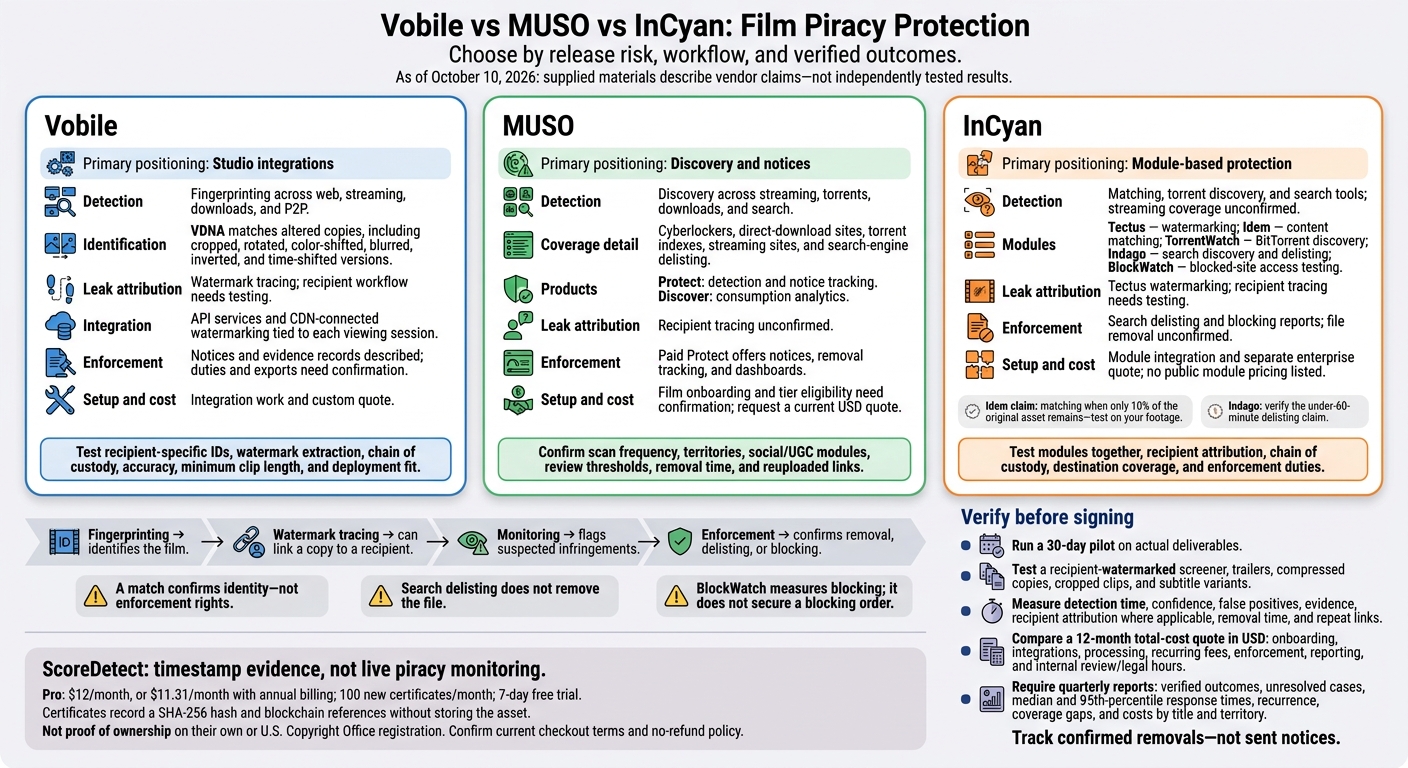
Vobile vs MUSO vs InCyan: Film Piracy Protection
Vobile: Content Identification and Leak Tracing
Vobile’s VideoTracker protects theatrical, set-top-box, and device-delivered releases. But support for these distribution channels doesn’t prove piracy coverage.[8] VDNA supports post-release identity matching, while watermarking supports leak tracing. For pre-release screeners, the key question is whether Vobile can trace a leaked copy back to its recipient.
VDNA Fingerprinting and Watermark Recognition
VDNA matches altered copies, including cropped, rotated, color-shifted, blurred, inverted, and time-shifted versions.[5][6] Test it against your masters. Confirm supported codecs and containers, minimum clip length, and how it handles subtitles and dubbed audio. A match confirms identity – not enforcement rights.
Identification and attribution need separate tests. Watermark recognition reads an embedded identifier that may help trace a copy’s origin.[1] Ask for proof that each screener has its own ID, that the ID can be extracted from a screen recording, and that chain-of-custody records link it to an authorized delivery. Public materials don’t prove recipient-level tracing across every deployment.
Check both the technical fit and the enforcement workflow.
Vobile Setup, Pricing, and Limits
Vobile describes API-based services and CDN integration for watermarking tied to each viewing session.[9][10] Get details on authentication, processing time, codecs, delivery systems, review, escalation, and monitoring in writing. Its materials also describe takedown notices and post-notice tracking. Confirm in the contract who reviews, signs, and escalates those notices.[7][8]
| Area | Documented advantage | Setup requirement or unconfirmed limit |
|---|---|---|
| Identification | VDNA matching of altered audiovisual content.[5][6] | Test accuracy and the shortest usable clip against your assets. |
| Leak tracing | Watermark recognition and distribution-origin tracing.[1] | Confirm who embeds watermarks, whether each identifier is separate, and which chain-of-custody records are kept. |
| Integration | API services and CDN-connected watermarking tied to each viewing session.[9][10] | Verify compatible systems, required engineering work, and deployment lead time. |
| Enforcement and evidence | Notices, post-notice tracking, and evidence archives are described.[2][7][8] | Confirm human review, counter-notice handling, export fields, and retention. |
Request a U.S. dollar quote with separate costs for integration, watermark processing, monitoring, evidence storage, and notice handling. Put ingestion deadlines, emergency response times, API availability, and service credits in writing.
sbb-itb-738ac1e
MUSO: Piracy Monitoring and Enforcement
For film releases, MUSO is the notice-led option in this comparison, with a focus on post-release enforcement. MUSO Protect handles detection and notice tracking, while Discover adds consumption analytics.[14][15]
Streaming, Torrent, Search, and Social Coverage
MUSO’s standard film offering covers cyberlockers, direct-download sites, torrent indexes, streaming sites, and search-engine delisting. Enforcement on social and user-generated-content platforms may need additional modules.[13] Ask for a platform-by-platform matrix that separates detection from enforcement.
MUSO Reports, Pricing, and Setup
Ask for a sample Protect report with these fields: title, source URL, first seen, notice sent, removal confirmed, and reappearance.[12][13] Track confirmed removals, not sent notices. When evaluating Discover, clarify whether “geography” means viewer location, host location, or a modeled market.[14][15]
| Area | Stated advantage | Limitation to verify |
|---|---|---|
| Monitoring | Coverage across cyberlockers, direct-download sites, torrent indexes, and streaming sites.[13] | Crawl frequency, private-source access, territories, and social/UGC modules. |
| Verification | AI-assisted checks and piracy-specialist review before notices go out.[11][13] | Review thresholds, false-positive handling, and treatment of cam recordings. |
| Enforcement | Notices, removal tracking, and search delisting.[13] | Acceptance rate, median removal time, and repeat or reuploaded links. |
| Reporting | Activity dashboards, compliance records, and audit exports.[12][13] | Export availability, field definitions, and whether audience figures are observed or modeled. |
Request a current U.S. dollar quote that covers title limits, setup, minimum term, renewals, and emergency coverage. Confirm when pre-release monitoring starts.[13]
The next section shifts to a more modular approach to matching, watermarking, and blocking.
InCyan: Film Protection Modules and Ownership Records
InCyan takes a more modular approach than the notice-led tools above. Choosing the right modules matters as much as detection.
It sells separate modules for watermarking, matching, torrent surveillance, search delisting, blocking tests, and timestamping. Before discussing price, check the contract for module availability, integrations, pre-release and post-release coverage, and enforcement duties.
For pre-release screeners, ask whether Tectus can trace a copy to its recipient while Idem finds unmarked or altered copies. TorrentWatch and Indago handle post-release discovery, BlockWatch tests access blocking, and ScoreDetect supplies timestamp records.
Tectus Watermarking and Idem Content Matching
Tectus says it applies invisible watermarks to images, video, and audio. For screeners, confirm recipient-specific IDs, supported formats, the extraction workflow, and the shortest clip from which a watermark can be extracted.
Idem claims it can match cropped, compressed, or edited content – even when only 10% of the original asset remains. Test that claim with your own footage: full films, short clips, trailers, cropped frames, low-resolution screen recordings, re-encoded files, dubbed or subtitled versions, mirrored content, and heavily edited excerpts.
Ask for confidence thresholds, false-positive rates, processing times, and manual-review requirements. For matched copies, try extracting the Tectus watermark. Confirm who handles analyst review, evidence packaging, and escalation, and put leak-response times in the contract.
TorrentWatch, Indago, and BlockWatch
TorrentWatch focuses on BitTorrent surveillance. Check whether it covers public torrent indexes, private trackers, magnet links, and DHT-derived discoveries.
Indago supports search-result discovery and delisting. Verify its authority to send notices and how long delisting takes.
BlockWatch tests DNS, IP, HTTP, and HTTPS blocking, using control checks to distinguish blocking from outages. It measures blocking; it does not secure a blocking order.
No public module pricing is listed.
| Module | Function | Setup | Limits to verify |
|---|---|---|---|
| Tectus | Invisible asset marking | Format testing, recipient registry, and extraction | Recipient tracing and watermark durability |
| Idem | Altered or unmarked content matching | Reference assets and review thresholds | 10% claim and notice inclusion |
| TorrentWatch | BitTorrent discovery | Title references and release calendar | Tracker coverage, reporting destinations, and response times |
| Indago | Search discovery and delisting | Rights documentation and notice authority | Under-60-minute delisting claim |
| BlockWatch | Blocked-site access testing | Defined ISPs, locations, and test methods | Network coverage |
ScoreDetect Timestamping and Enterprise Terms
For ownership records, InCyan treats timestamping as separate from piracy monitoring. This separation highlights how blockchain enhances digital watermarking by providing immutable ownership records alongside active protection.
ScoreDetect Pro costs $12 per month, or $11.31 per month with annual billing, for 100 new certificates each month. It also lists a 7-day free trial. Confirm the current checkout terms and no-refund policy.
Features include revision history, single and bulk PDF certificate exports, API access, Zapier integration, and the WordPress Timestamps plugin.
Certificates record a SHA-256 hash and blockchain references without storing the asset. They support version tracking and evidence records – not live piracy monitoring, proof of ownership on their own, or U.S. Copyright Office registration.
Enterprise pricing and bundled services require a separate written scope.
Conclusion: Choose by Release Risk and Total Cost
Fingerprinting identifies the film; watermark tracing can link a copy to a recipient. Monitoring flags suspected infringements. Enforcement confirms what was removed, delisted, or blocked. Choose a provider whose verified services match your release stage, territories, and budget.
Use the same scorecard as above: detection, attribution, enforcement, reporting, and total cost.
Provider Fit by Release Scenario
| Release scenario | Vobile | MUSO | InCyan |
|---|---|---|---|
| Studio-scale integrations | Best fit for fingerprinting, watermarking, multi-territory monitoring, evidence archives, and custom SLAs.[2][4] | Verify API, ingestion, catalog scale, and workflow integration. | Verify enterprise integrations, supported volume, and who owns configuration. |
| Distributor needing broad piracy discovery and enforcement data | Video identification, monitoring, evidence, and notices.[8] | Discovery, takedown tracking, and dashboard reporting across web, torrent, streaming, and search channels.[3] | Verify destination coverage and separate reporting for detections, notices, removals, and unresolved cases. |
| Pre-release screener leak tracing | Recipient-level tracing if watermarks survive the approved distribution workflow.[4] | Verify support for recipient-level tracing; current materials focus more on public-infringement monitoring. | Verify Tectus durability, recipient attribution, and chain-of-custody records. |
| Broad commercial releases | Broad monitoring across video-sharing and streaming services, direct downloads, search engines, peer-to-peer networks, and mobile apps.[2] | Discovery and enforcement across cyberlockers, downloads, torrent indexes, streaming sites, and search engines.[3] | Verify TorrentWatch and Indago coverage, plus reporting for detections, notices, removals, and unresolved cases. |
Compare 12-month total cost in USD, including onboarding, integrations, asset processing, recurring service fees, enforcement modules, reporting, and internal review or legal hours. For InCyan, request a module-by-module quote.
If your team is small, confirm who handles daily reviews and counterclaims. For staggered releases, map coverage and enforcement authority to each territory.
Claims That Need Verification
Treat marketing claims as provisional until a pilot proves them on your titles. Undisclosed fees, coverage guarantees, response times, false-positive rates, and removal percentages remain unverified without current supporting evidence. None of these alone proves recovered revenue.
Demo and Contract Checklist
Before signing, test the full workflow on actual deliverables. Run a documented pilot with a screener carrying its own watermark, plus trailers, compressed copies, cropped clips, and subtitle variants. Record detection time, confidence, evidence, recipient attribution where applicable, and final enforcement status. For InCyan, test the full module set together – not through separate demos.
Put the following in writing:
- Monitoring destinations and scan frequency; supported file types, title volumes, versions, languages, and territories; watermark durability; enforcement jurisdictions and escalation procedures.
- Setup responsibilities, service levels, reporting fields, security controls, retention rules, false-positive correction, counter-notice handling, and approval rights.
Require quarterly reports on verified outcomes and unresolved cases. These should include median and 95th-percentile response times, recurrence, coverage gaps, and costs by title and territory.
FAQs
How can I measure piracy protection’s ROI?
Set success metrics that match your goals, and ask vendors to back their commitments with baseline data. Run a 30- to 60-day pilot using assets that reflect your needs. Track detection coverage, accuracy, takedown speed, repeat-infringer rates, reviewer workload, and cost per resolved case.
Use business intelligence tools to combine these metrics with your internal data and report ROI in U.S. dollars (USD). Check the results against dated reports you can export, showing accepted notices, confirmed removals, and follow-up checks.
What proof do I need for a takedown?
Build an incident record that connects detection to proof of ownership. Include a ScoreDetect verification certificate with the asset’s SHA-256 hash, registration date, copyright owner’s name, and blockchain transaction ID. Add watermark logs, match reports, and original asset documentation.
Confirm that the video, audio, and metadata align, and check license exceptions and fair use. Preserve a litigation-ready export with the match rationale, detection timestamps, source locations, and account identity so others can reproduce the findings.
How should I prioritize protection on a tight budget?
Define your goals and how you’ll measure success first. Then rank your assets by priority so you can put resources where they’re needed most. Skip broad promises. Ask for itemized quotes in USD that cover only the channels, modules, and enforcement responsibilities you’ve tested.
Buy only the protection layers you need – not the full bundle. That might mean search-based delisting to reduce visibility or targeted P2P monitoring.