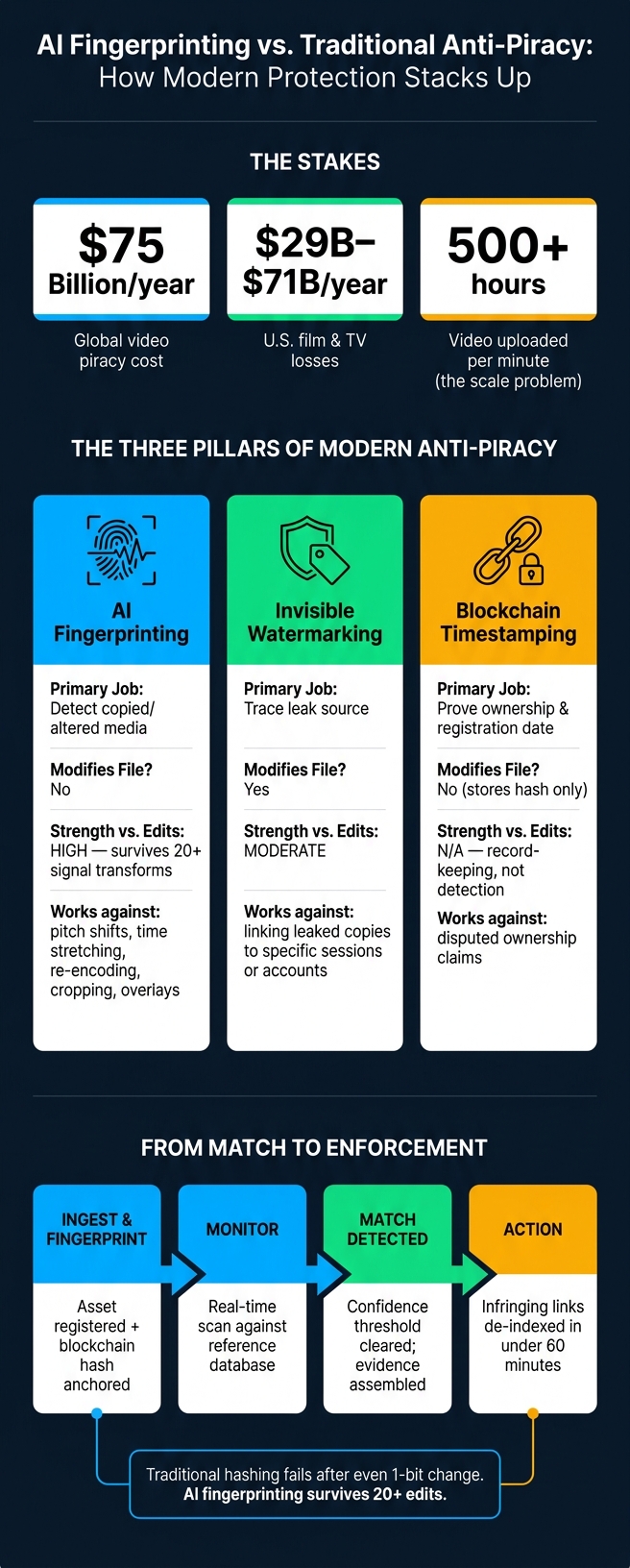
Piracy can spread in minutes, and exact-file matching often fails after small edits. My take is simple: if you want to stop copied media in 2026, you need AI fingerprinting to find altered copies, watermarking to trace leaks, and blockchain timestamping to show ownership records.
Here’s the short version:
- AI fingerprinting checks the media itself, not just the file bits
- It can still spot matches after pitch shifts, time stretching, cropping, re-encoding, and overlays
- Watermarking helps trace where a leak came from
- Blockchain records help show when a file was registered and who registered it
- Automation matters because platforms now handle huge upload volume, including 500+ hours of video per minute
- The money at stake is massive: global video piracy costs about $75 billion per year, and U.S. film and TV losses range from $29 billion to $71 billion per year
If I had to boil it down to one point, it’s this: detection alone is not enough. You need a chain that goes from match to proof to action.
Quick comparison
| Method | Main job | Changes the file? | Best use |
|---|---|---|---|
| AI fingerprinting | Find copied media | No | Spot edited or reposted content |
| Invisible watermarking | Trace leak source | Yes | Link a leaked copy to a user, session, or source |
| Blockchain timestamping | Show ownership record | No | Support claims with a dated checksum record |
So when I look at anti-piracy today, the answer isn’t manual search or plain hashes. It’s a combined setup that can find altered media fast, link it to ownership records, and push enforcement without long delays.
AI Fingerprinting vs. Traditional Anti-Piracy: How Modern Protection Stacks Up
Fingerprinting, watermarking, and blockchain timestamping: what each one does
These tools handle different parts of the problem: detection, leak tracing, and proof of ownership. So the key is to separate what each one can actually prove.
Content fingerprinting identifies assets without altering them
A content fingerprint is a signature pulled from the file itself – its audio traits, frame patterns, or neural embeddings. The file doesn’t change. That matters because fingerprinting can scan platforms at scale by comparing signatures instead of re-uploading assets.
Modern systems mix signals like MFCC (Mel-Frequency Cepstral Coefficients), chroma, Constant-Q Transform (CQT), spectral contrast, and neural embeddings. This helps them stay reliable even when someone pitch-shifts audio or stretches it in time [1].
That makes fingerprinting a strong fit for discovery. Watermarking, by contrast, is better for tracing where a leaked copy came from.
How watermarking and blockchain proof each support enforcement
Invisible watermarking adds ownership data to media before distribution. If a leaked copy shows up later, the watermark can point back to the source. Tectus by InCyan offers blind, invisible watermarking for images, video, and audio.
Detection is one part of enforcement. Proof of ownership is another.
Blockchain timestamping doesn’t detect content or trace leaks by itself. What it does is record a cryptographic hash of your content on a decentralized ledger. That creates a tamper-proof record showing when that version of the content existed [1]. ScoreDetect by InCyan captures a checksum and registers it on the blockchain without storing the file, creating proof that can be checked during enforcement.
"The blockchain layer… ensures decentralised hash storage, duplication control, and verifiable authorship." – Scientific Reports [1]
| Technology | Primary Purpose | Content Modified? | Strength Against Altered Media |
|---|---|---|---|
| AI Fingerprinting | Detection & Identification | No | High – designed to survive pitch and time shifts |
| Invisible Watermarking | Provenance & Leak Tracing | Yes | Moderate – can be fragile against heavy signal processing |
| Blockchain Timestamping | Ownership Proof | No (stores hash only) | N/A – used for record-keeping, not detection |
The next section shows why standard matching still misses altered content.
sbb-itb-738ac1e
Why standard anti-piracy methods fail against altered content
Most anti-piracy tools were built for a much simpler job: finding exact copies. That works fine until pirates make small changes to dodge exact-match systems. And that’s the problem. Once content gets edited, even lightly, those older tools start to fall apart.
That’s why altered-media detection needs fingerprints that can survive edits instead of collapsing the moment a file changes.
Common evasion tactics that break simple matching systems
A cryptographic hash only matches the exact file bits. Change just one bit by compressing, cropping, or re-saving the file, and the hash becomes completely different. To a person, the content may look or sound the same. To the hash system, it’s now a different file.
Pirates use that weakness on purpose. Common tactics include:
- pitch shifting
- time stretching
- EQ
- re-encoding
- cropping
- overlays
- paraphrasing
Even perceptual fingerprinting methods like spectral peak extraction can break under these edits. MFCC-based fingerprints tend to over-match on pitch edits and under-match on time-scale changes, which leads to both false positives and missed detections.
DRM can control licensed access, but once a copy leaves the platform, it can’t stop redistribution.
Manual search and fragmented enforcement slow teams down
When automated detection misses altered copies, teams often fall back on manual search. That usually means staff scanning platforms by hand, one case at a time. The problem is obvious: manual review can’t keep pace across platforms, regions, and large content libraries.
So the next step isn’t more manual effort. It’s detection that still works after content has been changed.
| Criterion | Traditional Detection (Hashes / Manual) | Modern Piracy Defense (AI Fingerprinting + Blockchain) |
|---|---|---|
| Robustness to Edits | Low – fails on pitch shifts, time stretching, and EQ | High – resilient to 20+ signal-processing transformations [1] |
| Scale | Limited by human staff and fragmented tools | High – suitable for edge and cloud deployments |
| Speed | Slow manual workflows; hard to scale deep models in real time | Fast – sub-second matching for short excerpts [1] |
How AI-driven fingerprinting detects altered and AI-manipulated content
The next step is building fingerprints that still match media after it has been edited. That’s the hard part, because pirates rarely repost files as-is. They crop, compress, clip, and tweak them to slip past detection.
Deep feature fingerprints are built to survive edits
AI systems look at audio and visual features such as harmonic patterns, motion vectors, spectral contrast, and pitch-class information. The goal is to match the content itself, not just the file wrapper.
Modern frameworks combine MFCCs, Chroma/CENS, CQT, and spectral contrast, then use DTW to realign timing shifts into a single fingerprint. In plain English: if someone stretches, trims, or slightly shifts the media, the system can still line things up and spot the match. Multi-feature systems stay accurate across 20+ signal-processing transformations.[1]
Multimodal matching improves coverage across media types
A one-channel approach leaves clear blind spots. If you only check video, you can miss reused audio. If you only check text, you can miss clipped visuals.
Combining visual, audio, and text signals helps close those gaps when content has been cropped, compressed, clipped, or partly reused. Idem from InCyan covers image and video edits, Idem Text covers text, and TorrentWatch extends monitoring to BitTorrent. Once matching works across media types, the next move is turning those matches into cases that can be acted on.
Detection only matters when it feeds enforcement
Finding a match is only half the job. The other half is turning that match into a documented case fast enough to matter.
A solid pipeline starts when original assets are ingested, fingerprinted, and anchored to a blockchain record for tamper-proof provenance, so fingerprint results carry verifiable ownership from the start.[1] Automated monitoring then screens incoming content against the reference database in real time. When a match clears the confidence threshold, the system flags it and assembles the evidence.
Indago from InCyan completes that pipeline. It turns matches into takedown actions by de-indexing infringing links in under 60 minutes.
That speed only matters when proof of ownership and enterprise workflows connect the match to action.
Combining AI fingerprinting with proof of ownership and enterprise workflows
Once a match shows up, the next step is simple: can you prove ownership fast enough to do something about it? Fingerprinting helps you find the copy. Ownership records are what make that match enforceable.
Where ScoreDetect fits in the protection stack
ScoreDetect records a SHA-256 checksum on-chain without storing the file itself. That creates a tamper-proof registration record. Its Verification Certificates include the registration date, the copyright owner name, and certified file details such as the SHA-256 hash and public blockchain URL. In plain English, that gives you documented provenance you can use for enforcement.
Zapier, the API, and the WordPress plugin handle registration automatically.
Of course, proof only matters if it moves into monitoring and takedown workflows instead of sitting in a dashboard.
How InCyan connects fingerprinting, watermarking, and enforcement

InCyan adds the enterprise layers that sit around and below fingerprinting. Each product handles a different part of the workflow.
The three core layers below show how detection, provenance, and enforcement work together.
| Protection Layer | Primary Role | Type of Evidence Produced |
|---|---|---|
| AI Fingerprinting (Idem) | Detects what the asset is | Perceptual hash / mathematical signature |
| Invisible Watermarking (Tectus) | Traces who distributed the asset | Session-specific forensic mark |
| Blockchain Timestamping (ScoreDetect) | Proves when and by whom content was registered | Tamper-proof on-chain checksum |
Tectus embeds invisible forensic marks into images, video, and audio. If a leak happens, the distribution point can be traced back to a specific session or account. Indago finishes the enforcement pipeline by de-indexing infringing links in under 60 minutes.
"The technology has not eliminated piracy – nothing has – but it has fundamentally changed the economics of it. Distributing stolen content at scale has become harder, riskier, and less profitable than it was ten years ago." – Terabytelabs [2]
AI fingerprinting identifies the copy. Watermarking traces the leak. Blockchain timestamping proves ownership. Enforcement tools take action.
FAQs
How accurate is AI fingerprinting after edits?
AI fingerprinting stays highly accurate even after edits because it builds mathematical signatures from a file’s underlying semantic essence, not the file’s exact data.
In plain English: it looks at what the content is, not just how the file is stored.
Because of that, fingerprints can still match after changes like cropping, compression, re-encoding, color filtering, and resizing. InCyan’s systems can identify content with high precision, sometimes from as little as 10% of the original source.
Can blockchain timestamping prove copyright ownership?
Yes. Blockchain timestamping creates an immutable record of when a file existed and who registered it.
By storing a cryptographic checksum of the content on the blockchain, as ScoreDetect by InCyan does, it creates a verifiable audit trail that shows the asset has not changed since registration. That gives you strong evidence of authorship. Still, it works best when paired with AI-driven monitoring.
When should I use fingerprinting vs. watermarking?
Use blockchain-based fingerprinting when you need proof of authorship and proof of creation time. It puts ownership on an immutable record, which makes it a good fit for publishers, legal teams, and R&D.
Use AI fingerprinting when your main goal is finding unauthorized copies online, even when the content has been edited, cropped, compressed, or resized. If you want stronger protection, use both.
ScoreDetect supports the proof layer by anchoring content checksums on the blockchain.