If I need to protect digital work, I’d use blockchain for proof and AI for detection. One shows when a file was registered and by whom. The other finds reused copies even after cropping, compression, resizing, or light edits.
Here’s the short version:
- Blockchain fingerprinting stores a hash, timestamp, and ownership data without putting the file on-chain.
- AI fingerprinting compares embeddings, so it can find edited matches at scale.
- Blockchain is weak at finding changed copies because exact hashes break after even small file changes.
- AI is better for monitoring but needs more data handling, storage, and threshold tuning.
- A small on-chain proof can cost about 25,380 gas on an EVM ledger.
- For most teams, the best setup is proof + monitoring, not one or the other.
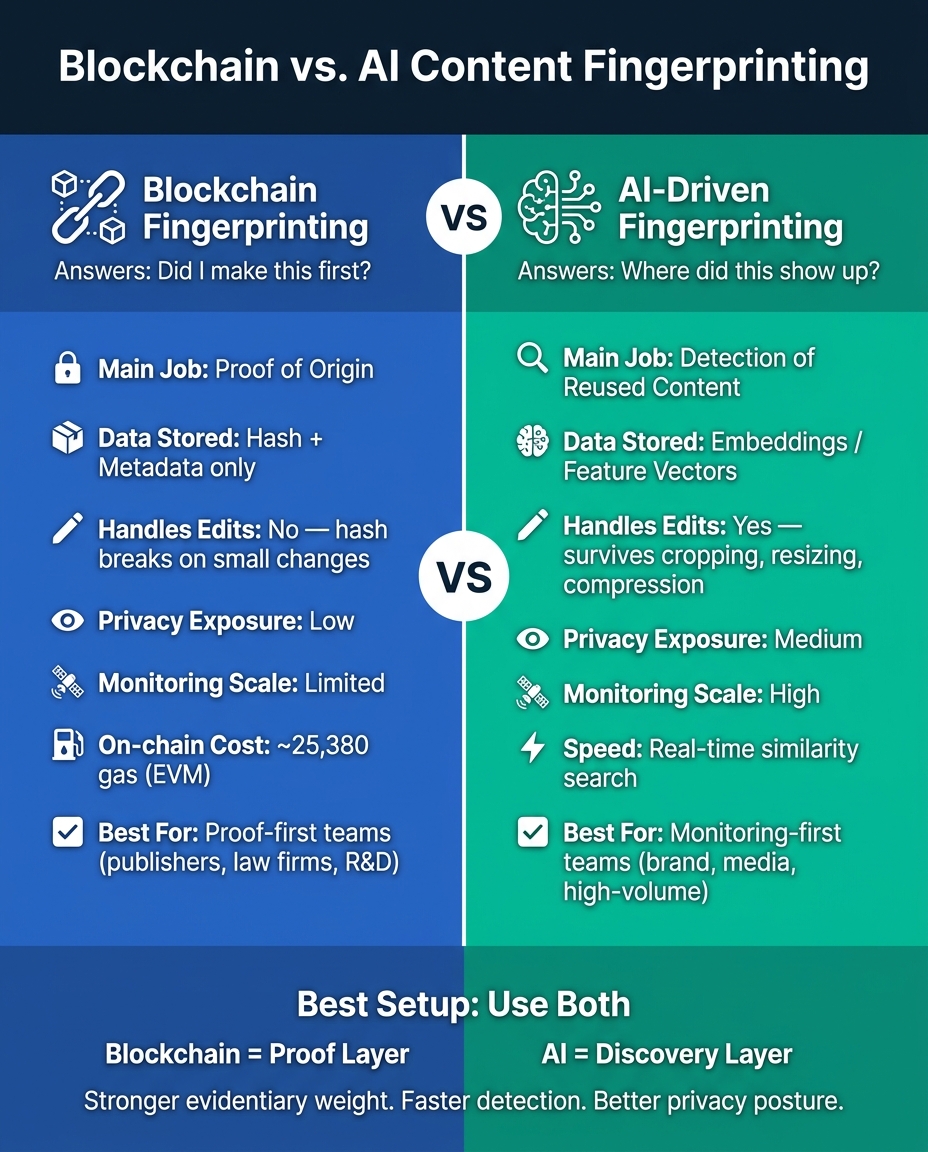
Blockchain vs. AI Content Fingerprinting: Key Differences at a Glance
Blockchain and Cryptography | Stuart Haber | Blockchain+AI+Human
sbb-itb-738ac1e
Quick Comparison
| Factor | Blockchain | AI |
|---|---|---|
| Main job | Proof of origin | Detection of reused content |
| Data stored | Hash + metadata | Embeddings / feature vectors |
| Handles edits | No, not with standard hashes | Yes, often after light changes |
| Privacy exposure | Lower | Higher |
| Scale for monitoring | Limited | High |
| Best fit | Proof-first teams | Monitoring-first teams |
If I boil the article down to one point, it’s this: blockchain answers “Did I make this first?” while AI answers “Where did this show up?” That’s why using both gives a better setup for many U.S. businesses. This approach aligns with emerging content authenticity verification tools used to secure digital assets.
Blockchain-based fingerprinting: strong proof, limited matching
Blockchain fingerprinting stores a hash, a timestamp, and ownership metadata on-chain, while the file itself stays off-chain. On an EVM ledger, recording this small proof takes about 25,380 gas [3].
Privacy strengths of blockchain fingerprinting
Only the hash is written to the ledger, so the original file stays private. That matters a lot in cases like healthcare, where a team may need to timestamp a draft without exposing patient data.
The ledger also gives you immutable, auditable records. If ownership is challenged later, you have a clear chain of custody that others can verify.
Efficiency limits in enforcement
Here’s the catch: blockchain can verify a file that someone submits, but it can’t scan the web for copies or spot edited versions on its own. And standard hashes are brittle. Even tiny file changes can produce a completely different hash [1].
That means blockchain won’t match:
- Cropped copies
- Compressed files
- Re-encoded versions
- Other lightly edited duplicates
So the role of blockchain is narrow but strong. It proves authorship. It does not detect infringement across the open web. That’s where AI-based fingerprinting has the edge for active monitoring.
Where ScoreDetect fits in a blockchain workflow

ScoreDetect, a product of InCyan, uses this blockchain workflow to record a checksum and timestamp ownership without storing the asset on-chain. For enforcement at scale, that proof layer works best when paired with faster AI-based matching.
AI-driven fingerprinting: fast matching, higher processing demands
Blockchain can show that a file existed at a certain moment. AI fingerprinting does a different job: it finds edited copies by comparing content embeddings instead of exact hashes. That’s why AI works better for monitoring, while blockchain works better for proof.
Why AI is more efficient for detection and monitoring
The big upside is scale. Even when images go through JPEG compression, resizing, or center cropping, AI similarity search systems still hit near-perfect recall and find the right match on the first try after those changes [3].
That matters in practice. Instead of checking for an exact file match, AI looks at the underlying content. So if someone trims an image, compresses it, or changes its size, the system can still spot it. AI systems also index embeddings and narrow results fast enough for real-time monitoring [3].
Privacy tradeoffs in AI workflows
The catch is data handling. AI systems need feature extraction and embedding storage, which means more obligations for U.S. businesses that use them. That’s why data minimization, access controls, and retention limits for embeddings matter [4].
Threshold settings also need care. Set similarity thresholds too low, and false positives go up. Set them too high, and heavily edited copies may slip through [2]. It’s a balancing act.
A simple yes-or-no result often isn’t enough. In many cases, tiered labels work better, such as:
- Verified
- Derived
- Unverified
- Suspected Tampered
These labels keep the gray areas visible, which helps when content has been edited rather than copied as-is [3].
That split in purpose shapes the tradeoff between privacy, speed, and enforcement.
How InCyan extends AI protection beyond timestamping
InCyan pushes AI matching past plain timestamping. Idem matches images, video, and audio against a multimodal database to identify ownership, even after cropping or compression, while Idem Text applies the same forensic matching to text [1].
AI does the discovery and matching. ScoreDetect handles the proof layer on blockchain.
Blockchain vs. AI: a direct comparison across privacy, efficiency, and business fit
The choice comes down to three things: proof, scale, and how much the content changes before someone reuses it. Once you look at it that way, the decision gets a lot simpler.
Side-by-side comparison across core decision factors
| Factor | Blockchain-Based Fingerprinting | AI-Driven Fingerprinting |
|---|---|---|
| Privacy exposure | Low – hash only | Medium – stores embeddings |
| Matching type | Exact match | Similarity match |
| Modified content detection | Fails on small edits | Handles cropping, resizing, and compression |
| Speed at scale | Limited by block times and transaction costs | Fast similarity search |
| Implementation complexity | Moderate | Higher |
| Evidentiary value | Best for creation proof | Best for misuse tracking |
| Cost profile | Transaction fees; batching lowers cost | Higher compute upfront; lighter models reduce overhead |
| Storage | Hash and metadata only | Feature vectors |
| Business fit | Proof-first teams | Monitoring-first teams |
Use blockchain when proof matters most. Use AI when discovery matters most.
When blockchain is the better first step
Blockchain fingerprinting makes more sense when your main goal is to prove when a piece of content existed and who created it – not to hunt down copies across the web. It creates a tamper-proof record without storing the file itself.
That’s why it tends to fit publishers protecting original editorial work, law firms documenting legal material, and R&D teams locking in pre-publication research. ScoreDetect covers this layer by taking a checksum of the content and anchoring it to the blockchain without exposing the underlying file.
If you need live monitoring, though, this stops being enough.
When AI is the better first step
AI fingerprinting is the better starting point when the job is to find unauthorized copies after edits have already been made. Instead of looking for an exact file match, AI looks for visual or text similarity.
That matters in the messy parts of the internet, where copied content gets cropped, resized, compressed, or lightly rewritten before it shows up somewhere else. High-volume brand and media teams usually need AI first for that reason.
Conclusion: why a layered approach works best
The choice isn’t blockchain or AI. It’s proof plus monitoring.
Blockchain answers when content was registered and who registered it. AI answers what was reused.
When you combine both, the result is stronger evidentiary weight. AI helps with discovery fast, while blockchain keeps tamper-evident proof in place.
Compared to blockchain vs traditional timestamping methods, blockchain sets the record without storing the asset itself. AI can still detect reuse even after edits or format changes that would break a standard cryptographic hash. And the way you handle data between those steps shapes your privacy posture.
For teams putting this workflow in place, ScoreDetect handles blockchain timestamping, and InCyan adds AI-driven detection on top of that base. Used together, blockchain and AI give teams proof, speed, and privacy.
FAQs
Can blockchain alone stop content theft?
No. Blockchain can create a tamper-proof record of ownership and timestamping, but it does not stop unauthorized copying or distribution of digital assets.
To fight theft more effectively, it has to work with other tools. For example, InCyan’s ScoreDetect pairs blockchain timestamping with AI-driven content fingerprinting and invisible watermarking to help identify and trace content, even after edits or modifications.
How much editing can AI still detect?
Advanced AI-driven content fingerprinting can still spot content after heavy editing. It looks at the asset’s semantic core, not just raw pixels, so it can hold up against changes like cropping, color grading, text overlays, re-encoding, and screenshots.
Some systems, including InCyan’s Idem technology, can find a match even when only 10% of the original content is still there.
When should I use both blockchain and AI?
Use both when you need reliable content identification and an immutable record of ownership.
AI-driven fingerprinting can spot content even after edits like cropping, color grading, or compression. Blockchain adds a tamper-proof timestamp that shows when the content was registered. Put them together, and you get support for both tracking and ownership checks.