If you want to find stolen media online, AI works best when you use four parts together: fingerprints, invisible watermarks, multimodal matching, and enforcement workflows.
I’d boil the whole article down like this: matching alone finds copies, but proof and process decide whether you can act on them. Fingerprints help spot edited reuploads, watermarks help tie copies back to the source, multimodal systems catch harder edits, and review plus takedown workflows turn alerts into action. For U.S. teams handling large libraries, that matters because Google has received requests to delist 17,917,574,286 URLs since 03/10/2011.
Here’s the short version:
- Fingerprinting finds reused images, video, audio, and text even after resizing, compression, or light edits.
- Watermarking puts a hidden signal in the file so you can trace copies later.
- Blockchain timestamps help show a file existed by a certain date without storing the file itself.
- Multimodal matching checks visuals, audio, and text together, which helps with memes, cropped clips, and caption-heavy edits.
- Human review still matters because a match score does not decide fair use, parody, news use, or license status.
- Workflows handle the next step: block, track, monetize, review, or send a takedown.
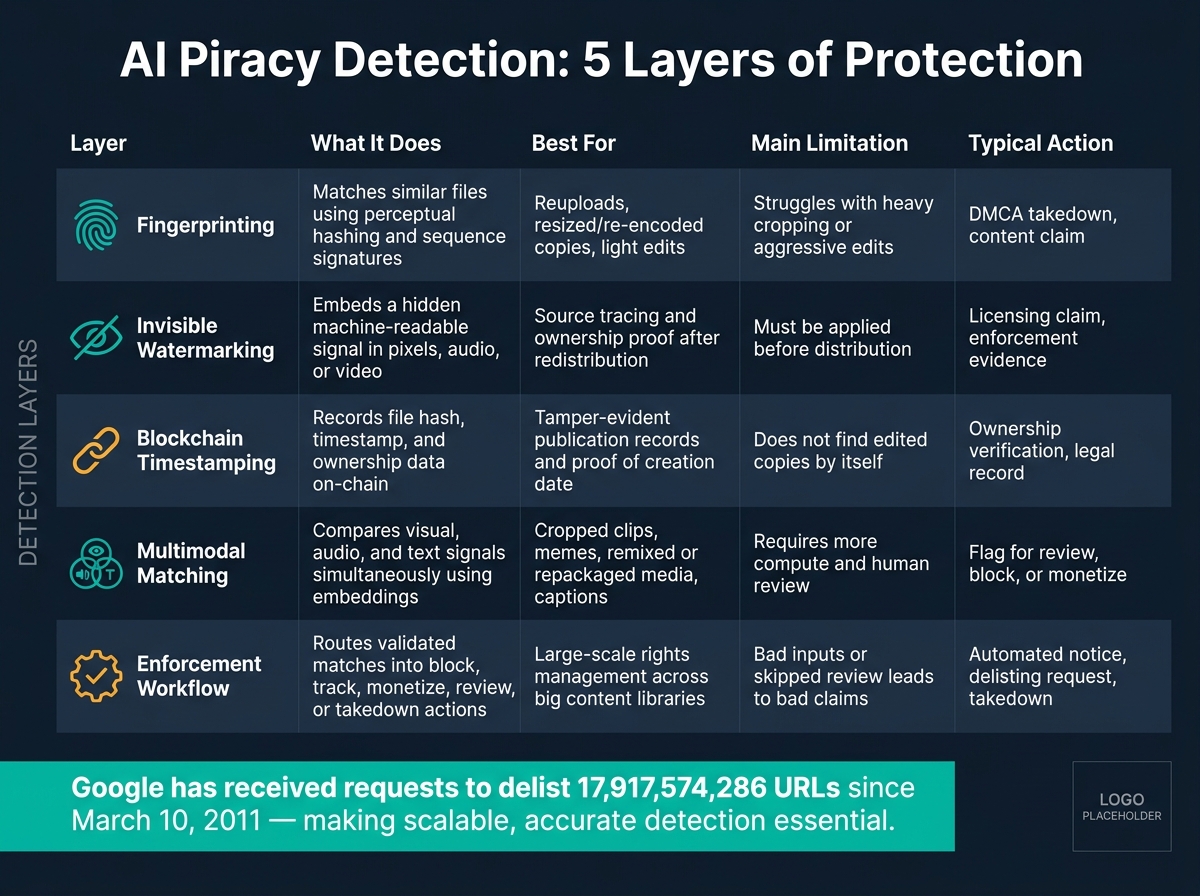
AI Piracy Detection Layers: Tools, Strengths & Actions
SynthID – Watermarking and identifying AI-generated text
sbb-itb-738ac1e
Quick Comparison
| Layer | What it does | Best for | Main limit |
|---|---|---|---|
| Fingerprinting | Matches similar files | Reuploads and light edits | Harder with heavy changes |
| Invisible watermarking | Links a file to its owner | Source tracing and proof | Needs watermarking before distribution |
| Blockchain timestamping | Records proof of time and ownership | Publication records | Does not find edited copies by itself |
| Multimodal matching | Compares image, audio, and text signals together | Cropped, clipped, remixed, or repackaged media | Needs more compute and review |
| Enforcement workflow | Turns matches into action | Large-scale rights handling | Bad inputs can lead to bad claims |
My takeaway: if you publish media, I’d protect files at creation, keep one clean reference catalog, and send only reviewed matches into automated takedown or delisting flows. That is the simplest way to cut wasted time and build a stronger case when reuse shows up.
AI fingerprinting and content matching
Fingerprinting turns each original asset into a compact reference fingerprint. Then it checks reuploads, reposts, and edited copies against that library.
Image, video, audio, and text fingerprints
Each media type needs a different fingerprinting method. The reason is simple: images, video, audio, and text are built in different ways.
For images, perceptual hashing creates a small visual fingerprint that still works after resizing, compression, and format changes. Two images that look almost the same can end up with hashes that have a very low Hamming distance, even when the files use different sizes or formats.
Video fingerprinting works frame by frame. The system samples keyframes, hashes them, and combines those results into a sequence signature. That makes it possible to find a short clip taken from a longer work, even if the clip was trimmed, resized, or covered with a logo. Media companies use this to spot highlight reels, sports clips, and short-form posts pulled from longer licensed works.
Audio fingerprinting pulls spectral and temporal features from a track to build a fingerprint that can survive re-encoding, background noise, and minor edits. Music labels and independent artists use it to find their tracks inside user-generated videos and livestreams. Text matching systems tokenize documents and compare them against a large proprietary database to generate similarity scores that flag scraped articles or cloned product descriptions.
| Detection Approach | Media Type | Best Use Case | Strengths | Common Limitations | Typical Action |
|---|---|---|---|---|---|
| Perceptual hashing (DCT-based) | Image | Stock photo agencies, ecommerce brands, news desks | Fast, scalable; survives resizing and re-encoding | Can flag visually similar but unrelated images; struggles with heavy cropping | DMCA takedown, licensing claim |
| Frame-level sequence matching | Video | Streaming platforms, sports media, UGC platforms | Detects short clips from long works; robust to overlays and bitrate changes | Aggressive cropping or heavy overlays can lower match scores | Auto-block, content claim, or removal |
| Spectral/temporal audio fingerprinting | Audio | Music labels, podcast publishers, livestream platforms | Survives re-encoding, noise, and minor edits | More aggressive edits can reduce accuracy | Mute, block, or monetize via content claim |
| Phrase/token similarity matching | Text | Publishers, SEO agencies, academic institutions | Flags potential plagiarism or unauthorized reuse at scale | Similarity score alone does not determine legality | Deindex request, licensing notice |
Why similarity matching outperforms exact file matching
Cryptographic hashes change when a file changes, even by one bit. That makes them useful for integrity checks, but weak at finding edited copies.
Similarity fingerprints work differently. Close inputs stay close in hash space. So when someone uploads a video that has been resized, re-encoded, or lightly covered with logos or subtitles, the system can still spot it. A checksum check would miss that kind of change.
For U.S. businesses with large content libraries, this isn’t just a technical detail. It affects time, risk, and money. Exact matching misses many day-to-day infringement cases. Similarity matching catches more of them, which is why fingerprinting sits at the core of any serious piracy detection pipeline.
Fingerprinting catches reused media after upload; watermarking and provenance signals make ownership easier to prove at the source.
Invisible watermarking and provenance signals
How invisible watermarking helps trace redistributed media
Invisible watermarking places a machine-readable signal inside pixels, audio, or video without changing how the file looks or sounds to people. That signal can still remain after resizing, recompression, re-encoding, and light edits. With blind watermarking, you don’t need the original file to check for it. You only need the copy you’re looking into.
InCyan’s Tectus uses blind watermarking for images, video, and audio. It keeps ownership proof in place through transcoding, cropping, captions, and format conversion. If a suspicious copy shows up, the detector can match the embedded ID to the rights holder’s catalog and generate structured evidence for enforcement.
This works best when you don’t rely on just one signal. Each layer does a different job, and blockchain enhances digital watermarking by adding a layer of immutable verification:
- Metadata stores creator and license details.
- Watermarking stays with the file even after platform processing.
- Provenance records track creation, revisions, transfers, and distribution.
That mix matters most when a platform or legal team needs to show where a copy came from, not only that it looks or sounds alike. Put together, these layers create a stronger evidentiary trail than any one signal on its own.
Blockchain timestamps and proof of ownership
Blockchain timestamps record a file hash, timestamp, and ownership data on-chain. Since the hash is deterministic and collision-resistant, any later copy of the same file will produce the same hash. That gives a rights holder a way to show the content existed at or before the recorded time.
ScoreDetect timestamps content to create verifiable ownership records. It also offers certificates, WordPress support, and Zapier automation for publishing workflows. When edits are heavy or the source file is missing, these records can back up the next layer of matching.
Multimodal detection for edited and repackaged media
Once edits move past simple re-encoding, exact hashes stop being enough. A cropped clip, a stitched meme, or a video covered in captions can slip past hash-based checks with ease. Multimodal detection steps in by comparing visual, audio, and text signals at the same time. That’s the layer built to catch edits that plain fingerprinting often misses.
Detecting partial matches and transformed content
Modern detection systems handle this by splitting media into smaller parts: scenes, keyframes, audio segments, and text snippets. Then they compute embeddings for each fragment. That matters because two frames from the same scene can still sit close together in embedding space even if one version has been cropped, compressed, color-graded, or covered with animated stickers.
Audio works in a similar way. Fingerprints built from spectrogram peaks can stay stable under noise, compression, and other distortions. So even short clips buried inside reaction videos can still be matched back to the source [1][2]. Text adds another layer. Subtitles, on-screen captions, and speech transcripts can be embedded by meaning, which helps catch paraphrases and translations that plain keyword search would miss.
The upside is clear. An entertainment rights holder can spot that a viral meme uses a zoomed-in clip from a premium series, even after fans add animated borders and bold captions. Why? Because the system can still recognize faces, background details, and motion patterns. Put visual, audio, and text pipelines together, and they tend to beat single-signal detectors when someone is trying hard to alter the content.
Enterprise-scale matching across large libraries
Finding partial matches is only half the job. The next hurdle is searching a huge catalog fast enough to act before the copy spreads.
At large scale, that usually means distributed vector databases and approximate nearest-neighbor search that can query millions or even billions of fragment embeddings. Continuous scanning pipelines check new uploads as they come in, generate embeddings during ingestion, and query the reference index right away. So possible infringement can be flagged at upload instead of turning up weeks later.
InCyan’s Idem is built for that kind of volume. It holds up against mobile edits, memes, cropping, and compression, and it can identify ownership even when only 10% of the original remains. When Idem works with InCyan’s Blueprint digital asset management platform, new releases are fingerprinted as soon as they enter the catalog. That keeps the index current and helps enforcement keep pace with publishing. And that speed counts, because a flagged match still needs review, evidence, and enforcement.
From detection to enforcement: review, evidence, and takedowns
After detection, the next step is action. But a match is just a lead. It is not proof on its own.
A better approach is to route each match into one of five actions: block, track, monetize, review, or takedown. The right choice depends on how certain the match is, what rights you hold, and how much time and money enforcement will take. YouTube’s Studio Content Manager works this way in practice: rights holders can tell the system to block, monetize, or track matching uploads instead of defaulting to removal. [4]
| Action | Best use case | Speed | Risk | Business impact |
|---|---|---|---|---|
| Block | Clearly unauthorized repost, no license | Fastest | High if overused; false positives possible | Stops harm immediately |
| Track | Monitoring spread, gathering intelligence | Low urgency | Very low | Informs licensing and enforcement strategy |
| Monetize | Authorized-but-unlicensed reuse | Medium | Low if license infrastructure exists | Recovers revenue without removal |
| Review | Ambiguous match, possible fair use or license | Slower | Low | Prevents over-enforcement and legal mistakes |
| Takedown | Validated, enforceable claim | Moderate | Medium if evidence is weak | Strongest enforcement outcome |
Evidence packages and false-positive control
Before sending any notice, build the claim file. This is where things either hold up or fall apart.
That file usually includes side-by-side views of the source and the suspected copy, the AI confidence score, timestamps, URLs, and a plain description of what matched. It should also log the detection method, analyst notes, and the final decision so the organization has an audit trail. Provenance signals, such as watermark data or blockchain timestamps, can make verification stronger and help legal and compliance teams confirm ownership faster.
Confidence scores, by themselves, don’t settle the issue. Recent platform reports show that many notices get rejected because they are invalid, incomplete, or abusive. That’s why human review still matters. AI can’t decide whether a match falls under fair use, parody, news reporting, or an existing license agreement.
Automated workflows for search delisting and takedown
Once a match clears review, automation can handle the repetitive parts. A validated claim can kick off a pre-built workflow: assemble the evidence record, fill in a notice template, route it for approval, and send it to the platform, host, or search engine.
Search delisting can cut off discovery early. Google says it carefully reviews notices for completeness and other issues before delisting URLs. [3] It has also received requests to delist 17,917,574,286 URLs from Search since March 10, 2011. [5]
In practice, validated claims can trigger templated notices, approvals, and delisting requests automatically. Zapier workflows cut manual work across large portfolios. Validated claims feed the takedown workflow.
Conclusion: What businesses should prioritize now
The main point is simple: detection without proof burns time, and enforcement without evidence falls apart. That’s why asset-level protection should come first.
Add invisible watermarks at the moment of creation so each downstream copy can be traced back to the source. Then pair that with blockchain timestamps through ScoreDetect to build a tamper-evident ownership record. In user-generated media, speed matters. Copied assets can spread long before a person reviewing content has any chance to step in. Those proofs only work at scale when every asset lives in one rights-aware library.
A governed reference catalog isn’t optional. Keep one governed reference catalog of fingerprints, rights metadata, and master files – using a platform like InCyan’s Blueprint – so ingestion, fingerprinting, and rights tracking happen in one governed environment. Once that catalog is clean, validated matches can move straight into action.
That means linking matches directly to takedown workflows, delisting, and reporting. Automated notice workflows can automate high-success takedown workflows across large content portfolios.
Modern anti-piracy data can also do more than support enforcement. Teams that use piracy signals as intelligence for release timing, regional pricing, and licensing decisions get more from the same detection stack.
Protect at creation, detect at scale, and enforce through workflow.
FAQs
How accurate is AI piracy detection?
Modern AI piracy detection can be highly accurate because it looks at visual, audio, and text signals at the same time.
That matters for a simple reason: pirates rarely repost content as-is. They crop it, compress it, speed it up, or tweak it just enough to try to slip past basic detection. Multimodal matching helps systems spot those altered versions by comparing more than one signal instead of relying on a single clue.
ScoreDetect, a product of InCyan, adds another layer here. It creates verifiable proof of ownership with a SHA-256 checksum and a blockchain timestamp. And it does that without storing the original file.
So you get a way to link ownership to the content while keeping the source file out of storage.
Can AI detect heavily edited or cropped copies?
Yes. Modern AI can spot pirated user-generated media even after heavy edits like cropping, compression, or speed changes. It does this with multimodal analysis, not just file hashes.
For broader protection, InCyan’s tools add a few more layers:
- ScoreDetect for blockchain-based timestamping
- Idem for multimodal matching
- Tectus for invisible watermarking
That matters because pirates rarely repost a file as-is. They trim it, recompress it, speed it up, or tweak the frame. A plain hash check falls apart fast. Multimodal systems look at the media itself, which gives them a much better shot at finding altered copies.
What proof do I need before sending a takedown?
Before you send a takedown, you usually need to show two things: the content is yours and the other use wasn’t allowed.
That proof often comes from tools and records like:
- fingerprinting matches
- invisible watermarking for source tracing
- blockchain timestamping for verifiable ownership
Here’s the basic idea: these methods help connect a copied asset back to the original source. That matters when you need to back up a claim with something more than “I made this.”
ScoreDetect, a product of InCyan, does this by recording a cryptographic checksum of your asset on the blockchain. That creates a tamper-proof timestamp and certificate of ownership without storing the file itself.