AI can find copied videos even after crops, speed edits, compression, and color changes. It does this by turning a video’s image and sound patterns into a compact fingerprint, then matching that fingerprint against videos found across sites, social feeds, search results, and file-sharing pages.
If I boil the article down, here’s the whole process:
- Create a fingerprint: I extract patterns from frames, motion, scenes, speech, music, and timing.
- Store proof of ownership: I log the asset before release so there is a record tied to the source file.
- Scan the web: Automated tools collect possible matches from public pages and platforms. This process often involves overcoming challenges of web scraping to ensure comprehensive coverage.
- Score each match: I compare image and audio signals, check timing and duration, and label match confidence.
- Review weak matches: Low-confidence cases go to AI or human review before action.
- Take action: High-confidence matches can move to delisting or takedown notices.
- Keep matching after edits: The system can still detect copies when only a small part of the source remains.
A few points stand out:
- Fingerprinting does not change the file.
- Watermarking does change the file, often using invisible markers to ensure ownership protection.
- Audio adds a second match layer, which helps lower false alarms.
- ScoreDetect reports over a 96% takedown rate for its automated delisting notices.
This means you’re not just looking for exact duplicates. You’re building a repeatable path from detection to proof to removal.
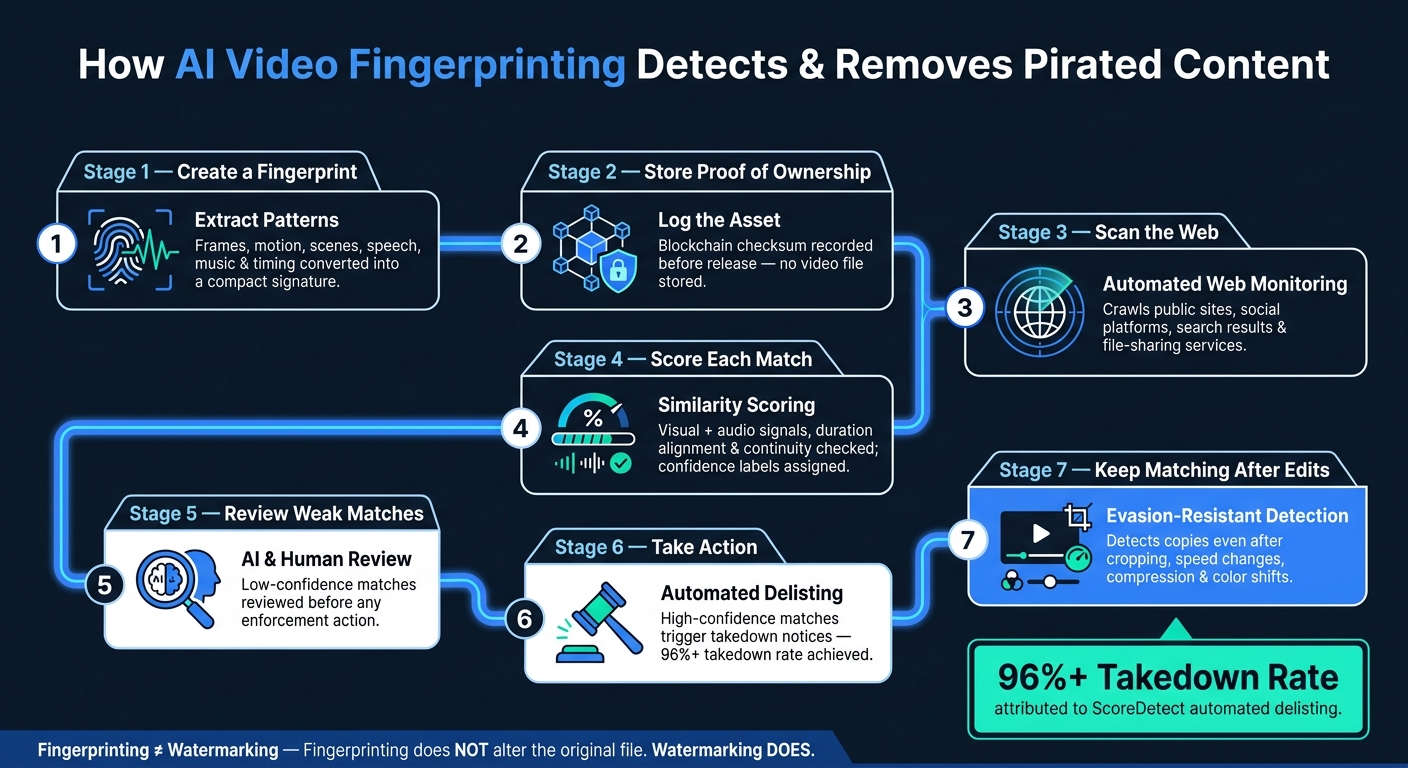
How AI Video Fingerprinting Detects & Removes Pirated Content
AI Content Is Now Undetectable Without AI – Max Eisendrath, Red Flag AI | EP123

sbb-itb-738ac1e
How AI Builds a Fingerprint from a Video
AI pulls visual and audio signals from a video, then turns them into a compact fingerprint of the asset. Once that fingerprint is stored, the system can compare it with copies found online.
How Visual Features Are Sampled Across Frames
Instead of leaning on raw pixel data, the system extracts features across the video. It looks at key frames, motion patterns, detected objects, and scene changes. Those signals are then folded into a compact signature that can still work even after edits, compression, or reposting.
How Audio Fingerprints Add a Second Match Signal
Audio is processed at the same time as the video. The analysis turns speech, music, and timing cues into a separate match signal. That gives the system a second, independent layer it can use when checking suspected copies.
Why Machine Learning Improves Match Quality
Machine learning helps the system spot transformed copies, not just exact duplicates. It learns how visual and audio features relate to each other, which lets it match content that has been cropped, re-encoded, or changed in other ways. Those signals then move into the monitoring and similarity-scoring steps described next.
How Pirated Videos Are Found and Matched
Once reference signatures are stored, the system starts looking for unauthorized copies. It checks new candidate videos and compares each one against the saved reference signature.
How the Web Is Monitored for Copied Videos
Automated crawling and scraping watch public sites, social platforms, search results, and file-sharing services. Those systems pull in candidate videos for comparison.
In ScoreDetect, targeted web scraping sends those candidates into analysis. From there, they move into similarity scoring.
How Similarity Scoring Controls False Positives
When a candidate is found, the system measures how closely it matches the registered asset. It looks at visual and audio similarity, duration alignment, and continuity. Confidence labels help separate direct evidence from inferred matches.
If a match has low confidence, it goes to AI or human review before enforcement. In ScoreDetect, the analyze step checks discovered content and verifies unauthorized use with quantitative proof.
How Fingerprinting Works After Pirates Edit a Video
Pirates rarely repost a video as-is. More often, they tweak it first and hope that change is enough to slip past detection.
That’s where AI fingerprinting helps. It can still match the underlying content after edits like cropping, resizing, compression, speed changes, or color shifts. Those edits may change how the video looks on the surface, but they don’t change the core fingerprint.
Common Edits Pirates Use to Avoid Detection
Cropping, resizing, speed changes, color shifts, and compression can make a repost look different at first glance. But the fingerprint still points back to the same source.
Why Fingerprints Hold Up After Those Changes
The system reads stable motion and frequency patterns that survive common edits [1]. So even if the presentation changes, AI can still match the video to the same source.
InCyan‘s Idem is built for this kind of evasion-resistant matching. Its multimodal AI is designed to detect content ownership even when only a small part of the original asset remains.
How to Use Fingerprinting in an Enterprise Anti-Piracy Workflow
Fingerprinting works best when it follows a clear path: register the asset, monitor for matches, verify what was found, and then enforce. The moment a match appears, the job shifts from detection to proof and action.
From Asset Registration to Proof and Takedown
Start by registering the asset, generating its fingerprint, and logging ownership before release. That record becomes your proof layer once enforcement starts.
ScoreDetect records a blockchain-based authorship verification checksum of the asset without storing the video file. When monitoring flags a match, review borderline cases before sending notices, and send high-confidence matches to automated delisting. ScoreDetect’s automated delisting notices consistently achieve over a 96% takedown rate.
Key Takeaways for Content Owners
Fingerprinting delivers the most value when it’s tied to continuous monitoring, a documented ownership trail, and a clear path for enforcement. Track:
- enforcement speed
- verification accuracy
- fewer human handoffs
Then connect fingerprint detection to verified evidence and automated delisting so you can move faster from detection to resolution.
FAQs
How is fingerprinting different from watermarking?
Fingerprinting identifies a video by reading the patterns inside the content itself. That means it can still match the video even when the file has been edited, compressed, renamed, or changed in other ways.
Watermarking adds hidden or visible information directly into the video. That extra data can help prove ownership or track down unauthorized copies when they show up elsewhere.
Can AI still detect a video after heavy edits?
Yes. AI-powered video fingerprinting can still spot a video even after heavy edits.
It doesn’t rely on an exact copy. Instead, it looks for the core patterns that often stay in place after changes like cropping, compression, re-encoding, overlays, or clipped sections.
That means it can help find pirated copies even when they don’t match the original frame for frame.
How are false positives reduced?
False positives drop when match checks get stricter, so flagged videos line up more closely with unauthorized use.
In practice, that usually means checking more than one identifying signal and confirming the result before any action is taken.