AI watermarking is reshaping how digital content is protected against piracy. With advanced tools, AI can embed invisible identifiers into media, making it traceable even after edits like cropping or compression. This approach is critical as generative AI enables the creation of synthetic media and the removal of visible watermarks in seconds.
Key highlights:
- Invisible watermarks embed data within media, surviving transformations like resizing or reformatting.
- AI tools achieve over 97% detection accuracy, even after heavy alterations.
- Platforms like Google’s SynthID-Image have watermarked 10 billion+ media files as of 2025.
- Blockchain integration enhances digital watermarking by ensuring tamper-proof logs for legal verification.
- Industries like streaming, advertising, and filmmaking are adopting these tools to prevent losses from piracy, estimated at $70–80 billion annually.
AI watermarking protects generative images and videos and, combined with blockchain, offers a powerful solution to protect digital assets, ensuring traceability and security at scale.
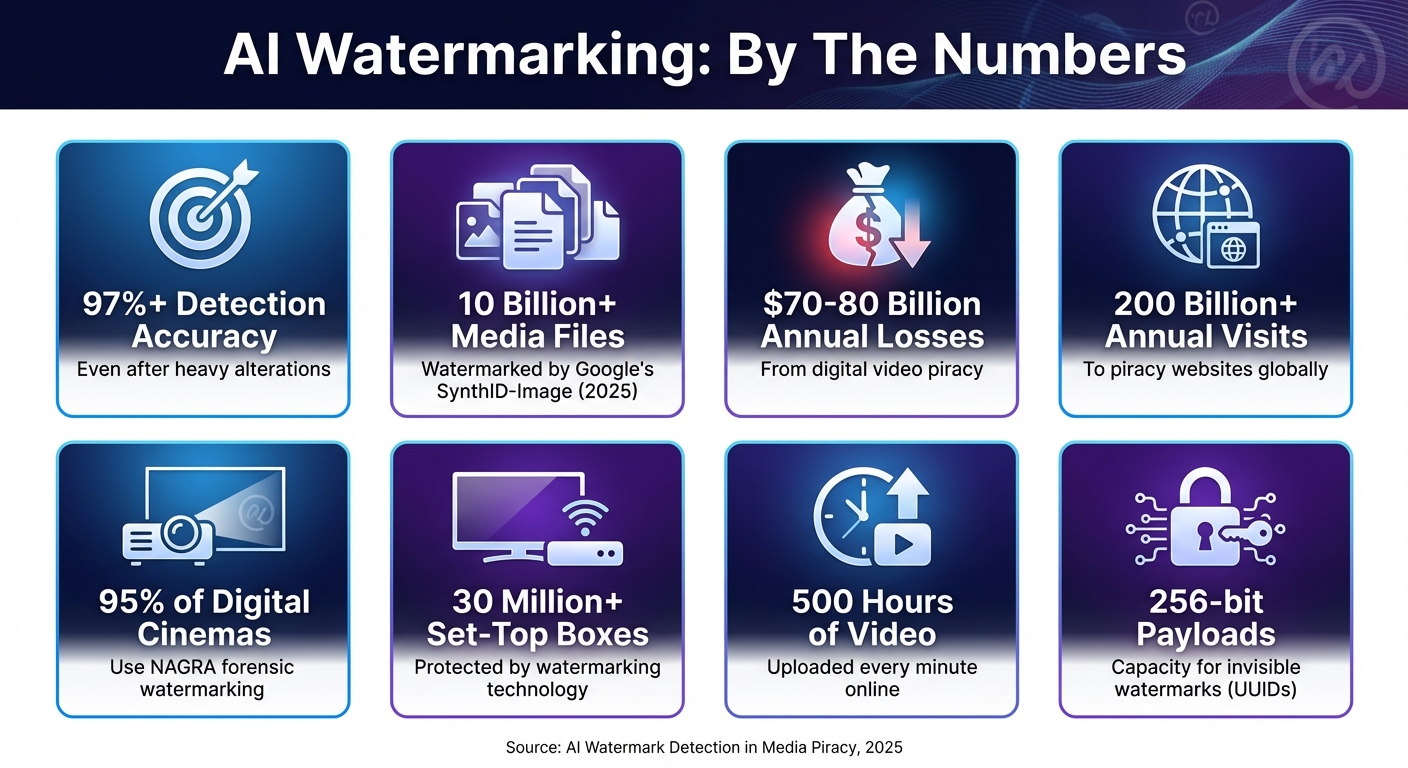
AI Watermarking Statistics: Detection Accuracy, Scale, and Industry Impact
AI Watermark Detection Techniques
Invisible vs. Visible Watermarking
Visible watermarks, like logos or overlays, are often the first line of defense against piracy. But they’re not foolproof – cropping or stripping metadata can easily remove them. Invisible watermarks, on the other hand, embed directly into the media’s signal. As Nikhil John from InCyan puts it, they act as "a latent serial number for the work itself" [4].
The challenge with traditional watermarking methods lies in balancing quality, resistance to edits, and data capacity. AI-driven techniques overcome these hurdles by embedding watermarks in areas that are less noticeable to the human eye [4][3].
| Feature | Visible Watermarking | Invisible Watermarking (AI-Driven) |
|---|---|---|
| Primary Goal | Deterrence and branding | Forensic tracking and provenance |
| Detection | Human eye | Specialized AI algorithms |
| Vulnerability | Easily removed via cropping | Survives compression and geometric changes |
| User Experience | Can degrade quality | Imperceptible to viewers |
| Data Capacity | Limited to visible content | Can carry 256-bit payloads (e.g., UUIDs) [6] |
This comparison highlights why AI-based invisible watermarking is gaining traction in combating digital piracy.
AI Algorithms for Watermark Recovery
Modern AI detectors use blind watermarking, which allows for watermark extraction and verification without requiring the original media file. This is especially important for managing vast amounts of digital content [4]. Techniques like Convolutional Neural Networks (CNNs), Generative Adversarial Networks (GANs), and Vision Transformers (ViT) play a pivotal role in detecting watermark signals, even after heavy distortions [7].
A standout example is the InvisMark system, which achieves over 97% bit accuracy across various manipulations while maintaining imperceptibility (PSNR > 51) [6]. Deep learning approaches far exceed the capabilities of older spatial and frequency-based methods, particularly when dealing with alterations made by AI tools [7].
This level of precision is critical for building effective real-time monitoring systems.
Real-Time Detection and Large-Scale Monitoring
AI technology has made it possible to embed watermark protection directly into the content creation process. This ensures that assets are safeguarded from the moment they are produced [8]. Real-time detection leverages computer vision techniques such as scene segmentation, motion tracking, and object recognition to verify the presence of watermarks instantly.
With over 500 hours of video uploaded every minute and piracy sites drawing more than 200 billion visits annually, AI-driven detection systems are essential. These systems use high-dimensional embeddings to recognize content, even after significant transformations. Researchers describe this shift as moving from "Generation 2" perceptual hashing to "Generation 3" deep learning-based detection [8].
To strengthen enforcement, many organizations are combining AI detection with blockchain for copyright enforcement. This approach stores tamper-proof logs of detection events and evidence hashes, creating a reliable chain of custody for legal actions. Given that digital video piracy costs the industry an estimated $70 billion to $80 billion annually, these advancements are becoming indispensable [8].
Two Hyderabad based start-ups have been shortlisted in the Anti-Piracy challenge under Waves-2025
Case Studies: AI Watermarking in Action
Here’s a look at how AI detection and watermarking techniques are actively used to tackle media piracy on a large scale.
Case Study 1: Streaming Platforms and Forensic Watermarking
United Cloud adopted NAGRA NexGuard forensic watermarking to secure its OTT (Over-the-Top) delivery system. This integration allowed seamless leak detection across all client devices. Sergej Berišaj from United Cloud shared:
"NAGRA was the obvious choice to fill our OTT security needs now and in the future" [9]
This isn’t an isolated case – 95% of digital cinemas worldwide rely on NAGRA’s forensic watermarking, with over 30 million set-top boxes protected by their technology [9].
In September 2025, Pathé implemented Synamedia ContentArmor to safeguard its "Pathé Home" video-on-demand service, targeting piracy of premium films [2]. Around the same time, Irdeto and Ateme joined forces to integrate TraceMark™ forensic watermarking into Ateme’s video delivery system. Remi Beaudouin, Chief of Strategy at Ateme, remarked:
"By integrating Irdeto’s TraceMark watermarking… we are giving our customers an effortless way to enhance their content security, without adding operational complexity" [10]
This integration enables broadcasters to apply real-time, invisible watermarking across video processing and distribution layers, making it possible to stop illegal streams at their source.
Another example is SK Broadband, which employed NAGRA forensic watermarking for its 4K premium content. This solution embeds invisible watermarks that don’t affect video quality, ensuring both security and a smooth user experience [9].
These examples highlight how forensic watermarking can be tailored to meet the needs of streaming platforms while maintaining content integrity.
Case Study 2: Detecting Collusion and Video Manipulation
Pirates often use collusion attacks, combining multiple watermarked copies to disrupt tracking systems. AI-powered tools counter this by extracting watermark signals from these mixed sources to pinpoint piracy clusters across platforms like social media and file-sharing networks [11] [3] [12]. The MovieLabs Specification for Enhanced Content Protection emphasizes:
"The watermark shall be robust against corruption of the forensic information, including collusion attacks, and transformations and capture techniques that leave the content still watchable" [11]
AI systems also combat content manipulation attacks, where pirates apply techniques like compression, cropping, or rotation. These tools use blind detection, meaning they can identify watermarks even after tampering attempts [11].
| Attack Type | Description | AI/Watermark Countermeasure |
|---|---|---|
| Collusion | Combining multiple watermarked copies to confuse systems | AI algorithms identify signals within mixed data |
| Geometric Transformation | Cropping, rotating, or zooming to obscure watermarks | Invisible watermarks modify pixel values across the entire frame |
| Transcoding | Altering file formats or bitrates to degrade watermarks | Watermarks designed to endure compression and re-encoding |
| Deepfake/Manipulation | Using AI to alter content or mimic sources | Embedded private keys verify content authenticity via blockchain timestamps |
These countermeasures ensure that even advanced tampering techniques don’t compromise watermark effectiveness.
Case Study 3: Identifying Screen-Recorded Content
In digital cinemas, projectors embed a projector ID and timestamp directly into the video. When a screen-recorded version surfaces online, AI tools can extract this data to pinpoint the exact theater and time of the recording [11] [1]. These watermarks are resilient against transformations like cropping, zooming, and trapezoidal distortions caused by physical recording setups [11].
Automated systems continuously scan streaming platforms, social media, and file-sharing sites for these hidden signatures [12]. Bev Kite from the Academy of Motion Picture Arts & Sciences acknowledged:
"Forensic watermarking is a significant breakthrough for the Academy, as well as for the entire film industry" [9]
Taking it further, manufacturers are embedding watermarking directly into cameras and smartphones at the point of capture to establish built-in content authenticity [1].
While pirates continue to experiment with methods like transcoding, altering framerates, and collusion [11] [13], invisible watermarks remain highly effective. Unlike visible overlays, their hidden nature makes them harder to detect and remove [1]. These advancements underline the critical role of AI in protecting digital content from piracy.
sbb-itb-738ac1e
ScoreDetect: Advanced Digital Asset Protection
ScoreDetect builds on the proven success of AI watermark detection, combining artificial intelligence with blockchain technology to offer a new level of digital asset security. This platform is designed to tackle piracy challenges faced by streaming services, content creators, and businesses of all sizes, providing accessible, enterprise-grade solutions.
How ScoreDetect Uses AI and Blockchain
The platform’s AI technology identifies watermark signals even when content has been compressed, cropped, or reformatted. It adapts dynamically to content characteristics and associated risks, ensuring reliable detection under various conditions [4].
Blockchain plays a key role by maintaining a secure, tamper-proof ledger. This ledger logs detection events, evidence hashes, and metadata without storing the actual media files [4]. The result is a time-stamped, verifiable chain of custody that can be shared with regulators and partners while protecting proprietary algorithms [4].
Core Features: Prevent, Discover, Analyze, and Take Down
ScoreDetect operates through four main functions to protect and enforce digital rights:
- Prevent: Uses invisible watermarking to deter unauthorized use of content.
- Discover: Employs intelligent web scraping tools, achieving a 95% success rate in bypassing anti-scraping measures, to find pirated content across the internet [14].
- Analyze: Matches unauthorized content with original works using AI fingerprinting, covering images, videos, and other media formats [4].
- Take Down: Automates the process of issuing delisting notices, with an impressive 96% success rate in removing unauthorized content [14].
The platform scans websites, search engines, apps, and social media in real time. It analyzes visual, audio, and contextual elements to identify matches, even when the content has been heavily altered.
Industry Applications
ScoreDetect is tailored for over 15 industries where protecting digital assets is vital. Media and entertainment companies use it to fight streaming piracy, while advertising agencies secure their creative work. Content creators benefit from blockchain-backed proof of ownership, and legal and government organizations rely on its tamper-proof logs for enforcement actions.
Beyond content protection, ScoreDetect integrates seamlessly with existing business workflows. It connects with over 6,000 web apps via Zapier, offering automated processes that save time and effort. A dedicated WordPress plugin further enhances functionality by timestamping every published or updated article, creating blockchain-verified proof of ownership. This feature also aligns with Google’s E-E-A-T principles, boosting SEO performance.
Key Takeaways from AI Watermark Detection
Why Businesses Need Anti-Piracy Measures
Digital piracy is a massive issue, costing an estimated $70–80 billion annually. It not only drains revenue but also compromises the integrity of digital assets. Traditional metadata protections are no longer enough, especially with the rise of AI-generated content. This is where AI watermarking steps in. By embedding imperceptible identifiers – essentially a "hidden serial number" – into digital assets, AI watermarking can withstand challenges like compression and cropping, addressing these growing risks effectively [4][8].
With more than 30% of social media images now featuring AI-generated elements, tools for embedded verification have become a necessity [3]. For businesses managing large-scale digital assets, blind detection systems that verify ownership without relying on the original file are essential [4].
AI and Blockchain for Digital Rights Management
The combination of AI watermarking and blockchain offers a robust solution to combat piracy and unauthorized use. AI handles the technical side, embedding and detecting watermarks that can survive manipulations like compression, cropping, or adversarial attacks. These advanced techniques boast over 97% accuracy, even under heavy asset distortion [6].
Blockchain complements this by providing a tamper-proof, unchangeable record of ownership and detection events. This legal and technical pairing has already proven scalable, showing that AI watermarking combined with blockchain verification is a powerful deterrent to piracy [5]. Together, they create a strong foundation for future advancements in digital rights protection.
What’s Next for AI in Media Piracy Prevention
Looking ahead, AI and blockchain systems will become even more sophisticated. Future watermarking tools will adapt dynamically to counter new threats [4]. Detection algorithms are being trained to isolate watermark signals from both natural and artificial noise, improving their ability to recover embedded marks even under extreme conditions [4]. Additionally, the industry is working toward comprehensive solutions that protect images, video, audio, and text, ensuring assets remain traceable even when converted between formats [8].
Standards like those from the Coalition for Content Provenance and Authenticity (C2PA) are gaining momentum, as platforms increasingly prioritize content verification [4]. As AI-generated content becomes nearly indistinguishable from real-world creations, the integration of invisible watermarking, AI-driven detection, and blockchain will likely become the cornerstone of digital rights management across various industries.
FAQs
How do invisible watermarks stay intact after edits like cropping or compression?
Invisible watermarks work by embedding signals directly into the structure of digital media, making them undetectable to viewers while remaining identifiable even after edits like cropping, resizing, or compression. These watermarks are designed to withstand such changes by targeting parts of the media that are less impacted by these transformations.
For example, frequency-based techniques embed watermarks in areas that compression algorithms usually overlook. On the other hand, AI-driven methods create semantic fingerprints that can identify content even after extensive alterations. This approach ensures the watermark remains intact, offering a reliable way to verify and protect digital content.
How does blockchain support AI in detecting watermark removal for media piracy?
Blockchain works hand-in-hand with AI-powered watermark detection by offering a secure and tamper-resistant way to track digital content ownership. Instead of storing the actual files, blockchain records a checksum – a unique digital fingerprint of the content. This acts as unchangeable proof of authenticity, helping confirm the origin of media files and detect any tampering or unauthorized use.
On top of that, blockchain uses a decentralized ledger to store watermarking data and ownership records securely. This makes digital watermarks harder to manipulate and easy to verify independently. When paired with AI, this combination strengthens content protection systems, offering a more reliable way to fight against media piracy.
How well can AI detect watermarks on heavily modified media?
AI algorithms excel at spotting watermarks, even on media that has undergone extensive changes. Techniques like invisible and robust watermarking are specifically crafted to withstand alterations such as cropping or tampering. This allows AI systems to detect embedded signals that are invisible to the human eye.
These systems rely on advanced analysis methods, including block-level detection, to pinpoint watermarks in fragmented or distorted media. By using these tools, AI can trace the origins of content and flag unauthorized use, offering a solid defense against media piracy.