AI watermarking is a powerful tool that embeds invisible signals into video content, offering creators a way to protect their work against piracy and unauthorized distribution. Unlike traditional visible logos or metadata, AI watermarks are designed to survive video compression, editing, and other modifications. Here’s a quick breakdown of its main advantages:
- Copyright Protection: Embeds unique metadata (e.g., user IDs, timestamps) to track and prove ownership.
- Piracy Prevention: Creates traceable digital fingerprints to identify the source of leaks. This is a core component of modern digital piracy solutions.
- Automation: Saves time by streamlining watermarking and detection processes.
- Tamper Resistance: Stays intact even after compression, cropping, or reformatting.
- Detection: Scans online platforms for stolen content and provides actionable insights.
- Viewer Experience: Invisible to the human eye, maintaining video quality.
- Modification Survival: Withstands common video edits like resizing or color changes.
- Rights Management: Strengthens DRM systems by embedding traceable identifiers.
- Cross-Platform Compatibility: Works seamlessly across streaming platforms and devices.
- Blockchain Integration: Provides tamper-proof proof of ownership with cryptographic hashes.
AI watermarking combines cutting-edge technology with practical tools, making it a game-changer for anyone looking to protect video content in an increasingly digital world.
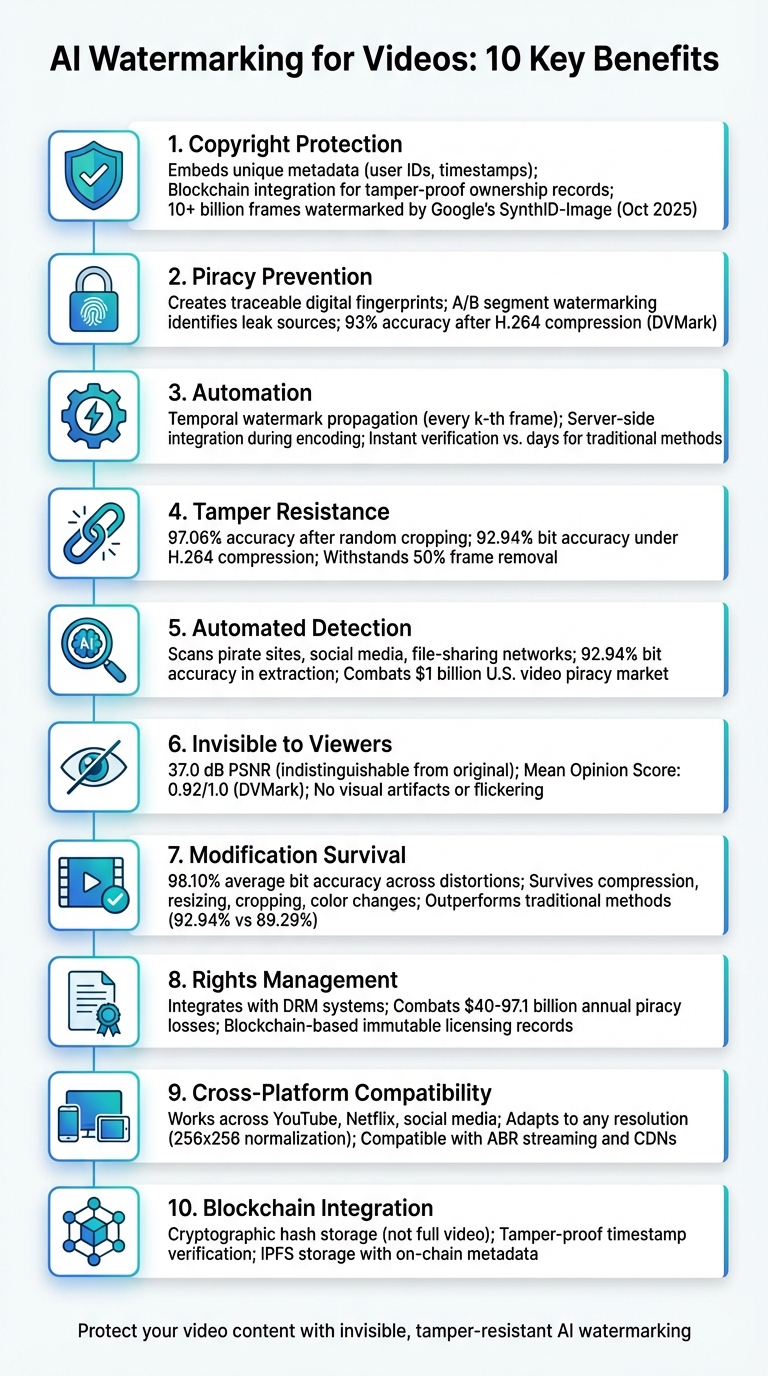
10 Key Benefits of AI Watermarking for Video Content Protection
AI Watermarks Explained: Can We Really Tell What’s Real?
1. Better Copyright Protection
AI watermarking takes video ownership to a new level by embedding unique forensic metadata directly into video frames. Unlike traditional visible logos, which can be easily cropped or blurred, AI-driven systems create a digital trail that ties the content back to its original creator. This makes it possible to track unauthorized leaks with remarkable accuracy.
What strengthens the legal standing of AI watermarking is its connection to blockchain technology. When a watermark is registered on a blockchain ledger, it establishes an unchangeable record of ownership. This record serves as solid evidence in copyright disputes, detailing exactly when and by whom the content was created, often by establishing ownership with timestamps. Researchers Darwish et al. emphasize this point: "The preservation of the blockchain and the impossibility of tampering or forging any of the data stored within may give irrefutable proof of the authenticity of digital works and strengthen the case for their integrity" [3]. This tamper-proof digital trail offers creators a powerful tool for proving ownership.
The scope of this technology’s deployment underscores its reliability. For example, in October 2025, Google’s SynthID-Image system successfully watermarked over 10 billion video frames across its platforms [4]. This system uses deep learning to embed signals that remain intact even after common image alterations, while also providing verification services to confirm the authenticity of media.
Another key feature is the use of exclusive private keys, which prevent unauthorized removal of watermarks. These keys make it nearly impossible to reverse-engineer the watermark [5]. Additionally, perceptual hash functions allow creators to verify watermark data without needing access to the original video – a critical advantage when pursuing legal action against copyright violations [3].
For even greater protection, server-side technologies add another layer of accountability. Server-side forensic watermarking creates unique "A/B" segment combinations during the encoding process, assigning distinct video versions to each viewer. If a leak occurs, creators can trace it back to the exact source [1]. With this level of precision, AI watermarking has become an indispensable tool for safeguarding video content.
2. Prevents Video Piracy
AI watermarking plays a vital role in protecting video content from piracy by making it traceable through real-time tracking for copyright enforcement. How does it do this? It embeds forensic metadata – like User IDs, IP addresses, device IDs, and timestamps – directly into the video pixels. This invisible trail ensures that if a video ends up on a pirate site, its origin can be identified without question.
The financial losses caused by video piracy highlight the need for such advanced protection methods. AI-powered watermarking rises to the challenge by deploying sophisticated techniques to track content. One standout method is A/B segment watermarking, a server-side approach that creates two versions of each video segment – labeled A and B. Every subscriber is assigned a unique combination of these segments. For instance, User 1 might receive "AABAA", while User 2 gets "ABABA." If a pirated version surfaces online, analyzing the segment sequence can quickly reveal the account responsible for the leak [1].
"Video watermarking is a good defensive strategy to identify the pirates behind stolen content and piracy services." – Andy Francis, Technical Content Lead at Bitmovin [1]
This method works hand-in-hand with tamper-resistance features to make piracy even more difficult.
One of the standout strengths of AI watermarking is its resistance to tampering. Pirates often try to bypass protections by compressing videos, cropping frames, or altering colors. However, modern AI models like VideoSeal and DVMark are designed to withstand such attacks. For example, DVMark maintains 93% accuracy even after H.264 compression (CRF 22) [6]. Whether it’s frame dropping, color adjustments, or changes to aspect ratios, the watermark remains detectable – foiling common piracy techniques.
Additionally, AI-powered extractors enhance real-time piracy detection by automatically scanning digital platforms for watermarked content. These systems can identify protected material across pirate sites and social media platforms, even when stolen clips are embedded within larger unauthorized uploads [5][7]. This automation ensures that the fight against piracy is not just effective but also continuous.
3. Saves Time Through Automation
AI watermarking streamlines the labor-intensive process of protecting content, making copyright defense and piracy prevention much faster. Instead of manually watermarking every frame – an expensive and time-consuming task, especially for high-resolution videos – AI models employ temporal watermark propagation. This approach watermarks only every k-th frame and automatically extends the signal to nearby frames [2]. The result? Significant time savings without compromising quality.
"The computational load of watermarking every frame is prohibitively high, particularly for high-resolution videos with high frame rates." – Meta FAIR [2]
Automation goes even further with server-side integration. Watermarking is seamlessly executed during the encoding and packaging stages, generating unique "A" and "B" segment combinations for each viewer [1]. This method optimizes video encoding and ensures efficiency. For example, Meta’s VideoSeal framework demonstrates this capability with an embedder containing 16 million parameters and an extractor with 24 million parameters – both designed to operate quickly, even on mobile devices [2]. This level of automation enables real-time, continuous content monitoring without manual intervention.
AI-powered detection tools also play a crucial role by scanning pirate streams across the internet, automatically recognizing watermark patterns and tracing leaks back to specific users or sessions [1]. Unlike traditional methods that required manual adjustments for distortions like compression or cropping, modern AI systems handle these challenges simultaneously thanks to end-to-end training [6].
In addition to detection, automated verification provides another layer of efficiency. By replacing the need for third-party notarization, AI systems offer instant timestamping and verification [3]. Blockchain integration in content distribution further enhances this process, allowing creators to confirm ownership in seconds rather than waiting days. This rapid verification empowers content creators to protect their work with unmatched speed and ease.
4. Resists Tampering and Removal
AI watermarks are designed to withstand the very techniques pirates often rely on. When videos are re-encoded, cropped, or compressed, traditional watermarks tend to vanish. AI-powered systems, however, are trained specifically to survive these attacks. By using adversarial training methods, these systems become far more resilient to tampering.
During development, frameworks like VideoSeal and DVMark simulate common attacks – cropping, rotation, noise, and compression – on watermarked videos. This process forces the AI to embed watermark signals in ways that hold up in real-world scenarios. For example, DVMark reached an impressive 97.06% accuracy after random cropping at a 0.4 ratio and maintained strong accuracy even when 50% of video frames were randomly removed [2][6].
"Our model consists of a novel multiscale design where the watermarks are distributed across multiple spatial-temporal scales. It gains robustness against various distortions through a differentiable distortion layer." – Xiyang Luo et al., Google Research [6]
Differentiable compression proxies also play a key role in combating heavy video compression. Since standard codecs like H.264 are difficult for AI to process directly, researchers use small neural networks, known as "proxies" (e.g., CompressionNet), to mimic compression effects. These proxies achieve a PSNR of 33.3 dB while replicating H.264 output at CRF 25, enabling watermarks to be pre-conditioned for survival. The result? AI watermarks maintain 92.94% bit accuracy under H.264 compression at CRF 22, outperforming traditional methods, which achieve 89.29% [6].
Another critical feature is multiscale embedding, where watermark signals are spread across multiple spatial and temporal layers [6]. This redundancy ensures that even if part of a frame is cropped or frames are dropped, enough watermark data remains to verify ownership. This resilience is a cornerstone of modern content authenticity verification tools used by creators today. Attempts to remove these watermarks without degrading video quality lead to visible artifacts, making piracy efforts futile.
5. Detects Unauthorized Use Automatically
Once your video is watermarked, AI-powered systems can actively scan online platforms to locate stolen copies. These detection services keep an eye on pirate streaming sites, social media, and file-sharing networks, using extraction algorithms to identify watermark signals embedded in suspicious content [1]. With the U.S. video piracy market estimated at nearly $1 billion [1], automated detection has become one of the most effective technology solutions to stop piracy on a large scale.
This automation is powered by advanced neural network extractors, which deliver impressive accuracy even under challenging conditions. These extractors are trained to retrieve hidden binary messages from video frames and achieve a 92.94% bit accuracy [6], even when the content has undergone heavy H.264 compression. This level of performance significantly surpasses older, more traditional methods.
Forensic watermarking takes this precision a step further. Industry leaders emphasize its effectiveness in pinpointing the source of leaks:
"The Watermarking Provider’s Detection Service uses the pattern of A/B segments in a pirate stream to identify the session and subscriber responsible for the leak and take appropriate action." – Andy Francis, Technical Content Lead, Bitmovin [1]
Modern frameworks also feature a detector head capable of identifying the exact frames containing watermarks [6]. This transforms copyright enforcement from a reactive effort into a data-driven process, providing clear evidence and actionable insights to combat piracy effectively.
6. Stays Invisible to Viewers
AI watermarks work by embedding signals into video pixels that are completely undetectable to the human eye. With a Peak Signal-to-Noise Ratio (PSNR) of 37.0 dB, the watermarked video looks indistinguishable from the original version [6].
This process relies on residual mapping [6], which adds a subtle layer of data to the original video frames. By adjusting the scaling factor, it’s possible to fine-tune the balance between protection strength and video quality [2][6]. Unlike visible watermarks like logos, this technique hides statistical patterns within the pixel structure, making it nearly impossible to spot.
"Invisible watermarks remain non-obtrusive, preserving the original content’s integrity, as well as making it more difficult to identify and detect for a potential attacker." – Xiyang Luo et al. [6]
To avoid issues like flickering between frames, AI models utilize advanced techniques such as 3D convolutions and discriminators to ensure smooth and consistent visuals [6]. In human evaluation tests, the DVMark system scored an impressive Mean Opinion Score of 0.92 out of 1.0, where a score of 1.0 indicates a video that is visually identical to the original [6]. This invisible watermarking is essential for seamless integration with automated detection systems and robust copyright protection.
Meta’s VideoSeal framework takes this a step further. It processes 96-bit messages using an embedder with 16 million parameters [2], scaling watermark signals from lower-resolution frames to maintain the original viewing experience. This ensures both quality and protection remain intact.
sbb-itb-738ac1e
7. Survives Video Modifications
AI watermarks are designed to withstand typical video edits like compression, resizing, reformatting, and cropping. This durability is achieved through advanced training that incorporates differentiable distortion layers, mimicking these editing conditions during the watermarking process. Unlike traditional methods, which often fail when videos are altered, this approach embeds the watermark in areas less likely to be affected by such changes, making it far more robust.
A clear example of this is DVMark, a deep multiscale network developed by Google researchers in 2023. Tested on the Kinetics 600 dataset, DVMark demonstrated impressive results, maintaining an average bit accuracy of 98.10% across various distortions. Under H.264 compression, it achieved 92.94% accuracy – outperforming traditional 3D-DWT methods, which reached only 89.29%. Even in cases where videos were randomly cropped, DVMark managed a detection accuracy of 97.06% [6][8].
"The watermarked message can still be reliably extracted by our decoder even if the video undergoes a series of common video editing operations, such as compression, crop, color shift, and padding." – Xiyang Luo et al., Google Research [6]
8. Supports Digital Rights Management
AI watermarking plays a key role in strengthening Digital Rights Management (DRM) systems, especially for streaming platforms and licensed video content. While DRM encryption secures digital content to block unauthorized access, forensic watermarking goes a step further by embedding unique identifiers. These identifiers can trace unauthorized distribution, even if someone manages to bypass the encryption [10].
The stakes are high – annual losses from piracy range between $40 billion and $97.1 billion, with piracy in the EU occurring an average of 10.3 times per month [10]. Invisible tracking data embedded through watermarking creates a reliable audit trail, enhancing licensing enforcement and ensuring compliance with cross-platform distribution rights. This audit trail integrates seamlessly with blockchain technology, further bolstering rights management systems.
"Digital rights management (DRM) solutions for streaming services and the safety of private video content often use forensic watermarking. This works with DRM technologies to add an extra layer of security, so that they can track every shared copy back to its source." – Cloudinary [10]
Blockchain technology takes DRM to another level by offering an immutable, timestamped record of ownership and distribution rights. As Darwish et al. highlighted in PLOS ONE:
"Blockchain’s key features – transparency, decentralization, trustworthy databases, maintenance, trackability, security, and programmable contracts – offer novel approaches to the problems of digital watermarks vs. copyright protection for traceability" [3].
This decentralized ledger ensures that licensing agreements and ownership records remain tamper-proof, providing undeniable proof in legal disputes. Additionally, smart contracts and API integrations enable automated licensing workflows, ensuring that licensed assets receive immediate and verifiable forensic protection [9]. The combination of forensic watermarking and blockchain creates a robust, multi-layered defense for digital content, reinforcing the strategies outlined earlier.
9. Works Across All Platforms
AI watermarking is built to function seamlessly across various video formats, devices, and streaming services. Unlike traditional methods that depend on codec-specific coefficients, neural watermarking embeds directly into the pixel domain. This means the same watermark remains intact whether your video is playing on YouTube, Netflix, or social media – even if the platform heavily re-encodes the content.
It also adapts effortlessly to differences in resolution. AI models typically normalize frame resolution to 256×256 for processing before scaling it back to its original size[2]. Meta’s VideoSeal model exemplifies this approach, delivering efficient performance across a range of devices, from smartphones to 4K displays[2].
"Our approach operates in 2D to ensure streamability, simplify extraction, and maintain flexibility. This design also enables a unified embedder-extractor mechanism for both images and videos." – Pierre Fernandez et al., Meta FAIR[2]
This design makes it easy to integrate AI watermarking into server-side workflows.
Server-side watermarking embeds protection during the encoding process, ensuring universal compatibility. It works smoothly with Adaptive Bitrate (ABR) streaming and standard Content Delivery Networks (CDNs). Any device capable of playing standard video segments – whether it’s a smart TV, tablet, set-top box, or web browser – automatically supports the watermark without requiring custom configurations[1].
The technology is also resilient against temporal changes. Temporal watermark propagation ensures the watermark remains detectable even when frames are dropped, frame rates are altered, or temporal edits are applied by platforms[2][6]. This makes the watermarking system reliable and consistent across all platforms.
10. Uses Blockchain for Proof of Ownership
Blockchain technology offers a powerful way to safeguard AI watermarking by using blockchain watermarking tools to create an unalterable record of video ownership. Instead of storing the entire video file – which would be inefficient – the system generates a unique hash based on the video’s structure. Think of this hash as a digital fingerprint: it’s small, precise, and securely stored on the blockchain. This ensures a permanent link between you and your content, making future verification straightforward.
One of the standout benefits of blockchain is its ability to provide undeniable proof of when your video was registered. This timestamp is critical in copyright disputes, as it establishes exactly when your content came into existence. Unlike centralized databases, which can be hacked or manipulated, blockchain’s distributed network of nodes makes altering or forging these records nearly impossible. This tamper-resistant design bolsters the integrity of your content.
When verifying ownership, the system compares a hash generated from the disputed video with the one stored on the blockchain. If they match, ownership is confirmed – no need to rely on the original file.
In modern setups, video files are often stored on decentralized networks like IPFS, while only cryptographic hashes and metadata are kept on the blockchain for added efficiency and security [3].
ScoreDetect‘s AI Watermarking for Videos
ScoreDetect is a platform designed to protect video content using invisible watermarks. These watermarks are embedded into video frames in a way that viewers can’t detect them, but they can still be retrieved later for verification purposes [6].
The system takes a proactive approach to video protection with its automated detection tools, which consistently achieve a 95% success rate in bypassing barriers to track down unauthorized copies. Once an unauthorized use is identified, ScoreDetect generates automated delisting notices, boasting a takedown success rate of over 96%. This streamlined workflow – Prevent, Discover, Analyze, Take Down – functions efficiently without requiring ongoing manual input, offering a comprehensive defense against piracy.
To further enhance security, ScoreDetect integrates blockchain technology for copyright enforcement. This feature creates a cryptographic checksum of your video that is stored as an unchangeable record. This ensures that even if your video undergoes changes like compression, frame deletion, or format conversion, its authenticity can still be verified [3]. Importantly, your video files remain fully under your control, as only the cryptographic hashes are stored on the blockchain, combining security with efficiency.
For those needing more tailored solutions, the Enterprise plan includes dedicated support, white labeling, and custom business options. Plus, with integration to over 6,000 web apps through Zapier, it’s easy to incorporate ScoreDetect into existing workflows. For content creators, media companies, and businesses battling video piracy – an industry that costs nearly $1 billion annually in the U.S. alone [1] – ScoreDetect offers a practical and effective solution powered by advanced AI and proven results.
Conclusion
AI watermarking plays a crucial role in protecting video content in today’s fast-evolving digital world [1]. This technology allows creators to monitor unauthorized use, withstand video alterations, and retain ownership proof and monetize content – all without disrupting the viewer’s experience.
ScoreDetect tackles these challenges head-on by integrating invisible watermarking, automated detection, and blockchain verification. With a 95% success rate in identifying unauthorized content and a 96% takedown rate, powered by automated takedown systems, it showcases how advanced tools can provide a strong defense for content creators.
For anyone dealing with video piracy – whether you’re producing educational materials, entertainment, or proprietary business content – AI watermarking offers the tools to protect your work. It delivers forensic evidence and automated processes, ensuring your videos remain secure across platforms and your ownership is indisputable.
FAQs
How does AI watermarking protect videos without affecting their quality?
AI watermarking embeds an invisible signal into videos without altering their visual quality. By using advanced algorithms, the watermark is tucked away in the subtle, high-frequency details of each frame, ensuring that resolution, color, and overall appearance remain unchanged. These watermarks are designed to endure typical edits and compression without causing any noticeable distortions.
To make the process more efficient, temporal watermark propagation is employed. Instead of embedding the watermark into each frame separately, it is carried across frames, avoiding cumulative artifacts and preserving the original visual integrity. Tools like ScoreDetect utilize this discreet and non-intrusive method to provide secure, cryptographically verifiable ownership while keeping the video’s quality intact.
How does blockchain enhance AI watermarking for video content?
Blockchain adds a powerful layer of security and permanence to AI watermarking for videos. By storing a cryptographic checksum of the watermarked content on a decentralized ledger, it ensures ownership details are securely recorded and cannot be tampered with. This creates a trusted audit trail that bolsters copyright protection.
Paired with AI watermarking – which embeds invisible, durable markers into video files – blockchain takes protection a step further. It links the watermark to a time-stamped, verifiable record, making it easier to establish ownership, discourage piracy, and simplify the process of removing unauthorized content.
How does AI watermarking help identify the source of video leaks?
AI watermarking works by embedding invisible, tamper-resistant identifiers – like timestamps or ownership data – directly into video content. These watermarks stay intact even after the video undergoes editing or compression, allowing the original distributor or source of a leak to be pinpointed with accuracy.
This technology serves as an effective way to safeguard intellectual property and curb unauthorized sharing, promoting accountability for distributed content.