Online piracy costs a lot of money, and simple file hashes are not enough to stop edited copies. I’d sum it up like this: if you want to find stolen media at scale, you need AI-based fingerprints, multimodal matching, proof of ownership, and a clear enforcement flow.
Here’s the short version:
- Basic hashes fail fast if a file is cropped, compressed, resized, or re-encoded.
- AI feature extraction looks at the content itself – images, video, audio, and text – so it can still find matches after edits.
- Image and video checks use perceptual hashes, keypoints, keyframes, and embeddings to spot reused visuals.
- Audio fingerprints can detect reused clips even with noise, compression, or small tempo shifts.
- Text embeddings help find paraphrased articles, reused scripts, and copied captions.
- Multimodal matching combines visual, audio, and text signals into one match score.
- Partial-match logic matters because pirates often reuse only a small part of the original file.
- Watermarking and blockchain-based timestamps help turn a likely match into proof your legal team can use.
- The best setup is a full chain: register → timestamp → watermark → monitor → enforce.
A few numbers make the point clear: online piracy leads to at least $29.2 billion in lost U.S. revenue each year, while global media and entertainment losses top $75 billion. And some systems claim they can still identify reused content even when only 10% of the original asset remains.
If I were judging a piracy detection system, I’d look at four things first:
- Edit tolerance
- Proof quality
- Processing time
- Scale across large media libraries
This article explains how those parts fit together in plain English, so you can see what matters before you pick a tool or build a workflow.
Traceory_AI – Google Solution Challenge 2026 | AI-Powered Anti-Piracy System for Digital Content |
sbb-itb-738ac1e
Core AI Feature Extraction Methods for Images, Video, Audio, and Text
Modern piracy detection rarely leans on just one signal. It stacks multiple methods together, so even heavily edited content still leaves behind enough clues to match.
Image and Video Features That Survive Cropping, Scaling, and Recompression
Detection systems usually mix global and local visual features. Global descriptors like color histograms, texture descriptors, and perceptual hashes describe the overall look of an asset. They work well for fast first-pass screening across large libraries. Local descriptors like SIFT, SURF, ORB, and AKAZE focus on stable keypoints that can hold up after cropping, rotation, and scaling.[10][13]
Perceptual hashes are useful for catching simple edits fast. Unlike cryptographic hashes, they rely on low-frequency DCT components that reflect visual structure instead of raw binary data. So if two images look the same to a person but differ in compression or resolution, they can still produce very similar hashes. Those hashes can then be compared with Hamming distance.[12] In practice, that helps spot re-uploaded thumbnails, lightly recolored frames, and format-converted stills.
For video, keyframe extraction helps keep the workload under control. Rather than checking every frame, the system picks representative frames at scene changes and sends them into a deep neural network to create visual embeddings. These are numeric vectors that represent semantic content, such as objects and scenes. They tend to stay stable even after cropping, mild color shifts, and recompression.[9][11]
Audio Fingerprints and Text Matching for Hidden Reuse Inside Media
When the visuals have been changed too much, audio and text often give the game away.
Audio fingerprinting works in the frequency domain, not on raw waveforms. The system splits audio into short windows, builds a spectrogram with Short-Time Fourier Transform, and looks for distinctive peaks across time-frequency space. Those peaks are turned into a compact fingerprint that can handle lossy compression, background noise, and small tempo shifts of about ±5%.[6][8] Shazam-style fingerprints can still recognize short clips under heavy noise and GSM compression.[6]
Text matching has moved past simple keyword overlap. Semantic text matching uses transformer-based sentence embeddings to find paraphrased or lightly rewritten content that lexical methods can miss. InCyan‘s text-matching tools can help identify plagiarized articles, reused scripts, and stolen captions, including text pulled from video through automatic speech recognition.[4][5][7]
Multimodal Matching for Cross-Media Piracy Detection
No single signal can catch every remix, so multimodal search fills in the gaps. A pirate might change the visuals, swap the audio, or layer text on top. That makes any one check easier to dodge. Multimodal matching runs separate feature extractors for each channel, then combines their similarity scores into one piracy risk signal.[3]
InCyan’s Idem is built for this kind of cross-media search. It matches digital assets against a multimodal database of images, video, and audio, delivering evasion-proof identification at enterprise scale.[1][2] The result is one pipeline where each modality adds evidence, moving from visual features to audio fingerprints and text embeddings, then into a single fused match decision.
Building Detection That Holds Up Against Low-Quality and Heavily Altered Media
The next challenge is proving those features still work after real-use degradation.
Handling Compression, Blur, Noise, and Low-Resolution Reposts
Lab tests are easy. Piracy in the wild is messy. Reuploads get recompressed, blurred, cropped, and turned into memes.
To test for that, use a degradation pipeline that mirrors how content gets reposted in the wild. The main conditions to cover are:
- JPEG quality 10–40 to mimic heavy lossy recompression
- Blur kernels at different intensity levels
- Gaussian or film grain noise at different signal-to-noise ratios
- 480p downsampling to match social feed resolutions
Before deployment, run extractors against these harsher versions of the media. Then measure precision and recall for each variant so you can see exactly where performance starts to break.
Idem is built to stay accurate under compression, scaling, and visual degradation.
Once quality drops, though, the harder issue is partial reuse.
Detecting Cropped Clips, Memes, Overlays, and Partial Matches
Crops, captions, and short clips often beat whole-file similarity checks. If someone crops an image or drops text over a copyrighted visuals, a global similarity score can fall too low to trigger a match. That’s where local feature analysis and partial matching logic matter.
A simple approach is to split the asset into tiles or segments and compare each part on its own. That way, a match can still show up even if only part of the original content is present. Idem’s pipeline is tuned to detect ownership even when as little as 10% of the original asset remains.
Memes and overlays add another layer. In those cases, text becomes part of the match. The pipeline pairs visual matching with OCR: deep vision models detect the scene, objects, and layout that still show through under added text or stickers, while OCR pulls the overlaid text for semantic analysis. Visual features identify the source. OCR checks the added caption or text. Put together, those signals can classify a meme built on a proprietary image as infringement even when the base image is partly covered.
From Feature Extraction to Enforcement: Watermarking, Evidence, and Operations
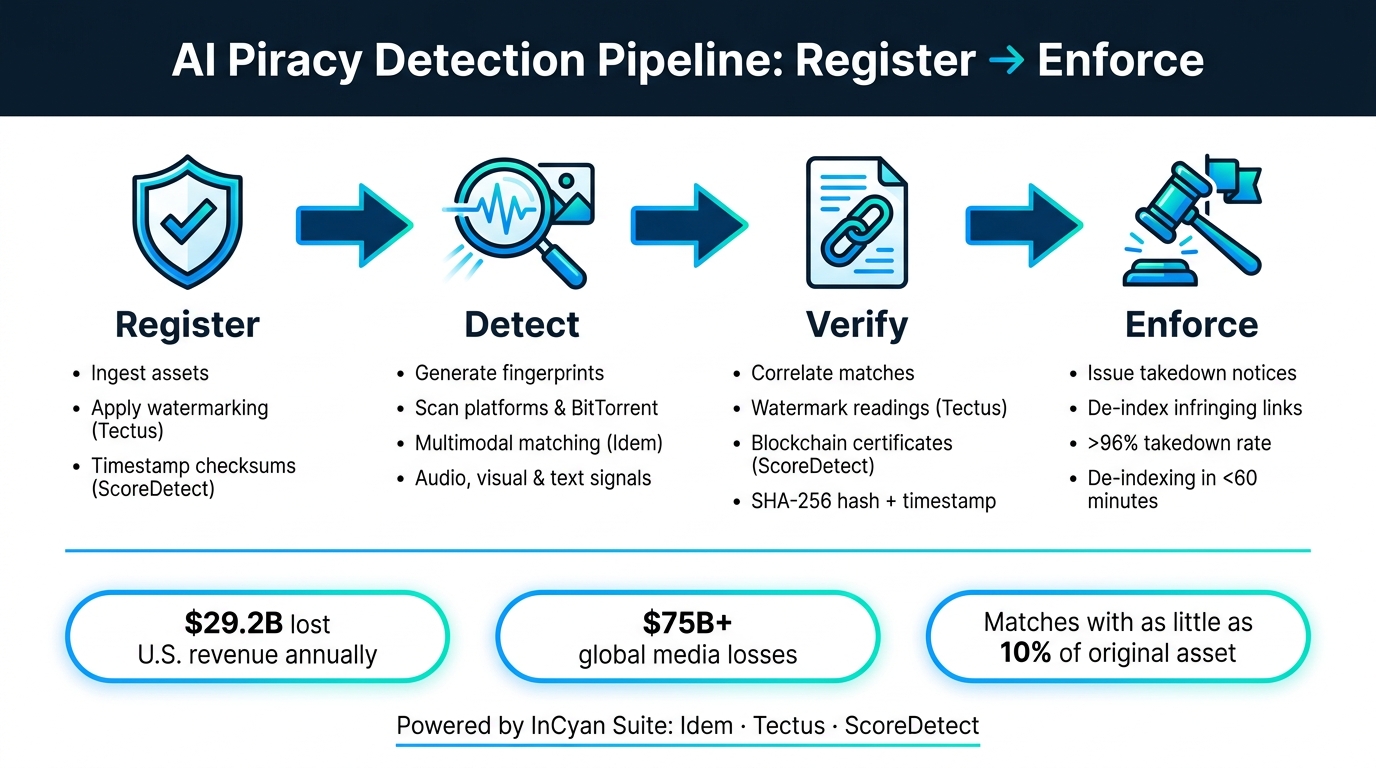
AI Piracy Detection Pipeline: Register to Enforce
Detection can tell you a file is probably a copy. Enforcement is a different game. To act with confidence, you need proof of ownership, a clear evidence trail, and a workflow your team can run again and again. That’s where watermarking and timestamping come in. They turn a likely match into something you can document and use.
How Feature-Based Matching Works with Invisible Watermarking
Feature extraction helps surface likely copies. Invisible watermarking checks provenance on the suspect file itself. In practice, you use it after feature extraction flags a suspicious repost.
InCyan’s Tectus uses blind watermarking, which means it can verify ownership from the suspect file alone. That matters when volume gets high, because teams can validate suspect files without pulling the source asset each time. The watermark survives resizing, format changes, and compression, and the extracted payload can be matched against your rights or ledger system.
When Idem flags a suspicious asset through content matching algorithms, Tectus watermark detection can confirm ownership and help screen out false positives before enforcement starts. That means fewer wrongful takedowns and a stronger position for the cases that do move ahead.
Blockchain Timestamping and Checksum-Based Proof of Ownership
Once ownership is verified on the file itself, timestamping creates the legal record. A blockchain timestamp records a SHA-256 hash of the file and a timestamp on a public blockchain. That gives enforcement teams a dated proof trail for claims involving reposted or altered media.
ScoreDetect is InCyan’s blockchain timestamping product, built around this model. It generates Verification Certificates that include the SHA-256 hash, public blockchain URL, and registration date – without storing the file on-chain. For text-heavy workflows, the ScoreDetect WordPress plugin automatically timestamps every article published or updated, creating verifiable proof of ownership with no manual steps.
These certificates become part of the evidentiary package when issuing takedown notices or pursuing legal action. They sit alongside AI similarity scores and watermark detection reports to show both originality and chronological precedence.
Operational Pipeline: Register, Detect, Verify, and Enforce at Scale
Put together, the process works like a four-step enforcement pipeline.
| Stage | What Happens |
|---|---|
| Register | Ingest assets, apply watermarking, timestamp checksums |
| Detect | Generate fingerprints, scan platforms and BitTorrent sources |
| Verify | Correlate matches with watermark readings and blockchain certificates |
| Enforce | Issue takedown notices, de-index infringing links, monitor ISP blocks |
InCyan’s suite covers each stage. Blueprint and Tectus handle registration and watermarking. Idem, Indago, TorrentWatch, and Txtmatch drive detection. ScoreDetect certificates support verification. On the enforcement side, ScoreDetect automated delisting achieves over 96% takedown rate, Indago handles de-indexing in under 60 minutes, and BlockWatch supports blocking actions.
Automation can also send verified cases straight into ticketing, CRM, or legal systems. So instead of dumping raw alerts on legal and compliance teams, the system delivers structured reports. That cuts manual triage and helps teams spend more time on high-risk cases.
Conclusion: What Businesses Should Prioritize When Using AI for Piracy Prevention
After detection, the bigger issue is simple: which systems can keep working in production. AI feature extraction sits at the center of modern piracy prevention. Basic hashes stop working once content gets edited. And in the wild, infringing copies almost never show up as perfect duplicates. That’s why multimodal matching should be the baseline for protecting media catalogs in the real world.
So the main thing to judge isn’t a vendor’s feature list. It’s whether the system can stand up under pressure. If you need to protect altered media at scale, test every system against four checks: resilience to edits, evidence quality, workflow speed, and scale.
- Resilience to edits means the system can still identify ownership even when only part of the original asset is left.
- Evidence quality means it can produce similarity scores, cryptographic checksums, and audit trails that support DMCA processes and U.S. civil litigation, in a format legal teams can actually read and use.
- Workflow speed means registration, detection, and enforcement happen in minutes, not hours or days.
- Scale means steady accuracy across millions of assets, with links into existing rights management systems.
Vendors should prove accuracy and reliability. Weak matches can create PR, trust, and legal risk.[15]
A strong protection stack combines feature extraction, watermarking solutions, and blockchain timestamping. InCyan’s suite – spanning Idem for multimodal matching, Tectus for blind watermarking, and ScoreDetect for blockchain-based timestamping – uses this model, covering detection through verification through enforcement in a single pipeline. Put those tools into one operating chain: register → timestamp → watermark → monitor → enforce. Once that chain is in place, each enforcement action becomes faster and easier to defend.[14][16]
FAQs
How does AI fingerprinting differ from file hashing?
AI-driven feature extraction looks at the meaningful patterns inside media, not just exact file matches. That includes things like harmonic patterns in audio, motion vectors in video, and visual structure in images.
Why does that matter? Because it can spot content even after someone has changed it. If a file has been altered, cropped, or compressed, this method can still flag it when older tools often miss it.
For broader protection, InCyan also offers tools for multimodal matching, invisible watermarking, search-engine takedowns, and blockchain-based proof of ownership through ScoreDetect.
Can AI still detect pirated media after heavy editing?
Yes. AI-driven feature extraction looks at the meaningful patterns inside a piece of media instead of depending on exact file matches. That means it can still spot the same content even after cropping, re-encoding, or compression.
ScoreDetect, a product of InCyan, supports this by anchoring content checksums on the blockchain, which gives you immutable proof of ownership.
Why do watermarking and blockchain timestamps matter?
AI-driven feature extraction helps stop piracy by identifying the semantic essence of media, not just exact file matches. So even if content is altered, cropped, or compressed, it can still be detected.
InCyan’s broader protection suite pairs watermarking with blockchain timestamps from ScoreDetect. The watermarking helps trace leaks, while the timestamps provide tamper-proof proof of ownership and creation time.