AI fingerprinting helps me track the same content even after it gets clipped, cropped, compressed, filtered, translated, or reposted. Instead of checking file names, metadata, or exact file copies, it turns text, images, audio, and video into math-based signals that stay close even after edits.
Here’s the short version:
- Fingerprinting tells me whether two files come from the same source.
- Watermarking links a file to an owner. These invisible watermarks are designed to resist removal attempts.
- Timestamping shows when the file existed.
- Using all three together gives me a stronger record for review and takedown work.
- Systems like InCyan Idem look across formats and can match content even when only 10% of the original remains.
- Tools like ScoreDetect log a SHA-256 hash and a public blockchain record without storing the file itself.
- For day-to-day use, teams still need human review, written thresholds, saved source files, match reports, and timestamp records.
If I had to boil the article down to one point, it’s this: single-format matching misses too much online, while multimodal fingerprinting gives me a better way to find copied content across platforms and edited formats.
A simple way to think about it:
| Tool | What it does | What it does not do |
|---|---|---|
| Fingerprinting | Matches content by pattern | Prove ownership by itself |
| Watermarking | Ties content to an owner | Find every repost by itself |
| Timestamping | Records when a file existed | Identify copied versions by itself |
So the core idea is simple: match the content, link it to the owner, and keep a dated record. That is what turns raw detection into a usable enforcement workflow.
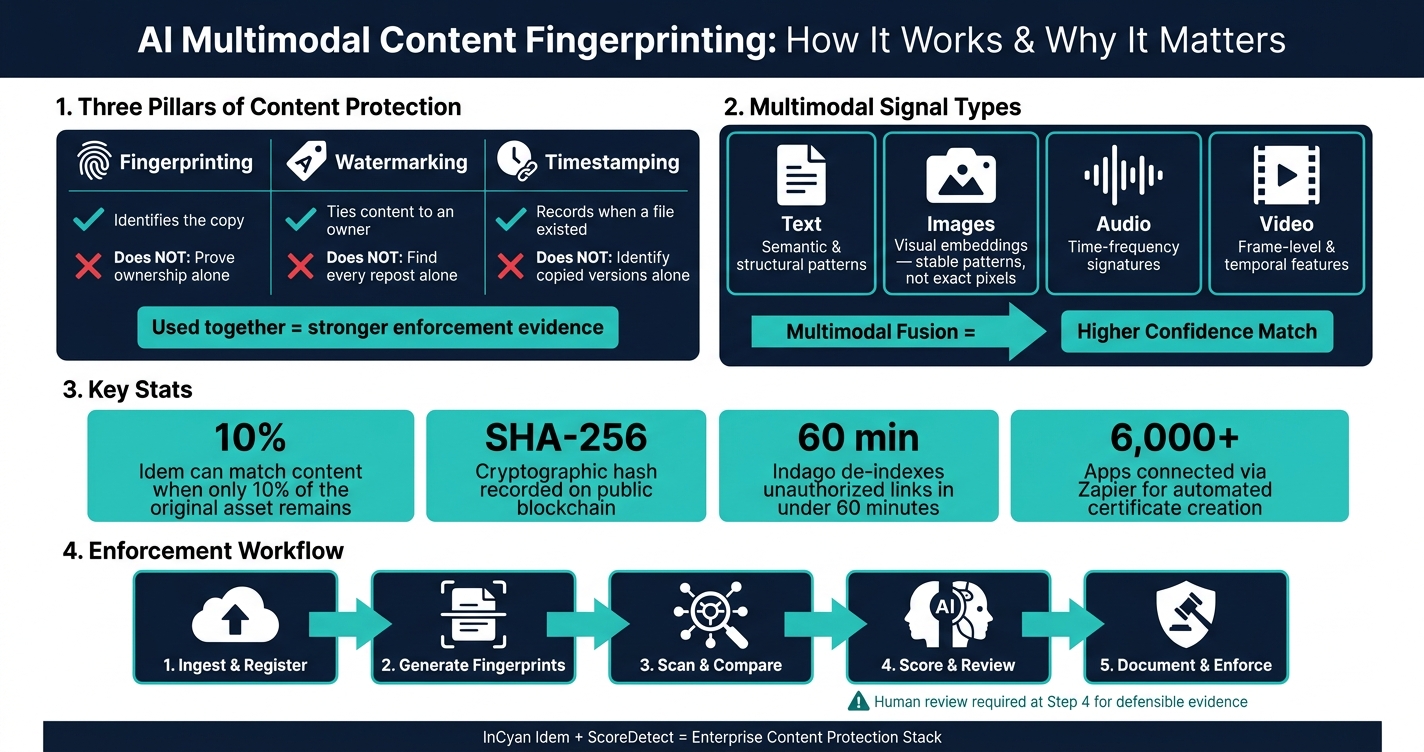
Fingerprinting vs. Watermarking vs. Timestamping: Content Protection Methods Compared
How AI builds and matches multimodal fingerprints
AI doesn’t rely on fixed rules here. It uses models to pull out features from content, which lets it spot the same piece even after common edits or format changes. The focus shifts from the file itself to what the content actually is.
Fingerprint signals across text, images, audio, and video
Each content type leaves behind different kinds of signals, so the system pulls the steadiest ones from each format:
- Text – semantic and structural patterns.
- Images – visual embeddings that capture stable patterns, not exact pixels.
- Audio – time-frequency signatures.
- Video – frame-level and temporal features.
When two or more of these signals line up, multimodal fusion increases confidence. That combined score is what makes cross-platform identification reliable at scale.
How AI stays accurate after cropping, compression, filters, and edits
Edited content can still stay close to the original fingerprint in embedding space. Instead of comparing raw files bit by bit, the AI maps content into embeddings that remain close even after common transformations.
That matters in the messy stuff people do every day: cropping an image, compressing a file, adding a filter, or converting it into another format.
InCyan’s Idem uses multimodal matching to detect modified content across mobile edits, cropping, compression, and format conversion – the applied example of the multimodal method described above.
How large-scale matching works in production systems
In production systems, scale changes the game. The system first uses indexed search to pull candidate matches fast, then gives each one a similarity score across modalities. Those scores are then passed into verification and enforcement workflows.
How multimodal fingerprinting supports cross-platform identification and enforcement
Building fingerprints is only the first step. What matters next is verified enforcement.
A practical workflow from upload to match verification
The workflow is straightforward. The original asset is ingested and registered, and the system generates fingerprints for each content type it contains. Those fingerprints then become the reference set.
After that, the system scans external channels and compares discovered assets against those reference fingerprints. When a candidate match appears, it gets a similarity score across the available modalities. The more those signals line up, the more confidence you have in the match.
Before any action is taken, candidate matches should be checked with multiple signals and human review. AI helps turn raw matches into verified enforcement evidence, which keeps the process defensible at each step. The end result is a documented match record that can support enforcement.
Why fingerprinting, watermarking, and timestamping work better together
These three methods do different jobs, and no single one can do everything alone. Each adds its own layer of proof.
- Fingerprinting identifies the copy.
- Invisible watermarking ties it to an owner.
- Blockchain timestamping shows when the asset existed.
Put them together, and the evidence chain gets stronger. A fingerprint match shows that a copy exists. An embedded watermark from InCyan’s Tectus links that copy back to the original owner without visible marks. A blockchain timestamp from ScoreDetect records a checksum on-chain without storing the file.
When the fingerprint match, the watermark and the timestamp all point to the same asset, the result is easier to verify and document. That gives enforcement teams stronger, more defensible evidence than any one method by itself.
sbb-itb-738ac1e
Where InCyan and ScoreDetect fit in an enterprise protection stack

InCyan provides the tools that turn fingerprinting, watermarking, and timestamping into an enterprise protection workflow. So the stack isn’t just about finding copied content. It’s also about proving what happened and backing enforcement with records you can point to.
Idem for evasion-resistant multimodal matching

Idem is InCyan’s AI-powered multimodal matching engine. It brings the same multimodal signal logic into day-to-day production use. Idem fingerprints images, video, audio, and text, then matches altered copies across platforms.
That matters because copied assets rarely stay in their original form. A photo gets cropped. A video gets compressed. An audio clip gets edited on a phone. A piece of text gets remixed into a meme. Idem can still match content when only 10% of the original asset remains, which means those altered versions can still be traced back to the source. Once a match is found, timestamping and watermarking add more weight to the evidence trail.
ScoreDetect for blockchain timestamping and proof of ownership
ScoreDetect handles proof of ownership. In plain English, it helps show when an asset existed and who owned it at that point in time. It records a cryptographic checksum on-chain without storing the file itself.
The setup is built for daily use, not just one-off checks. The WordPress plugin timestamps each post on publish or update. API and Zapier integrations connect to 6,000+ apps via Zapier for automated certificate creation. Each certificate includes:
- The SHA-256 hash
- A public blockchain URL
- The registration date
- Copyright owner details
Taken together, those records support review, audit, and takedown workflows.
Related InCyan tools for discovery, analysis, and action
Beyond Idem and ScoreDetect, InCyan offers tools that cover the enforcement workflow tied directly to multimodal fingerprinting. Tectus embeds invisible watermarks into images, video, and audio so assets can be marked before they leave your control. Indago focuses on search-engine enforcement by de-indexing unauthorized links in under 60 minutes.
Put it all together, and the stack moves from matching and proof into direct action.
The next challenge is balancing match accuracy, scale, and legal defensibility.
Key implementation and legal considerations
Balancing accuracy, scale, and false-match risk
Once matching is accurate, the next challenge is making sure the result stands up during review and enforcement. That’s where rollout gets tricky.
There’s always a tradeoff between coverage and false positives. Looser thresholds catch more edge cases, but they also bring in more noise. Stricter thresholds cut noise, but they can miss actual infringement. In plain English: if your threshold is too wide, teams waste time reviewing weak matches. If it’s too tight, some copied content slips through.
Model thresholds also shape whether a fingerprint match can serve as usable enforcement evidence. That’s why one score alone isn’t enough. A better approach is to use multiple signals and a tiered review process, instead of treating a single match score like the whole story.
A human-in-the-loop step should stay part of any high-stakes workflow. Teams also need to document how the model is set up, how it is tested and tuned over time, and exactly where human review is required. Use calibrated confidence thresholds and written review rules. Don’t lean on one score and hope for the best.
Privacy, evidence, and U.S. copyright workflow
After a match is verified, the evidence trail needs to stay complete and auditable. In U.S. copyright enforcement, the match itself is only one part of the record.
Teams should keep:
- source files
- fingerprints
- match reports
- timestamp certificates
- clear privacy and data-handling controls
ScoreDetect records a SHA-256 hash and public blockchain proof without storing the original file.
AI match output only becomes usable in practice when it is paired with preserved evidence and ownership records. Fingerprinting identifies the copy. Watermarking ties it to an owner. Timestamping records when it existed. Put together, these methods support legal recordkeeping for internal review and enforcement, with each one adding its own documented layer to the chain of custody.
Conclusion: What AI multimodal fingerprinting solves
AI multimodal fingerprinting closes the gap left by single-format detection by combining text, image, audio, and video signals. That helps teams identify content even after it has been edited, cropped, compressed, or changed in other ways.
The strongest programs pair fingerprinting with watermarking, timestamping, and documented review. That combined stack is what AI multimodal fingerprinting makes possible: stronger match resilience, enterprise-scale coverage, and evidence that can hold up in enforcement.
FAQs
How is multimodal fingerprinting different from basic file matching?
Basic file matching checks whether two files are exactly the same. Multimodal fingerprinting goes a step further. It looks at the content itself across different formats, which helps it spot matches even when a file has been edited or converted.
That makes it a better fit for cross-platform content identification, where the same material can show up in different versions or media types.
Can AI still detect content after heavy edits or partial reposts?
Yes. AI-powered multimodal content fingerprinting can still identify content even after heavy edits or partial reposts because it looks at underlying patterns, not just exact matches.
That matters for cross-platform identification. Content often gets changed along the way. It may be modified, cropped, reformatted, or reposted in part. Even so, this approach can still connect those versions back to the same source with better accuracy.
Why use fingerprinting with watermarking and timestamping?
Using fingerprinting with watermarking and timestamping gives you a stronger way to identify and protect content.
Fingerprinting helps match content across platforms. Watermarking helps trace unauthorized use. And timestamping helps show proof of ownership and creation time.