Most pirated video uploads are edited before they are reposted. That is why plain file hashes fail: they only catch exact copies, while video hashing aims to match the same viewing experience even after crops, trims, re-encoding, screen recording, brightness shifts, or bitrate loss.
If I had to sum up the article in a few lines, it would be this:
- Cryptographic hashes check file sameness
- Perceptual video hashes check visual and motion similarity
- The system works in 3 steps: normalize, extract features, and match
- Good hashing must handle both spatial edits and timing edits
- It works best as part of a stack with watermarking, timestamp records, monitoring, and takedowns
- The business case is simple: fewer missed copies, less manual review, and less revenue loss
A few numbers stand out. One method cited in the article reports 99.2% true positives with a 0.4% false-positive rate under mixed attacks. And the U.S. Chamber of Commerce estimate puts digital video piracy losses at $29.2 billion to $71.0 billion per year in the United States, or about 11% to 24% of industry revenue.
What matters most is this: the goal is not to preserve every pixel. The goal is to preserve identity. So instead of checking whether two files are bit-for-bit equal, the hash looks at stable visual patterns, scene changes, and motion signals that tend to stay in place after common edits.
Here’s the article in plain English:
- First, the video is cleaned up into a standard form, such as common frame rate, size, and luminance view
- Next, the system pulls spatial features from frames and temporal features from motion and scene flow
- Then it turns those signals into short fingerprints and compares them against a reference set
- For long videos, it often hashes by scene or time window so it can find partial reposts, clips, and highlight edits
- To avoid misses and bad matches, the system balances edit tolerance with separation between different videos
- In a rights workflow, the match then feeds proof records, review, and takedown action
I’d frame the core idea like this: SHA-256 tells you whether a file changed. Video hashing tells you whether the video is still the same to a person. That difference is the whole point.
| Topic | Main idea |
|---|---|
| Exact file hashing | Breaks when even 1 bit changes |
| Video hashing | Stays close after common edits |
| Main pipeline | Normalize → feature extraction → matching |
| Main attacks | Crop, blur, filters, frame drops, speed shifts, screen recording |
| Best use | Copy detection tied to proof and enforcement |
So if you want the short answer, here it is: evasion-resilient video hashing works by standardizing a video, reading stable visual and motion signals, and matching compact fingerprints that still line up after common edits. That is what makes it useful for piracy detection and rights enforcement at scale.
What Are The Uses Of Multimedia Fingerprinting? | The Applications Of Multimedia Fingerprinting
sbb-itb-738ac1e
How evasion-resilient video hashing works
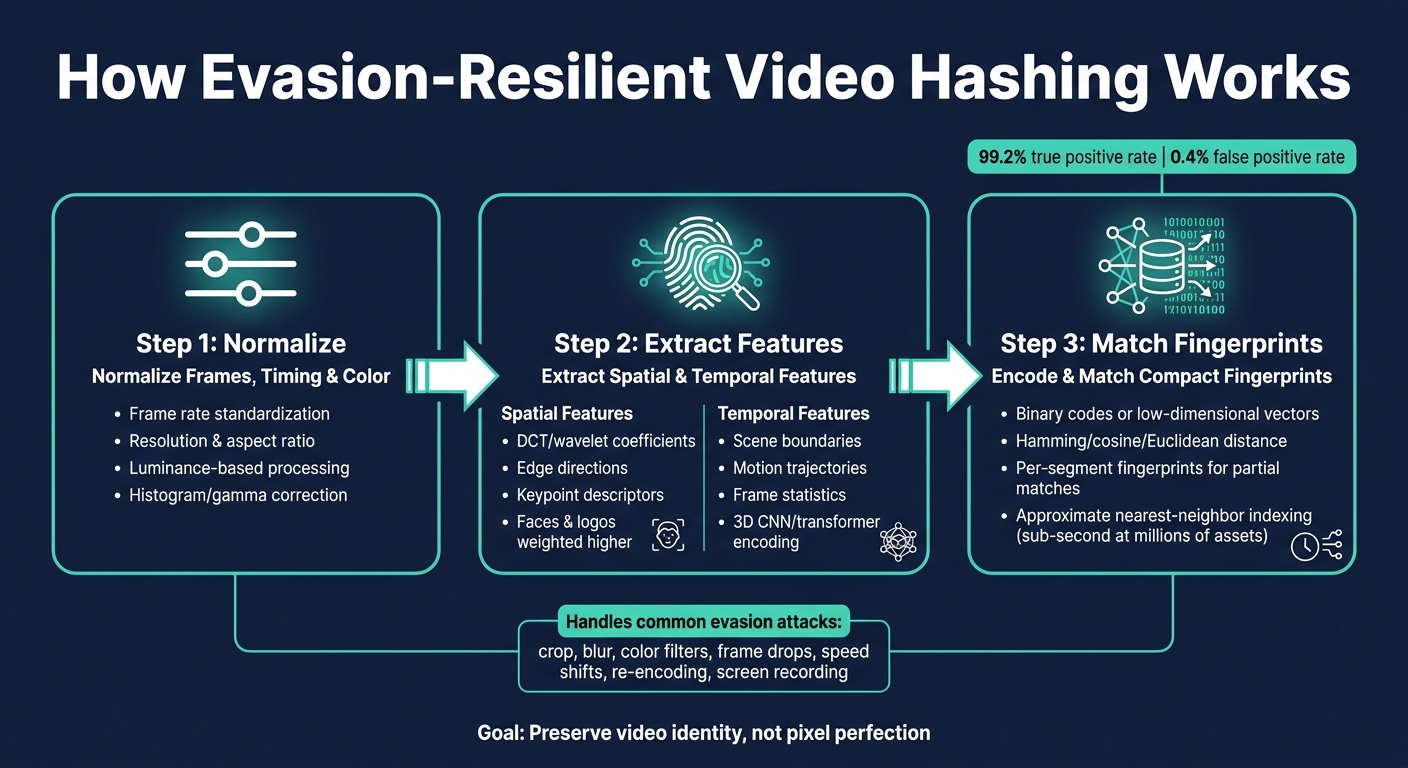
How Evasion-Resilient Video Hashing Works: 3-Step Pipeline
The core pipeline has three stages: normalize the input video, extract stable features, and match compact fingerprints against a reference database. The point isn’t to keep every pixel intact. It’s to keep the video’s identity intact through common edits. The next section shows the kinds of edits these fingerprints are built to handle.
Step 1: Normalize frames, timing, and color data
Before the system pulls features from a video, it standardizes the frame rate, resolution, aspect ratio, and color space. It also works mainly from luminance, which makes the process less sensitive to color grading and filters. On top of that, histogram normalization or gamma correction helps smooth out brightness and contrast changes.
That prep work makes comparisons fairer across different copies of the same video, even when they come from different sources or have been altered along the way. [5]
Step 2: Extract spatial and temporal features that survive common edits
Raw pixels are brittle. Change a filter, crop a frame, or tweak the playback speed, and a pixel-level check can fall apart. That’s the line between content recognition and file integrity checks.
After normalization, the system looks for features that can survive those changes. On the spatial side, that includes low-frequency DCT or wavelet coefficients, block-level edge directions, and local keypoint descriptors that can handle small changes in scale and rotation. Faces, logos, and recurring motifs often get more weight because they tend to remain visible even after heavy edits. [4]
On the temporal side, the system tracks scene boundaries, motion trajectories, and frame statistics grouped across short windows. A speed change or a few inserted frames may alter the surface, but they don’t wipe out the deeper motion pattern or the scene structure. Some systems use 3D CNNs or transformers to encode visual content and motion together. [3]
Step 3: Encode and match compact fingerprints
Once the features are extracted, the system compresses them into short signatures and checks them against a reference database. These signatures usually take the form of binary codes or low-dimensional vectors, then get compared with Hamming, cosine, or Euclidean distance.
For longer videos, the system often creates per-segment fingerprints, such as one per scene or one per fixed time window. That makes it possible to catch partial matches, like highlight reels or short reposted clips. Matching combines similarity scores with temporal overlap checks, and approximate nearest-neighbor indexes let the system compare incoming fingerprints against millions of registered assets in sub-second time. [2][6]
That resilience matters because attackers rarely upload exact copies.
Evasion tactics that video hashing must resist
Common visual and timing edits that break weak fingerprints
After normalization and feature extraction, attackers usually go after the match itself with spatial and timing edits. In video copy detection, these attacks show up again and again: re-encoding and quality reduction, brightness/contrast/gamma changes, noise and blur, geometric transforms, temporal transforms, picture-in-picture and overlay insertion, and camera recordings of a screen.[9][11][12]
Spatial edits change how each frame looks. Cropping, padding, horizontal flips, color filters, hue shifts, contrast changes, logo overlays, and burned-in subtitles can all disrupt visual consistency. That matters because a frame-by-frame hash may drift away from the source even when the underlying video is still the same.
Temporal edits go after the sequence. Frame dropping, speed changes, time shifts, clip shortening, and highlight extraction all introduce timing drift. Once that happens, systems that expect a fixed timestamp-to-timestamp alignment start to fail.
A common evasion chain is simple but effective: crop the frame a bit, add a color filter, change playback speed, then re-encode at a lower bitrate. For a weak fingerprinting system, that can be enough to push the match past its tolerance limit.
This gets to the heart of the problem. A hash has to stay steady under attack, but not so steady that two different videos start looking like the same one.
How resilient designs cut misses and false matches
That tension drives the next design problem: cutting misses without opening the door to false matches.
At the core, the hash has to do two jobs that pull in opposite directions. It needs to remain stable when the same video has been lightly edited. But it also needs to stay separate when two different videos are compared. Lean too far toward stability, and collisions start to show up. Lean too far toward discrimination, and normal re-encoding or compression can trigger false misses.
Research on perceptual hashing makes this trade-off pretty clear. Average Hash (A-Hash) has stronger perceptual robustness but weaker discrimination. Perceptual Hash (P-Hash) lands closer to the middle. SVD-based variants are highly sensitive to manipulation, which helps in tamper detection, but that same sensitivity becomes a problem when the task is matching content that was legitimately re-encoded.[7]
Spatio-temporal hashes deal with this by splitting appearance from motion. If the attack is only spatial, like a crop or rotation, the temporal part of the hash stays almost unchanged. If the attack is only temporal, like frame dropping or a time shift, the spatial part remains steady.[10] So an attacker has to beat both parts at the same time, which is a much taller order. One moment-invariants–based fingerprinting method that models both appearance and motion reports a 99.2% average true positive rate and a 0.4% false positive rate across a broad set of geometric and temporal attacks.[8]
Frame-by-frame hashing is simple, but it’s also the easiest to evade. Spatio-temporal hashing holds up better because it treats appearance and motion as separate signals. Deep learning–based video hashing goes a step further by learning compact codes from both RGB frames and motion, which helps matching under combined edits.
These are the attack patterns strong fingerprints are designed to survive.
How video hashing fits into a content protection workflow
A fingerprint only helps if it plugs into a workflow that can do something with the match. Pirates rarely repost a file as-is. They crop it, trim it, re-encode it, or make other small changes to slip past basic checks. So hashing needs to sit inside a process that can detect, verify, and act. That also means keeping ownership records, watching channels on a continuous basis, saving proof, and automating enforcement where it makes sense. At that point, fingerprinting stops being just a detection method and starts working like an enforcement system.
Detection, evidence, and enforcement in one process
This kind of workflow usually begins by registering the official reference videos, generating a resilient fingerprint, and storing that fingerprint with metadata like the title, creator, rights holder, publication date, and usage permissions [13][4]. From there, detection systems scan suspected copies across the open web, social platforms, and other distribution channels. They then rank possible matches by similarity and risk, check the likely matches, and send confirmed cases into enforcement [1].
But spotting a match isn’t enough on its own. The case also needs to be documented in a way that supports action. A defensible evidence package includes the reference file, fingerprint, suspected copy, match score, source URL, timestamp, and frame-level overlap [14]. If that record is missing, takedowns tend to slow down, and disputes become much harder to prove.
For business teams, the numbers that matter are pretty simple:
- detection speed
- match precision
- false-positive rate
- time to evidence readiness
- time to takedown
- removal success rate
Some fingerprinting systems also support real-time enforcement and automated takedown notices for confirmed matches [14].
Where InCyan and ScoreDetect fit

Each layer does a different job. In practice, this workflow works well alongside nearby protection layers.
InCyan’s Idem handles multimodal matching, Tectus adds invisible watermarking, and ScoreDetect records a blockchain timestamp for ownership proof.
A simple way to think about it: use hashing to find copies, Tectus to embed invisible proof of ownership, and ScoreDetect to timestamp the asset on blockchain. Together, those layers give rights holders a layered defense: hashing for discovery, watermarking for embedded ownership signals, and blockchain timestamping for a verifiable, tamper-resistant record.
Conclusion: Key takeaways for businesses
Evasion-resilient video hashing is built to spot altered copies, not just exact duplicates. That matters because the same video often gets changed before it’s reposted – compressed, cropped, re-encoded, or tweaked with brightness changes. By looking at stable spatial and temporal patterns, hashing can still recognize that it’s the same asset. A U.S. Chamber of Commerce study estimated that digital video piracy cuts U.S. content and distribution revenue by $29.2 billion to $71.0 billion per year – about 11% to 24% of industry revenue.[15]
In practice, hashing works best as one part of a broader protection stack. Each layer has a different job.
Invisible watermarking – such as what InCyan’s Tectus provides – embeds a hidden proof of ownership into the content. Blockchain timestamping through ScoreDetect creates a verifiable record showing when an asset existed, which helps support evidentiary documentation if a dispute comes up.
Here’s a simple way to look at that stack:
| Protection layer | Primary job | Business benefit |
|---|---|---|
| Resilient video hashing | Find altered copies | Fewer missed infringements |
| Invisible watermarking | Embed traceable ownership signal | Source attribution and leak tracing |
| Blockchain timestamping | Prove an asset existed at a specific time | Stronger evidentiary record |
| Monitoring & takedowns | Locate and remove infringing content | Faster resolution, reduced revenue loss |
For businesses, the payoff is pretty clear: faster detection, stronger evidence, and quicker takedowns. That applies whether you’re protecting training content, licensed media, demos, or ads. Monitoring, evidence capture, and takedowns are what turn a fingerprint match into a resolved case. For teams distributing video at scale, speed is the edge.
FAQs
How is video hashing different from SHA-256?
Evasion-resilient video hashing builds a structural signature from the video itself, using signals like motion, scene changes, and frame-level details, instead of hashing the file as-is.
That matters because it looks at content, not raw binary data. So it can still match a video even after edits like cropping, re-encoding, compression, or speed changes.
By contrast, SHA-256 hashes the exact file. Change even a small part of that file, and you get a different hash.
Can video hashing detect short clips or partial reposts?
Yes. Evasion-resilient video hashing looks at the actual video signal, not file metadata, to make compact fingerprints based on visual and structural patterns that tend to stick around.
Because those fingerprints come from the content itself, they can still match short clips or partial reposts – even after edits like cropping, compression, re-encoding, speed changes, or color grading.
What edits can evasion-resilient video hashing survive?
Evasion-resilient video hashing, sometimes called temporal fingerprinting, identifies a video by looking at patterns like motion, scene changes, and frame-level details instead of relying on fragile file hashes. That matters because file hashes break the moment a video is edited. Temporal fingerprinting can still spot the same content after changes like cropping, re-encoding, compression, or speed shifts.
For added protection, these fingerprints can be combined with invisible watermarking and blockchain-based timestamping. That mix can help trace leaks and verify ownership.