The best alternatives in 2026 are the tools that can find copied media, match altered files, prove ownership, and send takedown notices across images, video, audio, documents, and text.
If I cut through the sales talk, the article points to a simple split: some platforms focus on proof, some on detection, and some on copyright infringement solutions for removal. The strongest options are the ones that connect all three, because spotting a copied file is only part of the job.
Here’s the short version:
- ScoreDetect / InCyan: strongest for all-in-one proof, matching, and takedown flow
- Corsearch: strongest for managed enforcement with human review
- MarqVision: strong for social, UGC, and platform takedowns
- MUSO: strong for film, TV, music, and piracy tracking
- Digimarc Guardian: best when files are watermarked before release
- Audible Magic: best for platform-side audio/video upload checks
- Pixsy: best for still-image claims and recovery
A few numbers stand out right away: one vendor says manual review catches only 5% of infringements, another tracks 750,000 piracy sites, and another scans 1,500+ channels. That tells me the main issue in 2026 is scale. If your team is still working link by link, you will miss most of the problem.
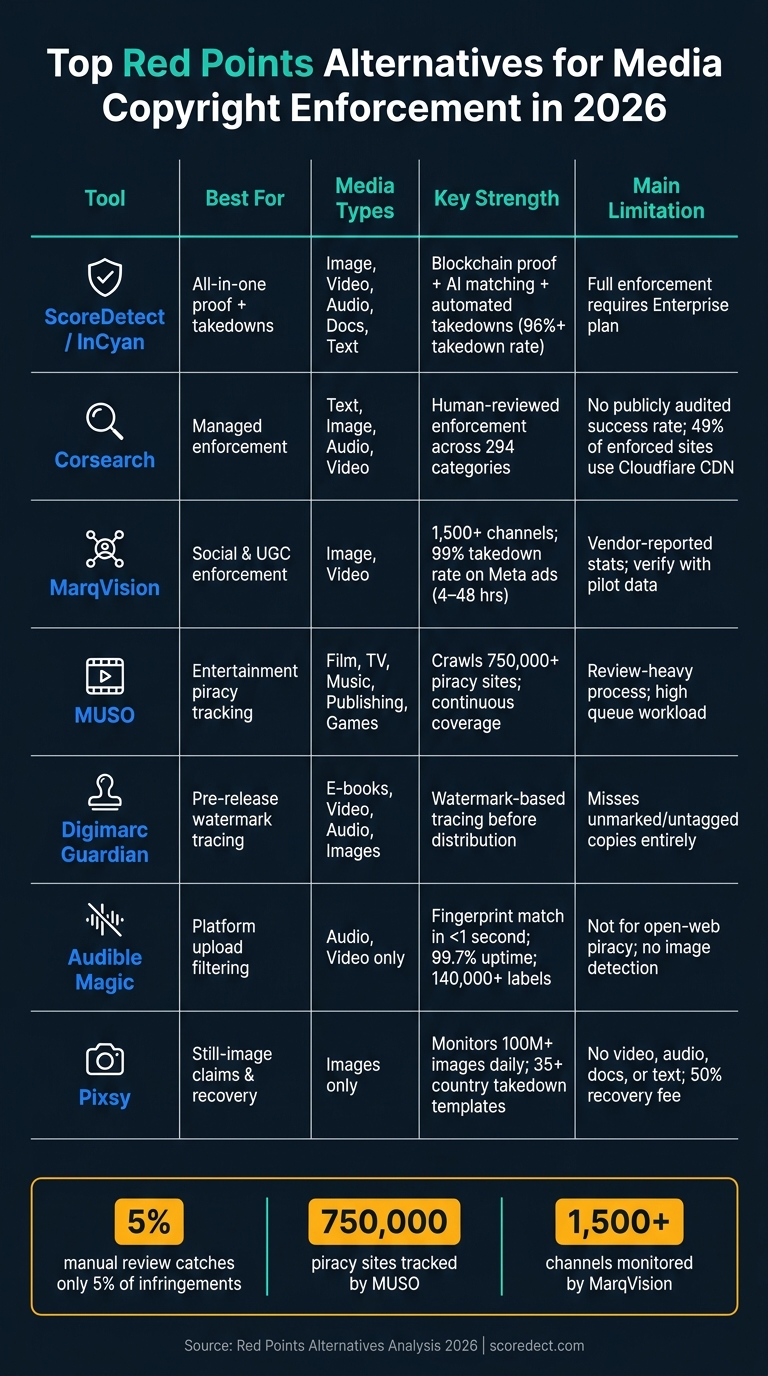
Top Red Points Alternatives for Media Copyright Enforcement in 2026
Quick Comparison
| Tool | Best for | Main media types | Best at | Main limit |
|---|---|---|---|---|
| ScoreDetect | Ownership proof + takedowns | Image, video, audio, docs, text | Blockchain proof, AI matching, takedowns | Full enforcement is on Enterprise |
| Corsearch | Managed enforcement | Text, image, audio, video | Human-reviewed enforcement | Ask for pilot data and report samples |
| MarqVision | Social and UGC enforcement | Image, video | Channel coverage, Meta/YouTube workflows | Check channel-by-channel removal data |
| MUSO | Entertainment piracy | Film, TV, music, publishing, games | Crawl coverage and piracy reporting | Review-heavy process |
| Digimarc Guardian | Pre-release watermark tracing | E-books, video, audio, images | Watermark-based tracing | Misses unmarked copies |
| Audible Magic | Platform upload filtering | Audio, video | In-platform fingerprint matching | Not for open-web piracy |
| Pixsy | Still-image claims | Images only | Image match + claim recovery | No video, audio, docs, or text |
So if I were narrowing the field fast, I’d group the choices like this:
- Pick ScoreDetect / InCyan if you want one system for proof + search + takedowns
- Pick Corsearch or MarqVision if you want more managed enforcement
- Pick MUSO if piracy sites and search results are the main pain point
- Pick Digimarc if your process starts before release
- Pick Audible Magic if you run or work with upload platforms
- Pick Pixsy if you only care about still images
The rest of the article breaks down where each option fits, what each one misses, and what to test before you sign a contract.
sbb-itb-738ac1e
1. ScoreDetect
ScoreDetect, built by InCyan, mixes blockchain proof, content matching, and takedown workflows in one setup. It works with images, video, audio, documents, and text, which makes it a fit for media rights holders dealing with more than one asset type.
Evidence and Attribution
ScoreDetect uses blockchain timestamping. It creates a SHA-256 checksum and records that checksum on a public blockchain without storing the actual file. Each registration creates a Verification Certificate with the copyright owner name, registration date, blockchain URL, and a signature from ScoreDetect Limited. It also includes a recognition letter that explains the timestamping process to authorities or organizations.
Discovery and Matching
After ownership is recorded, ScoreDetect moves into monitoring and identification. On the Enterprise plan, it uses AI web scraping to look for unauthorized use across the web. InCyan’s Idem handles multimodal matching across images, video, and audio, and it can spot reused content even after cropping, compression, or re-encoding. Idem Text adds forensic matching for text-based content. Indago de-indexes infringing links fast, which cuts referral traffic.
Enforcement Workflows
How far the workflow goes depends on the plan. Enterprise can generate automated delisting notices and reports takedown rates above 96%. It also connects with 6,000+ apps through Zapier, so teams can plug enforcement actions into current workflows without custom development.
| Plan | Starting Price | Key Enforcement Features |
|---|---|---|
| Pro | $11.31/month (annual) | Blockchain timestamping, certificates, Zapier, API |
| Enterprise | Custom | Invisible watermarking, AI web scraping, automated takedowns, 24/7 monitoring |
The split between plans is pretty simple. Pro focuses on proof of ownership. Enterprise adds monitoring and takedowns.
2. Corsearch
Corsearch is aimed at teams that want a managed enforcement desk, not just a monitoring tool. Instead of handing you software and leaving the rest to your team, it leans into hands-on takedowns. Corsearch provides managed copyright enforcement for media and publishing rights holders across text, image, audio, and video.[1]
Discovery and Matching
Corsearch uses AI-driven matching to spot infringement across different content types. Its system combines semantic search, image recognition, OCR, logo detection, and detecting unauthorized use of copyrighted images to find content even when it has been cropped, rotated, filtered, or changed in other ways.[3][4][6]
That matters because piracy rarely shows up in a neat, untouched form. A copied image might be trimmed at the edges. A video thumbnail might get a filter. Text might be reposted with light edits. Corsearch is built to catch those kinds of altered copies.
It can also connect related infringers across accounts and platforms, which helps teams spot coordinated piracy networks instead of chasing one-off links one by one.[2] Its 2025 Zeal 2.0 platform classifies findings across more than 294 categories, with median qualification in seconds.[7] In plain English: it sorts and qualifies findings fast, which helps cut false positives before notices go out.
Evidence and Attribution
Before enforcement starts, Corsearch verifies infringement and avoids decoy links.[1] That extra check can save time, especially when bad links are meant to waste an enforcement team’s effort.
That said, buyers should ask for a sample report before signing off. You’ll want to confirm that the evidence includes the fields your team needs for DMCA notices, platform appeals, and litigation support.[1]
Enforcement Workflows
Once Corsearch verifies infringement, enforcement moves through a mix of automated notices, human review, and platform API integrations.[1][6] That blend matters. Automation helps with scale, while human review adds a layer of judgment before action is taken.
Corsearch’s own research found that 49% of websites it enforced for content piracy used Cloudflare’s CDN.[5] That’s a useful signal. If a large share of infringing sites sit behind a CDN, search demotion may matter just as much as host-level removal.
There’s one catch: no independently audited success rate appears in public materials.[4][7] So if you’re weighing this vendor, don’t just rely on marketing language. Ask for pilot data based on your own assets, including:
- Platform-level removal rates
- Median time to removal
- False-positive rates
That kind of pilot can tell you a lot more than a sales deck ever will.
3. MarqVision
MarqVision is an AI-driven media monitoring and enforcement platform that tracks image, video, and UGC infringement across 1,500+ channels, including social media, websites, marketplaces, and streaming services.[8][11] That makes it useful for multi-format media enforcement, not just marketplace listings. For media rights holders, the big issue isn’t only detection. It’s knowing which channels can support direct removal.
Discovery and Matching
MarqVision uses AI image recognition and semantic analysis to find both visual reuse and misuse tied to context.[11] That means it’s not just looking for copied media files. It’s also trying to spot cases where content shows up in the wrong setting or with the wrong message.
Its YouTube ECMT partnership adds support for repeat-upload blocking and bulk takedowns for qualifying customers.[9][13] That can matter a lot for studios, sports rights holders, and subscription video services, where one clip can pop up again and again across linked accounts.
Evidence and Attribution
Once infringement is found, the next step is simple: can the platform package the proof well enough for takedown action? MarqVision uses generative AI to draft notices and evidence packets.[12] It also builds an evidence trail that includes the URL, matched asset, platform, and enforcement status.
That said, legal review still matters, especially when ownership or fair-use disputes come into play. Before relying on automated attribution, check that each alert includes:
- The original reference asset
- The match rationale
- The timestamp
- The infringing URL
- The account or seller identity
- Copies of submitted notices
If those details are missing, the case can get shaky fast.
Enforcement Workflows
That evidence chain only matters if it leads to fast, channel-specific removal. MarqVision says its YouTube ECMT setup can support real-time removal workflows, block repeat uploads before publication, and carry out bulk takedowns across infringer networks.[9]
The company also reports a 99% takedown rate on Meta ads as a Meta Trusted Reporting partner, and says successful requests usually take 4–48 hours depending on the platform.[10][14] Those numbers come from the vendor, not from independent audits, so buyers should ask for platform-specific breakdowns, sample sizes, and false-positive rates based on their own content categories.
4. MUSO
MUSO is a continuous anti-piracy service for film and television, music, publishing, gaming, software, authors, and independent creators. It covers piracy websites, torrent indexes, cyberlockers, streaming sites, direct-download sites, search engines, social platforms, and user-generated-content sites.[15][17][18]
That broad reach matters. If infringement is spread across many channels and search results, instead of sitting in one obvious place, MUSO can be a strong option.
For teams dealing with piracy across a lot of sources, the main draw is simple: continuous crawl coverage paired with verified matches.
Discovery and Matching
MUSO takes in catalog metadata, including CSV files and industry formats such as DDEX, and then crawls piracy domains and other distribution sources for possible matches. Its validated database covers about 750,000 piracy sites, and piracy-expert review checks partial or altered matches before any notice goes out.[17][19][23][16]
That review step is a big deal. A match isn’t just pushed through on autopilot. If a file has been changed, clipped, or renamed, human review helps sort out what’s legit before enforcement starts.
Evidence and Attribution
MUSO’s centralized dashboard tracks infringement URLs, source classification, notice status, and removal outcomes. That gives rights holders a live view of activity and takedowns by title and region. Public product materials confirm reporting and status tracking, but procurement teams should ask for sample case records that include page captures, timestamps, matched asset metadata, and notice history to check evidence exports and chain-of-custody details.[17][21]
In plain English: the dashboard may look good, but buyers should still ask to see the paper trail. They should confirm that each record shows what was found, when it was found, what it matched to, and what happened next.
Enforcement Workflows
Once MUSO verifies a match, it moves into notice and delisting workflows. The process runs from ingestion to discovery, verification, notice, and removal tracking. MUSO advertises unlimited takedowns, and rights holders can also submit infringing URLs manually through a Submit Infringement tool when the crawler misses a link. For sites that ignore notices, Google search delisting is part of the workflow.[16][17][21][15][22][20]
MUSO also shows where piracy demand is concentrated and how it shifts by region. That can help teams decide where to focus first across the detect, prove, and remove chain.
5. Digimarc Guardian
Digimarc Guardian adds an imperceptible watermark to a file before it goes out into the world, then uses that ID to trace later copies back to the original asset or release event. In plain English: it works best when you can stamp the file before release.
Media Coverage
Guardian’s clearest, best-documented use case is e-books and publishing, with confirmed support for EPUB, PDF, and MOBI formats.[26] Digimarc also describes hidden-signal protection for video, audio, images, and screens.[25][28]
That said, format support can get a little fuzzy once you move from "can detect" to the full service path. If your catalog includes more than one media type, get written confirmation on which formats include the complete workflow:
- watermarking
- crawling
- human review
- takedown handling
- reporting
Once a file is out in circulation, the watermark becomes the main link between that copy and the original record.
Discovery and Matching
Guardian continuously scans for watermarked copies and matches the detected ID against transaction or distribution records.[26][27] That’s the core of the system.
But there’s a catch. Unmarked screenshots, excerpts, or copied portions still need another matching method. So if infringement often shows up as clipped passages, cropped images, or screen captures, watermark detection alone won’t cover the whole problem.
Evidence and Attribution
The watermark carries an anonymous ID, which means attribution depends on the rights holder’s own records.[26] The watermark points to a trail, but your records still have to finish the story.
A solid evidence package should include the original asset, ownership records, the watermark ID, detection timestamp, infringing URL, a captured page or file, and the chain linking the identifier to the authorized distribution event. A two-step human review process can help cut false positives before notices go out.[24]
Enforcement Workflows
Once a match is verified, the process shifts from proof to removal. After review, Guardian sends host-level notices and search-engine delisting requests to Google, Yahoo, and Bing, covering a large share of global search traffic.[24]
Published figures can sound promising, but buyers should ask for current metrics tied to their own catalog, geography, and media type before treating those numbers as a forecast.
6. Audible Magic
Where web crawlers hunt for piracy across the open web, Audible Magic works inside upload and streaming systems. It checks audio and video fingerprints from uploaded or streamed files against a registry of content from 140,000+ labels and publishers across 150+ territories, then sends back a policy decision to the host platform.[29][36]
Media Coverage
Audible Magic is built for audio and video only. That makes it a strong fit for music labels, broadcasters, sports rights holders, and platforms that need content recognition in controlled systems.[29][32][35]
Discovery and Matching
The platform uses perceptual digital fingerprinting. In plain English, it analyzes the audio or video itself instead of relying on filenames or metadata.[33] That means it can still match re-encodes and reposts.
The company says searches can finish in one second or less on files as short as five seconds.[37] It also reports greater than 99.7% uptime.[34] Since these numbers come from the company, buyers should test match accuracy and false-positive rates against their own catalog before relying on them.
Evidence and Attribution
A fingerprint match creates an internal record, but that alone is not enough for enforcement. Rights holders still need their own proof set. The match response can be logged for reporting and workflow automation, but an enforcement case still needs the URL, uploader data, timestamp, territory, ownership records, and a copy or hash of the material.[29]
Enforcement Workflows
The main limit here is scope: the host platform applies the rule, not the vendor.[29][30] So this tool works best when enforcement happens inside partner services through upload filtering, pre-release scanning, or real-time monitoring of live streams.[31][35] It is not the main tool for open-web piracy on third-party sites.
7. Pixsy
Pixsy is a still-image enforcement platform built for photographers, visual artists, and agencies who need specialized image-rights protection. It does not cover video, audio, documents, or text.[43][44] That narrow scope makes Pixsy a strong fit for image-only programs that need proof, takedowns, and optional recovery. If you need protection across many asset types, though, it won’t serve as a full stack on its own.
Media Coverage
Pixsy covers still images only and monitors the public web. That makes it a strong specialist tool for photography studios, stock agencies, and publishers. For teams trying to protect a mix of asset types, it’s a more limited standalone choice.[38][43][44]
Discovery and Matching
For image teams, speed matters. A copied image only helps if you can tie it back to the original file fast enough to act on it.
Pixsy uses reverse-image search and AI-assisted matching to scan for where uploaded images appear online. You upload a portfolio, review matches, and then approve enforcement. Coverage is limited to public web content. Private groups, closed platforms, encrypted services, and some marketplaces still need separate monitoring.[38][45]
Pixsy says it monitors more than 100 million images daily, although that number is company-reported and not independently audited.[42]
Evidence and Attribution
When Pixsy finds a match, it builds a case file with the infringing URL, source domain, discovery date, screenshots, image-match details, and infringing account or business information.[42][44] That gives rights holders a clear record to review before taking the next step.
Pixsy also supports image registration with the U.S. Copyright Office to document ownership before escalation.[41][44] Even so, original files, licensing records, chain of title, and screenshots should still be stored separately on your side.
Enforcement Workflows
Pixsy offers both takedowns and compensation claims. Its takedown templates cover more than 35 countries and are translated into 14 languages.[39]
For compensation claims, there’s no upfront fee. Pixsy keeps 50% of recovered amounts.[39][40] It also says it works with a global network of 26 law firms and legal partners.[42] That no-upfront model is easy to start with, but a 50% success fee can cut deeply into net recovery on high-volume or high-value claims.
Plan limits scale based on image count and monthly notices.
| Plan | Monthly price | Images monitored | Takedown notices/month |
|---|---|---|---|
| Free | $0 | 500 | None included |
| Paid tier 1 | $19 | 2,000 | 20 |
| Paid tier 2 | $39 | 30,000 | 300 |
| Not listed | Not shown | 100,000 | 900 |
8. InCyan Specialist Services
InCyan offers a modular specialist-services stack for proof, discovery, and takedown work across images, video, audio, text, and documents. That setup matters most when proof, monitoring, and takedown need to run as separate layers instead of being bundled into one system.
Media Coverage
Tectus handles invisible watermarking for images, video, and audio. Idem and Idem Text extend matching to multimodal and text-only cases.
Discovery and Matching
Indago is InCyan’s search-delisting platform. It goes after unauthorized content indexed by search engines and is built to de-index infringing links in under 60 minutes. Idem adds AI-powered matching that can detect content even when only 10% of the original asset remains. That includes cropped, compressed, mobile-edited versions, and meme edits.
TorrentWatch pushes discovery into the BitTorrent ecosystem by monitoring unauthorized distribution in real time. So the platform isn’t just looking at search results. It’s also tracking how content moves across file-sharing channels.
Evidence and Attribution
Tectus uses invisible watermarking to embed ownership proof directly into an asset without visible marks. That adds a forensic ownership layer for infringement verification.
Once a match is found, the next step is proving ownership cleanly. That’s where this layer does its job.
Enforcement Workflows
For enterprise teams, InCyan offers automated takedown systems alongside rights and royalty tracking to support enforcement at scale. This setup works best when teams need separate layers for proof, discovery, and delisting.
Strengths, Trade-Offs, and Fit by Use Case
The tables below help line up each tool with the part of the enforcement chain it handles best. The first table looks at best fit, deployment model, and the main holes you may still need to cover.
| Solution | Strongest Fit | Major Limitation | Deployment Model | Enforcement Gaps |
|---|---|---|---|---|
| ScoreDetect | Blockchain proof and ownership verification | Enterprise plan required for monitoring and takedowns | SaaS | Marketplace-specific listing workflows |
| InCyan suite | Multi-format proof, discovery, and takedown stack | Best suited to teams that want one stack | SaaS with enterprise services | Marketplace listings |
| Corsearch | Evidence-ready brand and content enforcement | Complex rights setup required before enforcement begins | Mixed (API + platform) | Human review for borderline matches |
| MUSO | Film, TV, and music piracy discovery and measurement | Rules tuning is time-intensive; high review queue workload | Managed service + platform | Human review for borderline matches |
| Digimarc | Persistent asset tracking via imperceptible watermarks | Requires proactive watermarking before distribution | Mixed (embedder + API) | Discovery for non-watermarked files |
| Audible Magic | Real-time platform-side audio and video identification | No image or logo detection; limited to platform integrations | Platform (SDK/API) | Marketplace monitoring and image enforcement |
| Pixsy | Image revenue recovery through a legal network | Post-publication only; detection can be slow | Managed service | Pre-publication screening |
A couple of pricing notes help put this into context. Digimarc enterprise licensing usually starts at $50,000 per year, while Pixsy offers free monitoring and takes a 50% recovery fee [46].
The next table maps the same tools across the enforcement chain, from prevention all the way to measurement. This is useful because a tool can be strong in one layer and weak in another. In plain English: some tools help you stop misuse early, while others are better at proving it happened or cleaning it up after the fact.
| Stage | ScoreDetect + InCyan | Corsearch | MUSO | Digimarc | Audible Magic | Pixsy |
|---|---|---|---|---|---|---|
| Prevent | High (invisible watermarking) | Low | Low | High (watermarking) | Medium | Low |
| Discover | High (AI web scraping) | High | High | Medium | Medium | Medium |
| Match | High (AI matching) | High | High | High | High | High |
| Prove | High (blockchain verification) | High | High | High | Medium | Medium |
| Enforce | High (automated takedown workflows) | High | Medium | Low | Medium | Medium |
| Measure | Medium | Medium | High | High | Medium | Low |
A simple way to read this:
- ScoreDetect + InCyan stand out when you want broad coverage across proof, discovery, matching, and takedowns.
- Corsearch is strong for enforcement, but setup can take work before the system is ready to act.
- MUSO leans hard into piracy discovery and measurement, which makes sense for media-heavy teams.
- Digimarc is strongest when watermarking happens before files go out.
- Audible Magic fits platform-side audio and video checks, not image-heavy enforcement.
- Pixsy is more about recovery after image misuse has already happened.
That split matters. If your main problem is proving ownership, one set of tools makes more sense. If the pain point is marketplace cleanup, or platform-side media filtering, the better fit can look very different.
Conclusion
The right enforcement tool depends on where your process breaks down most: prevention, discovery, proof, or removal. Start there. Once you know the weak spot, it becomes much easier to match a tool to the job it actually needs to do.
After that, the best choice comes down to what matters most in your workflow: proof, monitoring, or removal. ScoreDetect stands out when you want one connected system that brings together invisible watermarking, web-scraping discovery, blockchain timestamping, and automated delisting notices. InCyan specialist services make more sense when you need a specific module rather than an all-in-one setup. If your enforcement work crosses into trademark issues or marketplace abuse, Corsearch and MarqVision are the main options worth checking. MUSO fits entertainment piracy intelligence. Digimarc Guardian is best used as a watermark-focused tracing layer. Audible Magic works for platform operators that need to screen uploads. Pixsy fits image-first agencies that want to pursue recovery.
Before you set a budget or sign anything, sort every claim into one of three buckets: documented, vendor-stated, or unverified. Then get the details confirmed in writing, including supported asset types, coverage, evidence format, pricing, and contract terms. For U.S. operations, spell out notice duties, response times, escalation paths, retention, security, and evidence ownership before the pilot starts. Then run a controlled pilot using a representative sample of high-value assets, and track discovery rate, true-positive rate, time to removal, and repeat-infringer rate. The tool that earns the deal is the one that can prove infringement and get it taken down, not just spot it.
FAQs
How should I choose between proof, detection, and takedowns?
Don’t pick just one. Proof, detection, and takedowns work best when they’re tied together in one enforcement workflow.
Start with proof before content goes live. Then use detection to watch for unauthorized copies. Check matches before taking action so you don’t over-enforce, then trigger automated takedown or search de-indexing workflows.
What should I test in a pilot before signing a contract?
Before you sign, run a pilot.
The goal is simple: see how the vendor performs in your setup, not in a polished demo. A sales deck can look great. Your actual channels, regions, and content mix are what matter.
Use the pilot to test:
- Detection coverage across your real channels, regions, and content types
- Accuracy on the edits you expect to see, like crops, resizing, re-encoding, filters, compression, partial clips, and low-match content
- End-to-end timing from discovery to verification, notice, and delisting
- Evidence quality, service levels, takedown durability, and who owns the data and evidence if you switch vendors
That last point matters more than it may seem. If you ever move to another provider, you don’t want your case history, proof files, or enforcement records stuck behind the old one.
Which tool fits mixed media types vs. image-only or platform-only needs?
For teams that need protection across mixed media types, InCyan is the best fit.
Its Idem engine can match images, video, audio, and text, even when files have been altered, cropped, or compressed. That matters in practice. A clipped image, a recompressed video, or an edited audio file can still be traced back to the source instead of slipping through the cracks.
Its modular setup also brings together tools like Tectus for invisible watermarking and Indago for search-based de-indexing. Put simply, you’re not stuck with a one-lane system. You get matching, watermarking, and removal support in one setup.
Image-only or single-channel platforms don’t offer the same multimodal forensic capability.