Pick the proof-first platform if you need watermark tracing, blockchain-certified file ownership records, and channel checks; pick the enforcement-first platform if you need removal across marketplaces, apps, domains, and 2.7 billion monthly data points.
I’d sum it up like this: one tool is built to prove who owns the file and trace copies back to the source; the other is built to find more infringements and remove them in bulk. If your team reports to legal, I’d lean toward the first. If your team reports on takedown volume and URL removal, I’d lean toward the second.
Here’s the short version:
- Best for proof and tracing: watermarking, blockchain timestamps, source tracking, ISP and torrent checks
- Best for scale and removals: broad monitoring, high-volume notices, marketplace and social media enforcement
- Best for legal support: proof tied to the original file
- Best for large queues: automation and repeat-offender handling
- Standout stat: one platform says it processes 2.7 billion data points per month and has removed 300 million+ infringing URLs from search results
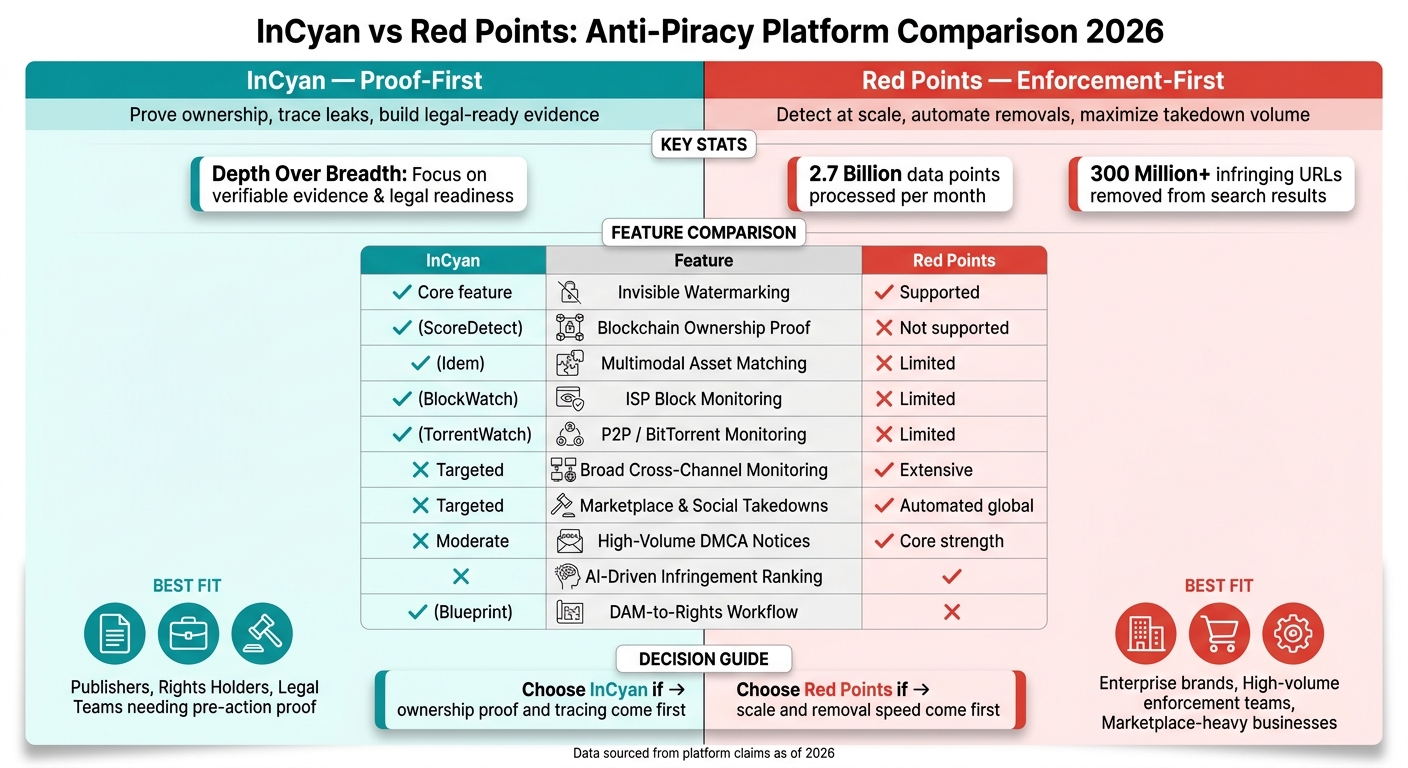
InCyan vs Red Points: Proof-First vs Enforcement-First Anti-Piracy (2026)
Quick Comparison
| What you need | Better choice |
|---|---|
| Ownership proof before action | InCyan |
| Invisible watermarking | InCyan |
| Trace a leaked asset back to the source | InCyan |
| Search, ISP, and BitTorrent checks | InCyan |
| Broad cross-channel monitoring | Red Points |
| Marketplace and social takedowns | Red Points |
| High-volume DMCA-style removal work | Red Points |
| Fast action across many listings and URLs | Red Points |
I’ll keep the rest focused on that one split: proof-first versus enforcement-first.
sbb-itb-738ac1e
InCyan vs. Red Points: side-by-side overview
InCyan and Red Points tackle different anti-piracy jobs. InCyan leans into proof of ownership and tracing. Red Points leans into broad detection and fast removal. That difference shows up across the anti-piracy tasks most teams care about.
InCyan puts the focus on ownership proof, invisible watermarking, and multi-signal matching. Its blockchain-backed trust markers help trace an asset from the original file to an infringing copy. Red Points is built for scale and removal speed. Its AI models process more than 2.7 billion data points each month, and the platform has helped remove over 300 million infringing URLs from search engine results.[1]
Quick comparison table by core anti-piracy need
| Anti-Piracy Need | InCyan | Red Points |
|---|---|---|
| Invisible watermarking | Supported; used to strengthen asset tracing and creator verification | Supported |
| Blockchain ownership proof | Supported via blockchain-backed trust markers | Not supported |
| Monitoring scope | Targeted discovery through deep integrations | Broad monitoring across marketplaces, social media, paid ads, and mobile apps |
| Evidence / matching method | Blockchain-backed proof and multi-signal matching | AI image recognition and evidence-based listing analysis |
| Automated takedowns | Automated delisting notices | High-volume takedown automation |
| Search engine delisting | Supported | Core feature; high-volume capability |
| Website & hosting enforcement | Supported | Supported |
| ISP-block monitoring | Supported via BlockWatch | Limited emphasis |
| P2P / torrent monitoring | Supported via TorrentWatch | Limited emphasis |
| Best fit | Publishers and rights holders | Enterprise teams |
That split stands out even more when you look at the workflow step by step: prevention, discovery, validation, and takedown.
Bottom line: proof-first vs. enforcement-first
If ownership proof is the starting point, InCyan makes more sense. If your main goal is removal at high volume, Red Points is the stronger match.
The next section looks at how each platform handles prevention, discovery, evidence, and enforcement.
How InCyan and Red Points handle each stage of the anti-piracy workflow
That split stands out even more when you line up each platform against the anti-piracy workflow.
Prevention, tracing, and ownership proof
InCyan starts earlier in the process. It embeds invisible watermarks in images, video, and audio, then adds blockchain timestamping to back up ownership claims. Red Points puts less weight on pre-enforcement ownership proof and more on finding infringements and getting them taken down.
Discovery, validation, and evidence quality
InCyan uses multimodal matching across images, video, audio, and text to connect suspicious use back to the original asset. The result is traceable evidence tied to the source file. That makes it a better fit for teams that need to confirm unauthorized use before they move.
Red Points goes broader. Its AI models process more than 2.7 billion data points every month to find infringements across marketplaces, social media, apps, paid ads, and websites [1]. It uses image recognition, keyword detection, and repeat-seller analysis to sort cases by impact and flag repeat offenders. The evidence it produces – URL logs, screenshots, and ranked infringement data – fits fast takedown work well.
Put simply, InCyan leans proof-first, while Red Points leans enforcement-first.
| Feature | InCyan | Red Points |
|---|---|---|
| Evidence type | Blockchain-verified checksums, watermark tracing | Screenshots, URL logs, prioritized infringement data |
| Validation approach | Ownership-first; proof of origin before action | Enforcement-first; AI-driven prioritization with expert oversight |
| Repeat infringer tracking | Watermark tracing to identify leak source | Repeat-seller analysis to flag recurring bad actors |
This is the point where the gap between the two tools becomes easiest to see. If legal-ready proof matters most, InCyan has the edge. If speed and volume matter more, Red Points is built for that job.
Takedowns and enforcement by channel
InCyan focuses on narrower, channel-based enforcement. Indago handles search engine delisting. BlockWatch checks ISP blocks by testing DNS, IP, and HTTP/HTTPS layers. TorrentWatch monitors the BitTorrent ecosystem. That setup makes InCyan a better fit when a team needs proof and enforcement tied to a specific channel.
Red Points is built for larger-scale enforcement across marketplaces, social media, apps, domains, and websites. It sends automated DMCA notices, escalates cases to hosts and registrars, and manages de-indexing requests at scale.
| Channel | InCyan | Red Points |
|---|---|---|
| Search engines | Delisting via Indago | De-indexing and paid search monitoring |
| ISPs | DNS, IP, and HTTP/HTTPS block verification via BlockWatch | Host and registrar escalation |
| P2P / BitTorrent | Specialized monitoring via TorrentWatch | General infringement monitoring |
| Marketplaces & social media | Targeted enforcement | Extensive automated global enforcement |
Those channel-level differences set up the best-fit choice in the next section.
Which platform fits your business priorities
The choice comes down to how your team works day to day: prove ownership first or remove at scale.
Choose InCyan when proof, tracing, and channel-specific monitoring matter most
If your team needs a buying call, not a long feature checklist, the clearest split is proof-first versus enforcement-first.
InCyan is the better fit when you need stronger evidence before taking action. It gives you blockchain-backed proof of ownership and invisible watermarking for images, video, and audio. Its matching tools cover multimodal and text content, and Blueprint links DAM with rights workflows.
Choose Red Points when scale and broad removal automation matter most
Red Points fits the other side of that tradeoff. When the main issue is volume, scale matters more than proof.
It automates notice-and-takedown workflows and tracks removals, mirror sites, and re-uploads. Its AI models process more than 2.7 billion data points each month [1], scanning marketplaces, social media, websites, cyberlockers, and video platforms to find and rank cases. Red Points is a stronger fit for teams that need action soon after detection.
Decision matrix for publishers, rights holders, and brands
The matrix below turns those priorities into a quick selection guide.
| Priority | Better fit |
|---|---|
| Invisible watermarking for images, video, or audio | InCyan (Tectus) |
| Blockchain-backed ownership records | InCyan (ScoreDetect) |
| Transformation-resistant multimodal matching | InCyan (Idem) |
| Text content matching and plagiarism detection | InCyan (Idem Text) |
| DAM-to-rights workflow for enterprise teams | InCyan (Blueprint) |
| Broad cross-channel enforcement | Red Points |
| High-volume notices | Red Points |
| Marketplace and social media infringement removal | Red Points |
Final verdict: InCyan or Red Points for content piracy in 2026
After looking at proof, discovery, and takedowns side by side, the call is pretty clear. It comes down to depth of proof vs. scale of enforcement.
InCyan is the better fit if you need invisible watermarking, asset tracing, and strong ownership proof before you act. Its blockchain-based timestamps and matching that holds up through transformations support a proof-first workflow across search, ISPs, and P2P networks. In plain English: if your team needs legal-ready evidence before takedowns start, InCyan makes more sense.
Red Points is the better fit if your biggest issue is enforcement at scale. Its AI models process more than 2.7 billion data points each month [1], and its automated workflows cover marketplaces, social media, paid ads, mobile apps, and domains. If speed and volume matter more than pre-action proof, Red Points has the edge.
For publishers, media owners, rights holders, and brands, the choice hinges on three things: proof needs, channel coverage, and enforcement volume. If ownership proof and tracing sit at the center of your workflow, go with InCyan. If high detection volume and automated removals matter most, go with Red Points.
FAQs
Which platform is better for legal evidence?
For legal evidence, InCyan is the better fit. It pairs evidence-based matching with forensic proof built for enforcement and legal workflows.
That includes Tectus invisible watermarking for ownership proof, ProofChain blockchain-anchored provenance, and verification and reporting connected to its detection-to-enforcement pipeline, including ISP-block verification through BlockWatch.
Which works better for large-scale takedowns?
InCyan is the stronger fit for large-scale takedowns. Its enterprise stack is built for high-volume enforcement across more sources, with fast search delisting, continuous BitTorrent/P2P monitoring, evidence-based reporting, and built-in workflows for repeat removals.
Red Points can also handle removals at scale. But in this 2026 comparison, it leans more toward broader brand enforcement than a fully tuned, end-to-end high-volume takedown pipeline for major media channels.
How should I choose between proof and enforcement?
Choose based on your goals and the size of your operation. Proof helps establish your rights and builds evidence you can use in legal action. Enforcement, on the other hand, is about getting unauthorized content taken down.
For independent creators and mid-sized teams, proof should come first. Blockchain-based timestamps and invisible watermarking can help show ownership without adding a lot of overhead.
Large media organizations usually need both. A common setup is to pair AI-based matching with watermarking for proof, then trigger automated enforcement actions like search delisting and P2P monitoring.