If someone crops, filters, screenshots, or compresses your image, exact-match tools usually miss it. In 2026, I’d look for a stack that does four jobs at once: find edited copies, prove I owned the image first, scan the web at scale, and send takedown notices fast.
Here’s the short version:
- Perceptual hashing works for resized or lightly edited copies
- AI similarity search helps with crops, overlays, screenshots, and memes
- Invisible watermarking helps trace where a leaked file came from
- Blockchain timestamping helps show I had the image first
- Web monitoring + takedowns turns matches into action
A few numbers stand out. StopNCII.org has used perceptual hash matching to protect 2,000,000+ images. And the workflow described here claims 96%+ takedown success for automated notices.
Quick Comparison
| Tool or method | Best for | Handles heavy edits? | Helps prove ownership? | Enforcement help? |
|---|---|---|---|---|
| Perceptual hashing | Resizing, compression, light edits | Limited | Yes, for close matches | No |
| AI similarity matching | Crops, filters, screenshots, overlays | Better than hashing | Sometimes, but less direct | No |
| Idem by InCyan | Heavy edits, memes, partial reuse | Yes | Yes | Indirect |
| Tectus | Invisible watermark tracing | Can survive many publishing changes | Yes | Indirect |
| ScoreDetect Pro | Timestamped ownership record | Not a matching tool | Yes | No |
| ScoreDetect Enterprise | Monitoring, proof collection, notices | Depends on setup | Yes | Yes |
| Indago / TorrentWatch / BlockWatch | Search removal, torrent tracking, access testing | Not image-matching tools | No | Yes |
If I wanted the simple answer, it would be this: use one tool for proof, one for edited-copy detection, and one for monitoring and takedowns. That gives me a better shot at finding reused images and doing something about them.
sbb-itb-738ac1e
How Image Matching Software Detects Edited Copies
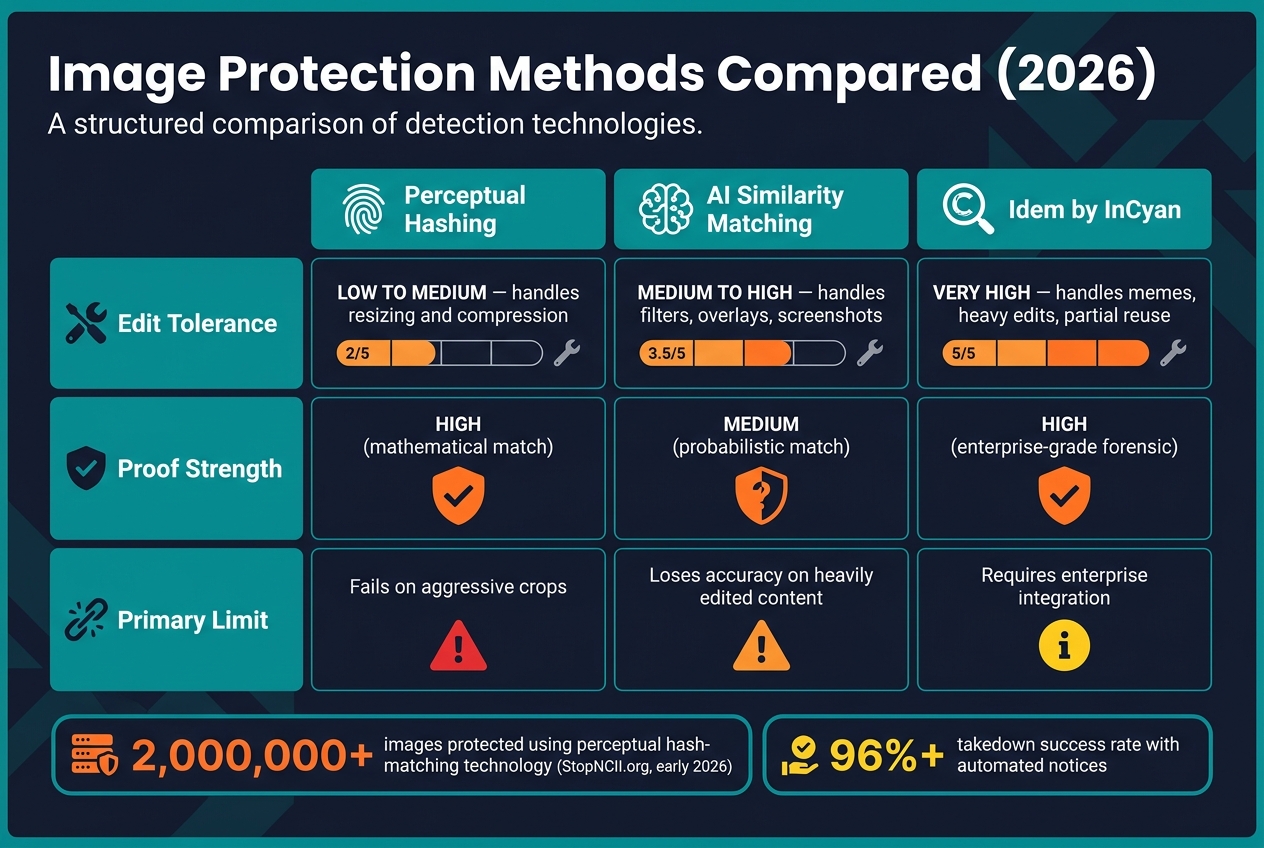
Image Protection Methods Compared: Edit Tolerance, Proof Strength & Enforcement (2026)
Perceptual hashing for resized, compressed, and lightly edited images
File hashing falls apart the moment a file changes. Perceptual hashing works differently: it looks at how an image appears, not just the raw file data behind it.
It turns visual structure into a compact fingerprint. That’s why it can still match images that have been resized, recompressed, or lightly edited. As of early 2026, StopNCII.org had protected over 2,000,000 images using perceptual hash-matching technology, including algorithms like Microsoft’s PhotoDNA and Facebook’s PDQ [1].
There is a catch. If someone crops the image too aggressively, too much of the original frame disappears. At that point, the match can get shaky. When the crop cuts away too much, AI similarity does the heavier lifting.
AI similarity matching for crops, filters, overlays, and screenshots
AI similarity models don’t rely on a fingerprint alone. Instead, they compare visual features, objects, and overall layout.
That makes them better at finding reposts after tougher edits, like screenshots, filters, text overlays, and memes. If perceptual hashing is good at saying, “This still looks a lot like the same image,” AI similarity is better at saying, “This uses the same visual parts, even after someone messed with it.”
Still, there’s a limit. Accuracy drops as edits become more extreme [2].
Idem by InCyan: detection that holds up under heavy edits at enterprise scale
When edits get heavier and image libraries get much larger, you need another layer. That’s where a forensic-grade engine comes in.
Idem by InCyan is built for cases where perceptual hashing and AI similarity matching stop being enough. Its multimodal matching system is designed to detect ownership across heavy crops, compression, memes, and partial reuse inside other graphics.
Put simply, the biggest difference between these three methods comes down to two things: how much editing they can handle and how strong the match is as proof.
| Method | Edit Tolerance | Proof Strength | Primary Limit |
|---|---|---|---|
| Perceptual Hashing | Low to medium – handles resizing and compression | High (mathematical match) | Fails on aggressive crops |
| AI Similarity Matching | Medium to high – handles filters, overlays, screenshots | Medium (probabilistic match) | Can lose accuracy on heavily edited content |
| Idem by InCyan | Very high – handles memes, heavy edits, and partial reuse | High (enterprise-grade forensic) | Requires enterprise integration |
How Invisible Watermarking and Verification Support Ownership Claims
Finding an unauthorized copy is only half the battle. The harder part is proving the image came from you.
That’s where invisible watermarking and blockchain registration come in. Once a matching system flags a suspect copy, these tools help back up your claim with proof you can use.
Invisible watermarking that survives common publishing edits
An invisible watermark is an imperceptible ownership marker embedded in the image data. It can survive re-encoding, format conversion, social compression, screen recording, and resizing[1].
That matters for a simple reason: people rarely repost files in their original form. Images get compressed, converted, cropped, or shared through platforms that change the file along the way. If a licensed copy leaks or gets reposted after edits, the embedded marker can still trace the leak back to the source or recipient.
Tectus and ScoreDetect Enterprise: watermarking, monitoring, and takedown in one workflow
Tectus by InCyan adds the watermarking layer for forensic tracing and leak identification[1]. Paired with ScoreDetect Enterprise, that watermark becomes part of a monitoring and takedown workflow that produces evidence for DMCA action[1].
Here’s how that workflow fits together:
- Tectus embeds the watermark for tracing and leak identification[1]
- ScoreDetect Enterprise uses targeted web scraping to find unauthorized uses and generate evidence for enforcement[1]
- Automated takedown notices from this workflow consistently achieve a takedown rate of over 96%[1]
In plain English, this means you’re not stuck with a watermark that just sits there. The system ties discovery, proof, and enforcement into one process.
ScoreDetect Pro: blockchain timestamping and ownership certificates
ScoreDetect Pro generates a SHA256 checksum and anchors it to a public blockchain without storing the image, creating a tamper-proof timestamp for ownership claims[1].
That timestamped record is created before any dispute starts, which is a big deal. In the U.S., having that record can turn a disputed authorship claim into a more direct case for DMCA or authorship action[1].
It also includes:
- verification certificates
- formal recognition certificates
- revision history
- API access
- a WordPress plugin
Once ownership is established, web discovery tools turn that proof into takedown action.
Web Discovery Software That Finds Unauthorized Image Reuse Online
Once ownership is in place, the next job is finding where edited copies show up online. Web discovery tools track down cropped or altered versions on the web and turn those matches into evidence you can use for enforcement.
ScoreDetect discovery and automated takedown workflows
After that, discovery needs to do more than spot a match. It needs to turn that match into proof you can act on. ScoreDetect uses automated crawling to access protected pages, compare findings against your original files, generate evidence of unauthorized use, and send automated delisting notices that achieve a takedown rate of over 96%[1].
That matters because it takes you from discovery to documented enforcement in one pass. If unauthorized copies appear online, image owners can move faster to protect licensing revenue instead of chasing screenshots and links by hand.
Indago, TorrentWatch, and BlockWatch for broader enforcement coverage
For search-indexed infringement, Indago can de-index infringing links in under 60 minutes. TorrentWatch pushes enforcement into the BitTorrent ecosystem, where unauthorized distribution can spread well beyond normal web monitoring. BlockWatch separates ISP-level blocks from outages through multi-layer testing across DNS, IP, and HTTP/HTTPS.
Taken together, these tools help cover blind spots and give rights holders a clearer picture of where copied assets are showing up.
Choosing the Right Protection Stack for Your Image Business in 2026
A practical setup for small businesses, publishers, and enterprises
Once detection, proof, and discovery are in place, the next move is simple: pick the smallest stack that covers your risk. The right setup depends on three things – how much your images are worth, how often they get copied, and how fast you need to act.
Start with ScoreDetect Pro at $12/month, or $11.31/month billed yearly. Use it to create a timestamped ownership record before publication. That record gives you something solid to point to later, which makes every enforcement step easier.
If copied images are already cutting into revenue, it makes sense to move beyond proof and into continuous enforcement. Add ScoreDetect Enterprise for 24/7 monitoring, invisible watermarking across image, video, and audio, and automated takedown notices. That shift matters when you can’t afford to wait around and check misuse by hand.
Edited reuse is where things get trickier. A cropped image, a meme format, or a screenshot can slip past basic checks. Use Idem for heavy crops, memes, screenshots, and partial reuse across large catalogs. If you manage a big archive, fingerprint back catalogs with Idem and connect InCyan Business Intelligence and Insights to licensing and enforcement reporting. Use Blueprint to keep assets and rights in one place.
What to prioritize when the goal is revenue protection and fast takedowns
Focus on four things:
- edit tolerance
- ownership proof
- discovery automation
- takedown speed
A simple path works best for most teams. Start with Pro. Add Enterprise when monitoring starts to matter. Bring in Idem when edited reuse gets tough to spot. Pro first, Enterprise next, Idem last.
FAQs
What tool should I start with first?
Start by proving ownership of your original assets with ScoreDetect. It creates tamper-proof blockchain timestamps, which gives you a clear record of when your content existed and who owned it.
Next, use AI-driven fingerprinting tools like InCyan’s Idem to track down unauthorized copies, even when someone has cropped, edited, or transformed the file. And if you want more durable protection from day one, add invisible watermarks with InCyan’s Tectus at the moment the content is created.
Can cropped screenshots still be matched reliably?
Yes. Even cropped screenshots and heavily edited images can still be matched with modern AI-driven tools.
Older methods like perceptual hashing often fall apart when an image is cropped hard or edited a lot. Newer systems go much further. They use multimodal matching, invisible watermarks, and AI fingerprinting to spot connections between files, even when only 10% of the original is still there.
How do I prove I owned the image first?
Build a clear chain of custody to show you had the image first, even if later edits strip out metadata. The best setup combines blockchain timestamping, invisible watermarking, and AI matching.
A blockchain record shows when you had the original file. Invisible watermarks help confirm where it came from after edits. AI matching can connect cropped or changed copies back to the source.
Used together, these three methods give you a defensible record of ownership.