Cropped content can lead to copyright issues. Even minor edits like trimming an image can legally qualify as an alteration, requiring the original creator’s permission. Cropping often removes metadata and visible watermarks, making it harder to prove ownership.
Key Points:
- Cropping as Alteration: U.S. copyright law considers cropping an adaptation, requiring creator consent.
- Loss of Metadata: Cropping and re-saving often erase embedded ownership details.
- Watermark Vulnerability: Visible watermarks can be easily removed through cropping.
- AI Solutions: Tools like Idem detect ownership even after heavy modifications, while Tectus embeds invisible watermarks that survive edits.
- Blockchain Proof: Platforms like ScoreDetect create tamper-proof timestamps to verify ownership.
Why It Matters:
Without proper tools, cropped content can sever ties to its original creator, complicating enforcement. Combining AI detection, invisible watermarking, and blockchain technology offers a stronger defense against misuse.
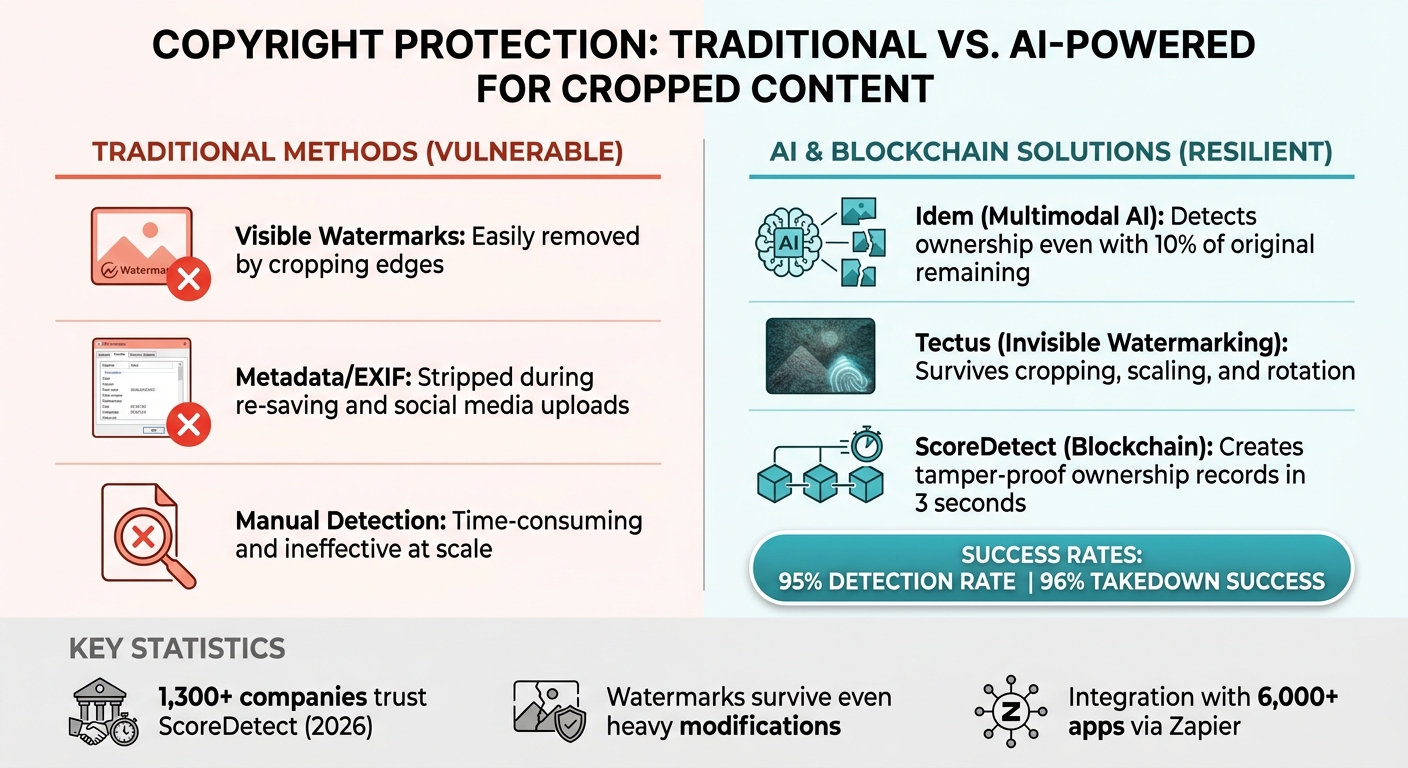
Traditional vs AI-Powered Copyright Protection Methods for Cropped Content
How Cropping Affects Copyright Enforcement
Cropping doesn’t just alter how an image looks – it can also sever the link between the image and its ownership information. This creates a real headache for rights holders trying to monitor and address unauthorized use.
How Cropping Removes Metadata
When an image is cropped and re-saved, the process often wipes out embedded metadata. This includes critical details like camera settings, timestamps, and copyright notices[1]. To make matters worse, social media platforms frequently strip or compress EXIF data during uploads, further detaching key ownership details from the image. As Nikhil John from InCyan points out:
The absence of consistent metadata in these workflows limits automated attribution.[3]
In addition to metadata loss, even traditional methods like visible watermarks struggle to provide reliable protection once cropping comes into play.
Why Visible Watermarks Fail Against Cropping
Visible watermarks, often placed along the edges or corners of an image, are particularly vulnerable to cropping[1]. A simple crop can easily remove these marks, leaving little to no trace of ownership. This makes them ineffective in proving copyright in cases of disputes.
sbb-itb-738ac1e
AI-Powered Detection of Cropped Content
When cropping strips away metadata and visible watermarks, AI-powered detection methods step in to bridge the gap. These systems rely on extracting unique visual fingerprints from an image’s structural features, rather than depending on metadata that can be easily removed.
Multimodal AI Matching
AI-powered multimodal matching works by creating a visual fingerprint using features like edge detection, color distribution, and structural patterns. This method is effective even when an image has been cropped, resized, or compressed, as it identifies visual similarities that persist through these changes.
A great example of this is InCyan’s Idem platform. Its proprietary multimodal matching technology is designed to withstand significant alterations, including mobile edits, memes, cropping, and compression. Remarkably, it can still detect ownership even if only 10% of the original asset remains intact[1]. This makes it an essential tool for verifying content provenance.
The platform uses advanced pattern recognition algorithms to locate fragments of content across vast databases, eliminating the need for the original, unwatermarked file. This highlights the critical role of AI-driven fingerprinting in enforcing ownership on a large scale.
In addition to visual fingerprinting, AI-driven invisible watermarking provides another layer of protection by embedding durable, machine-readable signals into the media.
Invisible Watermarking with AI
Unlike visual matching, AI-driven invisible watermarking embeds imperceptible signals directly into the media. These watermarks are added in transform domains – such as discrete cosine transforms – rather than in the image’s raw pixel data. This makes them highly resistant to geometric changes like scaling, rotation, and cropping.
InCyan’s Tectus solution is a standout example of this technology. Using blind watermarking techniques, it embeds ownership markers into textured areas of an image, such as foliage or fabric. These markers are invisible to the human eye but can be reliably retrieved by AI detectors. Properly designed, these watermarks survive transformations and act as a hidden serial number for the media.
Modern AI detectors are also capable of separating watermark signals from noise introduced by generative AI edits or other manipulations. This addresses the challenge of the watermarking triangle – balancing invisibility, durability, and capacity – by dynamically adjusting how the watermark is embedded. This adaptability ensures that the watermark remains both functional and undetectable to viewers.
How ScoreDetect Protects Against Cropped Content

AI-powered detection and watermarking are great for safeguarding content, but when it comes to legal disputes, you need more than technical measures – you need verifiable proof. That’s where ScoreDetect steps in, bridging the gap between tech-based protection and enforceable copyright claims.
Blockchain Timestamping for Ownership Proof
ScoreDetect taps into blockchain vs traditional timestamping methods to create tamper-proof records that prove when you owned a specific piece of content. Instead of storing the actual files on the blockchain, the platform generates a checksum – a unique digital fingerprint – of your content. This method ensures your assets remain private while still providing verifiable proof.
In just about 3 seconds, the system creates immutable blockchain certificates. These certificates establish a defensible chain of custody, which is critical when cropped or altered versions of your content appear online [1].
"A blockchain timestamp proves you had a file at a specific moment, but it does not register copyright or give you enforceable legal rights in most jurisdictions without additional filings." – ToolsForHumans Editorial Team [4]
These blockchain records work alongside existing copyright registrations, offering quick, reliable evidence that you possessed a file before someone else could claim it. This is especially useful when cropping or other transformations strip away traditional metadata. By creating this chain of custody, ScoreDetect seamlessly integrates with AI detection tools to strengthen your protection.
Integration with AI Protection Tools
ScoreDetect doesn’t stop at proof of ownership. The platform pairs its blockchain timestamping with InCyan’s AI tools to create a full-circle protection system. It integrates with Idem for multimodal matching and Tectus for invisible watermarking, ensuring every phase of protection is covered: AI detects unauthorized use, and blockchain provides the legal proof.
For example, if Idem identifies a cropped version of your content – even the smallest fragment – ScoreDetect’s blockchain records can confirm your ownership of the original file. This is vital because cropping often removes metadata, making traditional methods of verification ineffective. The platform’s AI-powered web scraping achieves a 95% success rate in spotting unauthorized content, while automated takedown notices boast a 96% success rate for removal [4].
For publishers managing large volumes of content, ScoreDetect simplifies the process with workflow automation. Through Zapier integration with over 6,000 web apps, blockchain timestamping becomes effortless. The WordPress plugin takes it a step further by automatically capturing and timestamping every published or updated article, eliminating the need for manual input. As of early 2026, ScoreDetect is trusted by over 1,300 companies, including media organizations, legal firms, and independent content creators [4].
The Future of Protection Against Cropped Content
AI and Blockchain Integration Trends
The world of copyright protection is evolving, moving toward systems that predict and counter new methods of evasion. Future detection tools will leverage AI to distinguish watermark signals from both natural and artificial noise, even when content has been heavily cropped or altered using generative AI techniques [1]. Instead of reacting to changes, these systems will be designed to anticipate them.
A powerful combination of AI and blockchain technology is shaping a more secure framework for content ownership. While media files themselves aren’t stored on the blockchain, compact records of detection events and cryptographic hashes are maintained using blockchain-inspired ledgers [1]. This approach ensures that ownership remains verifiable, even when metadata is stripped during processes like social media transcoding or re-exporting.
"Invisible digital watermarking is not a silver bullet, but it is a powerful control point in a world of frictionless copying and increasingly sophisticated synthetic media." – Nikhil John, InCyan [1]
Blind watermarking is becoming a cornerstone of these modern systems. It supports large-scale verification, even when content has been extensively altered, which is critical for platforms managing billions of assets. For example, InCyan’s Tectus offers this capability, making it feasible to verify content without needing to store the original files.
Despite these advancements, there are still notable limitations in the current technologies.
Where Current Technologies Fall Short
Even with all the progress, today’s technologies still encounter significant hurdles. AI-based inpainting, for instance, can erase pixel identities and watermark signals, while video watermarking often struggles with issues like frame synchronization when frames are dropped or re-timed [1][2].
Protecting non-visual content introduces its own set of challenges. Audio watermarking must avoid creating audible distortions while navigating psychoacoustic masking, and document protection becomes tricky with font substitutions, layout changes, and rasterization. Tools like InCyan’s “Idem Text” offer precise solutions for text-based content, but these methods are far from foolproof [1].
"In 2026, treat every JPEG as a hypothesis to be tested, not an immutable fact." – Dr. Lena Ruiz, Senior Data Analyst, analyses.info [2]
The "watermarking triangle" – balancing imperceptibility, robustness, and capacity – remains a core challenge. Improving one aspect often compromises the others [1]. As infringers use more advanced filters and generative AI tools, systems must carefully balance signal strength with usability, all while maintaining accurate detection.
These limitations highlight the ongoing need for more advanced AI and blockchain solutions to strengthen copyright protection and enforcement.
Conclusion
Cropped content continues to pose a tough challenge for copyright holders. Traditional defenses, like visible watermarks and metadata, can be rendered useless with a simple crop or re-export. As Nikhil John from InCyan points out:
Visible marks can be cropped away, and metadata can be stripped by a single re-export. Properly designed invisible watermarks can survive those transformations and act as a latent serial number for the work itself. [1]
To tackle this issue effectively, combining invisible watermarking with blockchain timestamping has emerged as a powerful solution. Invisible watermarks embed machine-readable signals directly into the media, ensuring ownership details remain intact even after heavy modifications. Meanwhile, blockchain creates an unchangeable record, offering proof of existence at a specific time – an essential tool for establishing ownership in legal disputes.
Tools like ScoreDetect simplify blockchain timestamping, producing verifiable certificates in just 3 seconds. For more robust protection, InCyan offers enterprise-grade solutions like Tectus for invisible watermarking and Idem, an AI-driven tool capable of identifying ownership even if only 10% of the original content remains. Together, these technologies provide a layered defense system that addresses discovery, identification, and prevention.
As editing techniques become more advanced, relying on outdated protection methods leaves content exposed. Leveraging AI and blockchain technologies isn’t just about addressing today’s threats – it’s about preparing for tomorrow’s. ScoreDetect’s ability to detect and remove infringing content at high rates further strengthens this protective framework.
This forward-thinking approach ensures digital assets are safeguarded against current and future threats. Whether you’re managing a handful of assets or billions across platforms, combining blockchain-backed ownership with AI-powered detection delivers the enduring, verifiable protection that traditional methods can’t match. Protecting your content starts with action today.
FAQs
Do I need permission to crop a copyrighted image?
Cropping a copyrighted image without getting permission first is usually seen as modifying the work, which could violate the copyright owner’s rights. If the changes are substantial – like altering the image’s overall meaning – permission is often needed, unless the use falls under fair use. For example, using an image for commentary, criticism, or news reporting might qualify as fair use. Tools like ScoreDetect are available to help rights holders spot unauthorized modifications, so it’s always a good idea to seek permission, especially if the image will be used commercially or shared publicly.
How can I prove ownership if cropping removes metadata?
Invisible watermarking offers a way to prove ownership of media, even after edits like cropping remove metadata. InCyan’s technology embeds subtle, durable signals directly into the content, ensuring they stay intact through changes like cropping, compression, or resizing. Unlike metadata, which can be easily tampered with or erased, these watermarks remain verifiable. This gives content creators a reliable method to safeguard their rights, even when their work is altered.
What should I do if someone posts a cropped version of my work?
If someone shares a cropped version of your work, you can use invisible digital watermarking to embed hidden signals within your content. These signals remain intact even after edits like cropping, allowing you to prove ownership. Additionally, advanced AI tools can detect unauthorized use of your cropped content online. These platforms often offer features like automated delisting notices, making it easier to act quickly and protect your rights while maintaining control over your digital assets.