An automated takedown system can organize repeatable enforcement tasks, but a match is not proof of infringement and a notice does not guarantee removal. A workflow may flag possible copies, review evidence, prepare or send a notice, and track a response; providers differ in which steps and sources they cover. Some tools use digital watermarks as one way to identify content. For the U.S. notice process, read the Copyright Office’s Section 512 resource.
- AI-assisted detection: Flags possible matches for review; a match alone does not establish infringement.
- Digital Watermarks: Can help identify or trace content, but do not by themselves show whether a specific use is unauthorized.
- Blockchain verification: Can record a timestamp or content fingerprint, but does not determine a legal claim or trigger removal.
- Takedown notices: May be prepared or sent through an automated workflow; a notice requests action, not a guaranteed outcome.
- Human review: Check ownership, permission, and context before sending a notice.
ScoreDetect offers verification certificates and blockchain timestamping. The ScoreDetect Enterprise pricing page lists “Automated Take Down Notifications.” Ask a provider which sources it covers and whether its notification is an alert or part of a notice workflow; read our guide to automated takedown notifications for more context.
How Automated Takedown Systems Work
Digital Watermarks and Content Tracking
Some systems use digital watermarking to help identify or trace content; it is one possible tool, not a feature of every takedown workflow. A watermark can help connect a suspected copy to a protected file, but rights, permission, and context still need review. ScoreDetect’s Enterprise plan includes invisible watermarking for images, videos, audio, and documents; see the permanent identifiers article for related background and the plan details.
AI-Powered Content Search
Automated tools may use web crawling or other matching methods to surface possible copies. A result is a lead for review, not proof of infringement: check the source, ownership, permission, and context before sending a notice. See ScoreDetect’s product overview for its published features; detection results and response times vary by service and workflow.
"ScoreDetect helps establish trust by providing transparent evidence of the authenticity and timestamp of digital content. It also aids in copyright protection, making it a valuable tool for businesses and individuals seeking to protect their intellectual property." – ScoreDetect
Blockchain Copyright Protection
Blockchain can record a timestamp or content fingerprint associated with a verification record; it does not by itself establish copyright ownership, determine whether a use is infringing, or cause a platform to remove content. A certificate can document information about content, but legal claims still require review of the relevant rights and context.
ScoreDetect offers blockchain timestamping and verification certificates. For background on the SKALE network, see its site. A certificate records information about content; it is separate from a DMCA notice and is not a decision by a service provider or court. Read the ScoreDetect product overview for details.
Content Verification and Removal Steps
Confirming Content Matches
Review a possible match before treating it as infringement: compare it with your content ownership records and check permission and context. A verification certificate can document a content state; it does not establish all rights to a work or decide whether a later use infringes. Learn more about checksum algorithms in our technical overview; deciding whether to send a notice is a separate step from finding a match. ScoreDetect offers verification certificates.
Sending Takedown Notices
The Copyright Office states: “The notice-and-takedown system allows rightsholders to send a notification to the online service provider regarding infringing material that appears on the service provider’s system.” See the Section 512 overview. For background, see our article on blockchain and court law. Our guide to takedown notifications explains that a notice is a request, not a guarantee. ScoreDetect’s Enterprise pricing page lists “Automated Take Down Notifications.”
Managing Legal Responses
ScoreDetect’s Enterprise pricing page lists “Automated Take Down Notifications.” Separately, the Copyright Office explains that a user who believes material was removed by mistake or misidentification may submit a counter-notice. After a compliant counter-notice, the provider must restore access after no less than ten and no more than fourteen business days unless the original sender informs the provider that it has filed a court action. See the Section 512 guidance.
"As a SaaS company owner, I find ScoreDetect to be a highly valuable tool for ensuring the integrity of our digital content."
- Joshua Chung, Startup Consultancy, CEO
Explore ScoreDetect’s content protection features and compare the current plan details before choosing a workflow.
Modern Takedown System Capabilities
Automated takedown tools differ in what they monitor, how they review possible matches, and which notice-related tasks they handle. Read our content protection guide for broader context.
ScoreDetect Protection Features
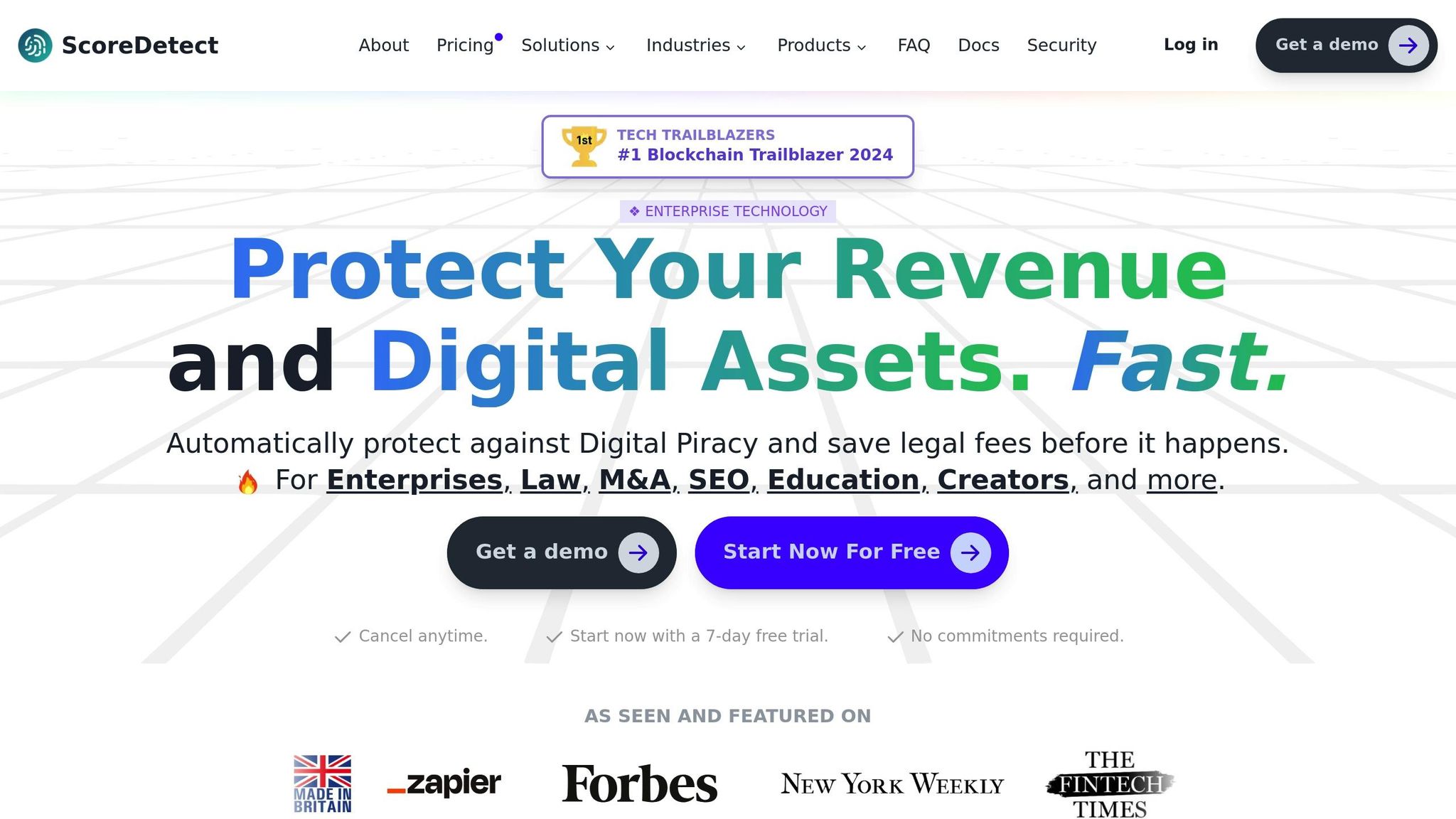
ScoreDetect offers verification certificates and blockchain timestamping. The ScoreDetect Enterprise pricing page lists “Automated Take Down Notifications.” These features do not guarantee that a service provider will remove material; see the current pricing page for the plan details.
"With ScoreDetect, I can take pictures for my travel blog and be confident that nobody will claim them as theirs. I can always prove that I am the author." – Kyrylo Silin, SaaS Founder, CEO [1]
ScoreDetect Integrations and Takedown Questions
ScoreDetect offers a WordPress plugin and Zapier automations; read our guide to blockchain timestamping for related background. An integration alone does not show whether a service monitors a particular source or submits notices. Before choosing a provider, ask which sources it covers, whether a person reviews matches, what a notification triggers, and whether responses are tracked. See our guide to automated takedown notifications.
What to Check About Coverage
If your workflow involves e-commerce or sources in different markets, confirm coverage and notice handling directly with the provider. Read our guide to protecting content from unauthorized sharing and e-commerce solution for related information; see WooCommerce for platform details and the SKALE site for blockchain background. A product or integration page is not a list of monitored sources or a promise that a takedown will succeed.
Conclusion
Automated takedown systems can support several stages of copyright enforcement, from surfacing possible matches to organizing records and handling notices. They still need human review of rights, permission, and context. Explore related guides on automated piracy detection, blockchain verification, and checking suspected unauthorized use.
Automation does not guarantee removal; outcomes depend on the evidence, the recipient’s process, and applicable law. For more background, read our guide to copyright considerations.
ScoreDetect’s verification certificate product saves immutable data states to the blockchain. Read more about secure file timestamping and ScoreDetect’s marketing and advertising solution.
A U.S. DMCA notice must include a good-faith belief statement and a statement under penalty of perjury that the information is accurate and the sender is authorized to act for the rights holder; see the Copyright Office’s notice requirements.
FAQs
How much does an automated DMCA takedown service cost?
ScoreDetect Pro is from $11.31 per month; the Enterprise plan has custom pricing and lists automated takedown notifications. The $11.31 amount is a Pro monthly subscription price, not a per-notice quote. See the current pricing page for plan details.
How can digital watermarks protect my content without changing how it looks?
The ScoreDetect Enterprise pricing page lists “Invisible Watermarking Images / Videos / Audio / Docs.”
How does blockchain help verify content ownership and support the takedown process?
ScoreDetect’s verification certificate product describes “integrated verifiable proofs with exportable PDFs” and says it saves immutable data states into the blockchain. Read the certificate product page and our digital-fingerprint guide for related information.
The Copyright Office states: “The notice-and-takedown system allows rightsholders to send a notification to the online service provider regarding infringing material that appears on the service provider’s system.” See its Section 512 overview.
How long does an automated DMCA takedown take?
The ScoreDetect Enterprise pricing page lists “Automated Take Down Notifications.” Separately, the Copyright Office says that a service provider receiving a compliant notice must act expeditiously to remove or disable access; see the Section 512 overview.
A counter-notice can affect the next step; see the “Managing Legal Responses” section above for the U.S. process.