Yes – an image agency can build a clear system to spot photo misuse at scale. I’d do it in 4 steps: lock down the catalog, find copied images, check license terms, and send takedowns or fee claims with proof.
Here’s the short version:
- Store each image with its rights data in one place
- Mark files with invisible watermarking and keep metadata updated
- Register proof of ownership with a dated hash record
- Scan high-value channels first like publisher sites, retail listings, marketplaces, and social ads
- Use AI matching to find edited copies, even after crops or compression
- Check each match against time, territory, media type, placement count, and exclusivity
- Save proof fast with screenshots, HTML, timestamps, host details, and watermark results
- Send takedowns and search removals as soon as misuse is confirmed
- Track results like takedown rate, response time, and recovered fees in $USD
A few points matter most. First, misuse usually falls into 3 buckets: licensed use, out-of-scope use, and unlicensed copying. Second, metadata alone is weak – one study cited in the article found 12 out of 12 platforms stripped IPTC copyright and creator fields from downloaded files. Third, AI matching can help find copies even when only 10% of the image remains.
If I were running this process, I’d keep the goal simple: find the copy, prove where it came from, check the license, and act before the page changes.
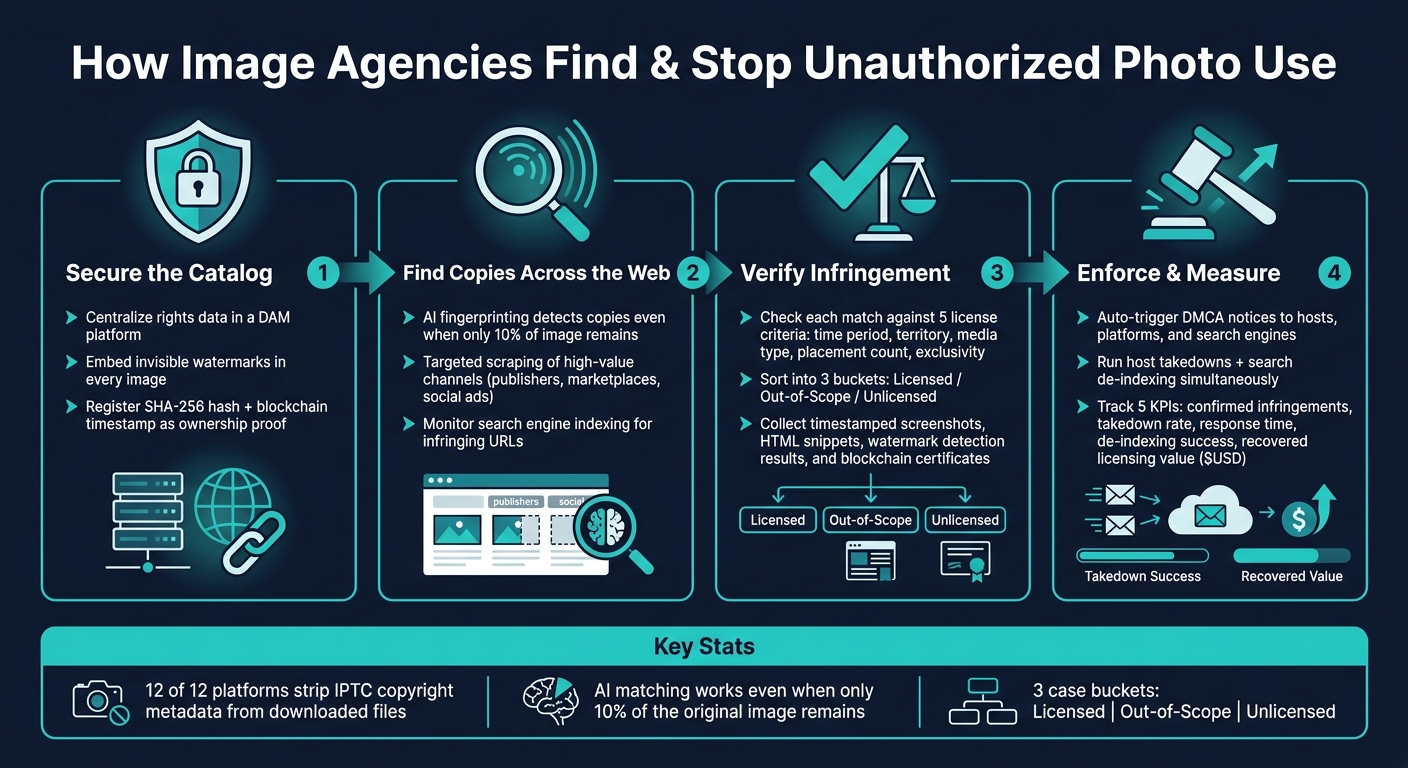
How Image Agencies Find & Stop Unauthorized Photo Use: 4-Step Workflow
Secure the Catalog Before Monitoring Starts
Detection only works when rights data lives in one place. If it’s scattered across folders, emails, and old contracts, checking whether a use is allowed can eat up hours. That record should be your first stop when a suspected copy shows up.
Centralize Master Files, Rights Data, and License Limits
A digital asset management platform gives every image one rights record tied to its contract terms. Each record should include asset ID, file hash, rights holder, license type, client, channel, territory, dates, exclusivity, and exceptions. When a suspected match appears, the enforcement team can open that record right away and see whether the use falls inside or outside the approved scope.
This is where teams cut down on false positives. A photo cleared for a one-time U.S. web campaign is not also cleared for global resale or forever archive use. A DAM-led workflow makes that difference clear fast, so the team spends time on actual violations instead of approved placements.
Embed invisible watermarks and Preserve Metadata
ScoreDetect’s watermarking adds an imperceptible signal to each image at upload or publish. That signal can hold up through common changes like resizing, mild compression, cropping, or light color edits. So if a suspect copy appears on a website, marketplace listing, or social post, the agency has a durable sign that the file came from its catalog.
Agencies should also keep IPTC, EXIF, and XMP metadata up to date, especially the Copyright Notice, Rights Usage Terms, and Creator fields. Metadata helps with internal review, but it can’t do the whole job on its own. A study found that 12 of 12 tested platforms removed IPTC data from downloaded copies and preserved no copyright or creator fields.[2]
Register Ownership Evidence with ScoreDetect
ScoreDetect anchors a SHA-256 hash to a public blockchain record and issues a Verification Certificate with the registration date, owner name, hash, and ledger links.[1] When a case needs more formal paperwork, a Formal Recognition Certificate provides an official letter confirming ownership and the timestamping method.
Agencies can make this part of day-to-day work through the developer API, Zapier automations, or the WordPress plugin, which can automatically capture published or updated content. That means ownership proof stops being a manual chore and becomes a routine check. Every distributed asset gets a dated record without someone needing to remember to create it.
With the catalog secured, the agency can scan the web and check each match against rights data in seconds.
sbb-itb-738ac1e
Find Copies Across the Open Web and Search Results
Infringing copies almost never show up as perfect duplicates. People resize them, crop them, add filters, turn them into memes, or save them again and again until the file looks different from the source. That’s why a strong discovery layer needs more than a basic reverse image search. It should combine AI-based image matching, focused web crawling, and search result monitoring so you can spot copies even after heavy edits.
Use AI Fingerprinting to Match Edited and Partial Copies
Standard image search tools tend to miss altered files. Once an image is cropped, filtered, or recompressed, the match can fall apart.
ScoreDetect’s Idem is built for those situations. Its AI-powered matching can still detect asset ownership even when only 10% of the original asset remains, including mobile edits, memes, heavy cropping, and recompression.
A practical setup looks like this:
- Fingerprint each image at ingestion
- Store the match data next to the rights record
- Use the match score to sort review priority
Higher-confidence matches should move to the front of the line. Lower-confidence ones can stay in review for a second look. The main point is simple: each hit should move straight into rights review, not sit as just another item on a long list of possible copies. Use the match score to decide which cases get reviewed first.
Run Targeted Web Scraping on High-Value Channels
Scanning the whole web sounds nice on paper, but it’s not practical and it usually isn’t needed. A better move is to crawl the highest-value channels identified earlier, where unlicensed use is more likely to create licensing value and where DMCA enforcement is easier to carry out.
ScoreDetect’s enterprise monitoring supports this with targeted web scraping that can reach pages basic crawlers can’t access. That helps surface new infringements sooner instead of finding them weeks later.
For each discovered match, the system collects details such as:
- The image URL
- The page context
- Ranking signals
That gives the enforcement team enough detail to sort cases by impact before a person even opens one.
Monitor Search Results and Indexed Exposure
A page doesn’t need huge direct traffic to cause harm. If Google or Bing indexes it, the unauthorized image becomes easy to find through a simple search. It aggregates results from major search engines to identify infringing URLs, their ranking positions, and which queries surface them.
Agencies can use Indago‘s structured output to prepare DMCA search delisting requests that go after the highest-visibility URLs first. Running host-level takedowns and search de-indexing at the same time helps reduce public access fast, and Indago‘s data makes it easier to pair the right URLs with the right enforcement action.
Use indexed exposure to prioritize the most visible cases for takedown. Then move confirmed matches into rights review and evidence capture before issuing notices.
Verify Infringement with Evidence Strong Enough for Enforcement
Finding a match is just the start. An image that looks copied is not, by itself, proof of infringement. Before you send a notice or take legal action, check the actual license.
Check Each Match Against License Terms and Usage Scope
When you find a match, pull the license record first. Every match should be checked against five points: time period, territory, media type, number of placements, and exclusivity.
If the use fits all five, it’s licensed. Close the case and add a log entry.
If it falls outside even one area, the use may still be a problem. For example, a license might allow North American web use only, but the image now shows up in a paid European social ad. That kind of mismatch can support retroactive licensing before you move further.
If there’s no license record at all, the case moves to enforcement.
This simple sorting step helps a lot. Each case should end up in one of three buckets: licensed, out-of-scope, or fully unlicensed. That keeps the next step clear and gives you a clean audit trail.
Collect Proof and Chain-of-Custody Records
If the use is out of scope or unlicensed, collect proof before the page changes. Web pages disappear, images get swapped, and bad evidence can sink an otherwise strong case.
A solid file should include:
- The infringing URL
- A timestamped full-page capture showing the image in context
- The HTML snippet with the image tag and file path
- Hosting provider details
- The match score
- The invisible watermark detection result linking the copy to the exact registered asset
You should also attach the ownership certificate and timestamp record. Then log who collected each file, when they collected it, and where it’s stored. That chain-of-custody record matters. Without it, even good proof can get picked apart later.
Comparison Table: Basic Screenshots vs. Watermarks, Match Scores, and Timestamp Certificates
Use the evidence package below to size up the strength of the case. Don’t rely on screenshots alone. A full capture package gives you a much better footing.
| Evidence Type | Speed to Collect | Reliability | Resistance to Dispute | Usefulness in Takedown/Settlement |
|---|---|---|---|---|
| Basic screenshot | Very fast | Moderate to low | Low; easy to challenge as edited or incomplete | Good for visual context, but weak as standalone proof |
| Screenshot with full URL + timestamp | Fast | Moderate | Moderate; better than cropped captures | Improved for platform review and internal case files |
| Invisible watermark detection | Fast after setup; automatable | High; payload ties image to a specific asset and owner | High; independently reproducible and verifiable | Strong ownership support, especially when the source is disputed |
| Match score / fingerprint | Automated at detection | High; statistical similarity can survive edits and crops | High; quantitative and repeatable | Useful when images are modified or partially used |
| Timestamp certificate + blockchain | Slower initial setup; quick retrieval later | High; combines fingerprint and ownership at a fixed point in time | Very high; anchored in tamper-evident logs | Powerful in disputes over priority and in settlement negotiations |
Automate Takedowns, Recovery, and Reporting
Trigger DMCA Notices and De-Indexing Workflows Automatically
Once a match is verified, the next step is simple: move from evidence to enforcement right away.
Use the verified case file to fill in standard DMCA notices automatically. When infringement is confirmed, webhooks or integrations can log the case, assign it to the right person, and set due dates without manual work.
That same workflow can send the case to legal, outside counsel, or vendor queues. From there, notices can go out to hosting providers, marketplaces, social platforms, and search engines. On manual platforms, it still helps to prefill forms, export batch files, and line up follow-ups so nothing slips through the cracks.
Host takedowns and de-indexing should work together. If you only remove the source but leave the page visible in search, the damage can keep going. Sending confirmed URLs into de-indexing requests helps cut indexed exposure before the host removal is complete.
Measure Missed Licensing Value and Enforcement Performance
Sending notices doesn’t mean much if you can’t see what’s happening after that.
Track five KPIs:
- confirmed infringements
- takedown rate
- response time
- de-indexing success
- recovered licensing value ($)
For recovered licensing value, tie each confirmed infringement to the closest matching license type on your rate card. That means looking at media type, territory, duration, and audience size. Record any retroactive payments that come in, and also log notional value for takedowns.
Business intelligence reporting brings detection, enforcement, and financial data into one view. That makes it easier to spot which images keep getting misused and which channels, such as specific marketplaces, domains, or regions, bring the highest value per enforcement action.
Here’s where the numbers start to tell a story: if a small set of commercial lifestyle images drives a big share of high-value infringements, that’s where detection resources should go first. The same data shows which assets and channels deserve more monitoring budget.
It’s also smart to track median response time alongside averages. A few slow cases can skew the average and make performance look better – or worse – than it is.
Conclusion: How to Find, Prove, and Remove Unauthorized Photo Use
The workflow is linear: secure, detect AI-generated or traditional art infringements, verify, enforce, and measure.
Automation is the piece that lets this run at scale. Without it, even strong detection piles up into a backlog that a small rights team can’t clear. With it, an agency can process hundreds of cases per week, keep response times tight, and use enforcement data to decide where to focus next.
FAQs
What counts as unauthorized use?
Unauthorized use means your licensed photo shows up online without permission, or gets used in ways the license doesn’t allow. That can happen on websites, marketplaces, or social posts.
It covers exact copies and edited versions that are still substantially similar. That includes cropping, resizing, compression, format changes, overlays, or use inside composites and background images.
To confirm unauthorized use, gather proof like screenshots, timestamps, and quantitative verification. The goal is to show that the image is your protected work and that the use isn’t covered by a valid license or fair use.
How accurate is AI image matching?
AI image matching is usually very good at spotting copied or edited photos, especially when it relies on perceptual or visual similarity methods instead of exact hashes.
That matters because exact hashes tend to break the moment an image is changed even a little. Crop it, resize it, rotate it, and a basic hash may miss the match. Visual similarity systems are built for that kind of messier, everyday use.
ScoreDetect cites up to 98.2% accuracy for finding altered images, including versions that have been cropped, resized, or rotated.
It also improves detection by accounting for common edits and by combining multiple methods to cut down on false positives and false negatives. Even so, human review still matters when context comes into play, especially for case-by-case calls like fair use.
What proof is strongest for takedowns?
The strongest proof uses a few layers of evidence that work together to form a clear chain of custody.
- Blockchain-verified timestamped records show when the content existed and who owned it.
- Invisible watermarks link the image to the original owner, even after cropping or edits.
- Multimodal matching or fingerprinting confirms technical similarity between the original and infringing copy.
Adding human review and documented similarity analysis can also improve removal success.