AI systems are transforming how we identify copyright issues in user-generated content. With millions of posts shared daily, manual monitoring is no longer feasible. Here’s how AI helps:
- Constant Monitoring: AI scans platforms like social media, marketplaces, and live streams 24/7 to detect unauthorized use of text, images, audio, and video.
- Advanced Detection: Tools like computer vision, OCR (text extraction), and machine learning identify infringements, even when content is heavily modified (e.g., cropped, sped up, or compressed).
- Ownership Proof: Blockchain timestamping provides verifiable records of content creation, making it easier to prove ownership and take action.
- Prevention Tools: Invisible watermarks and centralized asset management systems help secure content before issues arise.
- Automated Enforcement: AI streamlines takedown requests, de-indexing infringing links quickly and efficiently.
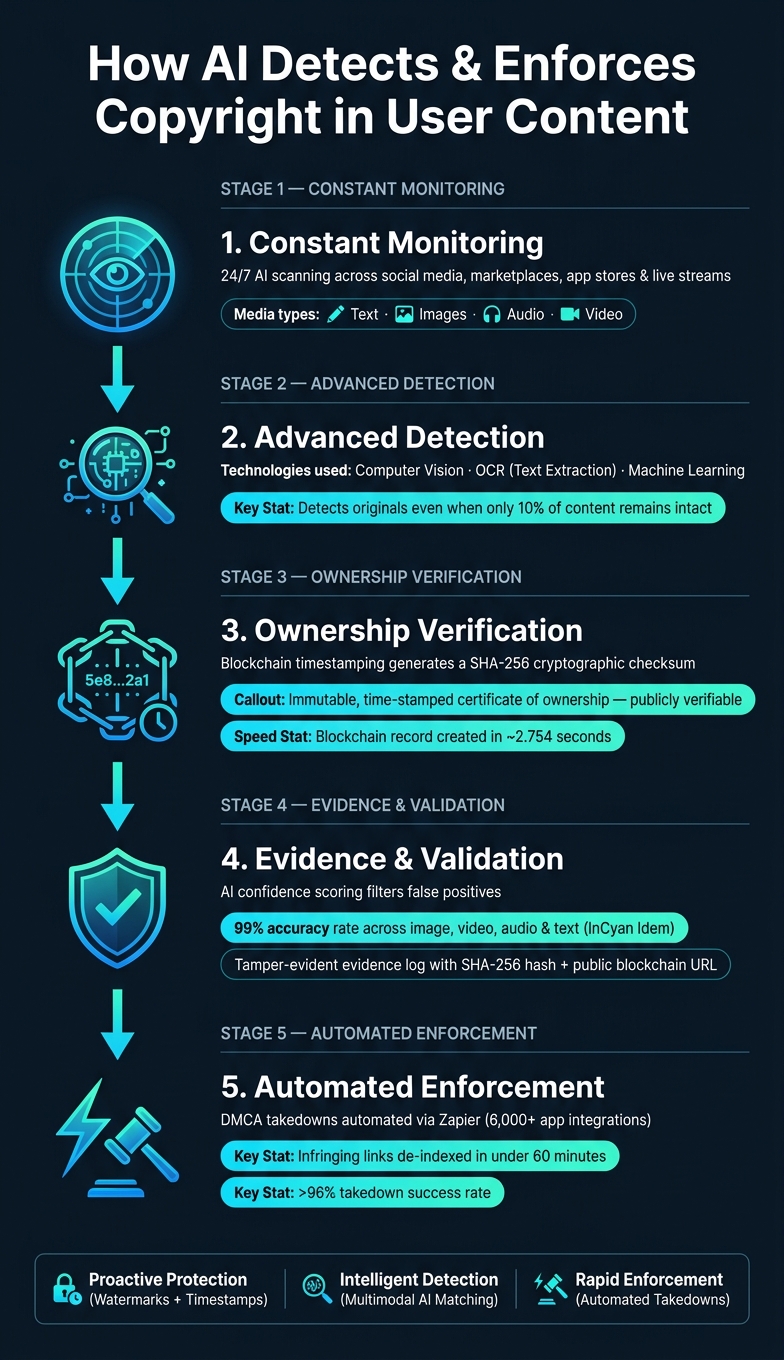
How AI Detects & Enforces Copyright: End-to-End Workflow
Understanding AI Copyright Detection
What Is User-Generated Content and Why Does It Create Copyright Risks?
User-generated content (UGC) includes anything people create and share online – social media posts, YouTube videos, memes, blog articles, podcasts, and even product reviews. The sheer amount of this content is mind-boggling, and its variety adds another layer of complexity. Take a single image, for example – it can be cropped, recolored, and reposted dozens of times in just a few hours. A music clip might be sped up or layered under a video to avoid detection. This remix-heavy culture makes it tough to pinpoint where original content ends and unauthorized copies begin.
The biggest challenge here is scale. No human moderation team can feasibly go through millions of posts every single day. And because platforms hosting UGC operate globally, infringing content can quickly spread across borders before the original creator even realizes it. These massive volumes of content call for AI systems that are always on and ready to detect potential copyright issues.
How AI Detects Copyright Infringement
AI detection systems work by combining several technologies to tackle the problem. Automated scanning runs nonstop across platforms like social media, marketplaces, app stores, messaging apps, and live-streaming services. It flags potential matches, which are then sent through more detailed analysis pipelines. Computer vision algorithms analyze images and video frames to pick out specific shapes, logos, or patterns – even when the content has been edited or distorted. Meanwhile, text extraction (OCR) pulls written content from images, catching unauthorized details hidden in visual posts.
Machine learning models play a crucial role by constantly refining these processes. They analyze historical infringement data to adapt to new tricks people use to dodge detection. Advanced AI can even identify an original asset when only 10% of it remains intact after heavy modifications[3].
Proving Content Ownership in AI Detection
Once AI flags something as potentially infringing, proving ownership becomes the next critical step. To enforce your rights, you need solid evidence that you were the original creator. This is where blockchain timestamping comes into play.
When you create a digital asset, a unique cryptographic checksum – essentially a digital fingerprint – is generated and recorded on a decentralized blockchain ledger. Importantly, the actual file isn’t stored on the blockchain; only the checksum is saved. This keeps the asset private while providing an unchangeable, time-stamped record of its creation[1][2].
This method gives creators a verifiable certificate of ownership that can stand up in legal disputes. Kyrylo Silin, CEO and SaaS Founder, summed it up well:
"With ScoreDetect, I can take pictures for my travel blog and be confident that nobody will claim them as theirs. I can always prove that I am the author."[2]
Additionally, having a blockchain record strengthens a creator’s case when their content is used without permission in AI training datasets. This extra layer of protection ensures that creators maintain control over their work.
sbb-itb-738ac1e
Preparing Your Digital Assets for AI Detection
Getting your content ready before any infringement happens can save time and strengthen your legal case. By taking proactive steps, such as blockchain timestamping, invisible watermarking, and centralized asset management, you can better protect your digital assets and ensure AI systems can identify and address misuse effectively.
Using Blockchain Timestamping to Establish Content Ownership
ScoreDetect offers a way to establish ownership of your content by generating a cryptographic checksum for each file and recording it on an immutable blockchain ledger. This creates a verifiable certificate of ownership without the need to store the file itself. The certificate includes your copyright name, a SHA256 hash, a public blockchain URL, and an official signature.
For web publishers, ScoreDetect simplifies the process with a WordPress plugin that timestamps every article you publish or update. This creates a blockchain record in about 2.754 seconds on average, allowing your entire content library to be protected automatically, with no extra effort [1]. If you decide to cancel your subscription, you can bulk-export all certificates as PDFs, ensuring you retain proof of ownership even offline [1].
For more complex workflows, ScoreDetect integrates with over 6,000 apps via Zapier, enabling automated timestamping as soon as new content is created – eliminating the need for manual uploads [1].
Applying Invisible Watermarks to Media Files
While blockchain timestamps confirm when content was created, invisible watermarks verify what was created – even if someone tries to alter it. InCyan‘s Tectus embeds invisible markers into media files that remain detectable even after modifications such as cropping, compression, speed adjustments, or added noise [3].
This is crucial because AI detection systems like InCyan’s Idem can identify an original asset even if only 10% of it remains intact after transformation [3]. For this to work, the watermark must be embedded properly before the content is distributed. Tectus ensures this is done seamlessly, without affecting the viewer’s experience.
Organizing and Cataloging Source Assets
A centralized Digital Asset Management (DAM) system is essential for maintaining a reliable reference library for AI detection tools. InCyan’s Blueprint is specifically designed for this purpose. It centralizes your visual assets, ensures version control, and keeps a secure audit trail – key elements for effective legal enforcement [3].
How AI Detects Copyright Issues Across Content Types
Once your assets are securely cataloged and protected, AI takes on the challenging task of identifying copyright infringements. These systems are designed to scan various media types – text, images, audio, video, or combinations of these – using specialized detection methods. This allows content creators and rights holders to enforce copyright efficiently and accurately.
Text Detection: Beyond Simple Keyword Matching
AI-driven text detection goes far beyond basic keyword searches. Modern systems use embeddings to analyze the meaning and structure of sentences, making it possible to identify paraphrased content that simpler methods might miss.
For example, InCyan’s Txtmatch compares text against a secure enterprise database, automating the process of verifying whether content has been copied or altered without permission. This is particularly useful for publishers, academics, and legal teams managing large volumes of material. Blockchain timestamps, like those generated by ScoreDetect, provide an additional layer of protection by creating an unalterable, timestamped record of original content. This serves as strong evidence in disputes [1].
Similarly, images are analyzed with techniques that account for the unique challenges of visual media.
Image Detection: Fingerprints and Watermarks
AI uses two main approaches to detect copyright issues in images: perceptual hashing and deep feature extraction. Perceptual hashing creates a digital "fingerprint" of an image based on its visual characteristics. This fingerprint remains recognizable even if the image is cropped, resized, or altered with filters. Deep feature extraction examines more detailed elements like shapes, textures, and patterns, ensuring detection even after significant edits.
Invisible watermarks add another layer of protection. Tools like InCyan’s Tectus embed these watermarks into images, making ownership verification possible even when the image has been altered. InCyan’s Idem platform is particularly advanced, capable of identifying ownership even when only 10% of the original image remains intact, resisting changes like cropping, noise, or speed adjustments [3].
Audio and video content bring their own challenges, requiring equally sophisticated methods.
Audio and Video Detection: Fingerprinting and Frame Analysis
For audio, AI uses spectral fingerprinting to detect unauthorized sampling and identify unique sound patterns. For video, frame-level analysis examines individual visual frames and their accompanying audio. This dual-layer approach makes it difficult for infringers to disguise stolen material, even after re-editing or re-uploading.
"Idem detects assets even with only 10% of the original content remaining, surviving heavy cropping, speed changes, and noise across image, video, audio, and text." – InCyan [3]
When content combines multiple media types, AI takes a more integrated approach.
Multimodal Matching for Mixed-Media Content
Mixed-media content, like a video that includes copyrighted images, licensed music, and embedded text, presents a unique challenge. No single detection method can handle all these elements at once.
InCyan’s Idem platform is designed specifically for this complexity. It analyzes images, audio, video, and text within a unified system, achieving an impressive 99% accuracy rate [3]. The platform is built to withstand common evasion tactics, such as mobile edits, compression, and heavy cropping. This ensures comprehensive detection and allows rights holders to identify and address infringements, no matter how the content has been altered.
"Gaining visibility into how content is utilised across the internet has truly been invaluable. We now have the automated intelligence needed to make smarter decisions, increase revenue through improved monetisation and enforcement, and maintain strict control over our assets." – Director, Shutterstock [3]
Acting on Detected Copyright Infringements
After identifying potential copyright violations, the next step is to confirm them, gather evidence, and initiate removal. Automation and forensic tools make this process faster and more precise, building on earlier detection methods to ensure efficient enforcement.
Validating and Scoring Matches
Not every flagged match is a case of infringement. False positives can waste time and erode trust in the system. To address this, modern detection platforms use confidence scores to assess each match. These scores consider factors like content overlap percentage, media type, and the number of matching features across different formats. This approach ensures a smooth transition from detection to enforcement.
For instance, InCyan’s Idem platform validates flagged matches at scale, achieving an impressive 99% accuracy rate across various media types, including images, videos, audio, and text [3]. This level of precision allows enforcement teams to act based on verified findings rather than assumptions.
Documenting Evidence for Enforcement
When a match is confirmed, solid evidence is crucial for successful takedown requests or legal action. This evidence must clearly prove ownership and show that the content was created before the infringement occurred.
ScoreDetect simplifies this by using blockchain to store a cryptographic checksum of your content at the time of creation [1]. This generates a Verification Certificate containing the SHA-256 hash, a public blockchain URL, a timestamp, and copyright owner details. While the content remains private, the proof is publicly verifiable [1]. These certificates can be exported as PDFs, making them easy to attach to DMCA notices or share with legal teams.
"ScoreDetect allows you to increase copyright protection by saving immutable data states into the blockchain. We offer a valid JSON schema for any form of data content, in line with industry standards." – ScoreDetect [2]
In addition, InCyan’s platform provides a tamper-evident evidence log to ensure the documentation meets legal standards [3]. With verified evidence ready, automated systems can proceed with takedown actions.
Automating Takedown and De-Indexing Requests
Handling DMCA submissions manually is impractical when infringing copies spread across numerous websites and search engines. Automated workflows are essential for managing this scale.
InCyan’s Indago platform de-indexes infringing links from search engines in less than 60 minutes [3], cutting off access to illegal content directly at the traffic source. For broader automation, ScoreDetect integrates with Zapier, connecting to over 6,000 apps to streamline tasks like evidence packaging, notice generation, and status tracking as new infringements are confirmed [1]. With a takedown success rate exceeding 96%, ScoreDetect demonstrates the power of blockchain-backed evidence in securing content removal [1].
"Working with InCyan has completely transformed how we handle our media operations. The ability to centralize, secure and protect our content has turned a previously chaotic workflow into a streamlined process." – Director, BPI Limited [3]
Conclusion: Using AI to Protect Your Copyright
AI has moved beyond basic keyword matching to offer advanced tools like text similarity analysis, perceptual image hashing, audio fingerprinting, and multimodal matching. These methods work together to detect infringement across various content types. However, detection alone isn’t enough. The real game changer is a full-circle approach – establishing ownership early and swiftly removing unauthorized copies when they surface.
The most effective strategy combines proactive ownership measures with rapid enforcement. For instance, ScoreDetect uses blockchain technology to create an immutable timestamp of your content, offering a legal-grade record that surpasses traditional web archives[1]. On the enforcement side, tools like InCyan’s Idem can identify infringing content even when as little as 10% of the original remains[3]. Meanwhile, Indago can de-index unauthorized links from search engines in under an hour[3].
"ScoreDetect is exactly what you need to protect your intellectual property in this age of hyper-digitization. Truly an innovative product, I highly recommend it!" – Imri, Startup SaaS CEO[1]
To protect your content effectively, it’s crucial to act before infringement occurs. Start by timestamping your assets as soon as they’re created, embedding invisible watermarks into media files, and integrating protection tools into your workflows. With platforms like Zapier offering connections to over 6,000 apps, such integrations are seamless[1]. Businesses that adopt these habits early save both time and money by reducing the need for reactive measures later.
For those ready to take the first step, ScoreDetect offers a 7-day free trial with no commitment. This allows you to test blockchain timestamping on your content before deciding whether to scale up to an enterprise-level plan[1][2].
FAQs
How accurate is AI at spotting altered copies?
AI systems excel at spotting altered content through multimodal matching – a process that evaluates images, videos, audio, and text all at once. Take InCyan’s Idem platform as an example: it boasts an impressive 99% accuracy rate, even when only 10% of the original material is intact. These systems work by creating unique digital signatures for content, allowing them to identify matches across different formats. This capability holds strong even after significant changes like cropping, compression, pitch adjustments, or paraphrasing.
What proof do I need before filing a takedown?
To file a takedown, you’ll need solid proof of both ownership and infringement. ScoreDetect, developed by InCyan, offers blockchain-based verification certificates that include cryptographic checksums. These certificates create a permanent, time-stamped record to confirm authenticity. On top of that, InCyan uses invisible watermarking to connect disputed assets back to their original source – even if the content has been edited. Together, these tools give you the evidence required to create precise, automated takedown notices.
When should I timestamp or watermark my content?
One of the best ways to establish ownership of your digital content is to timestamp or watermark it as soon as it’s created. This simple step creates a verifiable record of when the content was made.
Tools like ScoreDetect make it easier to safeguard both new and existing digital assets. Whether you’re publishing fresh content or protecting archived photos and articles, ScoreDetect has you covered. It uses blockchain-based checksums to provide proof of integrity and timestamps, ensuring your ownership is indisputable.
Additionally, invisible watermarking offers an extra layer of protection. It helps prevent unauthorized use, AI-driven edits, and even metadata stripping – ensuring your media stays secure over time.