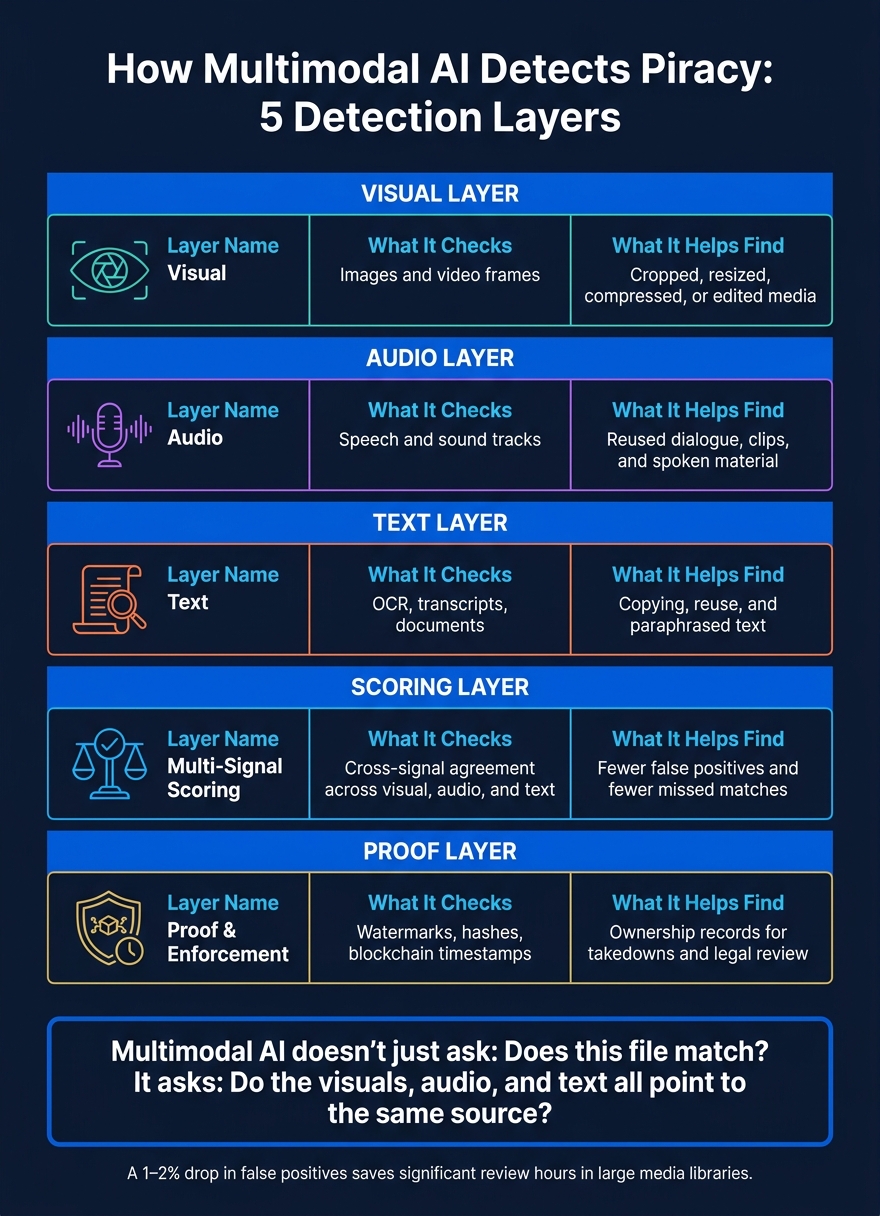
AI finds pirated media by checking more than one signal at once. Instead of looking only at a file hash or one frame, I look at image details, video frames, speech, sound, and text together to spot copied material after edits like cropping, compression, re-encoding, screenshots, memes, and paraphrasing.
Here’s the short version:
- Visual matching checks images and video frames for patterns that stay even after edits.
- Audio analysis turns speech into text and compares spoken words and sound tracks.
- Text matching uses OCR, transcripts, and semantic models to find copied or rewritten text.
- Multi-signal scoring cuts mistakes by looking for agreement across channels.
- Proof and enforcement tools help move from detection to takedown support and dispute review.
A single-signal system can miss changed copies, often failing where advanced content matching algorithms succeed. For example, a cropped image, a low-resolution repost, or a paraphrased document may slip through. But when I combine signals, the match is still easier to spot.
That matters because false alerts waste time, and missed matches can cost money. In large media libraries, even a 1% to 2% drop in false positives can save review hours. And when visual, audio, and text signals line up, teams have a stronger basis for notices, claims, and internal review.
Here’s a quick look at the job each layer does:
| Layer | What it checks | What it helps find |
|---|---|---|
| Visual | Images and video frames | Cropped, resized, compressed, or edited media |
| Audio | Speech and sound tracks | Reused dialogue, clips, and spoken material |
| Text | OCR, transcripts, documents | Copying, reuse, and paraphrased text |
| Scoring | Cross-signal agreement | Fewer misses and fewer wrong flags |
| Proof | Watermarks, hashes, timestamps | Ownership records for review and takedowns |
I’d sum it up like this: multimodal AI does not just ask “Does this file match?” It asks “Do the visuals, audio, and text all point to the same source?” That’s what makes it more useful for piracy checks at scale.
From there, the article explains how detection works, why multi-signal scoring is more accurate, and how tools like Idem, Txtmatch, Tectus, TorrentWatch, Indago, and ScoreDetect fit into detection, proof, and enforcement.
Multimodal AI Anti-Piracy: Detection Layers Explained
How AI Pulls Evidence from Images, Video, Audio, and Text
Multimodal AI turns images, video, audio, and text into machine-readable features, then checks them against protected references. In most cases, visual signals come first. Audio and text then help fill in what the image alone may miss.
Visual Analysis for Images and Video Frames
For images and video, AI samples frames and runs feature extraction on each one. It then maps those results into a matching index that can spot the same content even after edits.
That’s how InCyan’s Idem can detect visuals that have been cropped, resized, compressed, or turned into memes. The system looks for persistent signatures that stay in place even when the file itself has changed.
When the visual proof is incomplete, the next signal usually comes from audio.
Audio and Speech Analysis
Audio detection turns speech and recorded sound into machine-readable evidence. Automatic speech recognition tools such as faster-whisper transcribe audio into text features, and the audio track itself can be pulled from the source video.
This matters when the spoken words are the thing that needs protection. Instead of relying only on what appears on screen, the system can check the dialogue directly.
Those transcripts then move into the next matching layer: text.
Text Matching with OCR, Transcripts, and Semantic Models
Text extraction pulls from three main sources:
- OCR lifts text embedded in images or video frames
- ASR transcripts capture spoken content
- Raw documents go straight through semantic models
All three feed the same matching pipeline. That setup helps catch both direct reuse and paraphrasing.
InCyan’s Idem handles multimodal matching across images, video, and audio. Idem Text focuses on text, using large-scale comparisons to flag unauthorized reuse.
sbb-itb-738ac1e
Why Using Multiple Signals Produces More Accurate Detection
Each modality has blind spots. That’s why multimodal scoring works better: it looks for agreement across visual, audio, and text signals instead of leaning on just one.
The rule is simple. Weak evidence in one channel lowers confidence. Aligned evidence across channels pushes confidence up. So a weak visual match doesn’t trigger a flag by itself. But a visual match backed up by audio and text does.
How Multimodal Scoring Cuts False Negatives and False Positives
Multimodal scoring lowers false negatives on edited copies and cuts false positives by requiring cross-channel agreement. In plain English, it helps the system avoid two common mistakes: missing altered content and flagging the wrong thing.
It also helps spot edited copies the system hasn’t seen before. Why? Because the combined signal holds up across changes like compression, re-encoding, cropping, and overlays. Any one of those edits can throw off a single-channel check. Taken together, though, visual, audio, and text signals still point in the same direction.
Where Multimodal Detection Applies in Practice
This matters most in places where edited content is tough to verify. Think training videos, campaign assets, investor decks, social clips, and reused product photos on e-commerce sites.
These are the kinds of files people trim, resize, compress, repost, and layer with new elements all the time. Those edits can weaken single-signal confidence. But when visual, audio, and text signals are scored together, the match is still detectable.
That scoring layer is what turns detection into evidence for the next step: proof, review, and takedown.
How InCyan‘s Tools Cover Detection, Proof, and Enforcement

Detection is only the first step. A full anti-piracy workflow needs to do three things well: spot suspicious reuse, show who owns the work, and support enforcement. That flow starts with detection, then moves into proof and enforcement. InCyan’s tools are set up around those layers.
What Each InCyan Tool Does
| InCyan Tool | Primary Modality / Layer | Anti-Piracy Role |
|---|---|---|
| Idem | Images, video, audio | Finds reused or altered content across visual and audio assets |
| Txtmatch | Text | Matches text against a secure enterprise database to detect unauthorized or plagiarized content |
| Tectus | Invisible watermarking | Embeds invisible watermarks to provide persistent proof of ownership |
| TorrentWatch | BitTorrent network | Monitors the BitTorrent ecosystem for unauthorized content distribution |
| Indago | Search results | Finds infringing content indexed by search engines and helps de-index unauthorized links |
Taken together, these tools cover the main places where piracy shows up and spreads: reuse, discovery, and enforcement.
How ScoreDetect Creates Blockchain-Based Proof of Ownership

Proof comes next. ScoreDetect timestamps a checksum and metadata on blockchain, then issues a verification certificate with the hash, blockchain link, registration date, and owner.
In plain English, that gives you a recorded trail tied to the asset. If a dispute comes up later, you’re not stuck saying, “This was mine first.” You have dated records that point to when the work existed and who registered it.
Why Evidence Quality Matters for Takedowns and Legal Readiness
When you submit a takedown notice, the quality of your evidence can shape how persuasive that notice is. Weak evidence often slows things down. Strong evidence gives reviewers more to work with.
Here’s how the pieces fit together:
- Idem helps show what was copied across images, video, audio, or text through multimodal matching.
- Tectus backs ownership claims with invisible watermarking.
- ScoreDetect adds a blockchain timestamp that helps show when the work existed and who claimed ownership.
Those records then feed takedowns, review, and legal review.
Conclusion: What Multimodal AI Changes for Anti-Piracy Operations
Multimodal AI cuts down on piracy misses by checking visual, audio, and text signals together. So if one layer gets changed, detection doesn’t fall apart.
When the system looks for agreement across those signals, it also cuts noise and improves confidence. That helps teams spend less time chasing weak leads and more time on cases that look solid.
But detection by itself only gets you part of the way. Enforcement needs proof. Detection starts to matter in practice when InCyan adds proof and enforcement through Tectus, ScoreDetect, and Indago. These tools often utilize invisible watermarks to ensure that proof remains intact even if the media is tampered with.
For content-heavy businesses, this shifts piracy response from guesswork to evidence-backed action. That’s the real change multimodal AI brings to anti-piracy operations: proof that can stand up during enforcement.
FAQs
How is multimodal AI better than file-hash matching?
Multimodal AI works better here because it can look at the content itself across different formats instead of only asking, “Does this file match a known hash?”
That matters a lot for piracy detection. If someone changes the file, reformats it, clips part of it, or reuses only a section, a hash check can miss it. Multimodal AI has a better shot at spotting those altered or partial copies.
Can AI still detect pirated content after heavy edits?
The original answer doesn’t address piracy detection or AI at all.
Instead, it talks about a Supreme Court ruling on women’s and girls’ sports teams, Title IX, and player eligibility based on biological sex.
What proof helps support takedowns after detection?
Useful proof includes quantitative verification of unauthorized usage and clear evidence that the detected content matches the original asset.
That makes takedowns easier to validate and act on.