Pirated video and image content is a revenue problem, not just a legal issue. In 2026, if I want one platform to deal with it, I need it to do five things: prove I owned the asset first, find copied files across the web, match edited versions, store evidence, and send removal requests at scale.
Here’s the short version:
- U.S. losses tied to online video piracy are estimated at $29.2 billion to $71 billion per year
- Streaming providers may face $113 billion in cumulative losses by 2027
- More than 80% of stolen and shared U.S. content is viewed on streaming sites
- Piracy sites logged 216.3 billion visits in 2024
So if I’m reviewing a platform, I’m not just asking, “Can it find copied content?” I’m asking:
- Can it prove prior ownership?
- Can it find cropped, clipped, compressed, or reposted versions?
- Can it monitor websites, search, social, marketplaces, and torrents?
- Can it build a tamper-evident evidence record?
- Can it send DMCA, marketplace, and de-indexing requests with status tracking?
The article’s main point is simple: detection alone is not enough. I need one workflow that connects proof, detection, evidence, and takedown so legal, finance, brand, and ecommerce teams can track exposure, removal time, repeat offenders, and revenue at risk.
A quick way I’d frame the stack:
| Layer | What it does |
|---|---|
| Ownership proof | Timestamps and records who owned the file first |
| Watermarking | Marks images and video before distribution |
| Matching | Finds edited or partial copies |
| Monitoring | Checks search, social, marketplaces, sites, and P2P channels |
| Enforcement | Sends notices, tracks status, and logs case history |
If I were summarizing the full article in one line, it would be this: the right enterprise setup links ownership proof with monitoring and takedowns, then measures results in hours-to-removal, false positives, repeat infringement, and dollars at risk.
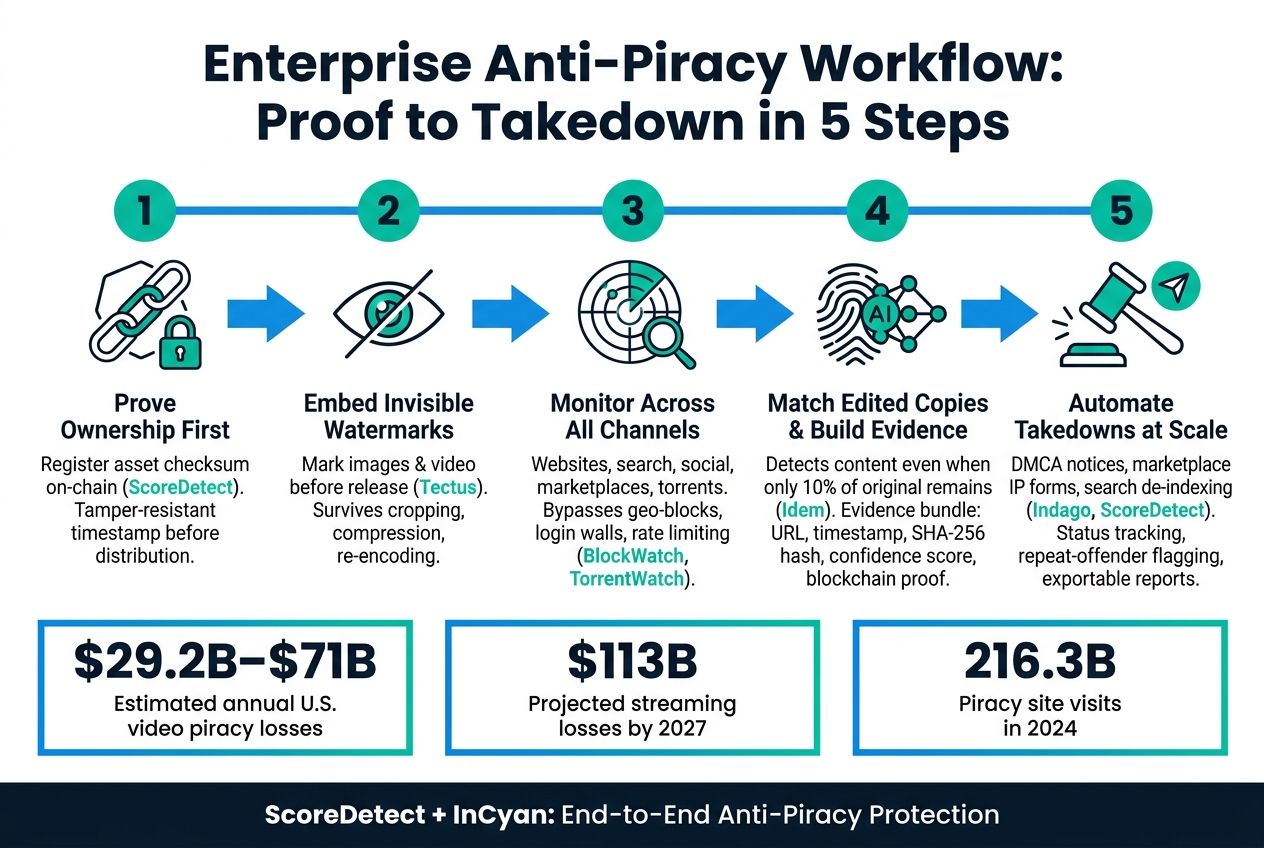
Enterprise Anti-Piracy Workflow: Proof to Takedown in 5 Steps
Why Streaming Antipiracy Needs to Move from Reactive to Preventive
sbb-itb-738ac1e
The 5 core capabilities every enterprise anti-piracy platform needs
An enterprise anti-piracy platform comes down to five jobs: proof, discovery, matching, evidence, and enforcement. That sounds simple on paper. In practice, it only works if the platform can prove who owned the asset first, spot edited copies in the wild, and turn each hit into action.
Proving ownership before infringement happens
If you wait until content is stolen, you’re already on the back foot. At that point, ownership can turn into a legal debate instead of a recorded fact.
Invisible watermarking handles this at the source. InCyan’s Tectus embeds imperceptible marks directly into image, video, and audio files. For enterprise use, those marks must survive resizing, compression, format conversion, and re-encoding while staying invisible to viewers. Tectus also supports watermark recovery without the original file, which means a watermark can be pulled from a suspect file at any stage of the enforcement process.
ScoreDetect covers the proof layer. When an asset is registered, ScoreDetect records its checksum on-chain, creating a tamper-resistant timestamp of first ownership. That on-chain record becomes the basis for every enforcement action that comes next, without storing the actual digital assets.
Finding and matching content across blocked, edited, and dynamic sources
Once ownership is locked in, the next job is finding altered copies across blocked and fast-moving sources: websites, search results, social platforms, marketplaces, and peer-to-peer networks. Detection is only useful if the platform can get to the content in the first place. Many infringing sites use geo-blocking, login walls, rate limiting, and anti-bot defenses to stop automated discovery. ScoreDetect’s web scraping engine is built to get past those barriers, using adaptive crawling to reach blocked pages, login walls, and rate-limited sites.
Matching is where many basic tools fall apart. Pirates don’t usually post neat, untouched copies. They crop, compress, add text overlays, clip short segments, and tuck content inside memes or reaction videos. InCyan’s Idem platform uses multimodal AI matching across image, video, and audio signals, and it can still identify content ownership even when only 10% of the original asset remains. For video, InCyan’s Indago search removal layer can de-index unauthorized links fast. TorrentWatch adds coverage across the BitTorrent ecosystem, giving rights holders real-time detection across peer-to-peer distribution channels.
Verifying infringement and automating takedowns at scale
A detection by itself doesn’t do much. It becomes useful when it turns into evidence and an enforcement record. Before a takedown can move forward, each detection needs to become a usable evidence file.
That record should include:
- The source URL
- The discovery timestamp
- A capture record, such as a screenshot or downloaded file with a cryptographic hash
- The extracted watermark or fingerprint match
- A confidence score
- The blockchain ownership proof tying the case back to the rights holder
ScoreDetect assembles and stores this evidence in tamper-resistant logs, then generates platform-specific notices automatically – DMCA takedown requests, marketplace IP infringement forms, and search de-indexing submissions – sent through the right filing channels with status tracking built in. That creates a takedown workflow that can scale, with automated notices, tracking, and escalation.
When a repeat offender uploads the same content again under a new account or domain, the system flags the pattern and routes the case to legal teams for escalated action. Finance and legal teams also get exportable reports showing incident volume, takedown timelines, and enforcement outcomes – the numbers they need to quantify exposure and show whether the program is working.
| Evidence element | Purpose |
|---|---|
| Source URL + account/listing ID | Identifies the specific infringing location |
| Discovery + capture timestamp | Establishes when infringement was found |
| Cryptographic hash of capture | Proves the evidence record hasn’t been altered |
| Watermark/fingerprint match + confidence score | Provides the technical basis for the infringement claim |
| Blockchain ownership proof | Demonstrates prior ownership before the infringing post |
| Takedown notice + status log | Documents enforcement actions and outcomes |
How ScoreDetect and InCyan support end-to-end protection
These tools work best when proof of ownership, detection, and enforcement all live in the same flow. ScoreDetect handles ownership proof. InCyan finds misuse and helps with removal. Put together, they create a single proof-to-enforcement workflow.
ScoreDetect for blockchain proof, certificates, and workflow automation
ScoreDetect hashes each asset and anchors the checksum plus minimal metadata to a public blockchain. The media file itself stays off-chain.
From that anchor, ScoreDetect issues two certificate types. Verification Certificates include the hash, blockchain transaction ID, timestamp, and submitting entity. They can be checked on the public blockchain URL. Formal Recognition Certificates add a signed attestation for legal review and internal dispute resolution.
For large libraries, ScoreDetect supports bulk exports, a developer API, and Zapier connections. That setup lets operations teams register full catalogs automatically, send infringement alerts into ScoreDetect cases, and notify legal teams without manual handoffs.
ScoreDetect creates the proof record. InCyan turns that proof into matched detections and enforcement actions.
InCyan capabilities for watermarking, matching, search delisting, and torrent monitoring
Each InCyan product lines up with a specific channel where pirated video and image content tends to spread.
Tectus embeds invisible watermarks into image and video files before distribution. That makes it possible to link discovered copies back to the original through both the watermark and the blockchain record.
Idem identifies copied or derivative images and videos across social platforms and marketplaces, even when they have been cropped, recolored, re-encoded, or covered with text and logos.
Indago monitors major search engines and marketplaces. It also supports automated or semi-automated delisting of unauthorized links from search results.
BlockWatch keeps watch over geo-fenced, login-walled, or fast-changing sites using scraping and circumvention techniques.
TorrentWatch scans torrent metadata and sampled content across the BitTorrent ecosystem. It surfaces info hashes, tracker URLs, swarm size estimates, and first-seen timestamps to support notices and takedowns.
Comparison tables: how each capability contributes to protection
The tables below show how each layer supports legal defensibility and scale in day-to-day operations, with the goal of faster detection and takedown to protect revenue.
| Technical pillar | Ownership proof | Detection strength | Legal defensibility |
|---|---|---|---|
| Blockchain timestamping (ScoreDetect) | Strong | Not applicable | High with chain-of-custody records |
| Invisible watermarking (Tectus) | Strong when applied consistently before distribution | Strong for copies where the watermark survives edits | High |
| Multimodal matching (Idem) | Supportive | Very strong across edited, cropped, and re-encoded derivatives | Moderate to high |
Use the product map below to match each tool to the right part of the anti-piracy program.
| Product | Content type coverage | Primary function | Typical enterprise use case |
|---|---|---|---|
| ScoreDetect | Images, video, documents, any file type | Blockchain timestamping, certificates, workflow automation | Legal proof |
| Tectus | Images and video | Invisible watermarking | Pre-distribution marking |
| Idem | Images and video | Multimodal AI matching | Edited-copy detection |
| Indago | Search-indexed content | Search delisting | Search delisting |
| BlockWatch | Blocked or geo-fenced sites | Blocked-site monitoring | Blocked-site monitoring |
| TorrentWatch | Video collections, image libraries, datasets | BitTorrent ecosystem monitoring | P2P monitoring |
How to evaluate an enterprise anti-piracy platform in 2026
Picking the right platform comes down to measurable results, not polished sales talk. Before you sit through a demo, define what success looks like and establish ownership of digital media in numbers your finance, legal, and brand teams will care about. Then use the five capabilities above as your demo scorecard.
Technical and operational checks that matter
Start with watermarking resilience. Test it on two major social networks and one marketplace. Then ask for written survival rates and failure rates. If a vendor can’t show where the watermark holds up – and where it breaks – that’s a red flag.
For matching quality, don’t settle for a clean lab test. Use mirrored, clipped, thumbnail, and recolored copies in the test set. That gives you a much better read on how the system performs when pirated content has been altered, which is almost always the case.
For crawling coverage, ask for a domain matrix by category:
- Major search engines
- Social networks
- User-generated content sites
- Marketplaces
- Torrent indexes
- Streaming sites
- Forums
Also ask what percentage of blocked crawls the platform successfully bypasses. Require the vendor to disclose blocked-crawl bypass rates, and use that figure as the pilot benchmark. Any bypass method must follow applicable law, platform terms, and documented escalation rules.
Evidence integrity is non-negotiable for legal teams. Require tamper-evident logs, SHA-256 hashes, and a full chain-of-custody record for every capture. On top of that, verify that the platform’s API supports webhooks, bulk case exports, and integration with the ticketing or case-management tools your legal and operations teams already use.
Metrics finance, legal, and brand teams will ask for
Next, report results by stakeholder group. Keep finance, legal, and brand separate. Each team looks at the same platform from a different angle.
Finance will ask for revenue at risk and estimated revenue recovered. Those numbers are most useful when tied to takedown timestamps and your internal sales data. Finance will also track detection-to-takedown latency. For high-value content, that should be measured in hours, not days.
Legal teams usually focus on number of unique infringing locations per asset, time exposed before removal, and repeat-infringer visibility. In plain English: how often the same account or domain shows up again after a notice.
Brand teams care more about visibility. They watch share of authorized vs. unauthorized content in top search results and social feeds, along with the geographic distribution of pirated copies for region-specific campaigns.
Across all three groups, false-positive rate can quietly drain time and money. Every wrongly flagged item pulls analysts away from actual infringements. Ask the vendor for measured precision and recall on a labeled dataset that includes licensed partners, fair-use clips, and commentary – not just obvious infringements. Then use a labeled test set of your own to verify precision, recall, and false-positive rate.
Evaluation table for internal review
Score each criterion from 1 to 5 and use the totals to rank pilots. Use the table below during demos and pilot reviews, then share it with finance, legal, brand, and IT before making a final recommendation.
| Evaluation criterion | Minimum 2026 requirement | Related capability | Questions to ask during a demo or pilot |
|---|---|---|---|
| Watermarking resilience | Invisible, survives platform recompression, cropping, and re-encoding | Tectus blind watermarking; invisible proof of ownership | Show watermark survival rates on two major social networks and one marketplace. Provide failure cases. |
| Content matching accuracy | Detects clips, thumbnails, mirrored and recolored copies; false-positive rate disclosed | Idem multimodal AI matching; detects content when as little as 10% of the original remains | Run our test asset set including short clips and overlaid text. Share confidence scores. |
| Evidence integrity | Tamper-evident logs, SHA-256 hashes, full chain-of-custody record for every capture | ScoreDetect blockchain timestamping with SHA-256 hash and public ledger URL | Generate a full evidence bundle for one infringement and walk us through the chain of custody. |
| Takedown automation | Covers major U.S. and global platforms; configurable templates; >96% success rate | ScoreDetect automated delisting notices | Initiate takedowns for a test URL set and show end-to-end tracking and resolution time. |
| Crawling and bypass capability | Handles JS rendering, infinite scroll, CAPTCHAs; reports bypass success rate | ScoreDetect targeted web scraping | Demonstrate a live crawl on a bot-protected site. What is your blocked-crawl bypass rate? |
| Integrations | REST/GraphQL API, webhooks, bulk exports, connects to legal/ticketing tools | ScoreDetect developer API and Zapier connections to 6,000+ apps | What are your API rate limits? Show us an existing connector to a case-management tool. |
| Enterprise support | SLAs for uptime and detection latency; 24/7 coverage; dedicated account management | Dedicated success manager; 24×7×365 premium support; private Slack channel | What are your SLA commitments for detection latency? How do you handle incident escalation? |
Building a practical anti-piracy program: implementation and next steps
Rollout steps for high-value image and video libraries
Once the platform clears evaluation, move from pilot to a phased rollout.
Start with the assets that carry the most risk: flagship product videos, premium photography, and prelaunch campaign files that could hit revenue the hardest if they leak. Register and timestamp those assets first. Then add watermarking and fingerprinting, watch the main channels where pirated image and video content spreads, and send matches into review or automated delisting when confidence is high.
That usually means monitoring places like:
- Websites
- Search results
- Social platforms
- Marketplaces
- File-sharing networks
A good way to keep this under control is to pilot just one or two content types first. From there, expand based on false positives, review time, and takedown success.
Reporting, governance, and continuous improvement
Once coverage is live, lock in reporting and governance.
Use one evidence standard across legal, marketing, ecommerce, and content teams. In plain English: one record set, one escalation path, and one infringement standard. That cuts confusion and makes case handling much cleaner.
Track the numbers that tell you what’s working and where things are slipping:
- Infringement volume by channel
- Discovery-to-takedown time
- Takedown success rate
- Repeat-offender frequency
- Highest-leakage content categories
A weekly or biweekly steering review helps teams stay aligned and spot campaign-specific risks before they spread. With 216.3 billion visits to piracy websites recorded in 2024 [1][2][3], steady monitoring and a fixed review cadence are what make the program scale without turning into chaos.
Key takeaways
With governance in place, the operating model becomes repeatable.
Enterprise anti-piracy in 2026 is a repeatable workflow. The strongest programs combine ownership proof, watermarking, matching, discovery, verification, and automated takedowns. ScoreDetect and InCyan support that workflow with blockchain proof, watermarking, matching, search enforcement, torrent monitoring, and automated delisting.
FAQs
How does an enterprise anti-piracy platform prove prior ownership?
It relies on layered proof. At the moment an asset is created, a SHA-256 hash of that asset gets recorded on a blockchain. That creates a tamper-evident record showing when the content existed and who claimed it, without putting the original file on-chain.
If a dispute comes up, that record works alongside invisible watermarking and AI-powered multimodal matching. Together, they help link edited or partial copies back to the original asset and support a verifiable chain of custody.
Can the platform find edited or partial copies of our content?
Yes. The platform is built to find edited and partial copies using multimodal AI fingerprinting. Instead of relying only on file hashes, it looks at the semantic core of an asset.
That matters because file hashes break the moment a file gets changed. This system keeps working after cropping, compression, color filters, resizing, re-encoding, and synthetic edits. It can even spot matches when as little as 10% of the original remains.
Invisible watermarking adds another layer. It helps keep ownership signals attached to the asset and supports automated takedowns.
What should we measure to judge anti-piracy ROI?
Measure the metrics that tie detection to business impact:
- Infringements detected
- High-confidence matches removed
- Enforcement speed, including takedowns within 60 minutes
- False-positive rates
- Reduced manual review hours
It also helps to track whether evidence-backed reports – including invisible watermarks and blockchain-verified timestamps – lead to better takedown and dispute success.