Temporal fingerprinting is a cutting-edge method for identifying video content by analyzing unique patterns like motion, scene transitions, and frame details. Unlike traditional file hashes, this approach works even if the video is altered – cropped, compressed, or re-encoded. Here’s why it matters:
- Rising Piracy Rates: Up to 60% of movies leak pre-release, impacting creators and studios.
- Resilient Detection: Fingerprints survive transformations, enabling real-time monitoring across platforms.
- Legal Strength: Provides forensic-grade evidence for ownership claims, even with altered copies.
How It Works:
- Fingerprint Creation: Keyframes are analyzed to generate a unique, compact signature.
- Database Matching: AI scans platforms for matches, even with changes like cropping or speed adjustments.
- Blockchain Integration: Some systems, like ScoreDetect, anchor fingerprints to tamper-proof blockchain records.
Comparison to Other Tools:
- Watermarking: Tracks leak sources but requires embedding unique markers.
- DRM: Prevents access but is bypassed by screen recording.
By combining fingerprinting with watermarking and blockchain-based timestamps, creators can protect content, identify leaks, and prove ownership. This layered defense is essential for industries like streaming, film, education, and media.
How Temporal Fingerprinting Works
Generating Temporal Fingerprints
The process of creating a temporal fingerprint begins with feature extraction, where the system identifies and condenses key visual details from the video into a compact mathematical signature. Unlike a simple file hash, this signature captures the unique visual identity of the video itself by analyzing its structural elements, such as frame geometry.
An essential step in this process is keyframe analysis. This technique samples specific frames throughout the video, extracting distinct visual patterns from each one. As Webkyte explains, "Persistent Optical Scanning: Detects visual fingerprints" [3]. Unlike metadata, which can be stripped or altered, this method directly analyzes the video’s content, making it far more reliable.
Once the fingerprint is generated, it is stored in a reference database. In some cases, the fingerprint is also anchored to a blockchain, creating a tamper-proof, timestamped record of the original content. For instance, ScoreDetect uses this approach by recording a checksum of the video on the blockchain while keeping the actual file private [2]. This ensures proof of ownership without exposing the content itself. With the fingerprint securely stored, the system is ready to compare it against potential duplicates.
Matching Temporal Fingerprints
When a potential copy is identified, its fingerprint is extracted and compared to the reference database. AI-powered matching algorithms perform these comparisons at scale, scanning across platforms and formats with impressive speed. This integration of extraction and matching enables the system to operate in near real time, providing robust protection.
What sets this method apart is its ability to handle transformations during the matching process. InCyan’s Idem engine exemplifies this resilience, as it can detect matches even after modifications like cropping, re-encoding, compression, or speed adjustments – limitations that traditional hash-based tools cannot overcome [5]. Idem can confirm ownership from even small fragments of content [5]. Additionally, some systems support blind extraction, which allows matches to be verified without needing the original source file. This feature is especially valuable when the master copy is unavailable or must remain confidential.
sbb-itb-738ac1e
Temporal Fingerprinting vs. Other Anti-Piracy Methods
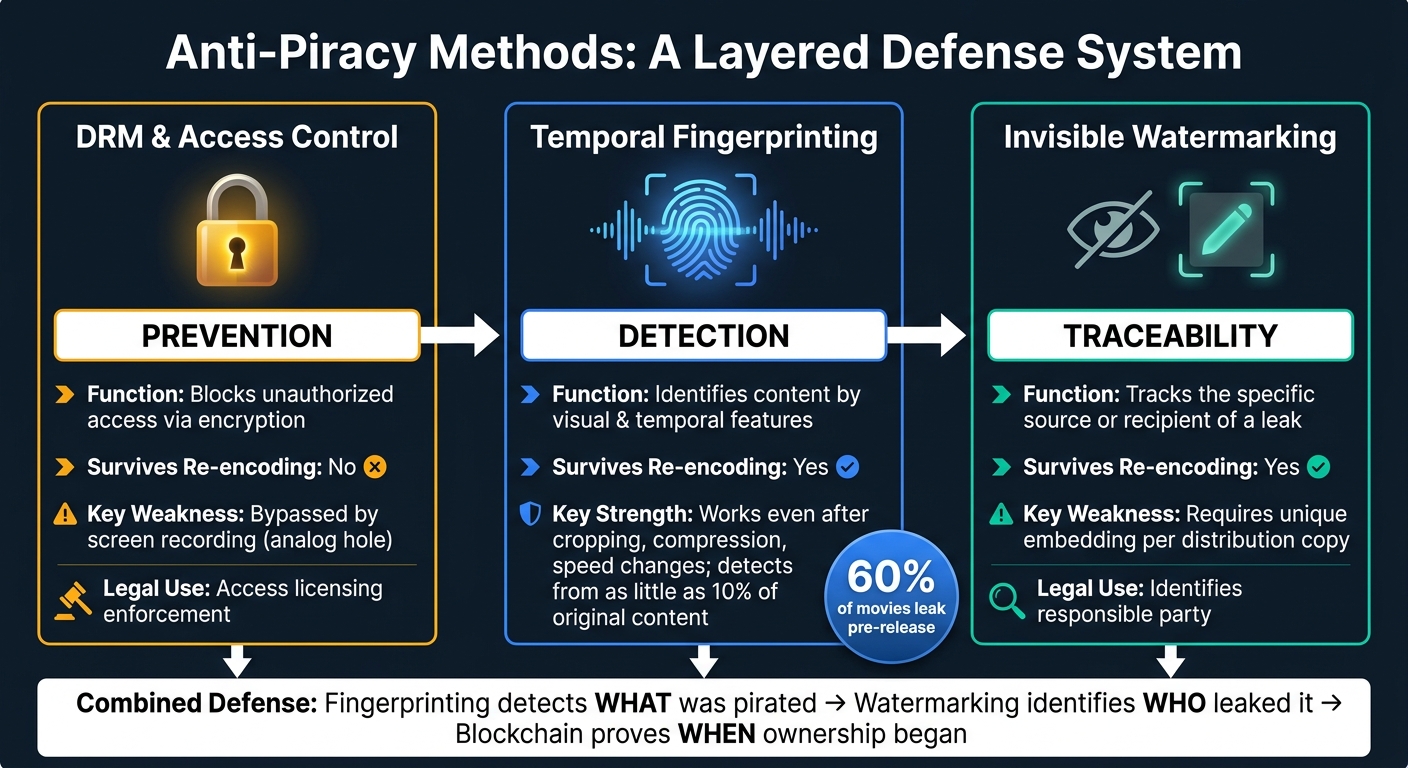
Temporal Fingerprinting vs. Watermarking vs. DRM: Anti-Piracy Methods Compared
Temporal Fingerprinting vs. Invisible Watermarking
While these two technologies are sometimes confused, they serve very different purposes. Temporal fingerprinting focuses on identifying content, analyzing a video’s visual and structural traits to match it against a reference database. On the other hand, invisible watermarking focuses on identifying the source of a leak, embedding unique, hidden markers into each distributed file to trace leaks back to a specific recipient or distribution point.
Both methods are imperceptible to viewers, leaving the content’s appearance unchanged. However, their applications differ. Fingerprinting is ideal for large-scale, automated monitoring – scanning social media, file-sharing platforms, and rogue sites to detect unauthorized copies. Watermarking, meanwhile, is better suited for controlled environments, such as distributing screeners to film critics or awards voters, where accountability is key. As Custos Media Technologies explains:
"The real power, however, is not as much in the tracking of infringement as in the deterrent effect that this so-called ‘social Digital Rights Management (DRM)’ has on would-be pirates." [4]
For enterprise-level protection, InCyan’s Tectus offers blind watermarking for video, images, and audio. This technology embeds invisible proof of ownership that withstands compression, cropping, and re-encoding without affecting content quality. When paired with temporal fingerprinting, the result is a powerful two-layer system: fingerprinting identifies unauthorized copies, while watermarking pinpoints the source of the leak.
While watermarking excels at tracking leaks, DRM takes a different approach by focusing on preventing unauthorized access altogether, making these methods complementary.
Temporal Fingerprinting vs. DRM and Access Control
DRM operates at the access control stage, using encryption and license keys to block unauthorized viewing or copying. Temporal fingerprinting, however, comes into play after distribution, identifying pirated copies wherever they surface online.
DRM’s major vulnerability lies in the analog hole: content can be captured via screen recording, bypassing encryption entirely. Temporal fingerprinting addresses this gap. Even if a pirated copy is screen-recorded, altered, and uploaded to unauthorized platforms, the fingerprint embedded in the video’s structural geometry remains detectable. DRM ensures secure delivery, while fingerprinting tracks breaches after distribution.
The table below highlights the distinct roles and limitations of these anti-piracy methods:
| Layer | Method | Function | Limitation |
|---|---|---|---|
| Prevention | DRM & Access Control | Blocks unauthorized access via encryption | Can be bypassed by screen recording (analog hole) |
| Detection | Temporal Fingerprinting | Identifies content by visual/temporal features | Requires a reference database of registered content |
| Traceability | Invisible Watermarking | Tracks the source or recipient of a leak | Requires unique embedding for each distribution |
A layered approach combining these methods offers the strongest defense. For example, ScoreDetect enhances this strategy by anchoring a checksum of your content on the blockchain. This creates a tamper-proof, timestamped record of ownership that holds up in legal disputes, even when DRM is bypassed and forensic analysis is required [2]. By integrating temporal fingerprinting, DRM, and invisible watermarking, organizations can build a comprehensive defense system that proactively protects their content.
Where Temporal Fingerprinting Is Used
Industries That Use Temporal Fingerprinting
Temporal fingerprinting plays a crucial role in protecting video content across multiple industries. Streaming platforms, for example, use it to pinpoint which distribution partners or regions might be leaking exclusive content before its official release. Film studios rely on this technology to monitor digital screeners sent to critics and awards voters, ensuring early access material doesn’t fall into the wrong hands [3].
Outside of entertainment, businesses use temporal fingerprinting to safeguard sensitive materials like training videos, executive communications, and other private recordings from internal leaks. Educational institutions apply it to secure proprietary course materials and high-value lectures, preventing unauthorized redistribution [4]. Media and stock agencies also benefit, as it helps protect licensed broadcast footage shared with third-party publishers, ensuring assets aren’t misused [1].
These varied use cases highlight the demand for flexible protection strategies. For example, InCyan’s Idem platform can detect content ownership even when as little as 10% of the original material remains intact. This adaptability makes it suitable for a wide range of applications, from live to on-demand communications.
Real-Time Detection vs. Batch Processing
The method of deploying temporal fingerprinting depends on the type of content being protected. For live broadcasts – like major sports events or breaking news – digital signatures are embedded directly into broadcast encoders during the ingestion stage. This ensures immediate protection with zero latency [3]:
"High-value live broadcasts require immediate forensic identity injection; digital signatures are applied in real time during ingestion." – Webkyte [3]
On the other hand, on-demand video libraries often rely on batch processing. Automated systems continuously scan piracy sites, file-sharing platforms, and rogue domains for fingerprint matches, analyzing vast amounts of unstructured video data. Here’s a breakdown of how these two approaches differ:
| Feature | Real-Time Detection | Batch Processing |
|---|---|---|
| Primary Use Case | Live sports, news, high-value events | VOD libraries, archives, bulk assets |
| Latency | Zero-latency / sub-millisecond | Variable, optimized for volume |
| Integration Point | Broadcast encoders / ingestion stage | Enterprise APIs / batch uploaders |
| Detection Goal | Immediate interception and takedown | Historical tracing and audit trails |
| Data Scale | High-velocity live streams | Petabytes of unstructured data |
Many organizations combine both methods to ensure comprehensive protection. Real-time monitoring is used for live events, while scheduled batch scans offer ongoing surveillance for existing content libraries. Together, these approaches provide a robust defense against unauthorized use.
Adding Temporal Fingerprinting to an Anti-Piracy Program
Implementation Best Practices
The first step is crucial: embed forensic identifiers directly into broadcast encoders during ingestion. This ensures a continuous mathematical link from the original source to every downstream copy, making it much easier to trace any leaks back to their origin – whether that’s a specific partner, region, or distribution channel [3].
Every distribution copy should be assigned a unique identifier. Whether it’s for a streaming platform, a regional distributor, or an awards screener recipient, this level of detail is essential for pinpointing the source of a leak. Without it, you might know piracy occurred, but identifying the responsible party becomes nearly impossible.
To keep the system manageable as your content library grows, maintain an up-to-date fingerprint registry that maps specific asset versions to their recipients. Pair this with automated detection pipelines , often powered by AI in real-time piracy detection, to ensure scalability across global platforms.
Another key practice is to integrate blind extraction capabilities from the beginning. This allows you to verify the origin of content, even if the original file isn’t available – a vital feature when dealing with pirated copies that have been heavily compressed or re-encoded.
By following these practices, you can establish a strong foundation for content security. From here, layering additional tools can further enhance your defenses.
Tools That Work Alongside Temporal Fingerprinting
Temporal fingerprinting is most effective when combined with other security measures, rather than used on its own. Pairing it with invisible watermarking adds another layer of protection: fingerprinting identifies what the content is, while watermarking identifies who leaked it. For instance, InCyan’s Tectus platform embeds invisible watermarks into video, audio, and images. These watermarks survive compression, cropping, and re-encoding, offering undeniable proof of ownership without affecting the viewer’s experience.
Another powerful tool is blockchain timestamping, which provides tamper-proof, time-stamped records of ownership that can hold up in legal cases. ScoreDetect excels in this area by creating a cryptographic checksum of your content – rather than storing the file itself – and anchoring it to the blockchain. With an average transaction speed of about 3.516 seconds [2], this method avoids the costs and privacy concerns of large file storage. ScoreDetect also integrates with over 6,000 web apps via Zapier, making it easy to incorporate content protection certificates into existing workflows.
When combined, temporal fingerprinting, invisible watermarking, and blockchain timestamping form a multi-layered defense system. Each layer addresses a specific challenge: detecting piracy, tracking its source, and proving ownership. Together, they reinforce one another for comprehensive protection.
| Layer | Primary Function | Survives Re-encoding? | Legal Use |
|---|---|---|---|
| Temporal Fingerprinting | Identify content across platforms | Yes | Forensic evidence of distribution |
| Invisible Watermarking | Trace specific leak source | Yes | Identifies responsible party |
| Blockchain Timestamping | Prove ownership & creation date | N/A (hash-based) | Court-admissible proof of creation |
Conclusion
Temporal fingerprinting has proven to be an effective tool for protecting video content. By analyzing a video’s structural traits, it can reliably identify content – even after compression, re-encoding, or cropping – without interrupting the viewing experience.
Its real strength lies in how it works alongside other security measures. As discussed earlier, fingerprinting pinpoints what content was pirated, invisible watermarking identifies who leaked it, and blockchain timestamping establishes when ownership began. Each method complements the others, creating a multi-layered defense. As InCyan explains: "Invisible watermarking meets immutable blockchain records, creating verifiable proof of authenticity, origin, and licensing with AI-powered verification." [1] This combined approach not only reinforces ownership claims but also simplifies the fight against piracy.
The industry is also moving toward more proactive strategies. Modern systems use continuous detection pipelines to catch leaks early, often removing infringing content within 60 minutes [6]. Every minute a pirated copy stays online means lost revenue and diminished control.
For rights holders, the roadmap is straightforward: embed fingerprints during content ingestion, assign unique identifiers to each distribution channel, anchor ownership with blockchain tools like ScoreDetect, and automate enforcement. Together, these steps create a strong foundation for safeguarding video assets.
FAQs
How accurate is temporal fingerprinting after heavy edits?
ScoreDetect’s approach is built to hold up even after heavy edits, thanks to the durability of its watermark or fingerprint. It’s specifically designed to endure transformations such as compression, cropping, filtering, and color grading. By using methods like transform-domain embedding and redundancy, the system ensures that signals remain detectable even after substantial modifications. Advanced AI tools can extract these signals, even when mixed with noise or altered through re-exports, making ownership verification possible even in tough scenarios.
What video data is needed for fingerprint matching?
Fingerprint matching operates by transforming video assets into compact 512-dimensional float vectors. These vectors encapsulate temporal segments of the video, integrating both frame and audio data. This approach enables the system to recognize content even if it’s been modified, such as through cropping or speed adjustments. To conserve memory, these fingerprints are compressed using a method known as Product Quantization. Additionally, ScoreDetect employs blockchain-based checksums, eliminating the need to store the actual digital assets for protection.
How does ScoreDetect’s blockchain timestamp help in a piracy dispute?
ScoreDetect, developed by InCyan, uses blockchain technology to create an unchangeable record by storing your asset’s checksum. This secure timestamp acts as cryptographic proof of both ownership and the time of creation. Importantly, it achieves this without storing the original file, ensuring privacy while maintaining security. The verification certificate connects the checksum to a blockchain transaction, providing solid evidence that can support takedown requests or legal actions.