Video splicing detection is critical for protecting content integrity and combating piracy. Splicing manipulates video segments to mislead viewers, evade copyright systems, or spread misinformation. Detecting these alterations is challenging due to advanced editing techniques, platform processing, and AI-driven tampering.
Key Challenges:
- Scene Reordering: Minor edits or partial reuse of clips can bypass older detection systems.
- Compression & Metadata Loss: Platforms like YouTube strip forensic markers, complicating detection.
- AI Evasion: Tools obscure watermarks, alter visuals, or even re-record videos to erase evidence.
Solutions:
- Multimodal AI Matching: Combines video and audio analysis to detect spliced content despite alterations.
- Invisible Watermarking: Embeds undetectable ownership markers that survive edits and compression.
- Blockchain Timestamping: Records video hashes on a tamper-proof ledger for legal verification.
These tools, when integrated into anti-piracy workflows, enable faster detection, documentation, and enforcement, reducing the impact of splicing on businesses and legal systems.
Challenges in Detecting Video Splicing
Understanding these challenges is essential for developing effective AI-based strategies to combat piracy.
Scene Reordering and Partial Content Reuse
Reordering scenes or reusing small clips makes detection tools struggle. Hash-based systems, for instance, falter when even minor changes occur – a simple re-encode or crop alters the file’s bitstream entirely, making the spliced content untraceable [5]. The difficulty increases when only a small fragment of the original is reused. Forensic AI, however, can identify source material even if just 10% of the original content is present [5]. Without such advanced AI, even small edits can bypass older detection systems.
"Digital assets now live in a world of constant reuse. A single file can appear as a scanned page on a piracy forum, as a clipped quote on social media, and as a compressed recording on a peer to peer network." – Nikhil John, InCyan [6]
Tracking how content fragments spread across platforms is another hurdle. An asset might show up as a short Instagram clip, a compressed torrent file, or a reposted YouTube segment. Detection systems must identify and align these altered segments with the original material, even when speed, aspect ratio, or resolution has been modified [6]. These challenges only grow when factoring in the additional impact of platform-specific processing.
Compression and Platform Processing
Platforms like YouTube, TikTok, and Instagram apply their own compression and transcoding processes when users upload videos. These processes often strip metadata and degrade forensic markers [7]. Visible watermarks, a common protective measure, are especially vulnerable. AI tools can blur or remove them, while heavy compression hides subtle frame-boundary artifacts that might otherwise reveal splicing [3].
"Standard visible overlays are easily cropped or bypassed, leaving your intellectual property vulnerable towards possible piracy." – WebKyte [3]
The financial impact of content leaks is massive, with an average loss of $10 million per incident due to lost revenue and recovery expenses [7]. To counteract these risks, pixel-level invisible watermarking has emerged as a stronger alternative. These watermarks are designed to endure resizing, compression, and re-encoding, offering better protection against piracy [3]. However, these measures must also contend with deliberate AI-driven evasion tactics.
AI-Driven Evasion Techniques
Bad actors are increasingly using AI tools to obscure logos, tweak colors, add overlays, and alter aspect ratios – all of which confuse detection systems while keeping the video visually intact [3]. The scale of the issue is staggering: deepfake video production has surged by 900% since 2019, and 68% of online images are reportedly used without proper licensing, often involving unauthorized splicing or reuse [4].
One particularly tricky method is the "analog hole", where a digital video is re-recorded using a physical camera. This process strips metadata and breaks digital signatures entirely [3]. Companies like InCyan are adapting to these evolving tactics, emphasizing that their algorithms are "continuously refined as the threat landscape evolves, keeping your protection ahead of new forms of infringement." [5] These sophisticated evasion techniques highlight the ongoing need for advanced AI solutions, which will be explored further in the next section.
sbb-itb-738ac1e
AI-Powered Solutions for Video Splicing Detection
Video Splicing Detection: AI Solutions Compared
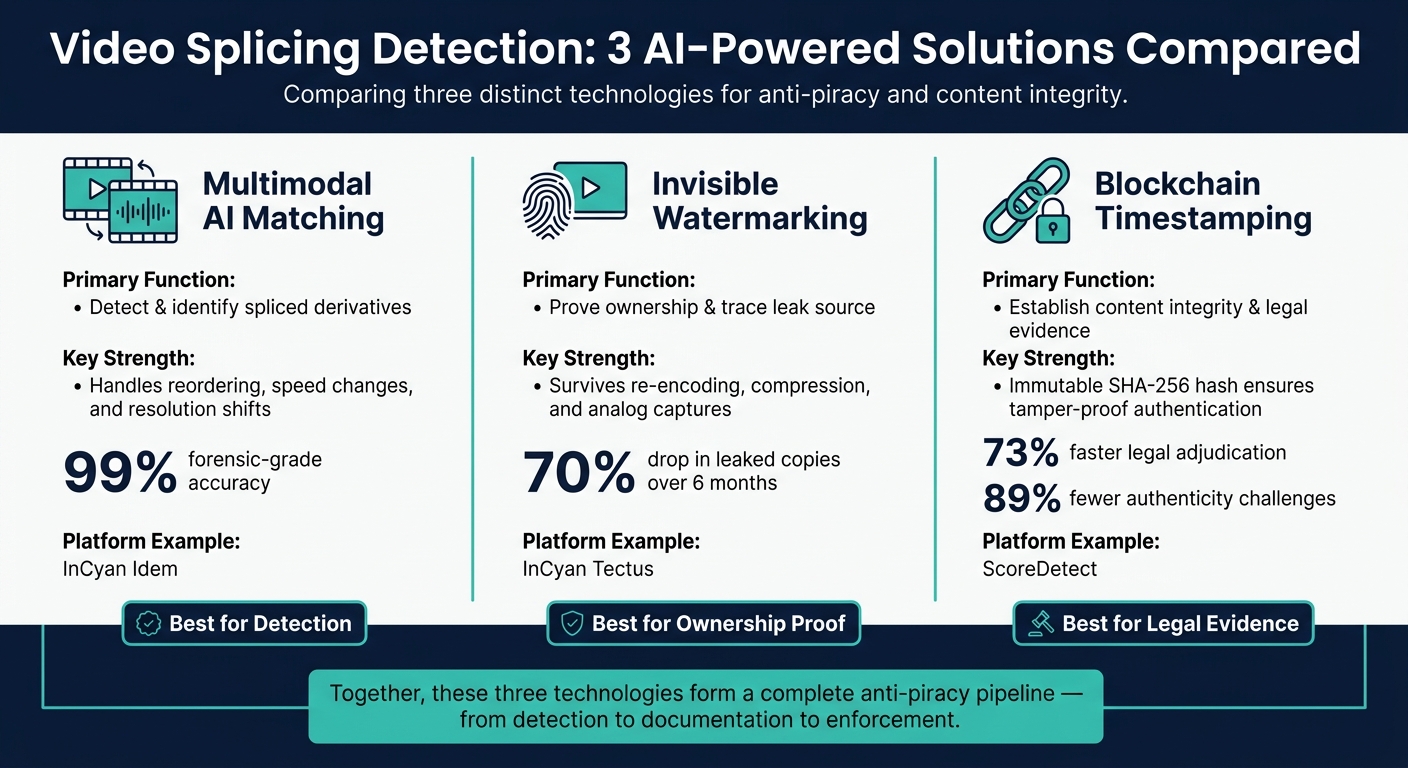
The challenges of scene reordering, platform compression, and AI-driven evasion call for detection tools that go beyond basic file hashing. To address these complexities, advanced AI tools have introduced powerful methods to counter sophisticated splicing techniques. Leading the charge are three technologies: multimodal AI matching, invisible watermarking, and blockchain timestamping.
Multimodal AI Content Matching
Modern AI detection systems operate on multiple levels, combining frame-level visual analysis with audio fingerprinting to identify spliced content, even after extensive transformations. Nikhil John from InCyan explains:
"Video classification aligns temporal segments with their source assets even when speed, aspect ratio, or resolution have changed." [6]
This cross-modality approach allows systems to detect clips where the video has been cropped and the audio pitch-shifted – two alterations that could bypass single-mode detectors. Audio models are specifically designed to recognize content despite changes in tempo or background noise, making it possible to catch even brief snippets embedded in spliced videos [6].
InCyan’s Idem platform takes this a step further, offering enterprise-scale identification with 99% forensic-grade accuracy. It clusters detected instances into "incidents", grouping near-duplicates and derivatives to help enforcement teams track how spliced clips spread across platforms like social media, torrent sites, and peer-to-peer networks [6].
Invisible Watermarking for Ownership Proof
Invisible watermarking addresses the limitations of visible overlays by embedding ownership markers directly into a video’s pixel data. These watermarks are undetectable to viewers but can be identified by forensic tools, even after re-encoding, compression, cropping, or analog hole captures (e.g., re-recording a screen with a camera) [3][8].
One major advantage is blind extraction, which eliminates the need for the original file to verify the watermark. This means even heavily modified fragments can be traced back to their rightful owner without requiring the master copy [8]. InCyan’s Tectus is designed for this purpose, providing invisible proof of ownership for images, video, and audio. This enables faster copyright enforcement without affecting the viewer’s experience.
The impact is clear: in 2024, dynamic A/B watermarking – which assigns unique, invisible forensic signatures to each viewer – led to a 70% drop in leaked copies over just six months [3].
Blockchain Timestamping for Content Integrity
While invisible watermarks confirm who owns content, blockchain timestamping establishes when it was created. Together, these tools provide a strong foundation for legal disputes.
ScoreDetect addresses this by generating a SHA-256 cryptographic hashing checksum of a video and recording it on the SKALE blockchain. This blockchain offers zero gas fees and an eco-friendly cost model [1]. Importantly, the video itself is never stored:
"ScoreDetect does not store any digital assets or content. It only stores the checksum of the content on the blockchain. This means that your digital assets are safe and secure with you." – ScoreDetect [1]
Even minor alterations, such as a single frame change, result in a new hash, making tampering immediately evident when compared to the original blockchain record. Verification certificates are created in about 3.5 seconds and include the hash, a public blockchain URL, and the transaction record. These certificates provide tamper-proof evidence that can be used in legal cases [1]. For high-volume content teams, ScoreDetect’s Pro plan starts at $11.31/month, billed annually, with a 7-day free trial.
The table below highlights how these three technologies complement each other:
| Approach | Primary Function | Key Strength |
|---|---|---|
| Multimodal AI Matching | Detect & identify spliced derivatives | Handles reordering, speed changes, and resolution shifts |
| Invisible Watermarking | Prove ownership & trace leak source | Survives re-encoding, compression, and analog captures |
| Blockchain Timestamping | Establish content integrity & legal evidence | Immutable hash ensures tamper-proof authentication |
Integrating Splicing Detection Into Anti-Piracy Workflows
Advanced AI detection becomes far more impactful when integrated into comprehensive anti-piracy workflows. Detection is just the first step – what truly matters is combining it with swift responses, thorough documentation, and legally sound evidence to tackle piracy effectively.
End-to-End Detection Pipelines
The process begins the moment content is uploaded. A cryptographic hash, such as SHA-256, is generated to lock in the content’s original state. AI tools then scan for splicing artifacts or reordered segments. To ensure transparency, a public verification record is created – either via a blockchain URL or a QR-linked certificate – allowing third parties to confirm the content’s authenticity without needing access to the original file.
These pipelines are designed for seamless integration. Many modern tools offer RESTful APIs, making it easy to embed this functionality into existing Content Management Systems (CMS) or Digital Asset Management (DAM) platforms. This eliminates the need for manual reviews and ensures content is protected right from the start. The result? A fully automated system that enables continuous monitoring across multiple platforms.
Automated Monitoring Across Platforms
Once content integrity is verified, the next step is ongoing monitoring to detect unauthorized copies. Tools like InCyan’s Indago platform excel in this area. Operating at the search layer, Indago combines rapid scanning with forensic precision, de-indexing unauthorized links in under 60 minutes. This cuts off access to pirated content before it gains momentum.
For peer-to-peer networks, InCyan’s TorrentWatch monitors the BitTorrent ecosystem in real time, identifying infringing torrents and providing immediate enforcement data. Together, these tools address the two primary channels for distributing spliced videos. With these systems, the average response time from leak detection to action is reduced to just 90 minutes [3].
Evidence Preservation and Legal Support
When it comes to legal action, having credible evidence is critical. Blockchain vs traditional timestamping methods and AI-generated reports lend the necessary weight to enforcement efforts. Cases using cryptographically sealed evidence have seen 73% faster adjudication and encountered 89% fewer challenges to authenticity compared to traditional methods [2].
ScoreDetect plays a key role here, generating Verification Certificates and Formal Recognition Certificates that meet rigorous standards. Each certificate includes essential details like the SHA-256 hash, a public blockchain URL, a transaction record, and an official signature from ScoreDetect Limited. According to the company:
"ScoreDetect certificates can be a valuable tool in copyright protection and can be used in conjunction with other legal safeguards." [1]
To simplify workflows, ScoreDetect integrates with over 6,000 web apps through Zapier, automating the protection process from start to finish [1].
Conclusion and Future Directions
Key Takeaways
The integration of multimodal AI matching, invisible watermarking, and blockchain timestamping is transforming the way rights holders protect their content. These technologies now provide a dependable method to verify content integrity and respond swiftly to violations. Tools like InCyan’s Idem and Tectus bring these innovations together, creating a robust defense system capable of adapting to various splicing techniques. Meanwhile, ScoreDetect adds a crucial legal component by linking content provenance to an unchangeable blockchain record, ensuring it stands up to scrutiny.
This new approach represents a shift from reactive measures to proactive protection. Instead of scrambling to address infringements after the damage is done, today’s systems detect, document, and enforce protections in near real time – sometimes within just 60 minutes of a leak appearing online. These advancements are paving the way for a future where proactive detection becomes the standard.
The Future of Video Splicing Detection
As proactive measures advance, detection technology will continue to evolve to meet the growing challenges. The threat landscape is expanding rapidly – deepfake video production has surged by 900% since 2019 [4], and this trend shows no signs of slowing down. With manipulation tools becoming more accessible, detection systems must keep pace. Enhanced matching algorithms are already capable of identifying content even when only 10% of the original remains [5]. Additionally, enterprise-scale monitoring systems that operate 24/7 are now emerging [5]. As these technologies develop further, they will address challenges like scene reordering and compression-induced data loss, dramatically reducing the time between a leak’s appearance and its removal. This will make unauthorized distribution far less profitable.
Sustainability is also becoming a key focus. Eco-conscious blockchains like SKALE are enabling zero-gas-fee timestamping [1], making large-scale, continuous content protection more feasible without adding substantial costs. For organizations managing extensive video libraries, this kind of efficiency is no longer optional – it’s a necessity.
FAQs
How is video splicing detected after YouTube or TikTok recompresses it?
Detecting splicing in videos becomes tricky after platforms recompress them, as this process can hide many editing clues. Still, AI-powered tools have stepped up to tackle this challenge. These tools focus on subtle forensic details, like pixel-level inconsistencies or editing traces that remain even after compression. Machine learning models are also evolving to recognize new types of manipulations, spotting irregularities in even the most compressed videos. On top of that, invisible watermarks or digital signatures – like those provided by tools such as ScoreDetect – offer another layer of verification, ensuring content integrity even after recompression.
What’s the difference between invisible watermarking and blockchain timestamping?
Invisible watermarking works by embedding unseen identifiers into media like images, videos, or audio. These identifiers help trace leaks or confirm ownership, even if the media has been edited or compressed. On the other hand, blockchain timestamping – used by tools like ScoreDetect – generates a cryptographic hash of the content and stores it on the blockchain. This method provides unchangeable proof of the content’s existence and authenticity. While watermarking focuses on forensic tracking, timestamping ensures ownership without modifying the original media.
How can I prove in court that a spliced clip came from my original video?
To demonstrate that a spliced clip came from your video, you can use digital verification tools such as ScoreDetect. By uploading your original footage, you can create a cryptographic checksum that’s stored on the blockchain. This acts as proof of ownership and authenticity. Features like blockchain timestamping and robust watermarking help maintain a verifiable connection between the original video and any altered versions, even if they’ve been cropped or compressed.