If someone copies just 10 to 30 seconds of your video, they can still steal search traffic. I’d sum up the fix like this: find copied scenes using content matching algorithms, prove the video is yours, and show when you published it.
Here’s the core idea in plain English:
- Scene detection splits a video into smaller parts so partial copies can be found
- Scene fingerprints help match clips even after cropping, compression, clipping, or overlays
- Invisible watermarking helps link a copied file back to the owner
- Blockchain timestamping helps prove the publish date and gives a record for disputes
- A clear workflow moves from monitoring to verification to takedown
Why does this matter? Because video theft usually isn’t a full copy. It’s more often a remix, a cropped clip, or a repost of the best section. And if that copied page ranks first, you can lose visits, leads, and ad or subscription revenue.
I’d think of it as a 3-step proof chain:
- Find the copied scene
- Link it to your file
- Show the date it existed
That’s what this article is about: using scene-level matching, hidden ownership marks, and timestamp records to support de-indexing and takedown work with less guesswork.
| Layer | What it does | Main use |
|---|---|---|
| Scene detection | Finds reused video segments | Discovery |
| Watermarking | Ties the video to the owner | Ownership proof |
| Timestamping | Shows publish timing | Date proof |
If you want the short version, it’s this: full-video checks miss partial theft, but scene-level checks give you a much better way to spot copied clips and act on them.
How AI Scene Detection Identifies Misused Video Content
AI scene detection turns reused video into searchable proof at the scene level. Instead of treating a video like one big file, the system looks for shot changes and breaks the video into separate scenes.
That matters because misuse usually happens in pieces, not as a full 1:1 copy.
Scene boundaries, key frames, and video fingerprints
Once the system finds scene boundaries, it pulls key frames from each scene and builds a fingerprint from them. That fingerprint works like a searchable signature for the scene.
Full-file matching misses a lot of how video reuse happens in practice. Scene-level fingerprints are much more granular, which gives detection systems a better way to find matches.
That also makes matching hold up even when someone edits the video before uploading it again.
Detecting partial copies after cropping, compression, and remixing
Pirates almost never repost a video without changing it first. Common edits include:
- Cropping
- Compression
- Clipping
- Re-encoding
- Overlays
- Remixing
Because the fingerprint is tied to the scene’s visual content, the system can still match edited copies after those changes. Multimodal matching goes a step further and catches heavier edits, such as trimmed intros and added overlays.
Which method catches which kind of reuse
Scene fingerprints catch clipped and lightly edited reuse. Multimodal matching extends coverage to heavier transformations.
sbb-itb-738ac1e
Building a Three-Layer Defense for SEO Protection
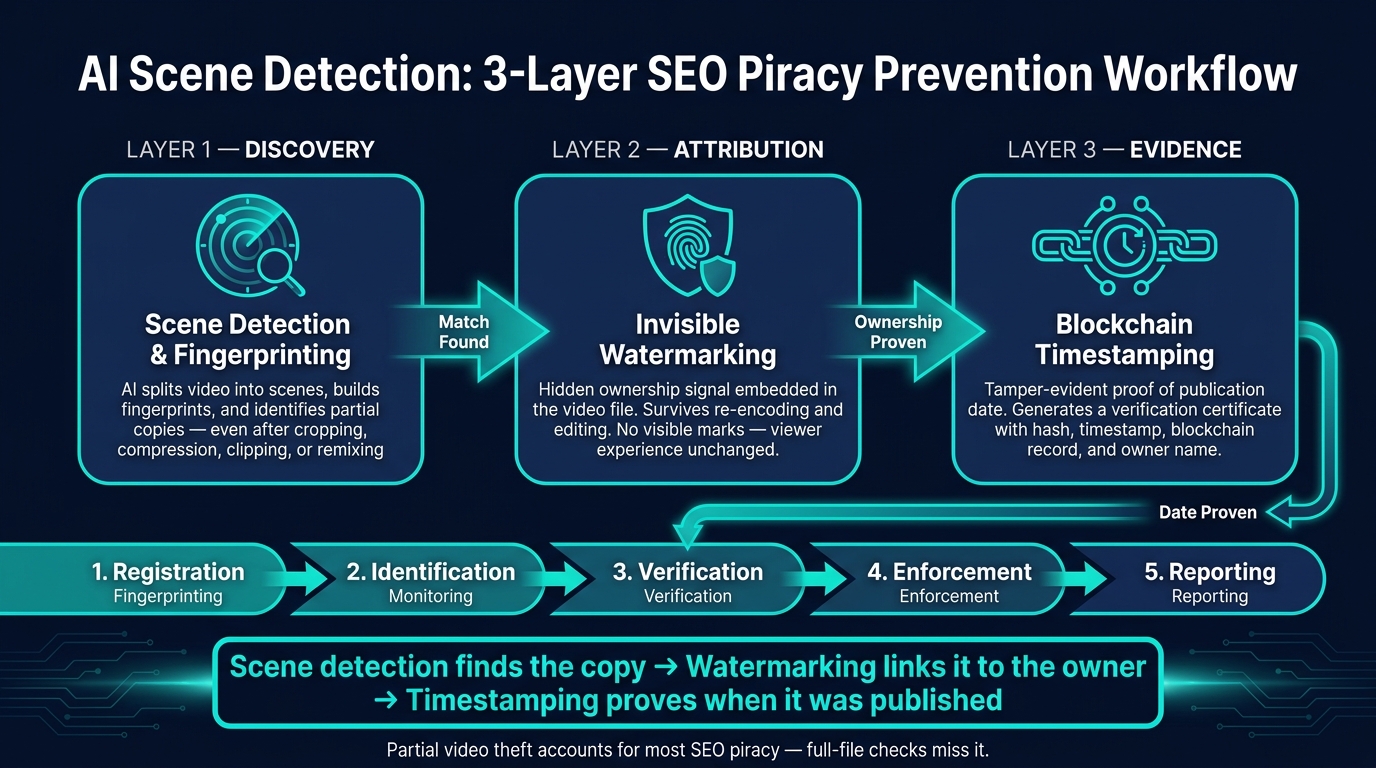
AI Scene Detection: 3-Layer SEO Piracy Prevention Workflow
Scene detection tells you where the problem is. But that alone doesn’t stop SEO piracy.
To take action, you also need to show that the video is yours and when it was published. That means detection is only one part of the job. You need two more layers on top of it.
Fingerprinting vs. invisible watermarking
Fingerprinting helps you find the copied scene. Watermarking and timestamping help you prove ownership.
That split matters. Discovery is one thing. Proving the asset belongs to you is another.
Invisible watermarking places a hidden ownership signal inside the file. Viewers can’t see it, and it stays in place even after compression or re-encoding. That means the viewing experience doesn’t change.
InCyan’s Tectus is an enterprise invisible watermarking solution that supports ownership claims when copied video shows up in search. And it does that without visible marks that hurt the asset.
Using blockchain timestamping to support ownership claims
After you find a match, one last gap remains: when the asset was published.
ScoreDetect, a product of InCyan, timestamps a content checksum on the blockchain at publication. That creates tamper-evident proof of when the asset existed. It can also generate a verification certificate with the hash, timestamp, blockchain record, and owner name – usable proof for platform, search, or legal disputes.
How the three layers work together
Each layer does a different job in one chain: discovery → attribution → evidence.
- Discovery – AI scene detection and fingerprinting identify partial copies, crops, and remixes from visual features.
- Attribution – Invisible watermarking (InCyan Tectus) embeds a resilient, non-visible ownership signal directly into the video asset.
- Evidence – Blockchain timestamping (ScoreDetect) provides tamper-evident proof of existence and publication timing.
Put together, these layers give teams match data, ownership proof, and a timestamped record to support de-indexing and takedown requests.
How Enterprises Run AI Scene Detection at Scale
Once scene fingerprints are in place, enterprises need a clear path from detection to takedown. Scene-level detection can spot reuse, but the next job is turning that signal into a process teams can run day after day.
That process starts before infringement shows up. Original video assets are registered and fingerprinted when they’re published. ScoreDetect captures a blockchain timestamp through automated registration workflows, creating a tamper-evident publication record. That timestamp becomes the anchor for later ownership claims.
After that, monitoring runs on a continuous basis across web and search surfaces. When a suspected match appears, the verification step checks the detected content against the registered fingerprint and ownership records. Only confirmed matches move to enforcement. That split – monitor, then verify, then act – helps cut false positives and keeps trust intact with platforms and search engines.
Once registration and verification are set, enforcement can move fast. Verified matches should flow straight into search enforcement. Pirated video pages that stay indexed keep siphoning search traffic and hurting brand visibility. InCyan’s Indago platform combines fast search crawling with forensic precision to de-index unauthorized listings quickly, stopping traffic loss before rankings are affected.
A simple enterprise workflow keeps ownership, monitoring, and enforcement aligned.
| Stage | Function | Relevant Tool / Technology | Team Owner |
|---|---|---|---|
| Registration | Fingerprinting | ScoreDetect | Marketing / Brand Protection |
| Identification | Monitoring | AI Scene Detection, Indago | SEO / Monitoring |
| Verification | Verification | ScoreDetect blockchain timestamping, invisible watermarking | Legal / Brand Protection |
| Enforcement | Enforcement | Indago, ScoreDetect automated delisting notices | Legal / SEO |
| Reporting | Reporting | ScoreDetect API | All Teams |
This kind of reliability comes from clear roles and automated handoffs. Each stage has a defined owner. Low-risk tasks can move through automation, while key decision points stay behind policy guardrails. That setup keeps the workflow repeatable at scale.
Conclusion: What AI Scene Detection Actually Solves for SEO Piracy
By the end of the workflow, AI scene detection picks up cropped, recompressed, and remixed copies that URL checks and basic content scans often miss. Once those matches are found, registered fingerprints make scene-level matching repeatable across search and video platforms.
Invisible watermarking from InCyan’s Tectus adds proof of ownership that can survive editing. ScoreDetect’s blockchain timestamping adds tamper-evident proof of when the content was registered. Put simply, scene detection finds the copy, watermarking links it back to the owner, and timestamping helps back up the claim.
Used together, these layers make enforcement faster, easier to defend, and simpler to scale. That helps protect search visibility, supports revenue, and protects brand trust.
FAQs
How does scene detection differ from full-video matching?
Scene detection looks at specific moments or segments inside a video. Full-video matching checks the entire file as one unit.
That difference matters a lot.
If someone reuses, edits, or republishes only part of a video, scene detection is usually the better fit. It can spot those smaller reused sections instead of treating the whole file like one big block.
Can AI still detect copied clips after editing?
Yes. AI scene detection can still spot copied clips after editing because it looks at the underlying visual content, not just exact frame matches.
That matters when you’re trying to track unauthorized video reuse. It also helps with SEO piracy prevention by finding misuse across edited versions, even when someone trims, crops, or changes parts of the clip.
How do watermarking and timestamping help prove ownership?
Watermarking and timestamping help prove ownership by tying content to its creator and showing when it existed.
A watermark can point back to the source. A timestamp adds a verifiable record linked to a specific moment in time.
Used together, they make ownership claims stronger and support efforts to track and deal with unauthorized use.