Yes – AI can flag copied content in seconds, but only the match step is that fast. In most cases, the system first turns a file into a fingerprint, scans the web or platforms for copies, and then checks possible matches almost at once. After that, people or legal teams still need to review the claim, confirm ownership, and send notices.
Here’s the short version:
- AI is fastest at matching images, audio, video, and text that were already indexed
- Fingerprinting and watermark checks can run in fractions of a second in test settings
- Detection is not the same as automated takedown
- Accuracy is strong, not perfect – some tools report 85% to 94% accuracy
- Losses are large: U.S. video piracy alone is tied to about $29.2 billion to $71.0 billion per year
- Proof still matters: timestamps, hashes, screenshots, and watermark checks help support claims
- Human review still matters for parody, commentary, licensing disputes, and edge cases
If I had to sum it up in one line, it would be this: AI is good at finding likely copyright misuse fast, but it still needs proof and review before action.
A simple way to think about it:
| Step | What happens | How fast |
|---|---|---|
| Fingerprinting | The file gets turned into a matchable signature | Usually fast |
| Matching | AI checks new files or pages against stored signatures | Often seconds or less |
| Monitoring | Crawlers and stream watchers keep scanning | Near-constant |
| Review and action | Teams verify, document, and send notices | Minutes to hours |
What stood out to me most is the split between speed and certainty. AI can find likely copies fast. But if you want to act with less risk, you still need a clear record of ownership and a person to review the hard cases.
How AI Detection Works: Fingerprints, Matching, and Monitoring
Content fingerprinting and perceptual matching
The backbone of fast copyright detection is the content fingerprint: a small numerical code that stands in for a piece of media. Unlike SHA-256, perceptual hashes stay close even when the content has been lightly edited.[2][6][8]
For images, pHash-style methods can shrink a photo into a 64-bit signature. If someone resizes it, saves it as a JPEG, or crops it a little, only a few bits usually change. For audio, these systems look at short spectral windows and produce time-stamped hashes that can survive re-encoding, background noise, and small tempo changes.[15][16][10][12]
Those fingerprints live in indexed databases that use content matching algorithms like locality-sensitive hashing or multi-index hashing to pull likely matches without checking every single record. That’s how lookups can stay in the millisecond range, even at very large scale.[2][4][5]
Deep learning for modified or partial copies
When edits throw off simple fingerprints, deeper models step in.
Perceptual hashing does a solid job with direct or lightly changed copies. But it starts to miss when content gets heavily cropped, turned into a meme, covered with text, or changed in other ways. That’s where deep learning comes in.
Modern convolutional and transformer-based models learn semantic embeddings. Put simply, they try to represent what the content is, not just the raw pixels. So a cropped image or a meme version of the same asset can still land near the original in embedding space, while unrelated content stays farther away.[4][5] Research suggests these models can still spot matches when only 10% to 30% of the original signal remains, or when the material has been repackaged into meme-style derivatives.[3][12]
Multimodal systems take it a step further by combining signals from visual frames, audio tracks, OCR-extracted on-screen text, and transcripts into one matching score.[4][5][7][10] That matters because people rarely alter every part of a file. If someone uploads a clip with changed visuals but leaves the soundtrack untouched, the audio alone may still confirm the match. InCyan‘s Idem uses this multimodal method across images, video, and audio.[4][5][7][10][12]
Automated monitoring across the web, streams, and P2P networks
The model matters. But the thing that drives speed is constant monitoring.[4][8][9]
On the open web, crawlers move through known piracy ecosystems, scrape search result pages, and watch marketplaces. Each file they find gets fetched, normalized, and fingerprinted before it’s checked against the rights holder’s reference catalog. For live streams, systems keep sampling rolling audio and video segments and query the fingerprint database in near real time. That lets unauthorized broadcasts get flagged while they’re still live.[5][10][11]
In P2P settings, surveillance tools watch torrent indexes, DHT traffic, and swarm behavior. Research indicates that a file sharer’s IP address can be logged within about three hours of starting a download on torrent networks.[13][14]
Indago by InCyan focuses on the search layer. It combines search monitoring with forensic matching to de-index infringing links within an hour. TorrentWatch by InCyan monitors the BitTorrent ecosystem at scale and automatically identifies infringement patterns while producing enforcement data teams can act on.
Speed matters, but detection only helps if the match is right. The next step is accuracy.
sbb-itb-738ac1e
What Research Shows About Accuracy, Speed, and Limits
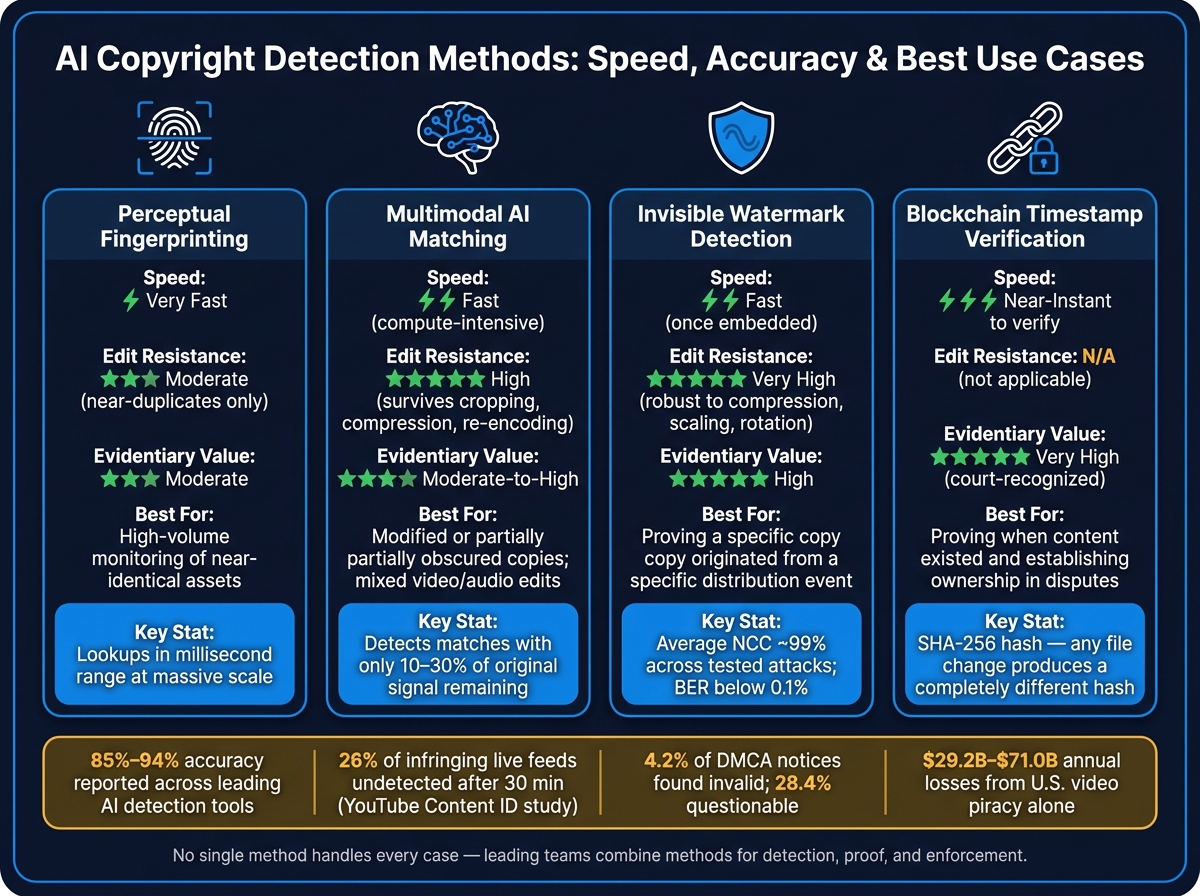
AI Copyright Detection Methods: Speed, Accuracy & Best Use Cases
Key performance metrics and why they matter
When you judge any AI copyright detection system, four metrics matter most: precision, recall, false positive rate, and false negative rate.
Here’s the plain-English version. Precision shows how much you can trust a positive alert. If the system says, “This looks like infringement,” precision tells you how often that call is right. Recall shows how much actual infringement the system catches in the first place. In copyright enforcement, you need both. A tool that flags everything creates noise. A tool that misses too much leaves your content exposed.
A single accuracy score can blur that tradeoff. It may look clean on paper, but it doesn’t tell you whether the system is over-flagging, under-detecting, or both. Scale matters too. A system may perform well in a lab, then stumble when it has to scan huge volumes of uploads, streams, and reposts in the wild. That’s where the tradeoffs start to show.
Where AI detection works well and where it falls short
Once a system finds a match, the next issue is simple: is the match strong enough to act on?
That answer changes when content has been edited, clipped, cropped, remixed, or reused in part. AI works best on near-duplicate or lightly edited copies. As the changes get heavier, performance drops.
Research on large vision-language models for copyright detection found that these models can deliver high recall, low precision. In practice, that means they catch many possible violations, but they also flag a lot of gray-area cases by mistake.[17] That’s useful for broad monitoring, but not enough on its own for clean enforcement.
You can see the same tension in platform systems. A study of YouTube’s Content ID found that 26% of infringing live feeds were still undetected after 30 minutes, and there were 29 misidentified claims in a 102-upload sample.[18] That’s a reminder that even well-known systems can miss infringing content while also making wrong calls.
The problem carries into takedown workflows too. In one sample analysis of DMCA notices, 4.2% were invalid and 28.4% were questionable, including possible fair use and other out-of-scope claims.[19]
That matters because AI cannot judge fair use, parody, commentary, or ownership disputes. It can spot patterns and similarities. It cannot weigh context like a person can. If an organization skips human review, it runs the risk of wrongful takedown disputes and damage to its reputation.
Comparison of common detection methods
No single method handles every case. Some are built for speed. Others are better when you need proof. Some hold up well after edits, while others are strongest when the copy is almost identical.
| Method | Speed | Resistance to Edits | Evidentiary Value | Best-Fit Use Case |
|---|---|---|---|---|
| Perceptual fingerprinting | Very fast | Moderate – effective for near-duplicates; less reliable with heavy transformation | Moderate – shows similarity, not provenance | High-volume monitoring of near-identical assets across web, platforms, and streams |
| Multimodal AI matching | Fast, but more compute-intensive | High – better at surviving cropping, compression, re-encoding, and other edits | Moderate-to-high – cross-modal corroboration strengthens the case | Modified or partially obscured copies; video and audio with mixed edits |
| Invisible watermark detection | Fast once embedded | Very high – robust to compression, scaling, and rotation; one 2024 study reported average normalized correlation (MNC) around 99% across tested attacks[7] | High – can link a copy back to its source file | Proving a specific copy originated from a specific distribution event |
| Blockchain timestamping verification | Near-instant to verify | Not applicable | Very high – verifiable creation-date evidence | Ownership proof in disputes |
Put simply, perceptual fingerprinting is built for fast matching at scale. Multimodal AI is better when the copy has been altered. Invisible watermarks help tie a file back to a source. Blockchain timestamps help show when something existed and who can point to that record in a dispute.
That’s why teams often combine methods instead of leaning on just one. One tool may find the match. Another may help support the claim.
Proving Ownership and Acting After a Match Is Found
Once AI flags a likely match, the next job is proof. Detection by itself doesn’t show ownership. What matters is showing that you had the content first, that the copied version leads back to your original, and that your evidence can stand up if someone pushes back.
Invisible Watermarking and Forensic Verification
Watermarking helps you verify a copy from the copy itself. The signal is embedded right into the content and can be detected later with math-based methods, even without the original file. That matters because suspected infringers rarely hand over source files.[25]
These systems are designed to survive the kinds of changes content goes through online. Research on robust invisible watermarking architectures reports bit error rates (BER) below 0.1% under attacks including JPEG compression, Gaussian blur, and cropping.[26] One improved scheme achieved near-perfect visual fidelity while maintaining an average NCC of 0.9998 under a wide range of attacks.[28]
There’s one technical point you can’t gloss over: the scheme must be noninvertible. If it isn’t, an infringer could add a fake watermark and then claim the work as their own. A noninvertible scheme shuts that down. Tectus uses this idea to provide invisible proof of ownership for images, video, and audio.
Blockchain Timestamping as Machine-Verifiable Evidence
Watermarking ties the copy to the source. Blockchain timestamps show when the source existed. A cryptographic hash is computed from the file, and only that hash is written to a public blockchain. If the hash matches, it shows the file existed at a certain time. Change even one part of the file, and the hash comes out completely different.[22][23][24]
Courts have recognized blockchain timestamps as evidence of prior existence and file integrity, though they still need supporting proof of authorship and originality.[20][21][22][23][24] ScoreDetect, a product of InCyan, puts this into practice by recording a content checksum on the blockchain and issuing verifiable certificates that include the SHA-256 hash and blockchain URL. Those certificates can go straight into enforcement dossiers without exposing the underlying asset.
Used together, watermarking and timestamping turn a likely match into something a legal team can work with.
From Alert to Takedown: The Automated Enforcement Workflow
After verification, teams need to turn evidence into a notice package. In plain terms, the flow is:
- Verify the alert through watermark extraction and fingerprint matching
- Document the evidence with URLs, screenshots, hash comparisons, and blockchain certificates
- Notify using a standard package that legal teams can reuse[1][22]
The biggest time saver is automation in notice generation. Studies of DMCA notice-and-takedown systems document a dramatic rise in takedown volumes once automated notice generation was introduced, reflecting that manual workflows simply can’t keep pace with the scale of online infringement.[27] Indago and TorrentWatch feed verified evidence into the notice process, while ScoreDetect’s blockchain certificates provide the proof of existence that supports each notice. After that, teams track removals and escalate cases that don’t get resolved.
Conclusion: What Businesses Should Take From the Research
The research points to a clear takeaway: AI can spot likely copyright violations in seconds or minutes when fingerprinting, multimodal matching, and continuous monitoring work together. That mix improves speed and accuracy. But it doesn’t remove the need for review, especially in edge cases. Heavy edits, context disputes, and false positives still need a person to step in. And that matters, because speed has value only when the alert is accurate enough to act on.
That speed matters for a simple reason: every day an infringing copy stays live can add to lost revenue, especially around a launch window. Still, fast detection by itself doesn’t settle a claim.
A detection alert becomes useful when it’s tied to proof. Invisible watermarking can verify the source from the source file, while blockchain timestamps can show when that file existed. Blockchain timestamping, such as ScoreDetect’s, anchors a cryptographic checksum to a public ledger. Once that proof is attached, the alert can move straight into copyright enforcement and takedown.
The strongest workflow connects detection, proof, and notice generation in one chain so legal teams can act right away. ROI tends to be highest when detection, evidence, and takedown are automated from the start. Fast detection without evidence is noise; fast detection with proof is enforcement.
FAQs
How does AI tell a real copy from a heavily edited version?
AI-powered systems use multimodal matching to scan images, video, audio, and text. The goal is simple: spot the same content even after someone edits it through cropping, compression, or pitch-shifting. To do that, these systems build digital fingerprints that are meant to hold up through major changes.
InCyan supports this work with a set of tools built for different parts of the job:
- Idem for multimodal identification
- Tectus for invisible watermarking
- Indago for de-indexing
- ScoreDetect for blockchain-based proof of ownership and creation time
Think of it like a layered system. One tool helps find the content, another marks it, another helps remove search visibility, and another records who owned it and when it was created.
Can AI prove I own the original content?
AI can help verify ownership by matching images, video, audio, and text with neural fingerprints instead of relying on exact file matches.
That matters because exact matching falls apart the moment someone tweaks a file. Crop an image, compress a video, or pitch-shift audio, and a basic match system may miss it. Neural fingerprints work differently. They can spot altered copies even when the content has been changed and even when only 10% of the original is still there.
ScoreDetect, a product of InCyan, adds blockchain-based proof of ownership. It records a tamper-proof cryptographic checksum and creates a verifiable audit trail.
Why is human review still needed after AI finds a match?
AI can quickly spot likely matches by finding patterns across images, audio, video, and text – even when the file has been changed through cropping, compression, or pitch shifts.
That said, people still need to review the results. Human review helps confirm the context, check whether the use was unauthorized, and back up any enforcement steps. Tools like ScoreDetect add another layer by attaching a blockchain timestamp and checksum, which can serve as proof of ownership.