Yes – an invisible watermark can still be found after edits like cropping, resizing, compression, and re-encoding. That works because the mark is spread across the file, placed in parts that often stay in place after common changes, and checked with recovery-based detection instead of exact file matching.
Here’s the short version:
- The watermark is hidden inside the media, not shown on top of it.
- It is repeated across the asset, so removing one part may not remove the whole mark.
- Detection looks for pattern traces, not a perfect copy of the original file.
- Blind detection means the original file is not needed during the check.
- Heavy edits can still break detection, especially severe cropping, print-scan steps, geometric warping, or many conversions.
- A second match layer can help when the watermark is weak or gone.
- Proof matters too: a SHA-256 fingerprint on blockchain adds a dated ownership record without storing the file itself.
- One claim in the article stands out: multimodal matching may still identify an asset when only 10% remains.
If I put it simply, watermark survival comes down to signal placement, repetition, recovery, and proof. The watermark helps identify the file after normal edits. If that fails, file matching and timestamped records help close the gap.
That is the full idea of the article in plain English.
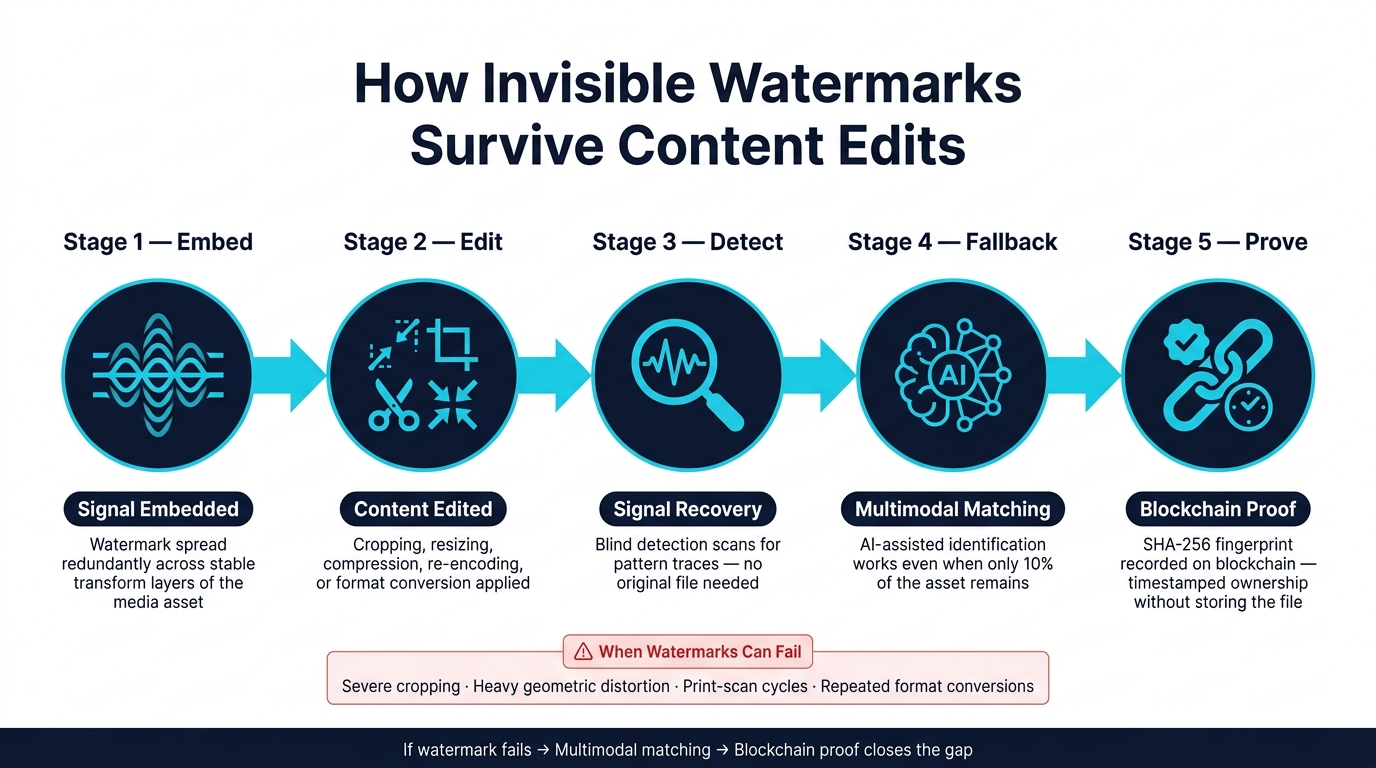
How Invisible Watermarks Survive Content Edits: Detection Workflow
How Invisible Watermarks Are Built to Withstand Common Edits
Embedding the signal in stable parts of the media
Robust watermarking works by placing the signal in parts of the media that tend to stay intact after editing. Instead of tying the mark to one pixel or one audio sample, these systems spread it across features that are less likely to change.
A common approach is to use transform layers, since those layers often hold up better during compression and resizing. Put simply, the watermark is tucked into areas that are more likely to survive routine changes.
Why cropping, compression, and resizing do not always remove the watermark
The big idea here is redundancy. A robust watermark isn’t placed just once. It’s repeated across the asset, which makes it harder to wipe out with a simple edit.
That means cropping may remove part of the signal, but not all of it. Resizing can weaken the mark, yet enough of it may still remain for detection. Modern systems often leverage deep learning for watermark detection to improve accuracy even when signals are degraded. Compression works the same way. It can damage the signal, but it does not always erase it.
Redundancy matters: a robust watermark is repeated across the asset, so cropping or resizing leaves enough signal for detection.
How InCyan positions blind watermarking for enterprise use

InCyan’s Tectus is a blind watermarking solution for images, video, and audio. ScoreDetect Enterprise also adds invisible watermarking for images, video, audio, and documents.
For enterprise teams, that matters because blind watermarking does not require the original file during detection. That can make deployment simpler across large media libraries and day-to-day workflows.
Still, there are limits. This kind of resilience can weaken when edits become aggressive or happen over and over.
sbb-itb-738ac1e
Where Watermark Robustness Has Limits
Invisible watermarks are built to hold up, but they’re not indestructible. They’re tuned for the kinds of edits people usually make, not endless damage. The limit shows up when those edits stop preserving the structure of the signal itself.
Edits that can weaken or erase watermark detection
Severe cropping, heavy geometric distortion, print-scan cycles, and repeated conversions can weaken or erase the signal. These edits can push past the redundancy built into the mark. Once that happens, detection can’t depend on the watermark by itself.
Why survivability depends on the threat model
A watermark is only as durable as the threat model it was built for. A system made for social media reposting will usually be tuned against platform compression and mobile editing apps. Other use cases may care more about surviving cropping or print-scan workflows.
That’s why risk planning should focus on resilience against expected edits, not on the idea that the watermark alone will resist removal attacks in every case. If the watermark fails, InCyan’s Idem can still identify the asset through AI-assisted multimodal matching.
How Detection Still Works After the File Changes
Once edits weaken the file, detection moves from exact matching to signal recovery. After resizing, cropping, compression, or re-encoding, detectors stop looking for a perfect file match and start looking for signal traces that still remain.
Signal recovery and AI-assisted detection
Modern detectors can handle noise and partial data loss by matching the watermark’s pattern instead of an exact copy. That means ownership can still be checked even when some of the original data has changed or disappeared.
Why multimodal matching strengthens edited-content identification
When a watermark is only partly recoverable, multimodal matching adds a second layer of proof. InCyan’s Idem adds another identification path across images, video, and audio, even when as little as 10% of the original asset remains after edits such as cropping or compression. If the watermark survives, use it. If it doesn’t, multimodal matching can still identify the asset. That recovered match can then be paired with timestamped proof and enforcement.
Watermarks, Blockchain Proof, and Enforcement Workflow
Once a match makes it through editing, the next step is simple: prove ownership and do something about it. An invisible watermark only becomes useful when you can pair it with a timestamped record that shows the content was yours first.
How ScoreDetect adds timestamped proof of ownership

ScoreDetect, a product of InCyan, records a SHA-256 fingerprint of the content on the blockchain without storing the file itself. That creates a timestamped ownership record for legal, commercial, and internal proof.
In plain terms, the file stays private, but its fingerprint is recorded in a way that can later help show when that content existed and who claimed it. With that fingerprint in place, enforcement can focus on the infringing copy.
How monitoring and enforcement complete the enforcement workflow
InCyan’s enforcement tools then turn proof into action: Indago de-indexes infringing links, and TorrentWatch monitors BitTorrent distribution in real time.
That means the workflow doesn’t stop at detection. First, you identify a surviving watermark. Then you connect it to a timestamped ownership record. After that, tools like Indago and TorrentWatch help deal with the copy where it’s being shared or found.
Conclusion: What makes an invisible watermark survive edits
Remaining detectable after edits requires resilient watermarking, recovery-based detection, and timestamped proof.
FAQs
How much editing can a watermark survive?
The original answer misses the point about watermark editing tolerance.
Instead, it talks about a telecom outage linked to outdated SyncServer S300 hardware. That hardware hit a 1,024-week limit, which threw off network time and triggered a broader service failure.
It also says the company is under investigation and could face civil penalties of up to $30 million.
Can a watermark still be found without the original file?
Yes. A watermark can still be detected without the original file if it’s built to survive edits and other changes.
That’s because the watermark is embedded in the content itself. So even after common edits or transformations, it can still remain in place and be detected.
What happens if the watermark is too weak to detect?
If a watermark is too weak to detect, it can disappear after edits, compression, cropping, or other changes. When that happens, proving ownership or tracking unauthorized use gets a lot harder.
In practice, the watermark needs to be strong enough to survive common changes while still staying invisible to the eye.