Deepfake checks work best when I stop guessing and start verifying. A detector may say a file looks AI-made, but invisible watermarking checks whether the file still matches the source record added at creation.
Here’s the short version:
- Watermarking is about provenance, not guesswork
- I embed a hidden signal into image, video, or audio
- That signal can point to:
- the creator or distributor
- license details
- an asset ID
- a time record for the original file
- Later, I scan the file to see whether the signal is:
- intact
- degraded
- missing
- If the scan fails, I don’t treat that as proof by itself. I send it for review with:
- checksum records
- blockchain timestamp records
- asset logs
- chain-of-custody data
The core idea is simple: watermark first, verify later, and review anything that does not match.
A few facts set the context. The article points to deepfake use in disinformation activity in Ukraine. It also explains a key limit of AI detection tools: they often return a probability score, not a clean yes-or-no result. That is why a watermark-based workflow can help with publish, approval, and review decisions.
If I had to sum up the whole piece in one sentence, it would be this: invisible watermarking does not prove a file is real; it helps me check whether the file still matches the proof linked to its original version.
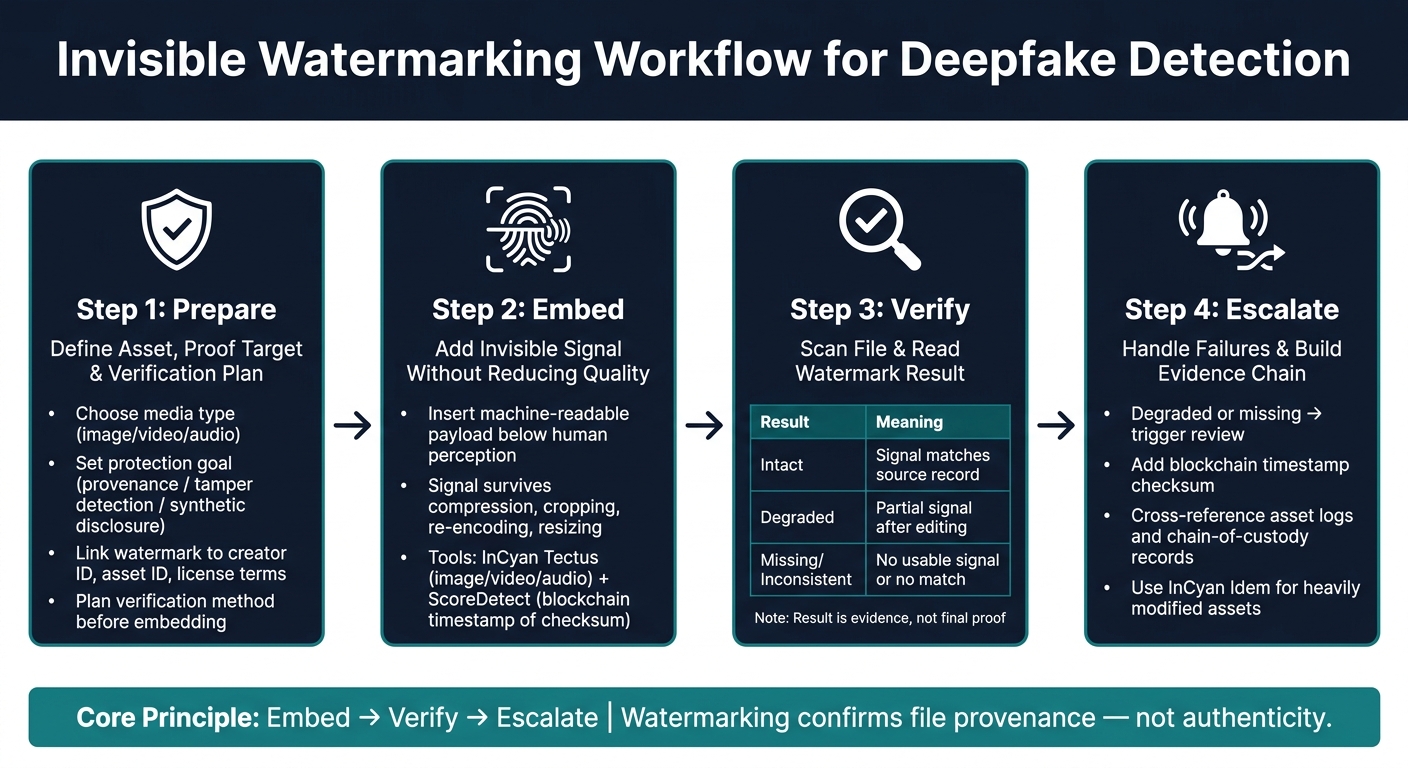
Invisible Watermarking Workflow for Deepfake Detection
Google SynthID, the Invisible Watermark to Detect AI Content
sbb-itb-738ac1e
Step 1: Prepare Media and Provenance Data Before Embedding a Watermark
Before you embed anything, get clear on three things: the asset, the proof target, and how you’ll verify it later. Those choices shape how blockchain enhances digital watermarking in Step 2.
Choose the Media Type and Protection Goal
Pick a watermarking method that matches the media format and the kind of proof you need.
| Protection Goal | Proof | Use Case |
|---|---|---|
| Provenance proof | Who created or distributed the file | Marketing assets, executive messages |
| Tamper detection | Whether the file has been altered since watermarking | Training videos, legal files |
| Synthetic media disclosure | Whether the content was AI-generated at the source | Product demos, press releases |
You can combine goals, but only if your verification plan can check both. That matters more than it may seem. A watermark that works well for source proof may not work the same way for edit detection. The media type matters too, since some files hold up better than others after cropping, compression, re-encoding, or other edits.
Decide What the Watermark Should Link To
The watermark should point to the facts you’ll need later. In most cases, that means the creator identity, source, licensing terms, and a unique asset ID.
Keep the linked data tight. If you stuff in too much, you make later checks harder, not easier. For higher-risk files, add a blockchain timestamp so you have a record of when the original asset existed.
Plan the Verification Method Before You Start
Set the verification method and chain of custody before embedding the watermark. That way, when someone reviews the file during a deepfake check, the result is easier to read: intact, degraded, or missing.
That’s the part that turns Step 3 from a nice idea into something people can actually use.[1][2]
Step 2: Embed the Invisible Watermark Without Reducing Media Quality
Once your asset, proof target, and verification plan are set in Step 1, the next job is embedding the watermark. The idea is straightforward: place a detectable signal inside the media file without changing what people see or hear.
How the Hidden Signal Is Added
Invisible watermarking puts a machine-readable payload into the media in a way that stays below human perception, while detection systems can still read it. In images, that means tiny changes the eye can’t spot. In audio and video, the signal sits below what people can notice. The file still looks or sounds the same, but it now carries a signal that can be checked later.
How Watermarks Survive Common Edits
This is where robustness matters. A working watermark can’t fall apart the moment someone compresses, resizes, crops, converts, or reposts the file. It needs to survive the same edits bad actors often make before they spread manipulated media.
If the watermark makes it through those changes, a detection system can still read the signal in the output file. If it doesn’t, verification falls apart.
How Tectus and ScoreDetect Fit
InCyan’s Tectus encodes an invisible proof of ownership into images, video, and audio without degrading the file for end users. That lets a detection system verify the signal from the distributed copy alone.
ScoreDetect captures a blockchain timestamp of the file’s checksum at a specific point in time, recording the media’s exact state at the moment of embedding. That record gives Step 3 a clear reference point for verification.
Step 3: Verify the Media and Read Tamper Signals Correctly
Once you’ve defined the expected record in Step 1, the next job is simple in theory: check whether the file still lines up with that record. This is the moment where the digital watermarking starts to earn its keep.
How Detection Software Checks the Watermark
Verification software scans the file in question and pulls out the hidden signal from the image, audio, or video. Then it compares that signal against the expected source record for the asset.
If the two line up, the file matches the record. If the signal is missing or doesn’t line up, the file should move to further review.
In day-to-day use, this check can’t drag on. It needs to happen fast enough to support publish, block, or escalate decisions.
How to Read Intact, Degraded, or Missing Watermark Results
Most scan results land in one of three states:
| Result | What It Means |
|---|---|
| Intact | Signal matches the expected record. |
| Degraded | Signal is partial after editing, recompression, or conversion. |
| Missing / Inconsistent | No usable signal or no match. |
A watermark result is evidence, not the final word. Read it alongside the rest of the file’s context before calling something tampered. If the result is degraded or missing, that should trigger escalation in Step 4.
Step 4: Handle Failures, Escalate Investigations, and Build a Practical Workflow
When Step 3 comes back degraded or missing, send the file to review.
What Watermarking Can and Cannot Prove
Invisible watermarking can confirm whether a file still carries the signal you expect. It cannot prove the file itself is authentic.
A failed scan may point to manipulated, converted, or heavily processed media. A missing result may simply mean the file was edited, recompressed, or converted until the signal could no longer be detected. That’s why a failed scan should start a review, not serve as proof of manipulation.
Watermarking on its own also can’t prove full provenance. Treat the scan as one piece of a larger evidence chain.
How to Add Evidence and Enforcement Layers
The next check should be a timestamped checksum. Blockchain timestamping creates a tamper-evident record showing when the original file existed, separate from the watermark signal. Asset logs, chain-of-custody records, and distribution metadata can all strengthen your case when the watermark result isn’t clear.
ScoreDetect supports this layered setup directly. ScoreDetect’s blockchain timestamping records a checksum of the original asset, which gives investigators a tamper-evident reference point when a watermark scan fails.
For heavily modified assets, InCyan’s Idem adds multimodal matching that can still identify content after major edits.
Conclusion: A Simple Deepfake Detection Workflow for Business Use
Use watermarking, timestamps, and monitoring together: embed, verify, and escalate when the scan is incomplete or missing.
FAQs
Can invisible watermarking prove a file is real?
The original answer misses the point.
It does not address invisible watermarking or whether such a mark can prove a file is real.
Instead, it talks about SK hynix’s ADR listing on July 10, 2026, along with possible effects on the domestic stock market and geopolitical tensions. That topic is unrelated to the question being asked.
A direct answer would need to explain that invisible watermarking can help trace origin or show that a file passed through a given system, but it does not, by itself, prove a file is real. A watermark can be removed, copied, forged, or added to altered content, depending on the method used. So it may support provenance, but it is not the same as proof of truth or proof that the underlying image, audio, or video is untouched.
What happens if a watermark is degraded or missing?
If a watermark is degraded or missing, detection and verification get harder. And when that happens, confidence drops. It becomes tougher to tell whether a piece of content has been changed or whether it’s the original version.
With deepfakes and synthetic media, that problem gets even more serious. A missing or weakened watermark can make it much harder to trace where the content came from or check that it hasn’t been tampered with.
How do watermarking and blockchain timestamps work together?
They work together by combining hidden content identification with a verifiable time record.
Watermarking helps tie media back to its source. A blockchain timestamp helps show when that content existed. Put them together, and you get a stronger way to check origin and ownership when reviewing possible deepfake or synthetic media changes.