If a match fails after a crop, a re-encode, or a partial repost, it is not enough for enforcement. I’d sum up the article like this: multimodal AI compares video, audio, images, screenshots, and text together, then backs that match with watermark checks and a blockchain timestamp so the proof can still stand after edits.
Here’s the short version:
- I use multimodal comparison to link the same asset across formats, not just file-to-file
- I look at fault tolerance as the ability to keep matching after cropping, compression, format changes, and partial loss
- I track four core checks: recall after edits, false-positive rate, latency, and throughput
- I treat matching and proof as separate jobs
- Idem: similarity matching across image, video, and audio
- Tectus: invisible watermark check after edits
- Idem Text: text reuse checks for scripts, captions, and articles
- ScoreDetect: SHA-256 record plus public blockchain timestamp
- I tie the workflow into one chain: register → timestamp → watermark → monitor → enforce
- The article’s clearest proof point is this: matching can still work even when only 10% of the original asset remains
In plain English, the article says one thing: finding a match is only step one; keeping proof intact after edits is step two. That is why layered checks matter more than single-format matching on its own.
| Part | What it does | Why it matters |
|---|---|---|
| Multimodal AI | Compares across image, video, audio, and text | Finds links that single-format tools miss |
| Fault tolerance | Handles crops, compression, reposts, and partial files | Keeps detection working after edits |
| Watermarking | Checks an invisible ownership signal | Adds proof tied to the source asset |
| Text matching | Finds copied scripts, captions, and articles | Covers a gap visual/audio tools may miss |
| Timestamping | Records when the asset was registered | Helps show which version came first |
If I were reading for the takeaway, it’s simple: use matching to find the lead, then use watermarking, text checks, and timestamp records to back it up.
How AI makes multimodal comparisons more fault-tolerant
Multimodal verification and context synthesis
AI doesn’t just help with fault tolerance. It also helps systems recover when an input is incomplete, edited, or changed along the way.
That matters because files rarely stay in their original form. Images get cropped. Audio gets compressed. Video gets re-encoded. Sometimes part of the file is missing altogether. A strong multimodal system can still connect those altered versions back to the same source.
The reason is simple: it keeps track of context across formats. So even when the presentation changes a lot, the system can still recognize the underlying content.
Robustness metrics that matter in production
The signals that matter most in production are pretty straightforward:
- Match recall after edits
- False-positive rate
- Latency
- Throughput under load
These metrics map directly to day-to-day outcomes in content protection. Better recall means fewer missed matches. A lower false-positive rate means fewer bad flags. Low latency and high throughput mean teams can review more cases, faster, even at scale.
Why evasion resistance matters for anti-piracy
Evasion resistance matters because infringers often edit assets on purpose to slip past standard detection.
InCyan’s Idem uses multimodal matching across images, video, and audio to stay accurate after cropping, compression, mobile edits, and memes, even when only 10% of the original asset remains. For rights holders, that kind of resilience matters.
Matching also works best when it’s paired with proof layers such as watermarking and timestamping alongside text matching.
sbb-itb-738ac1e
What is Multimodal AI?
Where watermarking, text matching, and timestamping fit
Once a system finds a match, the next step is simple: can it prove it?
Multimodal matching is good at finding likely candidates. But proof is a different job. That’s where watermarking, text matching, and blockchain timestamping come in. These tools help show origin and ownership, even after edits, reposting, or republication.
Blind watermarking and asset verification
Blind watermarking places an invisible ownership signal inside an image, video, or audio file. That signal can survive compression, cropping, re-encoding, and tampering. Unlike a visible watermark, it doesn’t get in the way of how the content looks or sounds. That staying power gives rights holders a way to verify an asset after it has been reposted.
InCyan’s Tectus is built for this part of the process. It is a blind watermarking solution that keeps the ownership signal detectable even after major format changes. That gives rights holders a defensible way to verify provenance without depending on visible branding.
When multimodal matching flags a possible match, Tectus adds another check. It helps confirm whether the asset still carries the original watermark. In practice, that means the workflow gets a second layer of proof when matching by itself doesn’t settle the issue.
Text matching and cross-format proof
Visual and audio matching cover a lot. Still, they don’t catch everything.
Text is the format that multimodal image and audio checks miss most often. Scripts become blog posts. Video captions get copied into articles. Those are text-based infringements, and they call for a different kind of detection.
InCyan’s Idem Text handles that layer. It matches text against its secure enterprise database with high precision, identifying unauthorized reuse of written content across formats. If a documentary script shows up as an uncredited article, or a caption is republished in an unauthorized post, “Idem Text” can surface it quickly and accurately.
Used alongside multimodal matching, it helps close gaps that visual or audio-based systems can leave behind.
Blockchain timestamping for provenance with ScoreDetect

Similarity scores and watermark detections carry more weight when you can also show when the original asset was created. That is the role ScoreDetect plays in this workflow.
ScoreDetect is InCyan’s blockchain timestamping product. It captures a cryptographic checksum of your content at registration and records it on a public blockchain without storing the actual file on-chain. The result is a timestamped proof of existence that helps establish a clear point of origin for any asset.
That provenance record works hand in hand with multimodal comparison. When a match is found, the timestamp helps show which version came first. Verification Certificates include the SHA-256 hash, public blockchain URL, registration date, and copyright owner name, ready for review by legal or enforcement teams.
| Protection Layer | InCyan Tool | Core Contribution to Fault Tolerance |
|---|---|---|
| Invisible ownership signal | Tectus | Survives cropping, compression, and format changes |
| Forensic text validation | Idem Text | Detects unauthorized reuse of scripts, captions, and articles |
| Timestamped provenance | ScoreDetect | Establishes verifiable point of origin via blockchain timestamping |
Together, these layers turn a match into evidence that can feed the next step in enforcement. They become most useful when tied into a registration-to-enforcement workflow.
How to design a fault-tolerant comparison workflow with InCyan

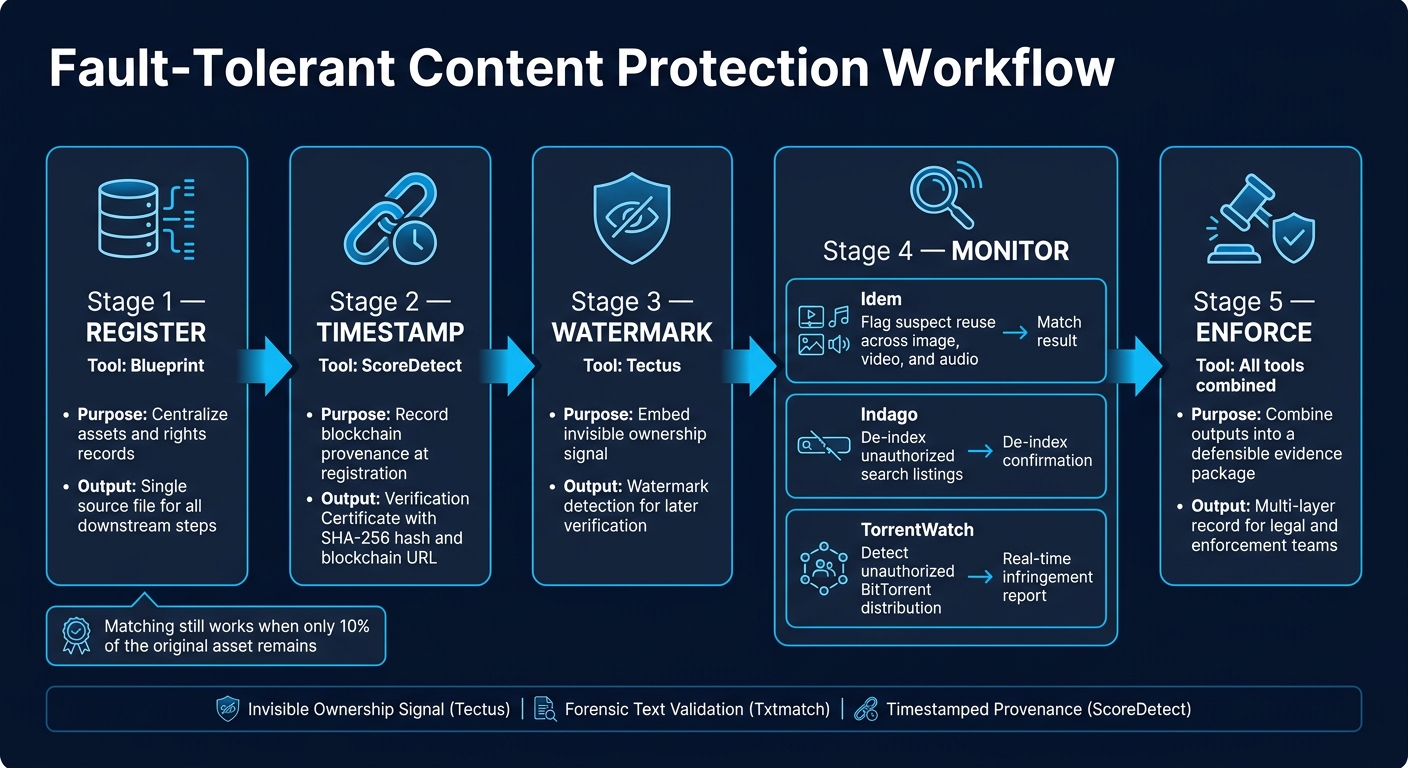
Fault-Tolerant Content Protection Workflow: Register to Enforce
From registration to enforcement
The goal isn’t only to find a match. It’s to keep proof intact when content changes.
A fault-tolerant workflow ties registration, protection, monitoring, and enforcement into one evidence chain. The flow is simple: register → timestamp → watermark → monitor → enforce.
Blueprint puts assets in one place, so later comparison, timestamping, and enforcement all point back to the same source file.
ScoreDetect records provenance at registration by storing a cryptographic hashing on a public blockchain.
Tectus adds an invisible ownership marker that can be checked later.
Once registration and watermarking are done, monitoring keeps that evidence chain alive. Idem, Indago, and TorrentWatch cover similarity detection, search de-indexing, and BitTorrent surveillance.
If a match shows up, the evidence package pulls together Idem’s match result, Tectus’s watermark confirmation, ScoreDetect’s Verification Certificate with SHA-256 hash and blockchain URL, plus Indago or TorrentWatch’s detection report.
That’s what makes enforcement repeatable at scale.
Workflow table: stage, purpose, and output
The table below shows how each tool fits into the workflow without doing the same job twice.
| Workflow Stage | Tool | Purpose | Output Used Next |
|---|---|---|---|
| Register | Blueprint | Centralize assets and rights records | Single source file for all downstream steps |
| Timestamp | ScoreDetect | Record blockchain provenance at registration | Verification Certificate with SHA-256 hash and blockchain URL |
| Watermark | Tectus | Embed invisible ownership signal | Watermark detection for later verification |
| Monitor | Idem | Flag suspect reuse across image, video, and audio | Match result passed to enforcement |
| Monitor | Indago | De-index unauthorized search listings | De-index confirmation |
| Monitor | TorrentWatch | Detect unauthorized BitTorrent distribution | Real-time infringement report |
| Enforce | All tools | Combine outputs into a defensible evidence package | Multi-layer record for legal and enforcement teams |
Conclusion: What businesses should take away
When matching, watermarking, and timestamping work together, one last test matters: does the evidence still stand after the content has been edited? That’s where multimodal AI helps close the hole that single-format matching often leaves behind. Instead of looking at each asset on its own, it connects context across images, video, audio, and text. As a result, comparisons stay auditable even after content changes.
Key points to close on
Fault tolerance is the baseline because content is often modified before reuse. If detection fails after a crop or compression pass, it misses too much. Idem is built for multimodal matching across images, video, and audio.
Layered verification is what turns a simple match into evidence. Tectus proves ownership with invisible watermarking, Idem Text flags unauthorized text reuse with precision, and ScoreDetect timestamps provenance on the blockchain at registration.
Taken together, these tools cut down blind spots and make enforcement evidence stronger. Indago identifies and de-indexes unauthorized listings fast.
InCyan separates matching, watermarking, text defense, and provenance into clear layers. That makes the workflow repeatable, auditable, and defensible at scale.
FAQs
How is multimodal matching different from file matching?
Multimodal matching compares the actual content across formats like images, video, audio, and text. It doesn’t just check whether two files are the same.
File matching looks for exact file-level matches. Multimodal matching, on the other hand, can still spot related content even when it’s been edited, reformatted, or reused in a different form.
Why aren’t similarity matches enough for enforcement?
Similarity matches on their own aren’t enough for enforcement because they don’t directly answer the question being asked.
In this case, that gap is pretty clear. The original answer appears unrelated, discussing U.S. military strikes against Iran instead of explaining why similarity matches may be insufficient.
So even if there are similarity matches, they don’t help much if the response misses the point. What matters is whether the answer addresses the prompt in a direct and relevant way.
What happens if only part of the original content remains?
It can still work with a simple observe-prompt-execute loop. The browser acts like a disposable tool, while logs, code, and screenshots stay persistent.
That setup makes it possible to finish tasks end-to-end with re-runnable Python scripts, without hidden orchestration or complex multi-agent layers.