Invisible watermarking is a method to protect digital content by embedding hidden identifiers directly into files without altering their appearance. Unlike older techniques, modern neural watermarking withstands challenges like cropping, compression, and social media re-encoding. This makes it a reliable tool for content protection and compliance with regulations like the EU AI Act, which requires machine-readable marks on AI-generated content by August 2026.
Key points:
- What it does: Embeds hidden markers in digital files for ownership proof.
- Why it matters: Protects against piracy, deepfakes, and ensures compliance.
- How it works: Uses advanced techniques like sub-pixel integration and frequency-domain embedding to endure alterations.
- Real-world use: Tools like InCyan’s Tectus and ScoreDetect combine watermarking with blockchain for secure ownership verification.
This approach ensures digital assets remain protected, even in the face of aggressive tampering or adversarial attacks.
Core Principles for Designing Resilient Invisible Watermarks
Embedding Techniques That Resist Attacks
One of the key shifts in watermarking has been moving away from older methods like Discrete Wavelet Transform (DWT) and Discrete Cosine Transform (DCT). These traditional techniques embed data in predictable frequency bands, making them vulnerable to disruptions from compression or resizing. Instead, modern neural watermarking takes a different path, using models that adapt to real-world attack scenarios and strengthen resilience.
An important approach is frequency-domain embedding, which strategically places identifiers in mid-frequency ranges. These ranges are less affected by compression and re-encoding, making them ideal for preserving watermarks [1]. For video, dynamic A/B sequencing offers another layer of protection by tailoring a unique sequence of segments for each user session during HLS or DASH streaming. This method doesn’t require expensive re-encoding but cleverly embeds the watermark into the playback sequence, enabling forensic tracking.
These advanced techniques strike a balance between making watermarks harder to disrupt while keeping them invisible.
Balancing Invisibility and Durability
Designing watermarks requires finding the sweet spot between strength and subtlety. A watermark that’s too strong risks creating visible artifacts, while one that’s too subtle might not survive common alterations like cropping, rotation, or compression [1][6].
Sub-pixel integration is a technique that embeds identifiers at a microscopic level. This ensures the watermark remains undetectable to the human eye but can still be identified by AI systems, even after significant transformations [6]. Alex Turner, Lead Engineer at ImageFlow, highlights the effectiveness of this approach:
"We watermark every image our platform generates. Three lines of code, and our compliance team stopped asking questions after we showed them the detection demo working on a screenshotted image." [1]
This balance ensures watermarks stay hidden while maintaining their durability under various conditions.
Training and Testing Against Adversarial Conditions
To reinforce watermark resilience, rigorous training and testing are essential. The most effective systems use adversarial training loops, where one model learns to embed a watermark while another "attacker" model tries to remove or distort it. This back-and-forth process helps the embedding model evolve to withstand real-world threats.
Testing should include blind extraction, which ensures the watermark can be detected without needing the original, unwatermarked file. This is especially important in enforcement situations where the original asset may not be available [5]. Another critical step is strength-to-visibility calibration, which involves testing the watermark at different intensity levels to find the right balance between being imperceptible and durable [4].
sbb-itb-738ac1e
PT-Mark: Invisible Watermarking for Text-to-image (Apr 2025)
Building a Secure Watermarking Workflow
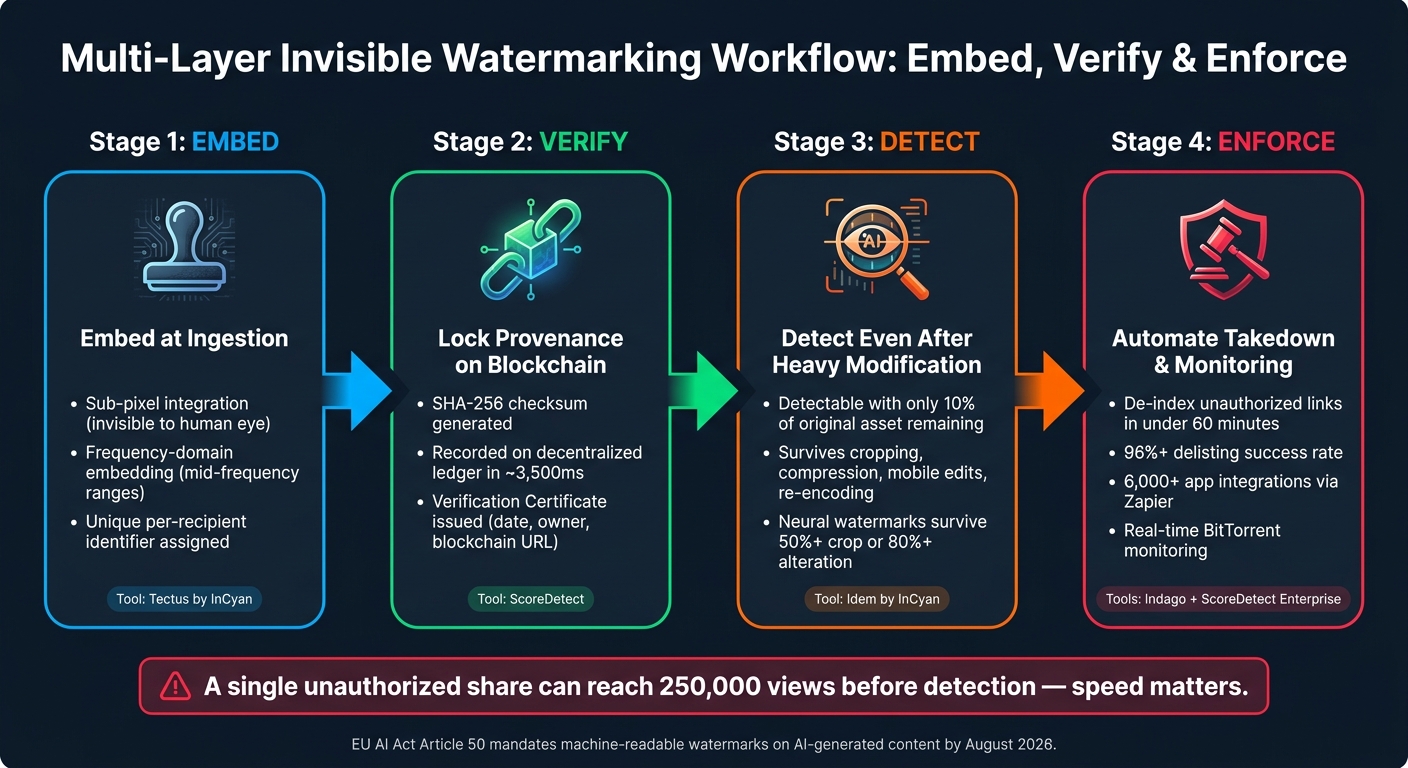
Multi-Layer Invisible Watermarking Workflow: Embed, Verify & Enforce
Strong watermark designs are most effective when paired with a secure end-to-end workflow.
Embedding Watermarks During Content Creation
The best time to embed watermarks is during content creation or ingestion. Waiting until distribution means losing critical forensic evidence. For high-value content, embedding at the point of ingestion is key. For example, in video production, watermarks should be added directly within broadcast encoders before the stream goes live. For images and documents, the watermarking process should initiate as soon as a file enters your Digital Asset Management (DAM) system. Tools like InCyan’s Tectus are designed for this purpose. This blind watermarking solution embeds invisible, legally defensible ownership markers into images, videos, and audio without impacting the asset’s quality.
A smart approach is unique per-recipient embedding. Instead of using a single generic watermark, assign a distinct identifier to each partner, distribution channel, or client. This way, if a leak occurs, you can trace it back to the exact source with precision – no guesswork involved [1][2].
Embedding watermarks early also sets the stage for verifiable ownership using blockchain technology.
Using Blockchain to Verify Ownership
Pairing invisible watermarks with blockchain timestamps creates a strong, two-layer system for proving content ownership and identity. This approach is both secure and difficult to challenge.
ScoreDetect handles the blockchain aspect of this workflow. It generates a SHA-256 checksum of your watermarked asset and records it on a decentralized ledger – without storing the actual file. This keeps your content private while making its "fingerprint" permanently and publicly verifiable. ScoreDetect completes this process in about 3,500 milliseconds, and the resulting Verification Certificate includes key details like the registration date, copyright owner name, blockchain URL, and a public ledger URL for independent validation [3].
"ScoreDetect is exactly what you need to protect your intellectual property in this age of hyper-digitization. Truly an innovative product." – Imri, CEO, Startup SaaS [3]
These certificates can be exported as PDFs and stored offline, giving you quick access to proof when enforcing copyright claims.
Automating Detection and Takedown
Once your assets are watermarked and ownership is verified, the next step is real-time protection. This means deploying systems that can detect unauthorized use and act immediately.
InCyan’s Idem excels at this, using AI-powered multimodal matching to identify your content even if only 10% of the original asset remains. It can withstand challenges like cropping, compression, and mobile edits. For content indexed by search engines, Indago can de-index unauthorized links in under 60 minutes by combining high-speed search with forensic precision, cutting off access to infringing material at its source.
ScoreDetect’s Enterprise plan ties everything together with automated takedown notifications and 24/7 brand monitoring. It boasts a success rate of over 96% for delisting notices. Additionally, ScoreDetect integrates with 6,000+ web apps via Zapier, enabling automated responses across your tech stack the moment infringement is detected [3].
Defending Against Adversarial Attacks in Real Time
Using robust watermarking techniques is a great start, but it’s only part of the equation when it comes to protecting your content. Defending against active, real-time adversarial attacks means staying vigilant as attackers attempt to strip, alter, or redistribute your content on a large scale. Here’s a closer look at strategies to tackle these threats head-on.
Continuous Monitoring and Fast Response
In live environments, passive defenses just won’t cut it. To combat fast-moving threats, you need systems that actively scan for your content across the web – catching unauthorized copies before they can spread widely.
For example, InCyan’s TorrentWatch keeps tabs on the BitTorrent ecosystem in real time, while Indago focuses on de-indexing unauthorized links from search engines in less than 60 minutes. That speed is critical. The longer infringing content stays accessible, the more damage it can cause.
The scale of redistribution can be shocking. Studies show that a single unauthorized share of watermarked content can rack up 250,000 views before detection [7]. Fast detection systems are the key to preventing small leaks from becoming massive problems.
Detecting Watermarks in Modified Content
Attackers rarely stop at simple copying. They crop, compress, filter, or re-encode your content to remove identifying metadata. Your watermark must be resilient enough to withstand these modifications.
InCyan’s Idem is designed to handle this exact scenario. It can detect watermarks even in heavily altered content – whether it’s compressed, cropped, turned into memes, or edited on mobile devices. Research backs this up: modern neural watermarks remain detectable even when over 50% of an image is cropped or more than 80% of the content is altered [1].
"The robustness benchmark sold us. We tested it ourselves – cropped, compressed, screenshotted, ran it through Instagram. The watermark came back every time." – David Kim, Security Lead at MediaStack [1]
Combining Multiple Layers of Protection
No single tool can address every possible attack. The most effective strategy involves layering multiple solutions so that even if one defense is bypassed, others remain active.
Here’s how a multi-layered approach might work: Tectus embeds an invisible watermark during ingestion, ScoreDetect locks in provenance with a blockchain timestamp, Idem identifies the asset even after significant modification, and Indago de-indexes unauthorized links before they generate traffic. These layers work together, automating the response process so your team doesn’t have to handle every incident manually.
Conclusion: Strengthening Digital Asset Security
Invisible watermarking has come a long way from being just a "stamp" on digital content. Thanks to neural embedding techniques, modern watermarking methods can withstand aggressive manipulations like cropping, compression, and social media re-encoding – challenges that older DWT/DCT methods simply couldn’t handle. This durability forms the backbone of advanced digital asset protection.
However, resilience alone isn’t enough. True protection requires a multi-layered approach: an invisible watermark that clings to your asset, a blockchain timestamp to prove its origin, and automated tools to detect and prevent improper use. For example, ScoreDetect delivers on the blockchain front, creating a tamper-proof checksum on the SKALE network in just 3.5 seconds – all without storing your actual content [3]. Together, these layers create a strong framework for safeguarding digital assets.
Organizations managing large-scale digital portfolios can benefit from InCyan’s tools, such as Tectus for blind watermarking, Idem for modification-resistant content matching, and Indago for quick de-indexing. These tools make it possible to detect and address infringements swiftly – sometimes resolving cases within an hour. With regulations like the EU AI Act’s Article 50 mandating machine-readable markings on AI-generated content by August 2026, invisible watermarking isn’t just a smart choice – it’s becoming a compliance requirement [1]. This end-to-end strategy, from embedding to enforcement, ensures your digital assets remain secure in a world of evolving threats.
Embed early, layer your defenses, and automate enforcement to stay ahead of adversarial attacks.
FAQs
How do you verify a hidden watermark without the original file?
To verify a hidden watermark without the original file, you can rely on detection techniques that spot irregularities in watermark energy within the frequency domain. These approaches don’t require specific decoding algorithms to work. Moreover, AI-based systems can examine high-frequency bands and analyze content characteristics to identify invisible watermarks, even when the embedding method is unfamiliar or not clearly defined.
What adversarial edits are most likely to break an invisible watermark?
Invisible watermarks can be disrupted through various types of manipulations. Common methods include cropping, resizing, scaling, or compression (such as JPEG re-encoding), all of which can distort or eliminate the watermark. Additional techniques involve applying filters, color adjustments, overlays, or even AI-driven alterations like blurring or deepfake modifications. The strength of a watermark lies in its ability to endure these changes, with continuous advancements aimed at making watermarks more resistant to such attacks.
How does blockchain prove ownership without uploading content?
Blockchain establishes ownership by storing a checksum or a verification certificate of the digital content. This approach guarantees the authenticity and ownership of the asset without needing to upload or store the actual content itself.