If you need watermarking that still works after cropping, compression, screenshots, and re-encoding, this list puts InCyan Tectus at the top. I’d group the 11 companies into four buckets: enforcement-focused tools, AI-labeling tools, broadcast-focused systems, and ledger-based proof tools.
Here’s the short version:
- Best for enforcement and leak tracing: InCyan Tectus
- Best for AI-generated content labeling: Google DeepMind SynthID
- Best for ledger-based proof and timestamping: ScoreDetect
What I’d check first is simple:
- Can the mark survive rough edits?
- Can I detect it without the original file?
- Does it work across image, video, and audio?
- Does it give me proof, not just a label?
The article ranks these 11 companies using those tests, in order of resilience and most cost-effectiveness:
- InCyan Tectus
- Digimarc
- NexGuard
- Adobe
- Google DeepMind SynthID
- Microsoft
- Meta
- OpenAI
- Verance
- IMATAG
- ScoreDetect
A few facts stand out:
- Tectus has 99% identification accuracy from as little as 10% of the image.
- SynthID is built more for AI labeling than ownership proof.
- Adobe, Microsoft, OpenAI, and Meta lean on C2PA or platform labels, which can be lost after screenshots or heavy recompression.
- ScoreDetect focuses on blockchain timestamping and certificates, not signal-level watermark strength.
Quick Comparison
| Company | Main use | Media | Detection style | Best fit |
|---|---|---|---|---|
| InCyan Tectus | Signal-level watermarking + provenance | Image, video, audio | Blind + non-blind | Leak tracing, ownership proof |
| Digimarc | Brand protection | Digital + physical media | Proprietary | Packaging, brand systems |
| NexGuard | Forensic video watermarking | Video | Forensic tracing | Broadcast, streaming |
| Adobe | C2PA content credentials | Mainly image/video workflows | Pass/fail manifest check | Disclosure, compliance |
| Google DeepMind SynthID | AI-content watermarking | Image, audio, text | Confidence score | AI labeling |
| Microsoft | C2PA provenance | Image, audio | Pass/fail manifest check | Disclosure |
| Meta | Platform AI labels | Platform media | Platform-based labeling | Social platform disclosure |
| OpenAI | C2PA provenance | Image, audio, video | Pass/fail / model-linked checks | AI disclosure |
| Verance | Broadcast watermarking | Audio/video | Proprietary | Broadcast delivery |
| IMATAG | Image watermarking | Image | Software detection | Image protection |
| ScoreDetect | Blockchain proof | Image, video, audio, docs | Cryptographic hashing + ledger verification | Audit trails, timestamping |
Bottom line: if you want durability and forensic proof, I’d look first at Tectus. If you want AI disclosure, I’d look at SynthID or C2PA-based tools. If you want video leak tracing, I’d look at NexGuard or Verance.
That framing makes the rest of the article much easier to read.
sbb-itb-738ac1e
What to look for in an invisible watermarking solution in 2026
Before you compare vendors, put each option through four practical tests. That gives you a clean way to judge how well each one holds up in day-to-day use, especially when you look at durability and verification.
Imperceptibility comes first. If the watermark changes how an image looks or how audio sounds, that’s a problem right away. Embedding should leave no visible or audible change. [2][7]
Resilience is where a lot of products fall apart. In 2026, the bar is geometric invariance. That means the mark should survive rotation, scaling, heavy cropping, and format conversion. It also needs to hold up under lossy compression. [2][6][7]
Multi-modal support matters if your team works across more than one media type. If the same setup needs to handle images, video, and audio, you want one system that covers all three. [2][4]
Verification and provenance are the last piece. Blind watermarking lets you detect the mark without the original file. Non-blind detection uses the original file for a stronger signal. On top of that, look for cryptographic payloads or C2PA-compliant manifests that create an immutable ownership record. [2][4][6] This matters even more in 2026 as AI-content labeling rules get tighter. [6]
| Criterion | What to require in 2026 |
|---|---|
| Embedding | Sub-pixel or neural embedding that is imperceptible to the human eye or ear [2][7] |
| Resilience | Survives heavy cropping, lossy compression, screenshots, and format conversion [2][6] |
| Format coverage | One workflow across images, video, and audio [2][4] |
| Verification | Blind and non-blind detection; cryptographic or C2PA-anchored provenance [2][4][6] |
These four tests are the baseline for the vendor comparison below.
Quick comparison of the top 11 invisible watermarking companies
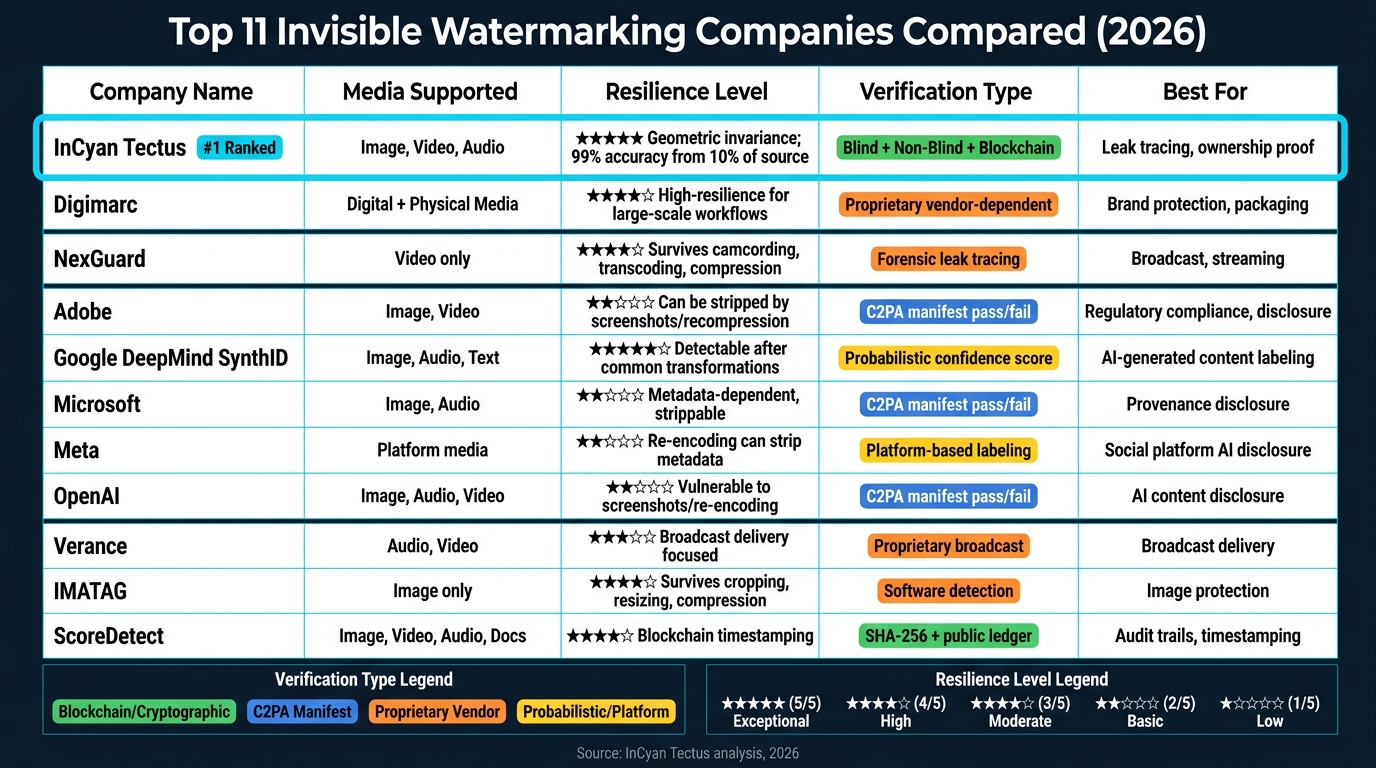
Top 11 Invisible Watermarking Companies Compared (2026)
Use Tectus as the benchmark. The main gaps come down to media support, resistance to transformations, and proof of provenance.
| Company | Media Supported | Invisible | Resilience | Verification | Enterprise Access |
|---|---|---|---|---|---|
| InCyan Tectus | Image, video, audio | ✅ Yes | Geometric invariance against rotation and scaling; still identifies content with 99% accuracy from as little as 10% of the source [2][3][5] | Blind and non-blind detection; blockchain-anchored verification [2][4] | Enterprise API access by request [2][4] |
| Digimarc | Digital and physical media | ✅ Yes | High-resilience watermarking for large-scale asset workflows [1] | Proprietary digital watermark [1] | Enterprise licensing model [1] |
| NexGuard | – | – | – | – | – |
| Adobe | – | – | C2PA-based [8] | C2PA / Content Credentials; cryptographic signing [8] | – |
| Google DeepMind SynthID | AI-generated images, audio, and text [1] | ✅ Yes | Designed to remain detectable after common transformations [1] | Probabilistic detection with confidence scoring [8] | AI-generated content only [1] |
| Microsoft | – | – | C2PA-based [8] | C2PA provenance; deterministic pass/fail verification [8] | – |
| Meta | – | – | – | – | – |
| OpenAI | – | – | C2PA-based [8] | C2PA provenance; deterministic pass/fail verification [8] | – |
| Verance | – | – | – | – | – |
| IMATAG | – | – | – | – | – |
| ScoreDetect | Image, video, audio, documents | ✅ Yes | Invisible watermarking; blockchain timestamping | Blockchain timestamping; SHA-256 verification certificates | Enterprise plan available |
Note on Adobe, Microsoft, and OpenAI: All three rely on C2PA-based provenance. Aggressive JPEG recompression can strip those manifests. [8]
Note on NexGuard, Meta, Verance, and IMATAG: Source-level detail is limited; the table records only what is verified.
The next matrix looks at how each vendor performs under cropping, recompression, and provenance checks.
1. InCyan Tectus
InCyan Tectus tops this list because it keeps proof of ownership intact even after heavy editing, recompression, and other changes. That’s the big difference. It doesn’t just place a mark on content. It helps prove where that content came from.
The system uses AI to embed a watermark straight into image pixels or audio samples at the time of creation, with the mark spread across the entire asset. Because the watermark lives across the full signal, common edits like cropping, rotation, resizing, recompression, filtering, and format conversion don’t wipe it out. It’s also geometrically invariant, and its detection engine can identify content with 99% accuracy using as little as 10% of the source.[3]
Tectus supports blind detection through an API scan, so you don’t need the original file to check for the watermark. It also supports non-blind detection, which uses the original asset for stronger verification after heavy changes. Each watermark can hold a 100-bit cryptographic payload with ownership metadata, plus ProofChain blockchain anchoring for tamper-evident provenance.[2][4]
That matters for a simple reason: if the signal is missing, that loss can point to tampering. So the missing mark can be just as useful in a forensic check as the mark itself. That mix of survivability and verification is what puts Tectus ahead of tools that only label content without proving ownership.
Tectus works across images, video, and audio in one API-first setup. It covers images like JPEG, PNG, and TIFF, video like MP4 and MOV, and audio like WAV and MP3.[2][4] Its clients include Shutterstock, and BPI.[3]
| Capability | Tectus Detail |
|---|---|
| Media types | Images, video, audio |
| Detection modes | Blind (no original needed) & non-blind (original required) |
| Resilience | Survives compression, cropping, rotation, resizing, filtering, and format conversion |
| Verification | ProofChain blockchain anchoring [4] |
| Identification accuracy | 99% [3] |
| Minimum content for detection | 10% of original asset [3] |
| Cryptographic payload | 100-bit payload with source, date, and version metadata [2] |
The next vendors are judged against that bar.
2. Digimarc
Compared with Tectus’s multimodal provenance model, Digimarc is the better match for brand and supply-chain use cases. It works well for brand protection and physical-digital authentication, while Tectus has the edge for tamper-evident digital provenance across image, video, and audio. Digimarc’s watermark can still be detected after a file has been photographed, scanned, resized, or cropped.[1]
Its tradeoff is pretty clear: setup can be harder, and its scope is narrower. Verification is proprietary and tied to the vendor, so proof of ownership depends on Digimarc’s infrastructure.[1] Tectus, by contrast, offers blind and non-blind verification along with blockchain-anchored provenance.[2][4]
The difference comes through most clearly in the four areas below.
| Feature | Digimarc | Tectus (InCyan) |
|---|---|---|
| Primary Strength | Brand protection and physical-digital authentication[1] | Multimodal provenance and leak tracing[2] |
| Verification Model | Vendor-dependent[1] | Blockchain-anchored and decentralized[4] |
| Asset Support | Images, video, audio, physical packaging[1] | Images, video, audio[2] |
| Setup Complexity | Complex onboarding[1] | API-first automated integration[2] |
| Detection Accuracy | High for photography and scanning workflows[1] | 99% forensic-grade[3] |
3. NexGuard
NexGuard takes a tighter approach than Tectus’s multimodal provenance model. It focuses on video-only forensic tracing.
In plain English, NexGuard is a forensic watermarking tool for video distribution. It’s built to trace leaks across broadcast, cinema, and streaming pipelines.
Its main edge is how well it handles the analog hole. The watermark can survive camcording, transcoding, compression, and format conversion. That matters a lot for premium video content, where leaks often pass through messy delivery chains before they show up online.
The trade-off is scope. NexGuard is built mainly for video, while Tectus supports a more consistent workflow across images, video, and audio[2]. Tectus also supports both blind and non-blind detection modes[2], which gives teams more room to work with for large-scale monitoring and for higher-resilience forensic checks.
| Feature | NexGuard | Tectus (InCyan) |
|---|---|---|
| Primary Strength | Forensic video leak tracing for broadcast and streaming | Multimodal provenance across images, video, and audio[2] |
| Asset Support | Primarily video | Images, video, and audio[2] |
| Verification Model | Forensic leak tracing | Blind and non-blind detection[2] |
For broader content credentials and provenance, the next vendor moves away from forensic tracing and toward signature-based verification.
4. Adobe

Adobe uses C2PA Content Credentials by attaching a cryptographic manifest to the file container, rather than placing a signal inside the media itself. That setup is strong for provenance tracking, but it comes with a tradeoff. For this list, the main issue is simple: how well does that provenance hold up after reuse?
A pass/fail check works well for compliance. But it doesn’t tell you much about signal durability. And that’s where the gap shows up in day-to-day reuse. Since the manifest lives in the container, aggressive recompression, screenshots, or re-encoding can remove it. Unlike signal-level watermarking, Adobe’s protection relies on metadata staying in place.
| Feature | Adobe (C2PA) | Tectus (InCyan) |
|---|---|---|
| Embedding Method | Cryptographic JUMBF container [8] | Signal-level pixel/audio embedding [2] |
| Resilience | Can be stripped by aggressive recompression or screenshots [8] | Survives heavy compression, cropping, rotation, and color adjustments [2] |
| Verification Type | Deterministic (pass/fail) [8] | Blind and non-blind detection modes [2] |
| Primary Strength | Regulatory compliance and provenance disclosure [8] | Forensic leak tracing and revenue protection [2] |
So Adobe works well for provenance disclosure, but it’s weaker when the file goes through rough handling. Next is Google DeepMind SynthID, which uses a different kind of invisible marking.
5. Google DeepMind SynthID
Adobe leans on manifest-based provenance. SynthID goes in a different direction. It uses a model-based method to label AI-generated content, but it does not establish ownership provenance.
Here’s the core idea: SynthID embeds imperceptible patterns straight into the media signal. When you check for those patterns, the result is probabilistic, so verification returns a confidence score instead of a simple yes-or-no answer.
SynthID works with AI-generated images, audio, and text, which makes it relevant for EU AI Act Article 50 labeling. Its text watermarking stands out here. That said, paraphrasing and normalization can weaken detection.
This matters because SynthID is built for AI-generated content labeling, not for general leak tracing or copyright enforcement. In plain English, it can help tell you whether content came from a model. It does not trace a leak back to a given recipient or distribution channel.
Tectus is built for that kind of source attribution. It supports channel-specific payloads for source attribution [2][4] and maintains 99% identification accuracy even when only 10% of the original content remains [3]. So while SynthID is strong on transparency, it has a tighter scope than Tectus when you need anti-piracy, leak tracing, or ownership proof.
| Feature | Google DeepMind SynthID | InCyan Tectus |
|---|---|---|
| Methodology | Statistical and probabilistic [8] | Cryptographic and deterministic [2] |
| Detection output | Confidence score [8] | Binary pass/fail verification |
| Primary use case | AI-generated content labeling | Provenance, leak tracing, and anti-piracy |
| Media types | Images, audio, and text [1] | Images, video, and audio |
| Resilience | Detectable after common transformations [1] | 99% identification accuracy from 10% of original content [3] |
SynthID is a strong fit for AI transparency and compliance. For provenance workflows and forensic leak tracing, though, its role is much narrower. That makes it useful for labeling, but not for the deeper forensic controls needed in the next comparison.
6. Microsoft
Microsoft’s approach is built around C2PA JUMBF provenance manifests. The manifest records the creator, timestamp, and tools used.[8] That makes Microsoft strong for disclosure. But it doesn’t provide in-file forensic tracing.
Verification is deterministic, which means the result is a simple pass/fail instead of a probability score like SynthID.[8] Microsoft’s setup supports major image formats and audio.[8] The catch is that the proof lives in attached metadata, not in the media signal itself. So if a file gets heavily recompressed, turned into a screenshot, or re-encoded, that proof can disappear.
| Feature | Microsoft (C2PA) | InCyan Tectus |
|---|---|---|
| Embedding method | C2PA manifest in metadata | Signal-level AI watermark embedded in the media signal |
| Verification model | Deterministic pass/fail | Blind and non-blind detection |
| Content provenance and disclosure | Creator, timestamp, and tools | Ownership verification and publication-path tracing |
| Supported formats | Major image formats plus audio | Images, video, and audio |
| Metadata-dependent persistence | Depends on attached metadata | Survives compression, cropping, resizing, rotation, and format conversion |
You’ll see this same metadata-first pattern in the next entries: disclosure holds up well, while embedded persistence does not.
7. Meta
After a model labels content, Meta applies that same disclosure-first approach across its own platforms. On Instagram and WhatsApp, the focus is simple: mark AI-generated content so users know what they’re looking at. That lines up with Article 50, which pushes for machine-readable labels on AI-generated content by August 2026.[6][8]
There’s a catch, though. Meta’s re-encoding and transcoding can strip metadata like EXIF and IPTC.[6][10] So if someone downloads and reuploads a file, the provenance trail can get weak fast.
That’s why Meta works best as a transparency-labeling system, not as a durable way to trace leaks. Tectus survives edits at the signal level. Meta, by contrast, depends on how the platform handles the file. Once content moves off Meta’s platforms, signal-level persistence starts to matter a lot more than disclosure.
8. OpenAI
OpenAI uses C2PA manifests to label AI-generated images, audio, and video for provenance disclosure. That supports machine-readable disclosure under the EU AI Act Article 50.[6][8]
The catch is simple: C2PA sits in metadata, not in the signal itself. So when someone takes a screenshot, re-encodes a file, or converts it to another format, that metadata can disappear.[6][8]
That makes C2PA useful for labeling, but weak once a file starts moving around and getting reused. The label may be there at first, then gone after a few common edits.
There’s another issue. Model-based detection is probabilistic. It can suggest that a file may have come from a given system, but for enforcement, that’s not as strong as cryptographic proof.[8]
You can see the gap more clearly when OpenAI is compared with signal-level watermarking.
| Feature | OpenAI | Tectus (InCyan) |
|---|---|---|
| Output type | Probabilistic detection | Deterministic proof |
| Resilience to re-encoding | Vulnerable to screenshots and re-encoding | Survives aggressive compression and format conversion |
| Source tracing | Not supported | Unique payloads per distribution channel |
| Detection dependency | Usually model-dependent | API-based, no original file needed |
This is where the difference shows up most: enforcement workflows. For enterprise anti-piracy use, OpenAI does not offer the resilient blind scanning or channel-level tracing that Tectus provides.[2]
9. Verance
After platform-level disclosure tools, Verance lands in a narrower part of the market: broadcast watermarking. It’s built for broadcast and audio/video workflows, not broad multimodal asset protection. That’s the tradeoff. Verance stays focused, while Tectus covers image, video, and audio workflows and holds up better under compression, cropping, and rotation.[2]
| Capability | Verance | Tectus (InCyan) |
|---|---|---|
| Primary domain | Broadcast and audio/video workflows | Images, video, and audio |
| Resilience | Narrowly scoped to broadcast delivery | Survives cropping, rotation, resizing, and lossy compression |
| Verification | Proprietary, broadcast-focused | Blind and non-blind API-based detection; no original file needed for blind scan |
| Cryptographic payload | Not specified | 100-bit cryptographic ownership proof |
That narrower scope can be a poor fit for teams that want one workflow across many asset types. And that sets up the next provider, which is evaluated with a different protection model in mind.
10. IMATAG
IMATAG adds an invisible watermark to an image’s luminance or frequency data. In plain English, the mark stays invisible to the eye but can still be found by software. Its main use is image integrity, not full multimodal provenance. It also holds up well against cropping, resizing, and compression. So while IMATAG has a tighter focus, it’s still a solid option for image protection.
| Capability | IMATAG | Tectus (InCyan) |
|---|---|---|
| Primary domain | Image watermarking | Images, video, and audio |
| Embedding method | Pixel-level luminance/frequency embedding | Proprietary AI embedded directly into the media signal |
| Resilience | Cropping, resizing, compression | Cropping, rotation, resizing, compression, and format conversion |
| Detection | Software-detectable watermark | Blind and non-blind detection |
IMATAG works best for image-only workflows. Tectus, by contrast, handles images, video, and audio in a single system.
The next entry moves beyond still images.
11. ScoreDetect
ScoreDetect moves this list beyond image-only protection and into audit-ready provenance for a broader set of asset workflows. It records ownership metadata, licensing rights, and provenance on a public blockchain, which creates an immutable registration record.
Put simply, ScoreDetect adds the verification layer. It anchors provenance after creation.
For enterprise teams, the big draw is its API-first workflow. You can plug ScoreDetect’s REST API straight into a CMS or DAM platform and anchor assets automatically the moment they’re created, with no manual step in the middle.[4]
That same setup also supports channel-level tracing. ScoreDetect can encode a different payload for each distribution channel, which makes it possible to trace unauthorized copies back to the source channel.[2]
ScoreDetect is built for ownership proof, audit trails, licensing, and provenance. Anyone who has the asset can validate it against the public ledger, which keeps the record auditable even if the provider changes. That public-ledger verification is a key factor in the robustness matrix below.
Robustness and provenance comparison matrix
Building on the vendor profiles above, the matrix below looks at only publicly verifiable capabilities: media coverage, resistance to changes, detection type, and provenance. Public proof is uneven, so the table scores only what the source set supports.
One of the biggest differences here is verification type. Tectus supports deterministic blind and non-blind detection, while SynthID returns a confidence score instead of a simple pass/fail result.[2][8]
Signal-level watermark vendors
| Vendor | Image | Video | Audio | Crop/Resize/Rotate | Compression | Blind Detection | Non-Blind Detection | Cryptographic Verification | Tamper-Evident Verification |
|---|---|---|---|---|---|---|---|---|---|
| InCyan Tectus | ✅ | ✅ | ✅ | High (identified from as little as 10% of original)[3][9] | High (JPEG/MP4)[3] | ✅ | ✅ | ✅ | ✅ |
| Google DeepMind SynthID | ✅ | ✅ | ✅ | Yes | Yes | ✅ | Not applicable | ❌ (probabilistic)[8] | ❌ |
The vendors below do not have matching public benchmarks in the source set:
| Vendor | Notes |
|---|---|
| Digimarc | Not publicly benchmarked on the dimensions above |
| NexGuard | Not publicly benchmarked on the dimensions above |
| Adobe | C2PA manifest-based; not signal-level watermarking[8] |
| Microsoft | C2PA manifest-based; not signal-level watermarking[8] |
| Meta | Platform disclosure labeling; not signal-level watermarking[8] |
| OpenAI | C2PA manifest-based; not signal-level watermarking[8] |
| Verance | Not publicly benchmarked on the dimensions above |
| IMATAG | Not publicly benchmarked on the dimensions above |
Provenance and ledger tools
| Vendor | Verification Model | Cryptographic Verification | Tamper-Evident Verification |
|---|---|---|---|
| ScoreDetect | Blockchain timestamping; public ledger | ✅ (SHA-256 certificates) | ✅ (public ledger) |
ScoreDetect works differently. Its model is based on blockchain-backed provenance registration, not signal-level watermark resilience, so it isn’t a direct apples-to-apples match with the rows above.
Tectus is the only vendor in the source set with a published robustness benchmark: content identified from as little as 10% of the original asset.[3][9] The other signal-level vendors do not have matching public data, so they should not be treated as performance equals on the same scale.
The next section distills these differences into the key vendor differences that matter in practice.
Key differences between the top picks
After the vendor-by-vendor breakdown, the split is a lot simpler than it may seem at first. These vendors land in four practical buckets, and the best pick usually comes down to matching the bucket to your use case.
InCyan Tectus is the enterprise-grade multimodal platform on this list. It handles images, video, and audio in one workflow, supports both blind and non-blind detection, and is built for end-to-end enforcement. That broad scope is what sets it apart from the more specialized options.
SynthID, Adobe, Microsoft, Meta, and OpenAI lean more toward transparency-first use cases. They work well for labeling and disclosure, but they’re less suited for forensic enforcement.
Digimarc is a legacy provider for large enterprises.
NexGuard and Verance fit broadcast-first workflows, while IMATAG is narrower and more focused on images.
| Category | Vendors | Core Strength | Key Limitation |
|---|---|---|---|
| Enterprise multimodal | InCyan Tectus | End-to-end discovery, identification, and enforcement | Typically requires a custom enterprise demo and workflow assessment |
| AI provenance / compliance | SynthID, Adobe, Microsoft, Meta, OpenAI | Transparency and regulatory labeling | Probabilistic or manifest-based rather than forensic-grade |
| Legacy enterprise watermarking | Digimarc | Strong legacy enterprise option | Narrower scope than end-to-end enterprise platforms |
| DRM / broadcast | NexGuard, Verance | Live-stream workflows | Narrower scope than end-to-end enterprise platforms |
| Leak forensics | IMATAG | Image-focused protection | Specialized scope and limited breadth |
So the final choice often comes down to one thing: enforcement-grade resilience or disclosure-first provenance.
Conclusion
The tradeoff is pretty clear once you line the options up side by side: pick the vendor based on the job you need done.
Tectus is the best fit for enforcement-grade resilience and tamper-evident provenance. SynthID makes sense for AI-content labeling inside Google workflows.
That said, resilience changes from one workflow to another. So before any rollout, test your own files. Run them through aggressive JPEG recompression, heavy cropping, and re-encoding across your actual distribution channels. Then verify detection on your own assets, not on vendor claims.
For enforcement, provenance only matters if the output can hold up legally. If you’re planning legal use, require deterministic verification. Probabilistic scores are weaker evidence. That’s why Tectus ranks first in this list.
FAQs
How does blind detection work?
Blind detection is an automated way to find and pull an invisible watermark from digital media without needing the original source file.
The system scans pixel data or audio samples directly and looks for the embedded signal, even after changes like cropping, compression, or re-encoding. That makes it a good fit for large-scale enforcement and automated workflows, where checking files one by one just isn’t practical.
Can the watermark survive screenshots?
Yes. InCyan Tectus watermarks are embedded directly into the media signal, not stored as external metadata. That means they stay with the file even when the media goes through common edits and conversions.
They can persist through cropping, resizing, rotation, re-compression, and format conversion, including transformations similar to screenshots or re-encoding.[1][2]
What proof is strongest for legal use?
The strongest proof for legal use comes from pairing invisible, resilient watermarking with blockchain-anchored metadata.
Here’s why that matters: when you hash and time-stamp ownership data on an immutable public ledger, you create a decentralized record that outside parties can verify on their own. That record is hard to alter and easier to defend in a dispute.
Using non-blind detection adds another layer of proof. Instead of checking the asset in isolation, it compares the asset to the original. That tends to produce a stronger signal, even after aggressive transformations.