AI watermarking tools are essential for protecting digital content like images, videos, audio, and text against misuse, piracy, and deepfake risks. These tools embed hidden patterns directly into the content, making them harder to remove than traditional methods. Businesses face rising costs from data breaches, and the global watermarking market is expected to grow from $1.60 billion in 2025 to $3.80 billion by 2033. Choosing the right tool depends on factors like resilience to edits, automation capabilities, and pricing.
Here are the top tools discussed:
- ScoreDetect: Combines invisible watermarks with blockchain certificates for images, videos, audio, and documents. Starts at $11.31/month.
- Google DeepMind SynthID: Embeds watermarks in AI-generated content, available via Google Cloud Vertex AI.
- Meta Stable Signature: Integrates watermarks during AI content creation, ensuring durability.
- C2PA and Content Credentials: Metadata-based system for tracing content origin, widely supported across platforms.
- Adobe Content Credentials: Built on C2PA, secures images and videos with metadata and invisible watermarks.
- Microsoft Azure AI Content Safety: Focused on protecting AI-generated images with embedded credentials.
- Forensic Watermarking: Targets streaming and broadcast media with deep learning-powered invisible watermarks.
Quick Comparison
| Tool | Supported Media | Watermark Type | Key Features | Pricing |
|---|---|---|---|---|
| ScoreDetect | Images, Videos, Audio, Documents | Invisible + Blockchain | AI web scraping, automated takedowns, blockchain proof | $11.31/month (Pro) |
| Google DeepMind SynthID | Images, Videos, Audio, Text | Invisible | AI detection, works with Google AI platforms | Included with Vertex AI |
| Meta Stable Signature | Images | Invisible | Embedded during creation, resistant to edits | Not disclosed |
| C2PA and Content Credentials | Images, Videos | Metadata + Invisible | Tamper-evident, broad platform support | Included in tools like Adobe |
| Adobe Content Credentials | Images, Videos | Metadata + Invisible | C2PA-compliant, Creative Cloud integration | Creative Cloud pricing |
| Microsoft Azure AI Content Safety | Images | Metadata | Auto-certification, API-based verification | Pay-as-you-go (Azure) |
| Forensic Watermarking | Images, Videos, Audio | Invisible | Resilient to edits, REST API automation | Contact for pricing |
Each tool has unique strengths, from blockchain integration to compatibility with creative and enterprise platforms. Whether you need forensic-grade protection, metadata-based tracing, or AI-specific solutions, these tools cater to a variety of business needs.
AI Watermarking Tools Comparison: Features, Pricing, and Capabilities
Fake Receipts, AI Watermarks, and the Fight for Digital Trust
1. ScoreDetect
ScoreDetect is a digital content protection platform that combines invisible watermarking with blockchain-based proof of ownership. It’s designed for businesses in over 15 industries – including media, entertainment, legal, healthcare, and e-commerce – offering tools to combat piracy, detect unauthorized use, and automate takedown processes.
Content Types Supported
With the Enterprise plan, ScoreDetect embeds forensic-grade watermarks into images, videos, audio, and documents. These watermarks integrate directly into the content’s data structure, making them resistant to cropping, compression, and color adjustments. For text-based content, the Pro plan offers blockchain timestamping, capturing a SHA256 checksum of articles, blog posts, and other written works without storing the actual files.
Watermark Type
ScoreDetect uses invisible watermarks that are imperceptible to the human eye yet remain intact even after heavy edits or platform re-encoding. These watermarks are paired with blockchain-anchored certificates, which store a cryptographic hash on a public ledger to provide undeniable proof of ownership. Each certificate includes details like the registration date, copyright owner, SHA256 hash, and blockchain links, creating a tamper-proof ownership record. These features integrate seamlessly with the platform’s AI capabilities.
AI Capabilities
ScoreDetect employs AI-powered web scraping with a 95% success rate, bypassing anti-scraping measures to identify unauthorized content. Once flagged, its analysis engine compares the content against your protected assets to confirm infringement. The platform’s automated takedown system then generates delisting notices, achieving a 96% removal rate and significantly reducing the manual workload involved in copyright enforcement.
Automation and Integrations
ScoreDetect connects with over 6,000 web apps via Zapier, enabling automated workflows for large-scale content protection. Its WordPress plugin ("Timestamps") automatically creates blockchain certificates for new and updated articles, boosting Google E-E-A-T signals for SEO. For developers, the API supports batch processing and custom integrations with Digital Asset Management (DAM) systems. Enterprise customers benefit from white-label options, a dedicated success manager, and 24/7 premium support through a private Slack channel. Pricing starts at $11.31/month (billed annually) for the Pro plan, with custom quotes available for Enterprise plans.
2. Google DeepMind SynthID
Google DeepMind SynthID introduces a clever way to embed invisible watermarks into content generated by Google’s AI models. This technology works across various formats, including images, video, audio, and text, and is seamlessly integrated into Google’s generative AI platforms like Gemini, Vertex AI, Lyria (for audio), and NotebookLM.
Content Types Supported
SynthID is designed to handle a variety of content formats. For images and videos, it embeds watermarks at the pixel level. For audio, it uses inaudible markers, while for text, it modifies token probability scores during content generation.
Watermark Type
The watermarks created by SynthID are invisible to the naked eye but detectable by specialized AI algorithms. Unlike metadata, which can be stripped away during file edits, these watermarks are deeply embedded within the data itself, making them resistant to common editing techniques. For instance, in images and videos, the watermark is spread across pixels. In audio, it uses frequencies that are inaudible, and in text, it subtly alters token selection patterns.
AI Capabilities
SynthID is built to endure typical modifications such as cropping, resizing, color changes, compression (like JPEG or MP3), speed adjustments, noise addition, and frame rate alterations. Users can check content authenticity through the SynthID Detector portal or by asking Gemini directly whether a piece of content – like an image or video – was created by Google AI. The system offers three levels of detection: detected, not detected, or possibly detected. This capability is particularly useful for integrating AI-generated content verification into enterprise anti-piracy workflows.
"SynthID isn’t foolproof against extreme image manipulations, but it does provide a promising technical approach for empowering people and organizations to work with AI-generated content responsibly."
– Sven Gowal and Pushmeet Kohli, Google DeepMind
Automation and Integrations
SynthID is accessible through Google Cloud Vertex AI, where enterprise customers can use it via API. For companies already operating within Google’s cloud ecosystem, integration is straightforward. Currently, access to the SynthID Detector portal is limited to early testers on a waitlist. Google is actively working to expand its availability, seeking partners to incorporate this tool into third-party workflows. As of now, pricing details for SynthID have not been publicly shared.
3. Meta Stable Signature
Meta Stable Signature introduces a unique approach to watermarking by embedding identifiers directly into AI-generated content during its creation. This ensures the watermark remains intact and inseparable from the content itself, setting Meta apart in the field.
Content Types Supported
Meta’s watermarking technology is designed to work across multiple content formats. A prime example is AudioSeal, which focuses on safeguarding speech and audio content. Demonstrations like SeamlessExpressive highlight Meta’s focus on protecting various modalities, including images, audio, video, and text.
Watermark Type
The watermarks are invisible to the human eye but detectable by AI systems. Since the watermark is integrated during the creation process, it becomes resistant to removal through typical editing methods. This level of security is a cornerstone of modern IP copyright protection strategies.
AI Capabilities
Meta employs a joint training method, where the watermark is embedded using a generator while simultaneously training a detector. This dual process ensures the watermark can still be identified, even after extensive edits [1].
4. C2PA and Content Credentials
The Coalition for Content Provenance and Authenticity (C2PA) has introduced a game-changing approach to securing your digital assets. By attaching metadata to digital assets, it creates a traceable history of their origin and edits without modifying the content itself. This digital trail helps verify authenticity and ensures transparency.
Content Types Supported
C2PA works seamlessly with various content types, including images, videos, audio files, and documents, across different platforms [1]. Its design ensures that provenance data is accessible from tools like Adobe’s creative software to platforms like TikTok [1]. This broad compatibility supports a reliable system for verifying content through metadata.
Watermark Type
Unlike traditional pixel-based watermarks, C2PA relies on metadata-based signing. It generates a manifest that certifies an asset’s origin and tracks its edit history. Many organizations pair C2PA with invisible forensic watermarks, creating two layers of authentication. Even if one layer is compromised, the other remains intact, offering extra security [4].
AI Capabilities
In May 2024, TikTok began using C2PA Content Credentials to automatically label AI-generated content with timestamps. By reading metadata embedded in uploaded images and videos, the platform can scan and tag content without manual intervention [4]. This feature helps differentiate official assets from manipulated ones – an essential function when 85% of the three billion daily uploads lack proper attribution [5].
Automation and Integrations
C2PA’s technical framework supports seamless integration through REST APIs, digital asset management systems, and software plugins. It connects with popular cloud storage services like Google Drive and OneDrive and incorporates JavaScript libraries such as Truepic. These tools embed credentials during the creation process, reducing the risk of distributing unprotected content.
sbb-itb-738ac1e
5. Adobe Content Credentials
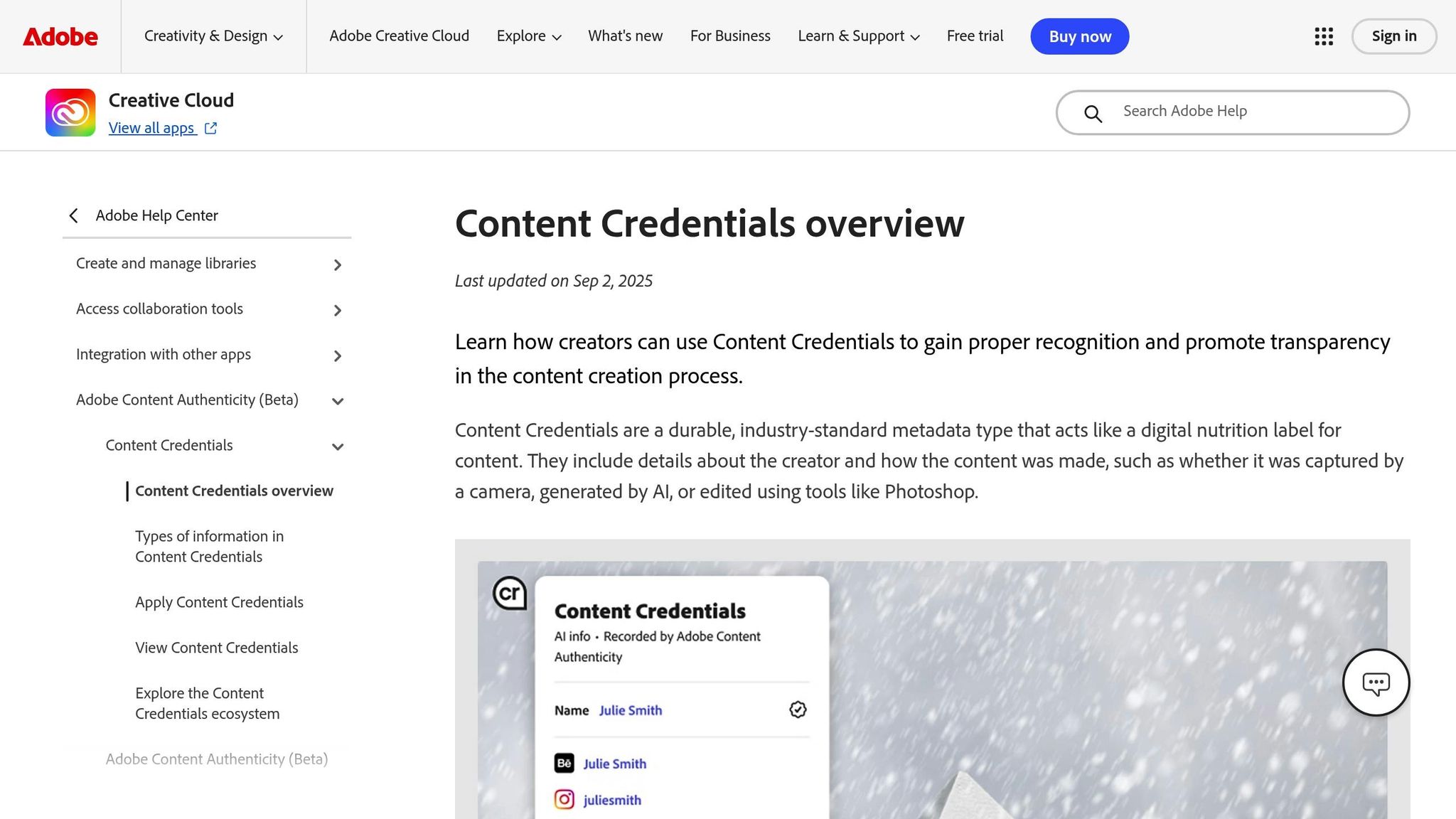
Adobe Content Credentials is a tool designed to strengthen copyright protection for digital images and videos. Built on the C2PA standard, it creates a secure, tamper-proof record of digital content. This allows businesses to confirm the authenticity and ownership of their digital media and identify whether it was created by humans or generated using AI [1].
Supported Content Types
This technology is tailored for images and video, making it ideal for marketing visuals and product photos. Since Content Credentials can be applied after production, businesses can easily tag outputs from both their own and third-party AI tools. This simplifies workflows and ensures proper attribution during post-production.
Watermarking System
Adobe Content Credentials acts as an invisible digital signature embedded within a file’s metadata. Combined with forensic watermarking, it offers a two-layer protection system. Even if metadata is removed, the embedded watermark remains intact, safeguarding the file’s origin.
AI Detection Features
The system identifies AI-generated content by analyzing embedded patterns and metadata while maintaining a detailed, verifiable record of edits. Its integrated watermarking is designed to withstand challenges like compression and re-encoding, ensuring the integrity of the content [1].
Automation and Integration Tools
Adobe also offers JavaScript libraries to automate the verification of Content Credentials. This addresses a common issue where many images lack proper attribution, making it easier for businesses to ensure their content is accurately credited [5].
6. Microsoft Azure AI Content Safety
Microsoft Azure AI Content Safety enhances the security of AI-generated images by embedding Content Credentials directly into the images. These credentials serve as a digital record of the image’s origin and history, ensuring transparency and traceability [6]. Like other C2PA-based systems, this solution integrates smoothly into broader strategies for digital content protection.
Content Types Supported
This tool is specifically designed for AI-generated images created through the Azure OpenAI Service. It supports content generated by models such as DALL·E and GPT-image-1.
Watermark Type
The system embeds Content Credentials as metadata and digital signatures. This approach maintains the image’s quality while securely recording key information, such as the issuer, date, and time of creation.
AI Capabilities and Automation
Built on the C2PA standard, Microsoft Azure AI Content Safety automatically certifies the source and history of each image during its creation. This eliminates the need for manual tagging. Additionally, Microsoft’s verification tools enable quick checks for authenticity, making it easier to ensure transparency and authenticating digital images for AI-generated visuals.
7. Forensic Watermarking for Streaming and Broadcast
Forensic watermarking is a method of protecting video and audio content by embedding invisible identifiers directly into the media. Unlike metadata, which can easily be removed during re-encoding, these watermarks are integrated into the media’s pixels or audio frequencies, making them extremely difficult to strip away. This makes forensic watermarking particularly effective in dynamic streaming and broadcast settings.
Content Types Supported
Forensic watermarking can be applied to various media types, including video, audio, images, and documents. For video, the watermarks are embedded into individual frames and are designed to endure processes like cropping, frame rate adjustments, and lossy compression [4]. Similarly, audio watermarks are placed in frequencies outside the normal hearing range – below 20 Hz or above 20,000 Hz – and are resilient against noise, MP3 compression, and speed changes [1]. These watermarks can be detected with high precision, allowing broadcasters to pinpoint exactly where alterations have occurred in the content.
Watermark Type
The technology relies on invisible, forensic watermarks that modify the underlying data structure rather than adding easily removable tags. As Steg.AI explains:
"Forensic watermarking invisibly watermarks digital media with unique identifying information that can be used to trace any asset back to the owner and licensee" [3].
Each licensee is provided with a uniquely watermarked version of the content, enabling organizations to trace unauthorized leaks back to their source. This capability is critical, given that unauthorized leaks and data breaches can cost companies an average of $10 million per incident due to lost revenue and recovery expenses [2].
AI Capabilities and Automation
Modern forensic watermarking tools use deep learning to create watermarks that can withstand even sophisticated regeneration attacks, where AI attempts to remove traditional marks [4]. This aligns with the growing trend of automating content protection. For instance, in 2025, Verance Authentication’s ATSC 3.0 watermark detection was adopted by major TV manufacturers like LG and Hisense, enabling broadcasters to activate interactive applications for viewers regardless of how they receive the signal – whether over-the-air, via cable, or through satellite [4].
Leading providers such as Steg.AI offer REST APIs that integrate seamlessly with existing Content Management Systems (CMS) and Digital Asset Management platforms. This allows automated watermarking to occur during distribution, while web-crawling tools continuously scan the internet for watermarked content to identify and address license violations [2][3].
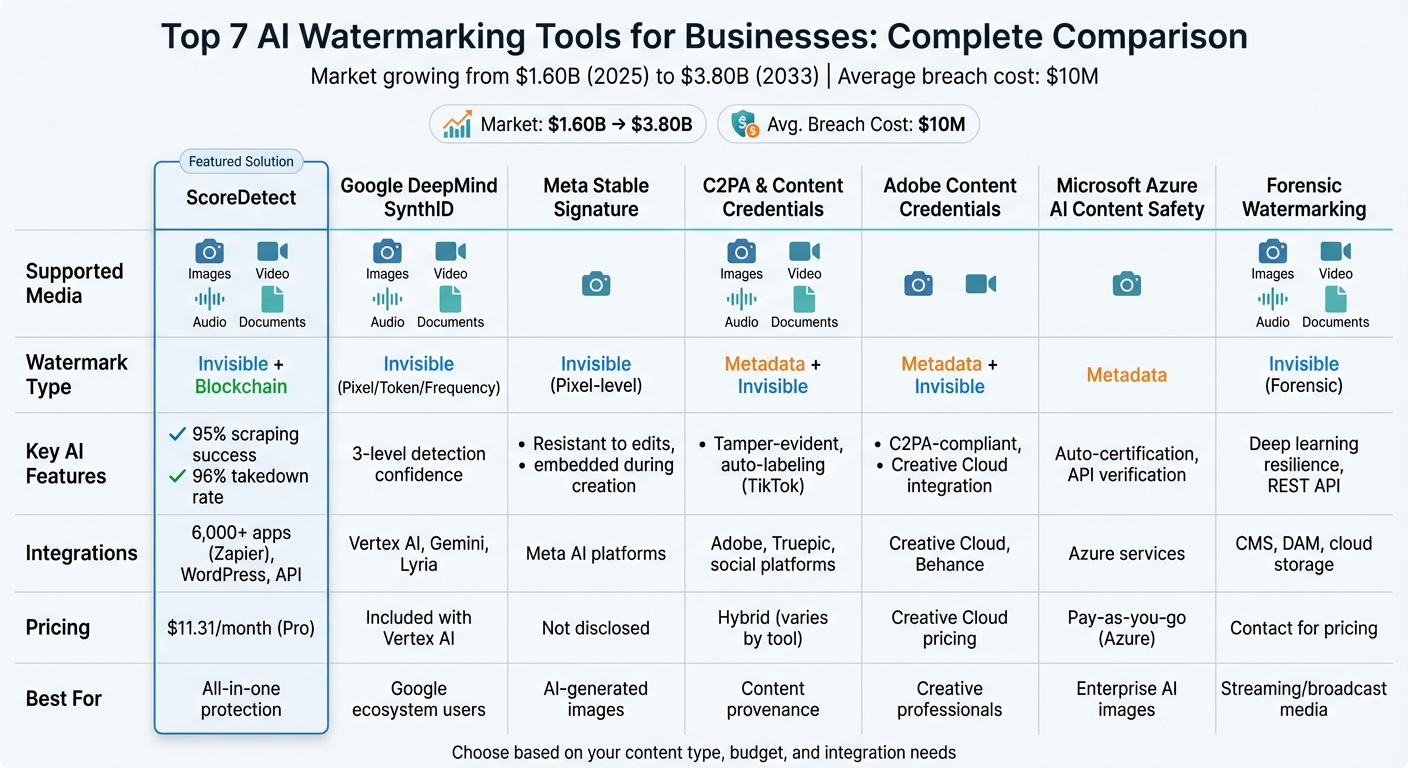
Tool Comparison Table
Deciding on the right AI watermarking tool depends on your specific business needs, budget, and the type of content you work with. Below is a side-by-side comparison of the tools discussed earlier, highlighting their supported media types, watermarking methods, unique features, integrations, pricing, and target industries.
Google DeepMind SynthID stands out for its ability to identify AI-generated content across many formats, while Meta Stable Signature focuses on specific media types. Meanwhile, tools like C2PA and Content Credentials and Adobe Content Credentials emphasize verifying content authenticity through metadata.
Pricing varies significantly: ScoreDetect Pro starts at $11.31/month (billed annually) and includes 100 verifiable certificates, while enterprise plans require custom quotes. Google’s SynthID is bundled into Vertex AI for its users, and several other tools follow contact-based pricing models.
| Tool | Supported Media | Watermark Type | Key AI Features | Integrations | Pricing (USD) | Target Industries |
|---|---|---|---|---|---|---|
| ScoreDetect | Images, Videos, Audio, Documents | Invisible (Forensic) | 95% web scraping success; 96%+ takedown rate; how blockchain enhances digital watermarking digital fingerprinting for content matching | Zapier (6,000+ apps), WordPress plugin, API access | Pro: $11.31/month (yearly) or $12/month (monthly); Enterprise: Custom quote | Academics, Content Creators, Legal, Marketing/SEO, Media & Entertainment, Healthcare, Government |
| Google DeepMind SynthID | Images, Video, Audio, Text | Invisible (Pixel/Token/Frequency) | Deep learning models; token probability adjustment; three-level confidence detection | Vertex AI, Gemini, Lyria, Notebook LM | Included for Vertex AI customers (Beta); verification portal in waitlist | Enterprise (Vertex AI users), Journalists, Media Professionals |
| Meta Stable Signature | Images | Invisible (Pixel-level) | Robust against cropping, compression, color shifts; embedded during generation | Meta’s generative AI platforms | Not publicly disclosed | AI Developers, Creative Agencies, Social Media Platforms |
| C2PA and Content Credentials | Images, Video | Metadata "Signing" + Invisible Credentials | Standards-based provenance verification; tamper-evident manifests | Adobe products, Truepic, social platforms (e.g., TikTok auto-labeling) | Hybrid (Public JS library / Private SaaS) | News Organizations, Social Media, Content Creators |
| Adobe Content Credentials | Images, Video | Metadata + Invisible Watermarks | C2PA-compliant; integrates with Creative Cloud workflow | Adobe Creative Cloud, Behance, social platforms | Included with Adobe Creative Cloud subscriptions | Photographers, Designers, Creative Professionals, Publishers |
| Microsoft Azure AI Content Safety | Images, Text | Detection-focused (analyzes content for AI origin) | Machine learning classifiers; API-based verification | Azure cloud services, enterprise applications | Pay-as-you-go Azure pricing | Enterprise, Cybersecurity, Government, Finance & Banking |
| Forensic Watermarking (Steg.AI) | Images, Video, Audio, Documents | Forensic (Invisible) & Visible | Deep learning resilience; survives regeneration attacks; REST API automation | CMS, DAM platforms, cloud storage (OneDrive, Google Drive) | Contact Sales | Stock Media (e.g. Shutterstock), Artists, Photographers, Broadcasters |
Conclusion
When it comes to protecting your digital assets, the key factors to consider are watermark robustness, automation, and cost-effectiveness. Selecting the right AI watermarking tool depends on your business’s unique needs. For those already integrated into Google’s Vertex AI ecosystem, SynthID provides a seamless option with support for images, videos, audio, and text. On the other hand, if your primary concern is tracking internal leaks of pre-release materials like films or product images, forensic watermarking tools can pinpoint the exact source of any unauthorized distribution.
The growing demand for content protection highlights how critical it is to safeguard valuable digital assets. With content leaks potentially costing millions, investing in reliable watermarking solutions is a no-brainer for businesses handling sensitive or high-value materials.
To ensure your chosen watermarking solution holds up under real-world conditions, tools like MarkDiffusion can be used to test watermarks against compression, editing, and even "regeneration attacks" where AI tries to remove pixel-level marks [4]. These tests can guide you in selecting the right layering strategy to enhance your overall protection plan.
Combining multiple defense layers offers the strongest protection. For example, using forensic watermarking to trace internal leaks alongside C2PA Content Credentials for interoperability can provide a comprehensive safeguard. As Gartner points out, "Authenticity signals like watermarking will matter more as generative content floods discovery channels, a shift already changing search and content policies" [4]. Platforms like TikTok are already adopting auto-labeling systems that leverage C2PA signals to verify content authenticity.
For businesses aiming for complete digital content protection, ScoreDetect delivers an all-in-one solution. Starting at $11.31 per month, it boasts a 95% success rate in web scraping and a 96% takedown rate, making it a powerful tool for safeguarding your assets.
FAQs
How do AI watermarking tools improve content security over traditional methods?
AI watermarking tools bring a new level of content protection by embedding invisible, non-intrusive watermarks directly into digital files. Unlike visible logos or metadata, these watermarks are undetectable to the human eye but can be identified by specialized algorithms. They’re designed to withstand edits, compression, and format changes, making them difficult to tamper with or remove.
On top of that, AI-driven solutions can actively scan the web for unauthorized use of marked content, even if it’s been modified. By linking the embedded watermark to the original owner, they provide secure, tamper-resistant proof – which can even be stored on a blockchain for legal purposes. This technology helps businesses safeguard their assets, minimize piracy, and streamline takedown processes with precision and efficiency.
What should businesses look for in an AI watermarking tool?
When choosing an AI watermarking tool, it’s important to focus on features that match your business’s protection requirements. One key aspect is the use of invisible, non-invasive watermarks. These watermarks should stay intact even after edits, compression, or format changes, ensuring smooth usability while maintaining ownership protection. Some tools even incorporate advanced technology, like blockchain, to provide tamper-proof evidence of ownership.
Another critical factor is the tool’s compatibility with different types of media. Whether you’re working with images, videos, audio files, PDFs, or even live and interactive content, the tool should be versatile enough to meet your needs. Pricing and scalability also matter – look for platforms offering flexible subscription plans and automation options, such as Zapier integrations or API access, to simplify workflows.
Lastly, consider ease of use, strong customer support, and adherence to regulations like GDPR. These are especially important for industries like healthcare, finance, or legal services, where compliance is non-negotiable. By prioritizing these features, businesses can secure their digital assets efficiently while keeping operations running smoothly.
How do invisible watermarks stay intact after content editing?
Invisible watermarks are crafted to blend directly into the foundational elements of digital content, like pixel arrangements or frequency data. This approach ensures that typical modifications – such as cropping, resizing, compression, or color tweaks – only impact minor areas of the content, keeping the watermark largely intact and recognizable.
By dispersing the watermark throughout the content in a durable way, it becomes extremely difficult to erase without severely degrading the quality or structure of the original material.