Blockchain is changing how copyrights are managed, but it comes with a big question: how do we balance energy use with security? Blockchain offers blockchain-certified ownership records, decentralized systems, and tools to fight piracy. But not all blockchains are created equal – some, like Bitcoin, consume as much energy as entire countries, while others, like Ethereum’s Proof of Stake, have cut energy use by 99.95%.
Key takeaways:
- Proof of Work (PoW) is highly secure but energy-intensive.
- Proof of Stake (PoS) offers efficiency but risks centralization.
- Permissioned systems are efficient but less decentralized.
- Tools like perceptual hashing and off-chain storage reduce energy without sacrificing security.
The right choice depends on your needs: public blockchains for global reach or private ones for faster, efficient copyright handling. With growing regulations like the EU’s MiCA, energy-efficient solutions are becoming essential.
How Consensus Mechanisms Impact Energy and Security
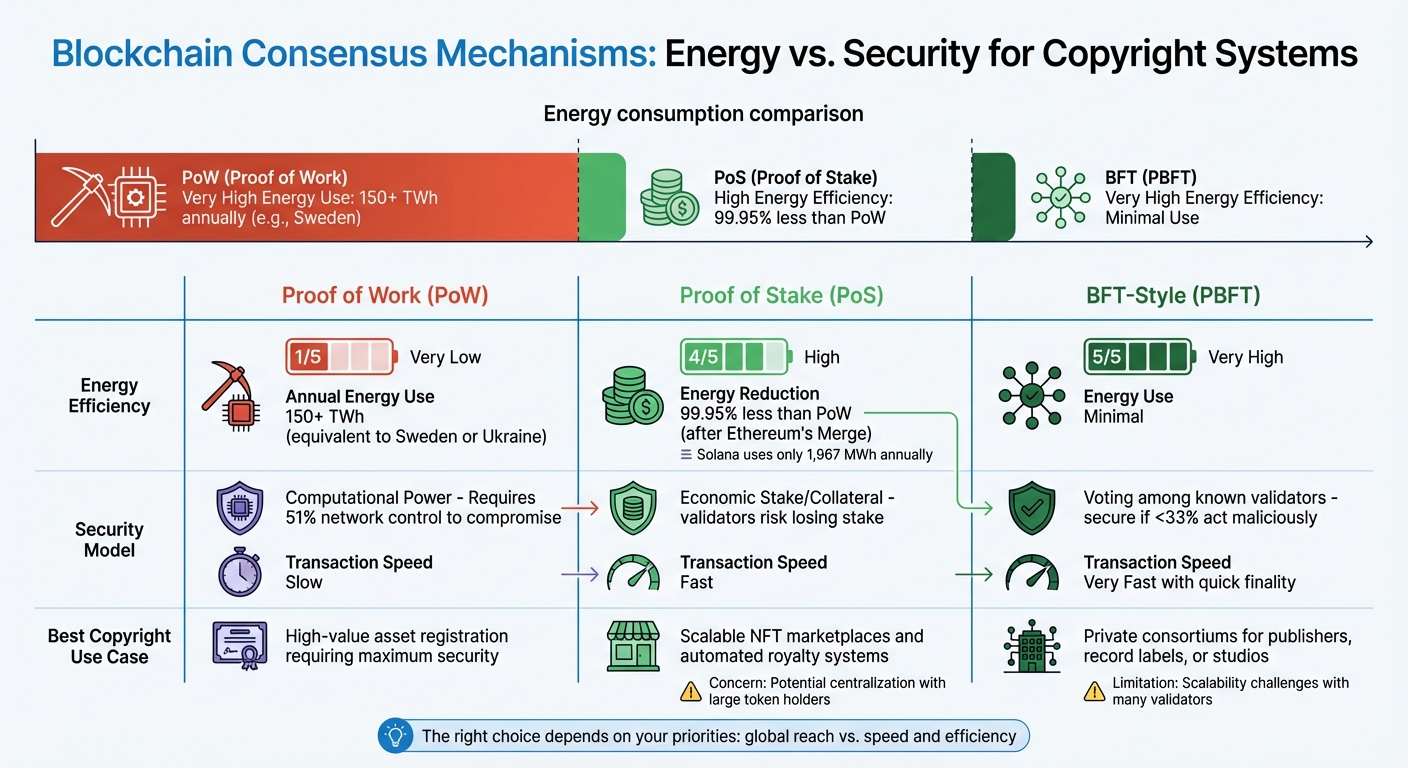
Blockchain Consensus Mechanisms for Copyright: Energy Use vs Security Comparison
The consensus mechanism you choose plays a critical role in shaping the energy consumption and security of your blockchain-based copyright system. Each method comes with its own set of trade-offs, influencing transaction costs, environmental impact, and system reliability.
Proof of Work (PoW)
Proof of Work relies on miners solving complex cryptographic puzzles to validate transactions. Changing the blockchain would require gaining control of over half the network’s computing power – a nearly impossible feat as the network expands. However, this security comes at a steep cost. Bitcoin alone consumes more than 150 TWh annually, surpassing the electricity usage of entire nations like Sweden or Ukraine [4].
This high energy demand and processing delays make PoW unsuitable for lightweight copyright tasks like comparing blockchain vs traditional timestamping for articles or registering digital assets. As one systematic review highlights:
"The process of repeatedly performing a cryptographic hashing operation… is one of the primary causes of the massive energy consumption in PoW" [7].
While PoW might make sense for safeguarding extremely high-value assets, it is generally excessive for most copyright verification needs.
Proof of Stake (PoS)
Proof of Stake operates differently, selecting validators based on the tokens they are willing to "stake" as collateral, rather than relying on computational power. Validators who act maliciously risk losing their stake, ensuring security through economic incentives rather than energy-intensive processes. Ethereum’s switch to PoS in 2022 – known as "the Merge" – reduced its energy consumption by a staggering 99.95% [4], proving that blockchain systems can be both secure and energy-efficient.
For copyright applications, PoS strikes a practical balance. It’s efficient enough to support high-volume NFT marketplaces and automated royalty systems while maintaining strong security. For example, Solana, which integrates PoS with Proof of History (PoH), uses just 1,967 MWh annually, a fraction of PoW’s energy use [4]. This makes PoS particularly well-suited for real-time copyright verification and digital asset registration.
One concern with PoS, however, is the potential for centralization. Large token holders could dominate validator selection, potentially undermining neutrality. Despite this, PoS remains a practical option for public copyright networks that require scalability and energy efficiency.
Permissioned BFT-Style Mechanisms
Byzantine Fault Tolerance (BFT) mechanisms achieve consensus through rounds of voting among pre-approved validators. The most common variant, Practical Byzantine Fault Tolerance (PBFT), ensures transaction security as long as fewer than one-third of validators act maliciously [6]. This approach is particularly well-suited for private copyright consortiums, such as collaborations between record labels or publishing houses, where participants are vetted beforehand.
As one systematic review puts it:
"Practical Byzantine Fault Tolerance (PBFT) guarantees the security of ongoing transactions among known participants… making it ideally suited for private blockchain environments" [4].
BFT mechanisms are highly energy-efficient and deliver fast transaction finality, making them ideal for enterprise copyright systems where speed and throughput are critical. However, scalability can be a challenge; performance often declines as the number of validators increases. In controlled environments with trusted participants, BFT offers a compelling mix of speed, efficiency, and security for copyright verification.
Below is a quick comparison of these consensus mechanisms:
| Consensus Mechanism | Energy Efficiency | Security Model | Best Copyright Use Case |
|---|---|---|---|
| Proof of Work (PoW) | Very Low | Computational Power | High-value asset registration where maximum security is critical |
| Proof of Stake (PoS) | High | Economic Stake/Collateral | Scalable NFT marketplaces and automated royalty systems |
| BFT-Style (PBFT) | Very High | Voting Among Known Validators | Private consortiums for publishers, record labels, or studios |
The consensus mechanism you choose will directly affect your operational costs, environmental footprint, and ability to comply with sustainability regulations. Up next, we’ll explore how these mechanisms perform in real-world copyright scenarios.
sbb-itb-738ac1e
Energy Efficiency vs. Security: A Practical Comparison
When designing a blockchain-based system for managing copyrights, decisions around network types, storage methods, and interoperability can significantly influence both energy consumption and security. Let’s break down how these factors play out in real-world scenarios.
Public vs. Permissioned Blockchains
Public blockchains like Bitcoin and Ethereum are known for their high level of decentralization and resistance to tampering, but these benefits come at a steep cost. For example, Bitcoin’s Proof-of-Work (PoW) mechanism uses over 150 TWh of electricity annually – more than the total energy consumption of countries like Sweden or Ukraine [4]. Ethereum’s shift to Proof-of-Stake (PoS) cut its energy use by 99.95% [4], but public networks still require all nodes to validate every transaction, which naturally leads to inefficiencies.
Permissioned blockchains, on the other hand, operate differently. By using consensus mechanisms like Byzantine Fault Tolerance (BFT) or Proof-of-Authority (PoA) among trusted validators, these networks significantly reduce computational demands [4]. This setup works well for enterprise-level copyright consortiums – such as record labels or film studios – where participants are pre-approved, and transaction speed takes precedence over the broad decentralization of public blockchains. For tasks like verifying copyright ownership, which mainly involves establishing ownership with timestamps, permissioned networks often strike a better balance between speed and cost-effectiveness [4].
| Feature | Public (PoW) | Public (PoS/DAG) | Permissioned (BFT/PoA) |
|---|---|---|---|
| Energy Use | Extremely High (150+ TWh/yr) | Low to Very Low | Minimal |
| Security | High (Decentralized) | High (Stake-based) | High (Among known nodes) |
| Scalability | Low | Moderate to High | Very High |
| Best Use Case | Global censorship resistance | General dApps/NFTs | Enterprise/Consortium copyright |
Next, let’s explore how storage methods can further optimize energy efficiency and security.
Hash Timestamping vs. Full On-Chain Storage
Storing entire copyrighted files directly on a blockchain is impractical. A single high-resolution image or audio file can take up megabytes of space, requiring every node in the network to process and store that data indefinitely. This approach is not only costly but also energy-intensive, particularly on public blockchains where transaction fees rise with data size.
A more efficient solution is hash timestamping. This method involves storing only a cryptographic hash – a unique digital fingerprint – of the content on-chain. For instance, a study published in Scientific Reports showcased the HashWave system, which compresses audio features into a compact hash anchored on Ethereum, while the actual files are stored on IPFS. This approach drastically reduces energy use while maintaining data integrity. Upload times were as short as 0.017 seconds, and contract execution took just 0.044 seconds [2]. Impressively, the system achieved a 0.952 True Positive Rate with only a 1% False Positive Rate when detecting pirated content, even for modified audio files [2].
This hybrid model offers several benefits. It provides a tamper-proof record of authorship, proving that a work existed at a specific point in time, without exposing the actual content publicly. This ensures both privacy and efficiency.
With storage sorted, the next challenge is managing these systems across multiple blockchains.
Cross-Chain Interoperability Challenges
As copyright systems grow to span multiple blockchains, interoperability introduces new layers of complexity. Bridges between chains can create single points of failure, which, if exploited, can lead to asset theft or data manipulation [9]. Another challenge is verifying data on one blockchain from another without relying on a trusted intermediary [8].
Energy use is another concern. Cross-chain validators often need to remain active around the clock to handle sporadic activity, leading to continuous energy consumption [5]. For example, coordinating copyright verification across Ethereum, Solana, and a private consortium chain can add significant processing overhead [9].
Emerging solutions aim to address these issues. Intents-based interoperability, for instance, allows users to specify outcomes (e.g., "verify this copyright on Chain B") rather than manually bridging assets. Third-party fillers then compete to fulfill the request [10]. The ERC-7683 standard is also being developed to streamline such intents within the Ethereum ecosystem, improving both security and usability [10].
For copyright systems, it’s often better to avoid unnecessary cross-chain complexity. If a single blockchain or a relay-chain architecture with specialized parallel chains can meet the system’s needs – such as registration, trading, and arbitration – both energy and security challenges can be minimized [11]. When cross-chain functionality is unavoidable, prioritize solutions with decentralized validators and strong risk management protocols to monitor transactions for anomalies [10].
Building Blockchain Copyright Systems: Energy vs. Security
Creating a blockchain copyright system that balances strong protection with efficient energy use requires thoughtful design from the ground up. The best systems combine solid security features with smart, energy-conscious strategies. Here’s how to build one that delivers results.
Key Security Features for Copyright Systems
For a blockchain copyright system to be effective, it needs three essential security features:
- Tamper-proof timestamps: These establish when a work was created, providing immutable proof of authorship without adding unnecessary data to the blockchain.
- Perceptual hashing: This technique detects piracy even when content has been altered. Frameworks like HashWave use this method to identify modified works with impressive accuracy [2].
- Unauthorized transfer prevention: Advanced defense protocols within smart contracts can automatically detect and block illegal transfers of copyrighted material [1]. As Nour El Madhoun from LISITE Laboratory explains:
"Blockchain technology has emerged as a robust solution in this sector as it offers enhanced security, trust for creators, and increased transparency" [3].
These features lay a solid foundation for a secure system while paving the way for energy-efficient improvements.
Strategies to Lower Energy Consumption
Security is critical, but optimizing the system’s energy use is just as important. By rethinking the underlying architecture, energy demands can be significantly reduced. Here are some proven strategies:
- Switch to energy-efficient consensus mechanisms: Moving away from energy-heavy models like Proof-of-Work to alternatives such as Proof-of-Stake or Byzantine Fault Tolerance can dramatically cut energy use per transaction [4]. For enterprise systems, Proof-of-Authority is particularly effective, offering security among trusted validators while keeping energy consumption low [5].
- Off-chain storage and batching: Storing large files off-chain using tools like IPFS and batching registrations can reduce both energy use and processing times. This method has shown upload times as fast as 0.017 seconds, with smart contract execution averaging just 0.044 seconds [2].
- Layer-2 scaling solutions: Technologies like ZK-Rollups handle high transaction volumes without the energy demands of processing each registration individually [4].
Governance and Compliance Considerations
Governance plays a crucial role in ensuring that copyright systems remain secure, efficient, and compliant with regulatory standards. For example, the EU’s Markets in Crypto-Assets (MiCA) regulation emphasizes transparency in energy usage and long-term sustainability [4]. Tiago M. Fernández-Caramés from the Universidade da Coruña highlights the issue:
"PoW consensus protocols involve high computational power and, consequently, substantial energy consumption" [5].
For industries with strict compliance requirements – like healthcare, finance, or government – permissioned blockchains offer a practical solution. Frameworks such as Hyperledger Fabric or Proof-of-Authority models provide detailed audit trails while maintaining low energy profiles.
Additionally, automating royalty management with smart contracts can cut down on administrative costs and energy usage by removing intermediaries. Tools like ScoreDetect, for instance, generate a content checksum and anchor it to the blockchain without storing the actual file. This approach delivers verifiable proof of ownership while keeping energy use in check. The platform’s WordPress plugin even timestamps published or updated articles automatically, offering blockchain-verified proof of authorship that enhances copyright protection and boosts SEO performance.
Conclusion
The future of blockchain-based copyright systems hinges on striking the right balance between energy efficiency and robust security. Tiago M. Fernández-Caramés from the Universidade da Coruña puts it succinctly:
"Blockchain’s future hinges on reconciling decentralization with sustainability" [4].
This challenge goes beyond environmental concerns. It’s about building systems that can scale globally while remaining cost-effective for creators and businesses alike. The examples and insights discussed earlier highlight both the hurdles and the potential solutions.
Take Ethereum’s transition to Proof of Stake (PoS) as a prime example – it slashed energy consumption by an astounding 99.95%. Similarly, Hedera Hashgraph operates with an energy use as low as 0.000003 kWh per transaction [4]. These advancements show that modern consensus mechanisms can deliver both sustainability and strong security.
But technology alone isn’t enough. Implementation plays a key role. Strategies like off-chain storage and Layer-2 scaling solutions help maximize efficiency. Smart contracts, which automate tasks like royalty distribution and prevent unauthorized transfers, not only streamline processes but also cut down on energy use by eliminating the need for intermediaries.
The ScoreDetect system, discussed earlier, is a perfect example of this balance in action. By securing ownership with minimal energy demands, it demonstrates how blockchain in content distribution and copyright can be both effective and efficient, all while adhering to regulatory standards.
With frameworks like the EU’s MiCA now requiring transparency in energy usage [4], the industry is moving toward stricter sustainability benchmarks. Blockchain copyright systems that integrate energy-efficient consensus models, thoughtful architectural designs, and practical tools will be best equipped to safeguard creators’ rights in an increasingly digital landscape.
FAQs
How does Proof of Stake provide security while using less energy?
Proof of Stake (PoS) secures blockchains by having validators stake their tokens as collateral. The system selects validators to propose and validate new blocks based on the amount they’ve staked. When validators act honestly, they earn rewards. However, engaging in malicious activities puts their staked tokens at risk of being forfeited.
Unlike Proof of Work (PoW), which relies on energy-intensive mining, PoS drastically cuts down on power usage. This makes it a more energy-efficient way to maintain blockchain security, offering a greener alternative without sacrificing reliability.
What are the key advantages of using permissioned blockchains for copyright management?
Permissioned blockchains bring a powerful combination of security and efficiency to copyright management. Unlike public blockchains, which allow anyone to participate, permissioned blockchains restrict access to trusted parties like rights holders or publishers. This controlled environment enables the use of energy-efficient protocols instead of resource-heavy methods like proof-of-work, cutting down on energy use without compromising data integrity or tamper resistance.
These blockchains also deliver faster transaction speeds and quicker finality, making processes like registration, licensing, and royalty settlements almost instant. Privacy and compliance are another key advantage – only authorized participants can view sensitive ownership records, which is crucial for safeguarding creative works and adhering to U.S. copyright laws.
ScoreDetect takes full advantage of these features by recording a cryptographic checksum of each digital asset on a permissioned blockchain. This approach ensures a tamper-proof record of ownership while keeping the actual content off-chain, striking the perfect balance between security, efficiency, and privacy.
How can blockchain systems achieve both decentralization and sustainability?
Blockchain technology has found ways to strike a balance between decentralization and reducing energy demands, ensuring security and transparency remain intact. Traditional proof-of-work (PoW) systems, while highly secure, are notorious for their heavy energy consumption. However, newer consensus mechanisms like proof-of-stake (PoS), delegated proof-of-stake, and hybrid models have emerged as energy-efficient alternatives that still maintain robust security.
Other techniques, such as sharding, off-chain scaling, and permissioned layers, also play a role in cutting energy usage. These methods reduce the amount of data each node processes and stores, making blockchain networks more efficient. For systems focused on copyright protection, lightweight solutions are particularly useful. For example, ScoreDetect utilizes blockchain to store only cryptographic checksums of content. This ensures proof of ownership without the need to store large media files on the blockchain. By combining decentralization with a design that minimizes environmental impact, this approach achieves both security and sustainability.