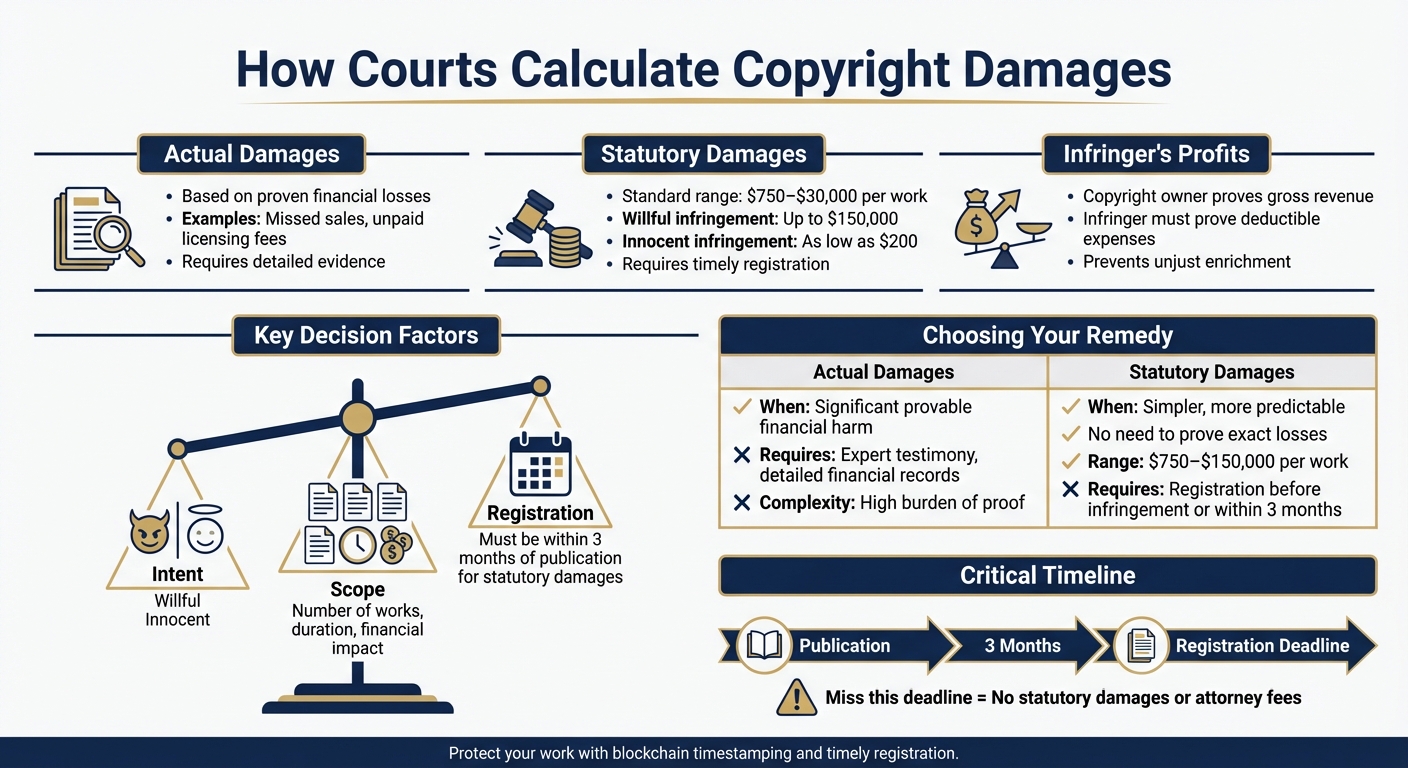
When someone uses copyrighted work without permission, courts calculate damages to compensate creators and discourage violations. Here’s how copyright for digital content creators works:
- Types of Damages:
- Actual Damages: Based on proven financial losses, like missed sales or unpaid licensing fees.
- Statutory Damages: Fixed amounts ($750–$30,000 per work), which can rise to $150,000 for willful infringement or drop to $200 for innocent mistakes.
- Infringer’s Profits: Courts can award profits earned from the infringement, requiring the infringer to disclose financial details.
- Key Factors:
- Intent: Willful violations lead to higher penalties, while innocent mistakes may result in lower awards.
- Scope: The number of works, duration of infringement, and financial impact on the owner influence damages.
- Ownership Proof: Timely registration with the U.S. Copyright Office is critical for claiming statutory damages.
- Statutory vs. Actual Damages:
- Choose statutory damages for simplicity and predictability.
- Opt for actual damages if you can prove significant financial harm.
Protecting your work through timely registration and tools like blockchain timestamping strengthens your claims and ensures fair compensation.
Copyright Damages Calculator: Actual vs Statutory Damages Comparison
Copyright infringement damages
sbb-itb-738ac1e
Actual Damages and the Copyright Owner’s Losses
Actual damages refer to the measurable financial harm caused by copyright infringement. Unlike statutory damages, which follow predetermined ranges, actual damages require clear evidence linking the infringement to specific monetary losses. These losses typically include missed sales revenue and unpaid licensing fees. The tricky part? Proving that the infringement directly caused the loss, rather than external market factors, can be quite challenging [2]. Now, let’s delve into how courts assess lost profits and market impact.
Calculating Lost Profits and Market Impact
To evaluate lost profits, courts look at whether sales dropped significantly during the time the infringing product was available. For example, if a software company experiences a 15% decline in sales over six months while a competitor markets an unauthorized copy, that drop could point to lost revenue. However, proving the connection isn’t straightforward because other market dynamics often come into play [2].
When it comes to licensing fees, courts use the standard market rate as a benchmark. Imagine a photographer typically charges $5,000 to license an image, and someone uses it without permission – that $5,000 becomes the baseline for calculating damages. The Copyright Act also allows the copyright owner to recover both the actual damages and any profits the infringer earned that weren’t already factored into the damages. This ensures the owner gets full compensation without receiving double recovery [1][2]. These complexities often require expert input to substantiate claims effectively.
How Expert Testimony Supports Damage Claims
Expert testimony plays a crucial role in helping courts untangle the financial impacts of infringement. Economic analysts and industry experts provide insights by conducting market evaluations, assessing economic impacts, and linking the infringement to specific losses. Their input translates complicated market data into clear, actionable monetary figures. To build a strong case, it’s essential to maintain detailed records of licensing agreements, sales data, and market trends—and protect your content from unauthorized sharing – these documents serve as the foundation for proving damages [2].
Recovering the Infringer’s Profits
In addition to seeking compensation for your own losses, you can claim the profits the infringer earned by using your copyrighted work. This approach ensures that wrongdoers don’t benefit from their illegal actions. Under copyright law, the process is straightforward: you need to prove the infringer’s gross revenue, and then the responsibility shifts to them to justify any deductions.
"In establishing the infringer’s profits, the copyright owner is required to present proof only of the infringer’s gross revenue, and the infringer is required to prove his or her deductible expenses and the elements of profit attributable to factors other than the copyrighted work." – 17 U.S.C. § 504(b) [7]
This legal framework makes sense because the infringer has access to their financial records, which you typically don’t. Your role is to show the total revenue generated from the infringement – after that, it’s up to the infringer to provide explanations and evidence.
Proving the Infringer’s Gross Revenue
To recover profits, you’ll need to establish the infringer’s total revenue from the infringing activity. This involves gathering financial details such as sales records, transaction data, and other relevant documents during the discovery process. Once you’ve presented this evidence, the infringer must prove their deductible expenses – like production costs, distribution fees, and overhead – to reduce the gross revenue to net profit. They must also demonstrate which parts of their profit came from non-infringing elements.
Determining Which Profits Came from Infringement
Another critical step is identifying how much of the infringer’s profit directly resulted from using your copyrighted material, which is easier to prove if you have established ownership with timestamps. This process, called apportionment, requires the infringer to show which portions of their profits stem from legitimate business activities rather than the infringement. For example, if their product combines your copyrighted work with their own original contributions, they must specify how much of the profit is tied to those contributions.
The central question is whether your copyrighted work was a key factor in driving sales or adding value to the product. If the infringer cannot clearly separate profits linked to your work from those arising from other sources, courts may hold them accountable for the entire gross revenue. This careful analysis ensures that only profits directly connected to the infringement are included in the damages you can claim.
Statutory Damages: An Alternative Approach
When calculating exact financial losses becomes too complex, copyright law offers an alternative: statutory damages. These are pre-determined monetary amounts set by the Copyright Act, designed to help copyright owners recover compensation without needing to prove the exact financial harm they suffered. Unlike actual damages, which focus solely on compensating the owner for their losses, statutory damages serve a dual purpose – they provide compensation and act as a deterrent to discourage future infringement.
"Statutory damages provide a clearly defined remedy for victims of infringement without the murkiness and uncertainty of the first two categories of damages."
– Richard Stim, Attorney [2]
To qualify for statutory damages, the work must be registered with the U.S. Copyright Office either before the infringement occurred or within three months of its publication. This option can be chosen at any time before the final judgment, making the process less costly by eliminating the need for expert testimony or detailed financial documentation. This streamlined approach aims to balance simplicity in recovering damages with the goal of discouraging infringement.
Statutory Damage Ranges and Willful Infringement
Courts have broad discretion when determining statutory damage amounts. For most cases, damages typically range from $750 to $30,000 per infringed work [2]. However, certain circumstances can adjust these amounts. If an infringer can prove "innocent infringement", meaning they genuinely did not know they were violating copyright law, the court can reduce the award to as little as $200 per work. On the other hand, in cases of willful infringement – where the defendant knowingly or recklessly violated copyright law – damages can climb as high as $150,000 per work [2].
For example, courts have issued awards as low as $2 per work in cases involving innocent mistakes, while willful violations have led to damages reaching hundreds of thousands of dollars. This range highlights the court’s ability to tailor awards based on the specifics of each case.
How Courts Define a "Single Work" for Damages
Statutory damages are calculated on a per-work basis. For compilations, courts treat the entire compilation as a single entity unless its individual components have independent economic value. For instance, if a single photograph is copied 1,000 times, it qualifies for only one statutory award. However, if 10 separate photographs are infringed, each can be treated as an individual work, making them eligible for separate awards.
Courts assess whether individual components have "independent economic value" and exist as stand-alone works [4]. A recent example is the 2023 VHT, Inc. v. Zillow Group, Inc. case, where the Ninth Circuit determined that individual real estate photographs were separate works because they were marketed and licensed independently. Similarly, in Columbia Pictures Television v. Krypton Broadcasting of Birmingham, Inc., each television episode was deemed a distinct work due to its unique production and registration history [4].
Factors Courts Consider When Awarding Damages
When courts determine the exact amount of damages to award, they don’t make these decisions lightly. Instead, judges carefully evaluate specific factors to ensure the award aligns with the unique details of the case. Under the Copyright Act, courts have the authority to make these decisions within defined statutory boundaries.
"The [trier of fact] has ‘wide discretion in determining the amount of statutory damages to be awarded, constrained only by the specified maxima and minima.’"
– L.A. News Serv. v. Reuters Television Int’l, Ltd. [4]
Judges weigh measurable losses against the infringer’s actions and financial situation. Let’s take a closer look at how the scale of the infringement and the infringer’s intent influence these awards.
Scale and Commercial Impact of the Infringement
The scope and commercial effects of the infringement play a key role in determining damages.
Judges examine the extent of the infringement, considering factors such as the number of works involved, how long the infringement lasted, and the financial gains from the unauthorized use. For instance, copying a single photograph once is far less severe than a large-scale operation infringing on dozens of works over a prolonged period.
Another critical element is the financial impact on the copyright owner. Courts look at evidence of lost revenue, such as licensing fees or decreased sales, to establish a baseline for damages. Using verification certificates to prove ownership can further solidify these claims. To ensure fair compensation and discourage future violations, courts often calculate awards as a "reasonable multiple" of the actual losses incurred [5][6].
The Infringer’s Intent and Financial Status
The intent behind the infringement and the offender’s financial position are also pivotal in shaping damage awards.
Intent can significantly influence the outcome. Proving willful infringement often results in much higher damages – up to $150,000 per work [1][3]. On the other hand, if the infringer can show they acted out of genuine ignorance, the minimum award might drop to as little as $200 per work [1][3].
"Statutory damages have punitive and deterrent purposes."
– Nintendo of Am., Inc. v. Dragon Pac. Int’l. [4]
Financial status is another factor courts consider. A fine that might deter an individual could be negligible for a large corporation with deep pockets. To ensure the penalty has the intended impact, courts adjust the award based on the infringer’s financial capacity [2]. This ensures the damages serve as both a punishment and a deterrent, regardless of the infringer’s resources.
Proving Ownership and Strengthening Damage Claims
Establishing clear ownership is the foundation for calculating damages in copyright cases. Without solid proof of ownership, even the strongest infringement claim can unravel in court. It’s essential to demonstrate your copyright ownership before damages can be accurately assessed.
Using Blockchain Timestamping to Verify Ownership
Blockchain technology creates a permanent and unchangeable record of content creation, making it a powerful tool for copyright protection. To qualify for statutory damages, you must register your work with the U.S. Copyright Office before infringement occurs or within three months of publication [9][10]. Failing to meet this deadline often means relying on actual damages, which requires detailed financial evidence and, in many cases, expert testimony.
ScoreDetect provides a solution by recording a checksum of your content on the blockchain. This process generates a verifiable timestamp without storing the actual files, creating a lasting record that can demonstrate the infringer had access to protected, timestamped content. Without this kind of proof, damage awards could drop to as little as $200. Blockchain-backed timestamps lay the groundwork for presenting strong, court-admissible evidence in the form of verifiable certificates.
Verifiable Certificates as Court Evidence
While a blockchain timestamp is a critical first step, courts require additional documentation to accept it as evidence. Verifiable certificates transform blockchain records into legal proof of ownership. These certificates meet evidence requirements by providing an unbroken digital trail, ensuring your claim holds up in court.
ScoreDetect’s certificates include key details such as the registration date, a unique digital fingerprint of your content, public blockchain URLs, and formal signatures. These elements create a robust piece of evidence that courts can rely on. When seeking the infringer’s profits, you only need to prove their gross revenue; the burden then shifts to the infringer to demonstrate deductible expenses [8]. Certificates that clearly establish ownership simplify this process by reinforcing your claim and supporting your timeline of events. Courts also weigh strong ownership evidence when determining whether infringement was innocent or intentional [10].
For industries where intellectual property is a core asset – like legal firms, content creators, and marketing agencies – maintaining these certificates is critical. ScoreDetect’s WordPress plugin automates this process by capturing every article you publish or update, creating blockchain-backed proof without requiring manual effort. This automation ensures you stay within the crucial three-month registration window and have the necessary documentation ready if infringement occurs.
Conclusion
Choosing Between Actual and Statutory Damages
When it comes to copyright infringement, you have two primary options for seeking compensation: actual damages or statutory damages. Actual damages require you to prove specific financial losses caused by the infringement. On the other hand, statutory damages provide fixed amounts under 17 U.S.C. § 504(c), without the need to show detailed evidence of losses. These statutory awards typically fall between $750 and $30,000 per work, but they can climb as high as $150,000 if you can demonstrate willful infringement [2][3][4]. For cases of innocent infringement, courts may reduce the amount to as low as $200 [2][3][4].
However, there’s a catch: you must register your work with the U.S. Copyright Office before the infringement occurs or within three months of its publication to qualify for statutory damages [2][4]. Additionally, you can only choose one remedy – either actual or statutory damages – before the final judgment. If your losses are unlikely to exceed $150,000, statutory damages often provide a more predictable and straightforward option.
Protecting Your Digital Assets
Once you’ve decided on your damages approach, safeguarding your digital assets becomes essential by recognizing the signs your content needs piracy detection to ensure your claim holds up in court. Timely registration of your work – within three months of publication – is critical. This not only preserves your eligibility for statutory damages but also allows you to recover attorney fees [11][12]. Without timely registration, you’re limited to actual damages, which can be harder to prove and may result in lower compensation.
Tools like ScoreDetect make protecting your intellectual property easier. By automating blockchain timestamping, ScoreDetect creates verifiable proof of ownership for every article you publish or update. This ensures you meet the critical three-month registration window. The certificates generated by ScoreDetect include essential details like registration dates, unique digital fingerprints, public blockchain URLs, and formal signatures – key elements courts use to evaluate ownership claims.
For industries where intellectual property drives income – like law firms, content creators, and marketing agencies – this kind of protection is invaluable. Beyond prevention, ScoreDetect’s Enterprise plan offers features like 24/7 monitoring, invisible watermarking, and automated takedown notices, boasting a 96% success rate. With these tools, you get comprehensive protection, from creation to enforcement.
Choosing the right damage remedy and implementing automated copyright protection are essential steps for safeguarding your creative work and enforcing your rights effectively.
FAQs
Why might a copyright owner choose statutory damages instead of actual damages?
Statutory damages offer a straightforward and reliable alternative to calculating actual damages. Unlike actual damages, which require detailed proof of the financial loss caused by infringement, statutory damages allow courts to award compensation within a set range. This range can be much higher in cases of willful infringement, serving as a stronger deterrent to those considering violating copyright laws.
Opting for statutory damages can also simplify the legal process. By eliminating the need for extensive financial evidence, it becomes easier and less time-consuming for copyright holders to pursue justice and secure compensation. Plus, the predictability of statutory damages provides reassurance and helps streamline the process for those seeking to protect their rights.
How does blockchain timestamping help protect copyright claims?
Blockchain timestamping provides a dependable way to bolster copyright claims by creating a secure and unchangeable record of ownership. When you timestamp content on the blockchain, it generates a permanent digital certificate that verifies the exact time the content was created or published. This can play a key role in legal disputes, serving as solid evidence of authorship and establishing priority over potential infringers.
What makes blockchain particularly valuable is its ability to securely store this proof without the risk of tampering. This gives content creators and businesses an added layer of protection against unauthorized use. Tools like ScoreDetect utilize blockchain technology to simplify the process of managing and protecting digital assets, making copyright protection more efficient and reliable.
What factors do courts consider when determining statutory damages in copyright cases?
Courts weigh several important factors when determining statutory damages in copyright cases. These include whether the infringement was intentional or accidental, the quantity and type of works involved, and any proof of financial harm or lost licensing opportunities. Additionally, the damages requested by the plaintiff and whether the case is decided by a judge or jury can influence the outcome.
The aim is to strike a balance: compensating the copyright owner for their losses while discouraging future violations. Since each case is different, these factors are applied based on the specific details of the situation.