Blockchain is transforming how digital evidence is protected, particularly in intellectual property (IP) disputes. By using cryptographic hashing, timestamping, and decentralized ledgers, blockchain ensures files remain unaltered and traceable, making it easier to prove ownership, originality, and chain of custody.
Here’s why it matters:
- Tamper-proof Records: Blockchain records a file’s unique digital fingerprint (hash), making any alterations detectable.
- Timestamp Verification: Proves a file’s existence at a specific time, which is critical in IP disputes.
- Chain of Custody Tracking: Logs every interaction with the evidence, ensuring transparency and accountability.
Tools like ScoreDetect simplify this process by automating hash creation, blockchain registration, and monitoring for IP violations. While blockchain offers strong protections, it works best when combined with established forensic methods and clear evidence management policies.
This article explores how blockchain strengthens digital evidence, its role in IP cases, and practical tools for implementation.
Starling Lab’s Fight for Digital Integrity with Adam Rose | DWeb Decoded

How Blockchain Preserves Digital Evidence
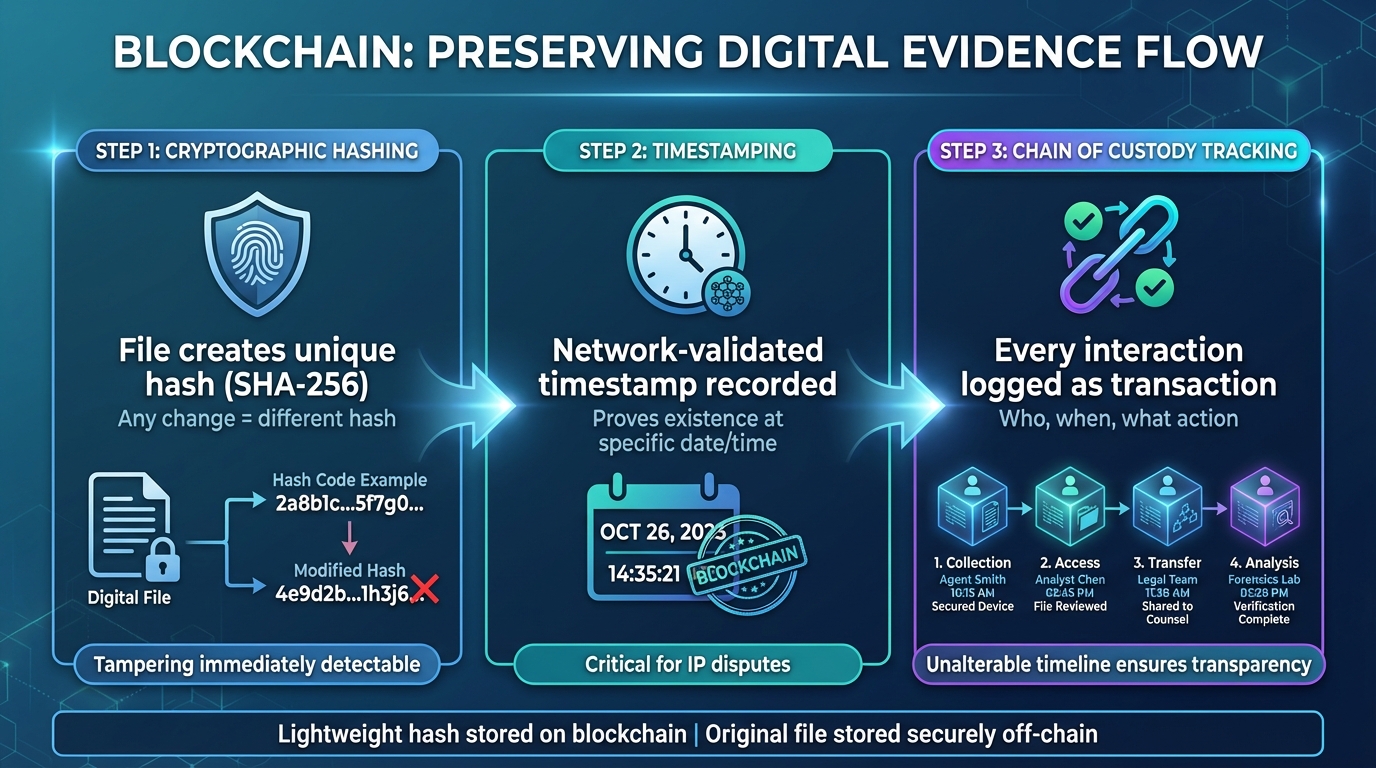
How Blockchain Protects Digital Evidence: 3-Step Process
How does blockchain prevent data tampering?
Blockchain uses cryptographic hashing to ensure data integrity, making tampering nearly impossible. Here’s how it works: when a digital file is created or collected, a unique hash – a fixed-length value generated using algorithms like SHA-256 – is produced. This hash acts like a fingerprint for the file and gets recorded on the blockchain. If even a tiny change is made to the original file, the hash completely changes, making any tampering immediately detectable. During legal proceedings, recomputing the hash and comparing it with the one stored on the blockchain confirms whether the file has been altered. This approach is especially useful for intellectual property, as large files can remain securely stored while their lightweight hash is anchored to the blockchain, ensuring their integrity.
How timestamping verifies evidence authenticity
Blockchain transactions include a network-validated timestamp, creating a chronological and tamper-proof record. When a hash of digital work – like an article, song, or source code – is added to the blockchain, the timestamp serves as proof that the work existed at a specific date and time. This feature is critical in intellectual property disputes, where creators can show that their work was registered long before a similar piece appeared. For instance, a writer could prove a manuscript’s originality by pointing to its blockchain timestamp. Tools like ScoreDetect simplify this process by capturing a checksum of the content and anchoring it on the blockchain, offering an automated, verifiable record of creation without revealing the actual asset. These timestamps also enable tracking of every subsequent action involving the evidence.
How does blockchain track chain of custody?
Blockchain also excels at documenting the chain of custody for digital evidence. Each significant event in the evidence’s lifecycle – such as who handled it, when, and what action was taken – is recorded as a blockchain transaction. These entries include the evidence’s unique hash, the identity or role of the person involved (like an investigator or attorney), a timestamp, and details of the action. Since blockchain transactions are sequentially linked using cryptographic methods, they create an unalterable timeline that ensures transparency and prevents unauthorized changes. This capability is particularly helpful in intellectual property cases, where it can track the movement of sensitive materials, such as documenting how a confidential design file transitions from research teams to legal advisors.
Using Blockchain in IP Disputes
Proving Ownership and Originality of Digital Content
By hashing your digital work and recording it with a blockchain timestamp, you can establish its existence at a specific moment in time. When current hashes match the blockchain records, it confirms the content’s originality. This method provides a solid foundation for resolving intellectual property disputes, especially by proving who created the work first.
For even stronger evidence, combine blockchain timestamps with traditional proof like drafts, emails, or contracts. While a timestamp alone doesn’t verify authorship, linking your identity to your blockchain account through documentation or digital signatures creates a more reliable record. Tools like ScoreDetect simplify this process by generating a checksum of your content and recording it on the blockchain without exposing the actual work. This preserves confidentiality while offering a robust proof of ownership, which can be invaluable during e-discovery stages.
Improving E-Discovery Processes in IP Cases
Blockchain systems automatically log key events – like collection, access, transfer, analysis, and production – as time-stamped, tamper-resistant transactions [4]. These records create an unchangeable history that minimizes disputes over whether files were altered during discovery.
Courts can also verify the integrity of digital exhibits by comparing their current file hashes with those stored on the blockchain [1]. This transparent evidence trail simplifies legal discussions and reduces the need for lengthy debates over authenticity. Such records are especially useful in resolving complex intellectual property cases.
IP Scenarios Where Blockchain Helps
In copyright infringement cases, rightsholders can use blockchain-recorded hashes and metadata to establish authorship, creation dates, and the scope of their content. This evidence strengthens claims of infringement and aids in calculating damages [2][3]. For trade secret disputes, blockchain can document versions and access events, showing that reasonable efforts were made to maintain secrecy and identifying when confidential information was accessed [4][5]. In licensing conflicts, an immutable log of license agreements, renewals, territory changes, and royalty events clarifies the rights granted and whether usage exceeded contractual terms [1].
Blockchain evidence also plays a role in cross-border enforcement and addressing online infringement. Since public blockchain records are accessible globally, rightsholders can use hash-timestamp proofs to support takedown notices or DMCA requests sent to platforms and hosting providers [1].
sbb-itb-738ac1e
ScoreDetect: Digital Content Protection with Blockchain
How Does ScoreDetect Use Blockchain for IP Protection?
ScoreDetect uses blockchain technology to safeguard your digital content by creating a cryptographic checksum and recording it on the SKALE blockchain with a verified timestamp. When you upload a digital asset – whether it’s an article, image, or video – ScoreDetect generates a unique cryptographic checksum directly on your device. This checksum is then anchored to the SKALE blockchain, along with a timestamp validated by the network. This process creates an unchangeable record that serves as a verifiable fingerprint, proving both the content’s integrity and originality at the time of registration.
This secure method lays the groundwork for reliable, blockchain-based proof, which ScoreDetect enhances with additional tools for intellectual property (IP) enforcement.
Features That Support Evidence Preservation and Enforcement
ScoreDetect delivers a comprehensive IP enforcement system. One standout feature is its invisible watermarking, which embeds ownership details into digital assets – such as images, videos, audio files, and documents – without affecting their quality or usability. Its discovery engine continuously scans websites, marketplaces, and social platforms to locate unauthorized copies of your registered content, even bypassing anti-scraping technologies.
When ScoreDetect identifies potential infringements, it uses an analysis layer to compare the discovered file with the original version stored on the blockchain. By calculating similarity scores and extracting watermark data, it provides quantifiable proof of unauthorized use. The platform then automates the enforcement process by generating takedown notices. These notices include URLs, timestamps, and ownership evidence, achieving a 96% success rate when sent to hosting providers, search engines, or platforms. From registering content to detecting and addressing infringements, ScoreDetect maintains detailed logs and blockchain records that can support internal reviews or legal proceedings.
Why ScoreDetect Helps Businesses in IP-Heavy Industries
ScoreDetect’s blockchain-driven approach is particularly valuable for industries where IP protection is critical. For example, its WordPress plugin automatically hashes and timestamps every article published or updated, completing the process in about 3.3 seconds. This provides publishers, SEO agencies, and content creators with a time-ordered record of their work without disrupting editorial workflows. Additionally, Zapier integration connects ScoreDetect to over 6,000 web apps, enabling businesses to automate blockchain registration for new assets stored in cloud drives, content management systems, or design tools. Discovered infringements can be routed into ticketing systems, and periodic enforcement reports can be generated effortlessly.
Industries such as media and entertainment, marketing, software development, legal services, ecommerce, finance, healthcare, and education benefit from ScoreDetect’s blend of blockchain-based proof, automated monitoring, and systematic enforcement. By simplifying IP protection and offering optional advanced features, the platform helps businesses reduce infringement risks, respond more quickly to violations, and create litigation-ready documentation for potential disputes.
Limitations of Blockchain-Based Evidence
Is Blockchain Evidence Admissible in U.S. Courts?
Blockchain records don’t automatically qualify as admissible evidence in U.S. courts. They must meet certain evidentiary standards, such as those outlined in FRE 901 and FRE 803(6). Courts generally view blockchain outputs as digital business records rather than inherently authenticated evidence. For instance, organizations using blockchain to protect intellectual property – like logging content hashes during uploads or publications – must thoroughly document their standard operating procedures and system design. According to an overview from Purdue Global Law School, blockchain ledgers maintained as part of regular business operations and supported by a records custodian can qualify as business records under FRE 803(6). However, uneven case law across jurisdictions creates uncertainty over how judges might evaluate these records. Additionally, blockchain typically only proves that a specific hash existed at a given time. To establish a link between the hash and its creator or context, further corroboration is required. These challenges highlight both the technical and operational hurdles associated with blockchain-based evidence.
Technical and Operational Challenges of Blockchain Evidence
One major technical issue is that errors in input data cannot be corrected. If an incorrect file is hashed, the blockchain permanently records that mistake. Since blockchains generally store only hashes (digital fingerprints) and not the actual content, losing or corrupting the original off-chain data compromises the ability to validate the hash. Privacy concerns also arise when public blockchains contain excessive metadata or sensitive transaction details, potentially clashing with trade secret protections, nondisclosure agreements, or data privacy regulations.
Operationally, organizations often face difficulties standardizing when and how evidence is recorded. Should it be hashed upon creation, during every edit, or only at key milestones? Inconsistent practices can lead to gaps in the chain of custody. Mismanagement of cryptographic keys further complicates verifying who performed specific actions. Tools like ScoreDetect can address some of these challenges by automating content hash captures at publication and integrating blockchain into existing workflows. However, clear policies around ownership, roles, and record retention are still critical to ensure reliability. Addressing these issues requires implementing strong best practices.
Best Practices for Using Blockchain in Evidence Workflows
Recognizing blockchain’s limitations can help refine its role in preserving digital evidence. Rather than replacing traditional methods, blockchain should complement established digital forensics practices. For example, investigators should still image original media, maintain detailed chain-of-custody logs, and use validated tools to preserve unaltered copies of data. Blockchain can serve as an additional layer by recording hashes and key lifecycle events, such as acquisition, handoffs, and reports, to provide an immutable record that supports traditional processes. This hybrid approach strengthens the overall authenticity and reliability of evidence by combining the strengths of both methods.
Organizations should set clear goals for blockchain use – whether it’s proving first creation, tracking distribution, or documenting takedowns – and avoid trying to record every detail. Standardized procedures should dictate when hashes are generated, whether at creation, publication, or during significant revisions. Automating these steps through tools like CMS plugins can improve consistency. Written policies should also address key areas such as platform selection (public vs. permissioned), key management, access controls, retention periods, and handling legal holds or discovery requests. Regular audits and mock e-discovery exercises can ensure that both blockchain and off-chain records are ready for efficient collection and presentation in legal settings. By combining blockchain with robust processes, organizations can enhance their ability to present reliable evidence in court.
Conclusion: Digital Evidence Integrity with Blockchain
Blockchain technology provides a secure, time-stamped, and tamper-proof system for maintaining digital records through its decentralized ledger. This ensures transparent audit trails and strengthens the integrity of digital evidence, from its creation to its use in court – especially for blockchain-based copyright enforcement. Industries like media, software development, legal services, and marketing can benefit by reducing litigation risks, speeding up investigations, and building more robust enforcement strategies.
With blockchain-based systems, every access, transfer, and modification of digital evidence is meticulously logged, creating verifiable records. These records align with U.S. business records standards under the Federal Rules of Evidence when maintained correctly. Studies have shown that such systems achieve over 98% accuracy in verifying evidence integrity, far surpassing traditional centralized logs that are more susceptible to administrative alterations.[5]
Tools such as ScoreDetect make blockchain adoption more accessible by handling the technical complexities. For example, ScoreDetect automates the creation of cryptographic checksums, records them to the blockchain, and manages these processes through intuitive dashboards and workflows. Its WordPress plugin seamlessly integrates into content workflows, capturing proof of ownership for every published or updated article through blockchain-based authorship verification without requiring specialized technical skills or disrupting operations.
While blockchain offers a strong foundation for managing digital evidence, it should be part of a broader evidence strategy. Combining blockchain records with identity controls and traditional forensic methods creates a multi-layered approach that enhances both technical reliability and legal admissibility. To maximize effectiveness, organizations should ensure their blockchain solutions align with legal requirements, integrate smoothly with content management and e-discovery systems, and establish clear governance policies. These policies should define the roles and responsibilities of IT, legal, and business teams to ensure a cohesive and effective strategy.
FAQs
How does blockchain ensure the integrity of digital evidence in intellectual property disputes?
Blockchain technology plays a key role in safeguarding digital evidence by establishing a secure, unchangeable record of ownership and authenticity. When a digital asset is registered, a unique checksum – essentially a digital fingerprint – is stored on the blockchain along with a timestamp. This permanent record ensures that the content remains unaltered from the moment it was registered.
In cases involving intellectual property disputes, blockchain provides solid evidence of ownership and originality. This makes it a powerful tool for reinforcing copyright claims and preventing fraudulent activity. By delivering a reliable and transparent way to verify digital assets, blockchain serves as a vital mechanism for protecting intellectual property rights.
What challenges can arise when using blockchain-based evidence in legal cases?
Using blockchain-based evidence in legal cases comes with its own set of hurdles. A major concern lies in how courts across various jurisdictions handle and interpret this type of evidence. While blockchain technology can offer solid proof of authenticity – thanks to features like timestamping and checksum verification – whether this evidence is accepted often hinges on the specific legal framework of the region.
Another significant challenge involves proving the integrity and chain of custody of blockchain records. Since blockchain relies on decentralized and highly technical mechanisms, its reliability and security aren’t always straightforward to explain. This often necessitates expert testimony to demonstrate that the evidence is tamper-resistant and complies with legal standards. The lack of consistent guidelines or legal precedents in some areas only adds to the complexity.
How does ScoreDetect make blockchain-based IP protection easier?
ScoreDetect simplifies the process of safeguarding intellectual property on the blockchain. By uploading your digital content, you can instantly create a secure, timestamped proof of ownership. This method not only protects your intellectual property but also prioritizes privacy and security by avoiding the need to store the actual assets.
With compatibility across more than 6,000 platforms through automation tools, ScoreDetect makes managing and securing your digital assets straightforward and efficient. Its streamlined approach removes complexity, offering dependable protection for your content with ease.