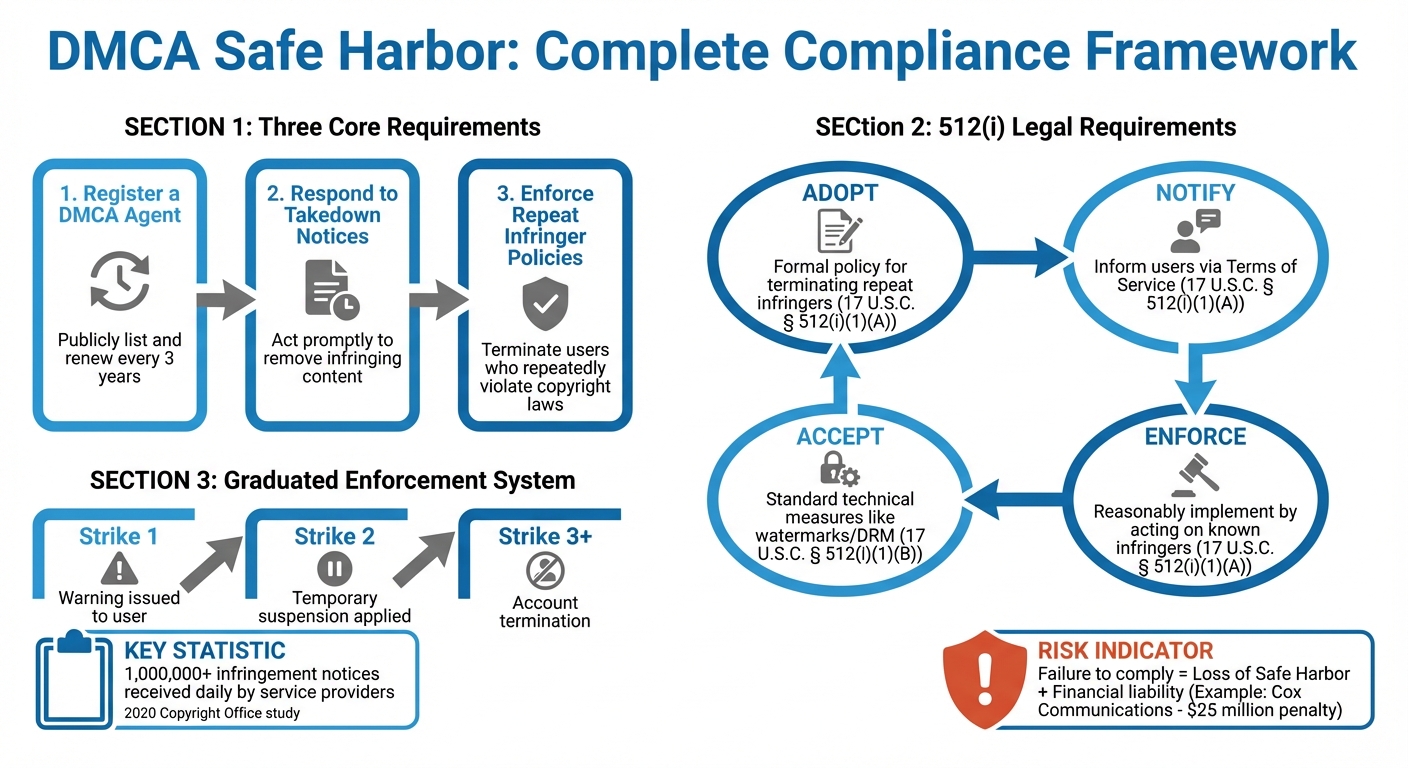
Online platforms are legally required to enforce repeat infringer policies to maintain DMCA Safe Harbor protections. These protections shield platforms from financial liability for copyright violations by users, but only if specific rules are followed. Here’s what platforms must do:
- Register a DMCA agent: Publicly list and renew this registration every 3 years.
- Respond to takedown notices: Act promptly to remove infringing content.
- Enforce repeat infringer policies: Terminate users who repeatedly violate copyright laws.
Failing to meet these requirements can strip platforms of their legal immunity, as seen in cases like Cox Communications, which lost its Safe Harbor status and faced a $25 million penalty for not enforcing its policy. Platforms must track DMCA notices, link them to user accounts, and document enforcement actions to ensure compliance. Automated systems and clear policies are key to managing these obligations effectively.
DMCA Safe Harbor Compliance Requirements and Enforcement Process
What Is The DMCA Safe Harbor? – SecurityFirstCorp.com
sbb-itb-738ac1e
The Repeat Infringer Rules Explained
Section 512(i) of the Digital Millennium Copyright Act (DMCA) lays out specific conditions that online platforms must meet to maintain their safe harbor protections. Failing to meet these requirements can strip platforms of their legal immunity.
Legal Requirements Under Section 512(i)
To comply with Section 512(i), platforms are obligated to:
- Adopt a formal policy for dealing with repeat infringers.
- Notify users of this policy, often through the Terms of Service.
- Enforce the policy by actively addressing known repeat infringers.
- Accept standard technical measures, like digital watermarking solutions used by copyright owners to safeguard their works.
Here’s a breakdown of these requirements in a table:
| Requirement Type | Obligation | Legal Source |
|---|---|---|
| Adoption | Must have a formal policy for terminating repeat infringers | 17 U.S.C. § 512(i)(1)(A) |
| Communication | Must inform users of the policy (e.g., in Terms of Service) | 17 U.S.C. § 512(i)(1)(A) |
| Implementation | Must "reasonably implement" the policy by acting on known infringers | 17 U.S.C. § 512(i)(1)(A) |
| Technical | Must accept standard technical measures used by copyright owners | 17 U.S.C. § 512(i)(1)(B) |
Platforms are also expected to establish effective systems to detect and address habitual violators. Courts evaluate whether platforms use the information they have – like DMCA takedown notices – to identify and terminate repeat offenders. While platforms aren’t required to monitor users proactively, they must connect the dots between repeated takedown notices and user accounts.
For instance, in the EMI Christian Music Grp., Inc. v. MP3tunes, LLC case (October 2016), the Second Circuit Court of Appeals ruled against MP3tunes. Although the company terminated 153 users, it failed to link takedown notices to users who repeatedly sideloaded infringing files into their cloud lockers. This case highlights the importance of platforms being diligent in addressing repeat infringers to maintain their safe harbor protections.
"The purpose of subsection 512(i) is to deny protection to websites that tolerate users who flagrantly disrespect copyrights." – Gene Markin, Attorney, Stark & Stark
How to Identify Repeat Infringers
Pinpointing repeat infringers is a critical part of enforcing the DMCA. A "repeat infringer" is anyone who repeatedly uploads or downloads copyrighted material without authorization. Under the DMCA’s strict liability standard, users can be deemed repeat infringers regardless of whether they knew the material was copyrighted.
"All it [takes] to be a ‘repeat infringer’ [is] to repeatedly [upload or download] copyrighted material for personal use." – Second Circuit Court of Appeals
Platforms typically track DMCA takedown notices and link them to specific user accounts. Each notice may count as a "strike", with an internal system tallying these strikes over time. Courts have consistently ruled that platforms must act on multiple takedown notices or obvious signs of infringement, even if the user hasn’t been found liable in court. Both uploading content for public use and downloading copyrighted material for personal use can trigger the repeat infringer policy.
A 2020 Copyright Office study revealed that service providers receive over 1,000,000 infringement notices daily [9]. This staggering volume underscores the need for reliable systems to track and act on repeat violations. Platforms that fail to connect takedown notices to user accounts risk being seen as intentionally ignoring repeat infringers – a stance courts have repeatedly rejected.
How to Create and Enforce a Repeat Infringer Policy
Enforcing a clear and effective repeat infringer policy is crucial for maintaining your platform’s DMCA safe harbor protections. To meet legal requirements, platforms must establish a formal policy, communicate it transparently to users, and enforce it consistently. Courts have repeatedly ruled that unclear or poorly enforced policies can strip platforms of these protections.
Writing a Clear Policy
To comply with legal standards, your policy must clearly state that repeat infringers will face account termination "as warranted." This specific language, drawn directly from Section 512(i), should be prominently displayed in your Terms of Service or on a dedicated DMCA policy page [11][12]. The policy should define what qualifies as a "repeat infringer" – typically a user with multiple copyright complaints within a set timeframe – and outline the consequences, such as warnings, temporary suspensions, or permanent account termination.
A sample policy might include the following statement:
"In accordance with the DMCA and other applicable law, we have adopted a policy of terminating, in appropriate circumstances and at our sole discretion, users who are deemed to be repeat infringers" [11].
This statement underscores both the legal framework and the platform’s discretion in applying the policy.
What Counts as Reasonable Implementation
"Reasonable implementation" involves using DMCA takedown notices to identify and monitor users who repeatedly engage in infringing activities [5]. For example, in the 2016 EMI Christian Music Grp., Inc. v. MP3tunes, LLC case, the Second Circuit found that MP3tunes failed to enforce its policy adequately. Despite terminating 153 users, the company did not track users who repeatedly uploaded the same infringing files, exposing a gap in its enforcement process [4][5].
To avoid such pitfalls, adopt a graduated response system:
- First offense: Issue a warning.
- Subsequent violations: Apply temporary suspensions.
- Repeat offenses: Terminate accounts [12].
Platforms should document all DMCA notices, actions taken (removals, suspensions, terminations), and communications with users. This thorough record-keeping can serve as evidence of reasonable implementation if the policy is legally challenged [11]. Automated systems that link takedown notices to user accounts are particularly effective in identifying repeat offenders, even when they attempt to bypass detection by renaming files [5].
| Policy Component | Requirement | Implementation Action |
|---|---|---|
| Transparency | Inform users about the policy | Publish it in Terms of Service [10][11] |
| Identification | Track repeat offenders | Link takedown notices to specific user IDs [5] |
| Termination | Define "appropriate circumstances" | Set a specific number of strikes (e.g., 3) [12][13] |
| Fairness | Handle counter-notices | Restore content if no lawsuit is filed in 10–14 days [10][11] |
| Technical | Respect technical protections | Avoid interfering with watermarks or DRM [10] |
Next, it’s important to address how to handle disputes and false claims to ensure fair enforcement.
Dealing with False Claims and Unclear Cases
Not every takedown notice is legitimate. Section 512(f) of the DMCA allows platforms and users to seek damages, costs, and attorney fees if someone knowingly makes a false claim in a takedown notice or counter-notice [2][1]. Platforms should provide a straightforward way for users to dispute takedowns through a counter-notice process. If a valid counter-notice is submitted, the platform must restore the removed content within 10–14 days unless the copyright owner files a legal action [1].
A "strike" should not be counted against a user if the takedown notice is retracted or if the user submits a valid counter-notice [13]. Additionally, platforms should create an appeals process for users to challenge account terminations if they believe they were wrongly identified as repeat infringers [12].
For example, in the January 2025 decision of Capitol Records v. Vimeo, the U.S. Court of Appeals for the Second Circuit ruled that Vimeo employees’ interactions (e.g., liking or commenting) with infringing videos did not constitute "red flag knowledge" of infringement. The court found that the infringing nature of the content was not "obvious to an ordinary person" without specialized copyright knowledge, ultimately protecting Vimeo in this case [8].
"Vimeo was entitled to summary judgment ‘unless plaintiffs can point to evidence sufficient to… proving that Vimeo personnel either knew the video was infringing or knew facts making that conclusion obvious to an ordinary person who had no specialized knowledge of music or the laws of copyright.’" – Second Circuit Court of Appeals [8]
Fair use is another complex area. Automated filters often fail to account for legitimate uses like parody, criticism, or education. To address this, platforms should allow for manual review of cases where fair use might apply [6][1]. If notified of ongoing litigation after a counter-notice, platforms should delay permanent action until the case is resolved [13]. This balanced approach helps protect both copyright owners and users while ensuring compliance with DMCA requirements.
Court Cases That Shaped Repeat Infringer Rules
Several landmark cases have played a pivotal role in defining how the DMCA’s repeat infringer rules are enforced. These rulings have clarified what "reasonable implementation" entails and set the standards that platforms must follow today.
The MP3tunes Case
The case of EMI Christian Music Grp., Inc. v. MP3tunes, LLC had a major impact on how "repeat infringer" is interpreted under the DMCA. In 2016, the Second Circuit Court found that MP3tunes failed to effectively enforce its repeat infringer policy, even though the platform had terminated 153 users for unauthorized file sharing [5].
This decision expanded the scope of what constitutes a repeat infringer. Initially, the District Court defined repeat infringers as "blatant infringers" who knowingly uploaded content for others to copy. However, the Second Circuit took a broader view, concluding that "all it [takes] to be a ‘repeat infringer’ [is] to repeatedly [upload or download] copyrighted material for personal use" [5]. In other words, even users who download copyrighted content for personal use, without any intent to distribute, can be classified as repeat infringers.
The ruling reinforced that copyright infringement operates under strict liability. This means users can be held accountable for infringement regardless of whether they understand copyright law or intend to violate it. Judge Pauley of the District Court highlighted this point, stating:
"The purpose of subsection 512(i) is to deny protection to websites that tolerate users who flagrantly disrespect copyrights" [4].
This case sent shockwaves through the tech industry. Major companies like Google, Facebook, and Twitter filed amicus briefs, warning that the decision could push platforms into "tallying strikes" against users for merely engaging with content that might later face takedown requests [5].
Another key ruling, the Aimster case, further clarified the obligations of platforms under Section 512(i).
The Aimster Case
The In re Aimster Copyright Litig. case, decided by the Seventh Circuit Court of Appeals in 2003, established an essential standard for how platforms must handle repeat infringers under the DMCA. The court ruled that service providers must "do what it can reasonably be asked to do to prevent the use of its service by ‘repeat infringers’" to qualify for safe harbor protections [4].
This decision stressed that platforms must adopt and enforce repeat infringer policies to maintain their safe harbor status. The ruling also introduced the "anti-blindness principle", which holds that platforms lose safe harbor protections if they willfully ignore evidence of infringing activity or fail to identify repeat infringers through blockchain-based authorship verification. The Aimster case reinforced the DMCA’s "grand bargain": platforms are granted immunity from liability, but only if they actively work with copyright owners to curb infringement. Failing to meet these obligations can strip a platform of its safe harbor protections, leaving it vulnerable to claims of contributory or vicarious liability.
Together, these cases highlight the critical importance of platforms implementing and enforcing effective repeat infringer policies to retain their safe harbor protections under the DMCA.
Best Practices for DMCA Compliance
To maintain DMCA safe harbor protections, platforms need more than just a written policy. They must actively monitor, enforce, and document their actions to show they are effectively implementing their repeat infringer policies. Courts closely examine not just the policies on paper but also the actual steps platforms take when dealing with infringing activity.
Monitoring and Enforcement Strategies
A key part of DMCA compliance is linking each takedown notice to a specific user account. Platforms should have systems in place to automatically log each DMCA notice along with the corresponding user ID, making it easier to track repeat offenders over time.
Every valid infringement notification must be processed, tied to the relevant user account, and documented. This includes recording whether the issue resulted in a takedown, a counter-notice, or even account termination. Importantly, a user’s strike count should not reset upon reactivation. Courts often view this as a failure to enforce the policy. Strikes must remain on record, and internal communications should never contradict the official policy with terms like "reactivate" or "restart" that bypass termination procedures [14].
These practices set the stage for automated systems that can further streamline compliance, as outlined below.
Using Technology for Compliance
While manual monitoring remains important, modern tools can greatly simplify the process. Automated webforms, for instance, process DMCA notices far quicker than manual submissions [10]. These systems can parse incoming notices, match them to user accounts, and create an audit trail that demonstrates compliance.
Tools like ScoreDetect go beyond the traditional notice-and-takedown approach. For example, its invisible watermarking technology helps prevent unauthorized content from spreading, while its intelligent web scraping identifies infringing material with a 95% success rate. Once infringement is detected, ScoreDetect’s automated takedown notices achieve a 96% takedown rate consistently [scoredetect.com].
For platforms managing large volumes of content, ScoreDetect’s AI-powered analysis can match discovered content with clear proof of unauthorized use. This documentation is critical for showing that repeat infringer policies are being enforced. Additionally, ScoreDetect integrates with over 6,000 web apps via Zapier, enabling automated workflows to flag repeat offenders and trigger enforcement actions.
Platforms should also support standard technical measures like digital watermarks or encryption and DRM systems. Failing to accommodate these measures can jeopardize safe harbor protections [10][15].
Documenting Your Enforcement Actions
Thorough documentation is essential for demonstrating that your enforcement actions align with a reasonably implemented repeat infringer policy [1][4]. Courts will scrutinize internal records to ensure compliance.
Keep detailed records of each notice, including timestamps, content details, user accounts, prior strikes, and actions taken. If an account is not terminated despite multiple notices, document the reasoning – whether it’s due to invalid notices or successful counter-notices.
Additionally, remember that DMCA agent designations registered with the U.S. Copyright Office must be renewed every three years to remain valid [10]. Missing this renewal results in the immediate loss of safe harbor protections, regardless of other compliant actions. Setting reminders to update your registration is a simple but crucial step.
Finally, regularly review and update your policies to reflect changes in case law and industry standards. For instance, the MP3tunes case highlighted the importance of connecting takedown notices to user accounts. Systems and procedures should be designed to automate these connections and ensure thorough documentation [16].
Conclusion
To maintain DMCA safe harbor protection, platforms must actively enforce and thoroughly document their repeat infringer policies. Courts have emphasized that policies existing only in theory provide no real protection. As the U.S. District Court for the Southern District of New York put it, "The purpose of subsection 512(i) is to deny protection to websites that tolerate users who flagrantly disrespect copyrights" [4].
This means platforms need to implement clear policies that terminate repeat infringers, connect takedown notices to specific user accounts, and meticulously document enforcement actions. A stark example comes from the MP3tunes case: while 153 users were terminated for unauthorized sharing, thousands of other notices were never tied to specific accounts. This oversight ultimately cost the platform its safe harbor protection [4][7]. These kinds of rigorous measures are now the baseline for compliance.
Technology plays a critical role in meeting these demands. Automated systems can monitor user accounts, handle takedown notices efficiently, and create the detailed audit trails courts expect. Tools like ScoreDetect simplify this process by integrating features like invisible watermarking, intelligent web scraping, and automated takedown notices. They even support streamlined workflows through Zapier integration, making compliance management more efficient.
Administrative tasks are just as important. For instance, failing to renew your DMCA agent registration every three years automatically voids your safe harbor status [3]. Treat this as a must-do task – set reminders and prioritize it as part of your compliance routine.
It’s also important to understand the legal weight of copyright infringement. A user doesn’t need to knowingly infringe for their actions to count toward repeat infringement, and strike records must remain permanent [4][5]. By combining clear policies, consistent enforcement, detailed documentation, and smart technology, platforms can protect their users, uphold copyright laws, and safeguard their business operations.
FAQs
What happens if a platform doesn’t enforce a repeat infringer policy under the DMCA?
Platforms that don’t put a repeat infringer policy in place – or fail to enforce it – could lose the safe harbor protections granted by the DMCA. Without these protections, they may face financial liability for copyright violations carried out by their users.
To stay compliant, platforms need to take practical measures to identify and deal with repeat infringers, ensuring they meet their responsibilities under the DMCA.
What steps can platforms take to manage repeat infringers and maintain DMCA safe harbor protections?
Platforms looking to maintain DMCA safe harbor protections must have a well-defined and actively enforced repeat-infringer policy. This means they need to consistently identify and take action against users who repeatedly share infringing content. A policy like this can’t just exist on paper – it has to be implemented and backed by proper documentation.
To make this process effective, platforms can rely on a mix of automated tools and clear enforcement protocols. For instance, AI-powered tools like invisible watermarking and web scraping can help detect infringing content and keep tabs on repeat offenders. Platforms should also set specific thresholds for actions, such as issuing warnings, suspending accounts, or even terminating them. Documenting these actions is crucial to show compliance with the law. Pairing these tools with a smooth notice-and-takedown process ensures infringing content is removed quickly, reducing potential risks.
Solutions like ScoreDetect offer platforms a way to efficiently monitor user behavior, enforce their policies, and safeguard their digital assets – all while minimizing the chances of legal trouble.
How can platforms fairly handle false DMCA claims and enforce repeat infringer policies?
To tackle false DMCA claims effectively, platforms should adopt a multi-step verification process before acting on takedown requests. Each notice must be carefully reviewed to ensure it includes all the necessary elements, such as a valid copyright holder’s signature, a precise description of the allegedly infringing material, and a statement made in good faith. If any part of the notice is incomplete or raises concerns, it should be flagged for further review rather than triggering immediate content removal. In cases where a claim is later determined to be false, the content should be restored without delay, and platforms should maintain detailed records of the entire process to ensure compliance and minimize liability risks.
Additionally, platforms need a clear and transparent repeat-infringer policy that outlines how repeat offenders are identified, warned, and potentially banned. This policy should be publicly accessible, consistently applied, and include an appeals process for users who feel they’ve been unfairly flagged. Appointing a registered DMCA agent and providing accurate, up-to-date contact information is also crucial. This ensures legitimate claimants can easily reach the platform while allowing users to contest false claims. Such measures strike a balance between fair enforcement and maintaining protection under the DMCA’s safe harbor provisions.