Subtitle piracy is no longer just a file problem. It’s a text + video + proof problem. With global video piracy linked to about $75 billion a year in lost revenue, I’d sum up the answer like this: the best way to fight subtitle abuse is to combine OCR, speech-to-text, language matching, video fingerprinting, watermark tracing, and timestamped ownership records in one workflow.
If I strip the article down to its core message, it says:
- Text inside video matters now. Pirates don’t only copy
.srtor.vttfiles. They also burn text into frames, add banners, and cover ownership marks. - Old matching systems miss too much. File hashes and basic audio checks can fail after re-encoding, cropping, speed shifts, or overlay edits.
- AI works best as a stack. OCR reads on-screen text, ASR turns speech into text, and NLP checks meaning across rewrites and translations.
- Detection alone is not enough. You also need a way to trace leaks and show when a subtitle file, script, or caption set existed.
- The full workflow matters. Monitoring, matching, tracing, and takedowns need to work together if you want to cut response time from days to minutes.
What stood out to me most is that subtitle abuse can travel in two forms at once: as a separate text file and as text baked into the video itself. That changes enforcement. A team can’t rely on one signal anymore. It needs to compare what is said, what is shown, and what was published first.
I’d also boil the workflow down to three parts:
- Find the copy with multimodal matching
- Trace the source with forensic watermarks
- Prove ownership and version history with checksum-based timestamps
That’s the big takeaway: if you handle only detection, you leave a gap. If you handle only proof, you react too late. The article makes the case for a joined-up system that spots altered subtitle use, links it back to a source, and supports takedown or legal review with a dated record.
The AI Methods Behind Subtitle Piracy Detection
OCR, Speech Recognition, and Language Matching Working Together
Subtitle piracy detection works best when OCR, ASR, and NLP operate as a single multimodal pipeline. OCR reads burned-in text straight from video frames. ASR turns the audio into a reference transcript. NLP then compares meaning with semantic vectors, which helps catch translations and paraphrases across languages.
That means the system can compare spoken, visible, and written text at the same time. If a pirated copy rewrites the subtitles but leaves the audio intact, ASR can still catch it. If the audio is muted but the subtitles stay on screen, OCR and NLP can still flag the mismatch. Put simply, the system has more than one way to spot abuse, even after heavy edits.[3]
How AI Handles Common Evasion Tactics
Pirates change tactics fast. A few of the most common tricks are retiming subtitle lines so timestamps no longer match, cropping the frame to remove burned-in text, and placing scrolling banners or channel branding over the original content.
Semantic matching gets past many of these surface-level edits because it checks meaning and structure instead of exact wording or file hashes. Speed changes can be tracked through motion and scene timing. Overlaid graphics and channel branding can be handled by isolating the base frame underneath. These are the core evasion patterns the detection stack is built to absorb.
"For the first time in twenty years, the detection side has a real technological advantage over the distribution side. That advantage came almost entirely from AI." – DMCA Masters [3]
The table below shows which method lines up best with each type of evasion.
Table: AI Techniques Used to Detect Subtitle Abuse
| Technique | What It Detects | Best Use Case | Resistance to Evasion |
|---|---|---|---|
| OCR | Burned-in subtitles, banners, and text overlays | Detecting hardcoded text in pirated social media clips | Moderate; challenged by heavy blurring or complex backgrounds |
| ASR | Spoken dialogue converted to text | Verifying if subtitles match the actual audio track | High; audio is harder to mask than visual text |
| NLP / Semantic Vectors | Semantic meaning and translation patterns | Identifying unauthorized translations or paraphrased scripts | High; detects meaning even if specific words are changed |
| Multimodal Matching | Combined visual, audio, and text signatures | Platform-scale detection of modified or re-encoded videos | Very High; survives cropping, re-encoding, and speed changes |
sbb-itb-738ac1e
AI in Action: Case Study Patterns and Platform Examples
Platform-Scale Detection and Subtitle Enforcement Signals
This same multimodal logic is already at work in large production systems that police altered subtitles and burned-in overlays at scale.
YouTube’s Content ID compares uploads against reference files from rights holders. When it comes to subtitle abuse, that matters because platform matching can still flag the source video even if the subtitles have been translated, retimed, or burned in.[2][3]
At the stream level, OCR and overlay analysis catch the stuff file matching can miss. HBO, for example, used forensic watermarking and robust fingerprinting to trace Game of Thrones leaks back to compromised user accounts.[4]
Monitoring Pirated Streams with OCR and Overlay Analysis
Live-stream monitoring leans on OCR to detect hardcoded subtitles, scrolling text, and channel branding. In plain English, the system reads what is shown on screen and uses those clues to spot stolen streams fast.
Compressed-domain pipelines also help teams watch thousands of live streams at once while cutting compute overhead by up to 60%.[1] That kind of scale matters when pirated feeds pop up, shift, and disappear in minutes.
Operation Offsides is a clear example. It used real-time monitoring and automated takedown requests to cut advertising revenue from stolen FIFA World Cup streams.[1]
This is why more enterprises now treat watermarking as part of the enforcement workflow instead of a separate step.
Policy and Enforcement Trends Shaping Enterprise Response
Forensic watermarking is moving from optional add-on to production requirement. In late 2024, NAGRAVISION integrated NexGuard watermarking into Evercast, making watermarking a studio requirement for high-value remote review workflows.[2]
"The goal is no longer just ‘suppression’ of theft and revenue loss; it is about opportunity: to use AI-driven architecture to bridge the gap between unmet audience demand and legitimate content availability." – Steven Hawley, Managing Director, Piracy Monitor [1]
That change puts workflow integration front and center. The issue is no longer just can a company detect abuse. It’s whether detection, tracing, and takedown are built into the same day-to-day system teams already use.
How InCyan and ScoreDetect Fit Into Subtitle Protection Workflows
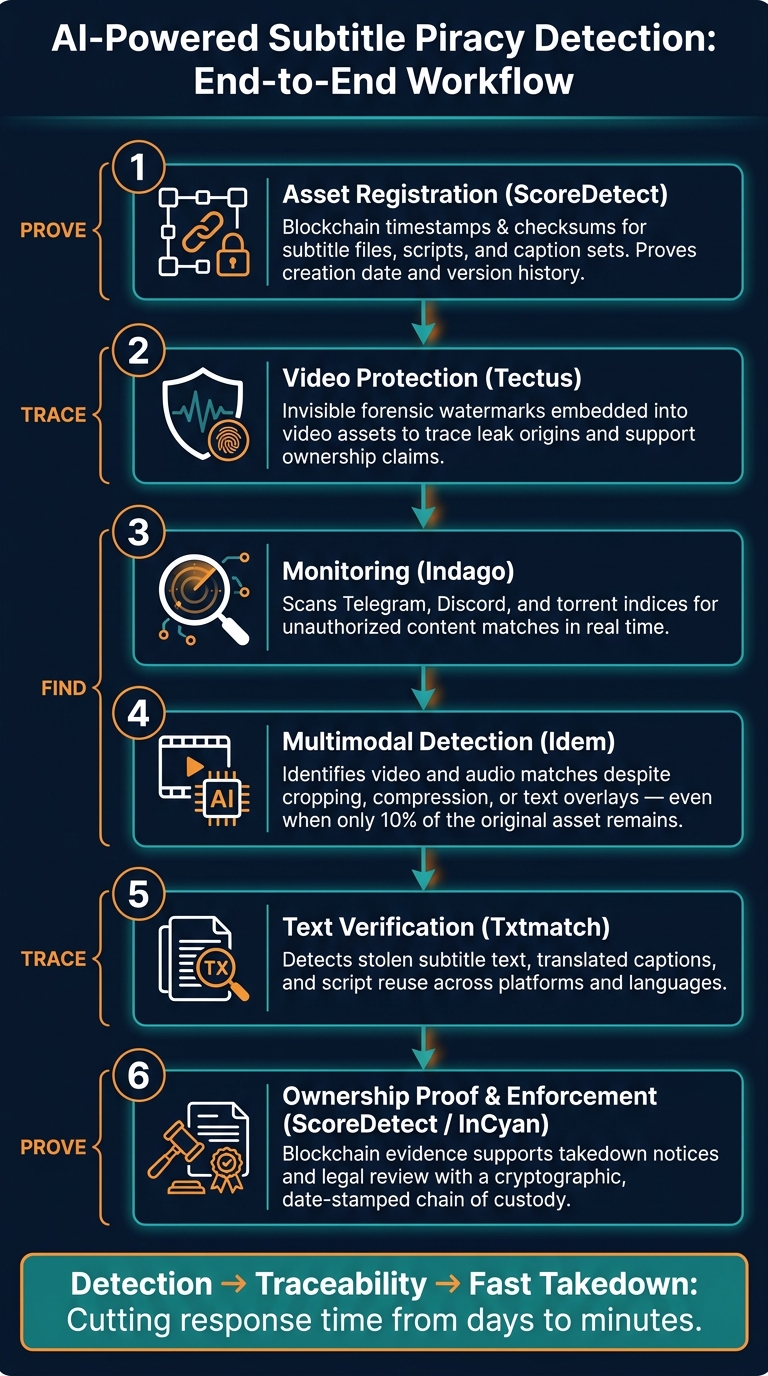
AI-Powered Subtitle Piracy Detection: End-to-End Workflow
InCyan Tools for Matching Altered Video and Stolen Text
InCyan helps bridge the gap between spotting abuse and proving it.
Idem handles the video side. It looks at frames and motion to create a durable fingerprint that can survive cropping, re-encoding, color changes, and burned-in text overlays. Even if only 10% of the original asset is left, Idem can still find a match. That makes it a strong fit for pirated copies with unauthorized subtitle burns or channel overlays.[4][2]
Txtmatch handles the text layer. If pirates pull subtitle files, auto-translate captions into other languages, or repost scripts under different names, Txtmatch can compare that text against InCyan’s proprietary database with high accuracy, even when the video itself has changed.[3] That’s a big deal because subtitle theft often travels on its own, separate from the video, and often shows up in closed spaces like Telegram and Discord.
Detection alone isn’t enough. You also need attribution. Tectus, InCyan’s invisible watermarking layer, adds invisible session watermarks so leaked copies can be traced back to a source.[2]
ScoreDetect for Timestamping Subtitle Files and Proving Version History
For subtitle teams, proof starts before infringement happens. ScoreDetect timestamps subtitle files, localized caption versions, and production scripts on the blockchain using a checksum. The file itself is never stored. Only the checksum is recorded. That means pre-release scripts stay private, while their existence at a specific point in time can still be proven.[3][4]
Each time a localized caption version is approved or a script gets revised, a new ScoreDetect timestamp creates an immutable proof-of-ownership record for that version. If a takedown notice or legal review calls for proof, the blockchain record gives you a clear timeline. It’s not just a metadata field someone can edit. It’s a cryptographic signature tied to a specific date.[3][4]
Table: End-to-End Subtitle Piracy Workflow
| Step | InCyan or ScoreDetect Tool | Role in the Process |
|---|---|---|
| 1. Asset Registration | ScoreDetect | Generates blockchain timestamps and checksums for subtitle files, scripts, and caption sets to prove creation date and version history |
| 2. Video Protection | Tectus | Embeds invisible forensic watermarks into video assets to support ownership claims and trace leak origins |
| 3. Monitoring | Indago | Scans Telegram, Discord, and torrent indices for unauthorized content matches[3] |
| 4. Multimodal Detection | Idem | Identifies video and audio matches despite cropping, compression, or unauthorized text overlays, even when only 10% of the original asset remains[4][2] |
| 5. Text Verification | Txtmatch | Detects stolen subtitle text, translated captions, and script reuse across different video files and platforms |
| 6. Ownership Proof and Enforcement | ScoreDetect / InCyan | Provides blockchain evidence and automates takedown notices |
Put together, these tools turn subtitle abuse into a workflow you can monitor, trace, and document.
Conclusion: Key Takeaways for Businesses Dealing with Subtitle Piracy
Put it all together, and the pattern is pretty clear: subtitle piracy is a text, video, and workflow problem all at once. Pirates don’t just copy caption files. They also change video frames and take advantage of weak spots in the workflow. If you deal with only one part of that problem, you leave gaps.
AI-driven detection has changed the game. That matters because AI can now spot altered content faster than pirates can rework it. Modern multimodal systems still identify heavily edited media with high accuracy, even when pirates use AI to auto-translate subtitles into dozens of languages. A detection layer that looks only at surface pixels won’t hold up against those tactics.
But finding the clip is only the first step. Detection matters only when it leads to proof strong enough for takedowns and legal action. Proving ownership with a verifiable chain of custody is what gives a takedown or legal case real weight.
What many teams are moving toward is a clear working standard: AI-powered detection to find altered content fast, forensic watermarking to show where a leak started, and timestamped provenance records to prove when the file was created. Cutting response time from days to minutes limits damage. The stack that wins is detection, traceability, and fast takedown. For many teams, that’s now a production requirement.
FAQs
How does AI catch burned-in subtitles?
AI can spot burned-in subtitles with multilingual OCR and deep learning. That lets it pull text out of video frames and make sense of it, even when the text is baked into the image and written in different languages.
Pair that with video analysis, and it can flag copyrighted text even when the text appears as part of the video itself.
It may also work with multimodal matching tools like InCyan’s Idem to verify ownership after cropping or re-encoding.
Can subtitle piracy still be traced after edits?
Yes. Subtitle piracy can still be traced even after heavy edits.
AI-based methods like semantic embeddings, visual fingerprinting, and multilingual optical character recognition can spot content that has been cropped, compressed, or covered with new text.
Instead of relying on exact file hashes or metadata, these systems look at the media’s underlying structure. That lets them connect edited content back to the original source.
ScoreDetect, a product of InCyan, can also provide blockchain-based timestamping as verifiable proof of ownership.
Why are timestamps important for takedowns?
Timestamps matter for takedowns because they give rights holders proof they can point to.
When a timestamp is tied to a content checksum on the blockchain, it shows that the asset existed at a specific time. ScoreDetect, a product of InCyan, uses this approach to create an immutable record and a clear cryptographic chain of custody.
That matters in legal enforcement. If a platform, marketplace, or other party asks for proof, rights holders have a verifiable record to support their claim. In plain terms, it helps prevent takedown requests from falling apart because the proof is missing or too weak.