I would choose an anti-piracy monitoring platform for film and TV distribution in 2026 based on four tests: source coverage, verified content matches, confirmed removal times, and title-level reporting.
I compare InCyan with ScoreDetect, Friend MTS, NAGRA, and Verimatrix against those tests – not vendor promises. My buying rule: <u>test the same assets and sources before signing</u>, and keep search delisting, app shutdowns, and hosted-copy removals separate.
Quick Comparison
| Offering | Main tools or services | What I would check |
|---|---|---|
| InCyan with ScoreDetect | Watermarking, matching, search enforcement, BitTorrent monitoring; separate timestamp certificates | How records connect across tools, transformed-copy accuracy, and hosted-copy removal |
| Friend MTS | Monitoring, fingerprinting, watermarking, and enforcement | Closed-channel access, episode accuracy, notice timing, and title-level exports |
| NAGRA | Pirate-service intelligence, investigations, watermarking, and enforcement | Source coverage, attribution, territory rules, and confirmed removals |
| Verimatrix | App protection, watermarking, web monitoring, and app shutdowns | External-site reach, unwatermarked-copy matching, and external removal status |
Timestamping is not monitoring. The article lists ScoreDetect Pro at $11.31 per month with annual billing or $12 month-to-month for timestamping and certificates – not alerts or takedowns.
I would use a controlled pilot to measure coverage, match accuracy, response times, and remaining exposure during the first 24–72 hours, then put the agreed targets, U.S. notice handling, support hours, and data export rights in the contract.
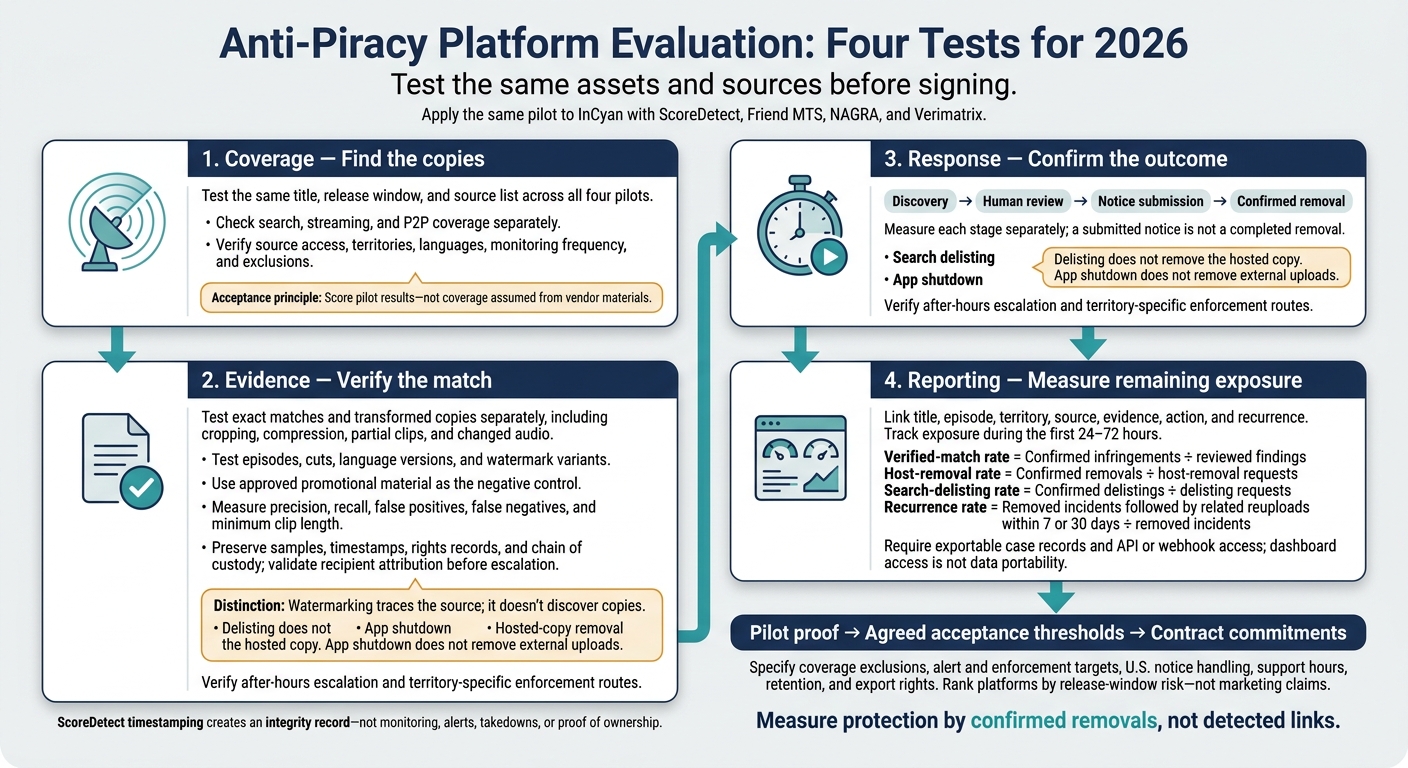
Anti-Piracy Platform Evaluation: Four Tests for 2026
1. InCyan Content Protection Suite with ScoreDetect
Monitoring Coverage
InCyan divides protection among four tools: Tectus for invisible watermarking, Idem for content matching, Indago for search-result enforcement, and TorrentWatch for BitTorrent monitoring. Ask whether TorrentWatch covers trackers, DHT, and magnet links.
ScoreDetect Pro provides blockchain timestamping and verification – not release monitoring, alerts, or takedowns. For monitoring to be useful, each hit must link to the correct reference asset.
Matching and Evidence
Treat Idem’s claim that it can identify content with only 10% remaining as unproven until you test it with your own files[9]. Tectus can help trace the source of a leaked screener, while Idem matches discovered files against reference masters. Ask for precision, recall, false-positive and false-negative rates, and minimum clip length.
ScoreDetect records a file’s SHA-256 checksum and timestamp. You can check its certificate against the linked public blockchain transaction[6][8]. This creates an integrity record, not proof of ownership. Keep the matching master file, chain-of-title documents, licenses, and delivery records with the certificate.
After a match is verified, enforcement speed depends on how quickly the platform moves from detection to notice.
Alert and Enforcement Speed
Measure discovery, human review, notice submission, and completed enforcement separately. Indago can delist search results, but delisting does not remove the hosted copy. Ask how hosting-level notices are handled.
Document monitoring frequency, escalation steps, and takedown commitments. Reporting should then track each title from its first detection through removal.
Reporting and Release Protection
Before release, register authoritative reference files, apply Tectus where appropriate, and catalog release dates, authorized platforms, and permitted windows. Track protection during those windows using validated detections and notices that received action.
Require case records and dashboards to include:
- Title, episode, territory, platform, and source URL or torrent ID
- First-seen and last-seen timestamps, detection method, match confidence, and watermark result
- Enforcement status, removal date, repeat-infringer history, and unresolved links
Confirm API or webhook access, support for languages and dubbed content, user roles, audit logs, data retention, hosting location, U.S. support, and service-level commitments.
sbb-itb-738ac1e
2. Friend MTS
Monitoring Coverage
For film and TV releases, monitoring needs to find leaked screeners and illegal episode uploads across public and closed channels fast enough to protect the release window.
Friend MTS offers 24/7 monitoring for movies, entertainment, live content, on-demand content, and linear broadcasts. Its stated coverage includes global and regional pirate services, streaming platforms, file-sharing networks, social platforms, and closed IPTV services behind authentication or paywalls.[5][10][12]
For a U.S. rollout, ask for a written coverage map that confirms search engines, torrents, cyberlockers, messaging channels, and IPTV apps. Finding content is only part of the job – the platform also needs to prove the match.
Matching and Evidence
Friend MTS says it uses automated video capture and fingerprinting to verify the content it finds.[13] Subscriber ID watermarking identifies the source of redistributed content. Distribution watermarking traces whether a leak came from the customer’s own platform or a third-party path.[11][14] The company claims it can identify the source in as little as 3 minutes in some deployments.[14]
For screeners or pre-release episodes, check whether watermarking identifies the recipient, account, platform, or territory – and whether it needs to be embedded before delivery. Also confirm that the portal attaches video, metadata, and case details suitable for DMCA notices and escalation.[1]
Alert and Enforcement Speed
Ask for written targets covering detection, review, notice submission, after-hours handling, and urgent pre-release leaks. Get clear terms on which enforcement actions the base service includes and which cost extra or require a legal partner.
With detection and notice timelines defined, reporting should document what happened for each title.
Reporting and Release Protection
Friend MTS offers a portal with incident tracking, evidence, and disruption status.[1][13] Check whether you can filter reports by territory and release window, retain evidence and audit logs, and export data through CSV or an API.
Before onboarding, set territory-specific claim rules and configure monitoring by title, season, episode, language, and territory. This helps prevent permitted uploads from being treated as piracy.
3. NAGRA Anti-Piracy Services
Monitoring Coverage
NAGRA reports intelligence on pirate storefronts, social channels, marketplaces, app stores, and pirate IPTV services.[15][19] Confirm whether coverage also includes streaming sites, search results, cyberlockers, P2P networks, and territory-specific domains.
Ask how NAGRA ranks threats. Does it account for release window, territory, reach, and repeat history – or just count infringing URLs? Each hit needs to be verifiable for coverage to matter.
Matching and Evidence
NexGuard forensic watermarking traces the source of files and live content. Test it against altered clips, fragments, and re-encodes.[18] Watermarking traces the source; it doesn’t discover copies. NAGRA doesn’t publish general accuracy or false-positive rates, so check both in your own test.
For legal escalation, request a sample investigation report that includes evidence, attribution limits, and chain of custody. Once attribution is confirmed, measure how long it takes to send a notice.
Alert and Enforcement Speed
NAGRA’s IP Blocking Platform supports workflows, evidence submission, request tracking, and automated actions.[16][17] Set separate contractual SLAs for detection, validation, and enforcement, including emergency pre-release leaks.
Confirm which actions are available in each licensed territory and whether U.S. DMCA notice handling is included.
Reporting and Release Protection
NAGRA describes dashboards, alerts, activity reports, and enforcement analytics.[16] Check that these connect domains, repeat incidents, removal status, titles, and release windows.
Keep notice submission separate from confirmed removal, and track unresolved cases by licensed territory. Confirm API or webhook access, title and territory metadata imports, evidence retention, and required team responsibilities. Reports should show where piracy repeats and which release windows remain exposed.
4. Verimatrix Anti-Piracy Services
Monitoring Coverage
Verimatrix is strongest when a leak starts inside a protected app. Distributors still need external-site monitoring to find copied files. Its Streamkeeper portfolio combines Multi-DRM, forensic watermarking, Counterspy, and Deepscan.
Deepscan uses an anti-piracy web-crawling service to monitor possible piracy sites and identify redistribution without permission. Public materials mention search engines, social media, illicit streaming sites, and forums. Request a coverage matrix that lists source types, geography, languages, monitoring frequency, watchlist ownership, and confirmed P2P reach.[20][23][26][27]
Matching and Evidence
Verimatrix’s forensic watermarking and Reveal can extract source data from pirated samples. Deepscan can surface the recovered watermark and its associated app instance without exposing personal data.
Confirm the minimum sample length, whether the system can match unwatermarked copies, and how reliably it tells apart episodes, cuts, screeners, and regional versions. For screener delivery, verify that each watermark identifier maps to the correct recipient and content version.[21][23][24]
Alert and Enforcement Speed
Once watermarking identifies the source, the next test is how fast the platform can act. Counterspy can disable an identified app instance immediately, but that does not remove external uploads. Treat fast-shutdown claims as deployment-specific, not a universal SLA.
Require a pilot that measures first detection, alert delivery, watermark extraction, notice preparation, escalation, and confirmed removal. Also verify who handles external notices and after-hours escalation.[23][25]
Reporting and Release Protection
Confirm which delivery paths are covered, including screener delivery and affiliate distribution. Require exports that link watermark IDs to titles, episodes, recipients, territories, app shutdowns, external removals, and reappearances.
Reports should separate detected URLs from verified infringements and submitted notices from completed removals.[21][23]
Compare Coverage, Evidence, Response, and Reporting
Use the same title, release window, and source list across all four pilots.
Monitoring Coverage
Find copies shared without permission across search, streaming, and P2P before the release window ends. Test the same source list on every platform before scoring coverage. Score pilot results – not coverage assumed from vendor materials.
| Offering | Source-access check | Contract requirement |
|---|---|---|
| InCyan Content Protection Suite with ScoreDetect | Check direct-site, search, and P2P coverage separately | List included monitoring services and excluded sources |
| Friend MTS | Separate monitoring from blocking and enforcement | Document accessible sources and monitoring frequency |
| NAGRA Anti-Piracy Services | Test each source category in the pilot | Record exclusions and regional access limits |
| Verimatrix Anti-Piracy Services | Separate direct monitoring from inferred findings | Verify direct-access and P2P coverage |
Matching and Evidence
Test transformed copies separately from exact matches. Preserve the chain of custody, and require human validation before taking recipient-level action on leaked screeners.
| Offering | Transformed-copy test | Attribution and evidence check |
|---|---|---|
| InCyan Content Protection Suite with ScoreDetect | Test cropping, compression, partial clips, and changed audio | Confirm which module provides matching, integrity records, and attribution evidence |
| Friend MTS | Test matching and watermark survival independently | Distinguish distribution watermarking from subscriber watermarking |
| NAGRA Anti-Piracy Services | Measure results for each transformation | Verify attribution scope, exportable samples, and extraction confidence |
| Verimatrix Anti-Piracy Services | Test unmarked and transformed assets separately | Validate extraction results against delivery records |
Alert and Enforcement Speed
Measure discovery, review, submission, and verified removal as separate stages.
| Offering | Response stages to verify | Outcome to record |
|---|---|---|
| InCyan Content Protection Suite with ScoreDetect | Confirm review, notice routing, acknowledgment, and rechecks | Track search delisting separately from removal of the hosted copy |
| Friend MTS | Verify investigation, takedown, claim, and escalation workflows | Record results by enforcement route |
| NAGRA Anti-Piracy Services | Confirm who approves, submits, and escalates notices | Measure verified removal – not just notices sent |
| Verimatrix Anti-Piracy Services | Measure external enforcement separately from app controls | Check external availability after action |
With removal timing measured, compare how well each platform tracks titles, territories, and recurrence.
Reporting and Release Protection
After timing detection and enforcement, score how clearly each platform reports release-level risk: which titles, territories, and windows remain exposed? Use only customer pilot data.
Compact enforcement workflow
- Review: Group duplicates; assess authorization, ambiguous clips, and fair use.
- Preserve and submit: Keep locations, timestamps, samples, rights records, and notice recipients. For U.S. DMCA notices, include work identification, material location, contact details, a good-faith statement, an accuracy and authorization statement under penalty of perjury, and a physical or electronic signature. Send notices to the designated DMCA agent.[28][29][30]
- Verify and follow up: Recheck access; record counter-notices, restoration, recurrence, and escalation. Section 512 requires expeditious action for relevant safe-harbor protection – not a universal hourly deadline. Automation does not replace legal review.[28][29]
| Offering | Reporting acceptance test |
|---|---|
| InCyan Content Protection Suite with ScoreDetect | Confirm that cross-service records link assets, evidence, actions, and recurrence |
| Friend MTS | Require customer-level results rather than aggregate processing capacity |
| NAGRA Anti-Piracy Services | Verify title-, episode-, territory-, and source-level exports |
| Verimatrix Anti-Piracy Services | Keep source-level findings separate from external enforcement |
| Release-risk measure | Definition or pilot requirement | Distributor outcome |
|---|---|---|
| Detection latency | Time from first observed availability to first detection; record observation limits | Measure episode-level exposure during the first 24–72 hours |
| Verified-match rate | Confirmed infringements ÷ reviewed findings | Reliably separate episodes, cuts, and language versions |
| Screener attribution | Validate recipient mapping before escalation; measure recipient attribution rate | Trace leaks without acting on unvalidated matches |
| Host-removal rate | Confirmed removals ÷ host-removal requests | Track removal of underlying copies |
| Search-delisting rate | Confirmed delistings ÷ delisting requests | Track reduced search visibility |
| Territorial exposure | Record intended and observed access territories | Identify licensed territories still exposed |
| Release-window exposure | Measure hours of availability without permission during the protected window | Prioritize premium video-on-demand releases |
| Promotional false positives | Check approved clips and partners; measure false-positive rate | Avoid notices against authorized promotion |
| Recurrence rate | Removed incidents followed by related reuploads within 7 or 30 days ÷ removed incidents | Link repeat piracy by asset, account, domain, and available hashes |
Strengths, Limits, and Buying Criteria
Separate documented features from what the pilot proves and the contract promises. A feature page does not confirm coverage, support hours, or enforcement scope.
Use this matrix to check vendor claims against pilot results and contract terms. The test: can the platform find leaked screeners and illegal episode uploads across streaming, search, and P2P, document the infringement, and move toward removal fast enough to protect the release window?
| Offering | Documented strengths | Verification gaps | Buying questions |
|---|---|---|---|
| InCyan Content Protection Suite with ScoreDetect | ScoreDetect documents a verification-certificate API for timestamping and digital watermarking only – not end-to-end monitoring.[33][7] | Confirm which InCyan services handle discovery, matching, review, attribution, and enforcement. | For evidence workflows, what does the itemized quote cover for integrations, API limits, exports, and support? |
| Friend MTS | Documents monitoring, capture, fingerprinting, evidence, enforcement, and reporting.[1][5][10][13] | Check catalog accuracy, coverage exclusions, and watermarking or subscriber-data requirements. | For closed IPTV and regional sources, which analyst languages, support hours, APIs, retention terms, and enforcement routes are included?[12][31] |
| NAGRA Anti-Piracy Services | Documents threat intelligence, investigation, prioritization, and takedown services.[32][22] | Require proof of transformed-copy matching, recipient attribution, and territory-aware decisions. | For investigation-led monitoring and enforcement, who handles analysis, rights-system integration, APIs, exports, support, and escalation? |
| Verimatrix Anti-Piracy Services | Documents detection and countermeasures.[34] | Check external-source coverage, attribution requirements, human review, and evidence portability. | Which delivery and external-enforcement needs are covered? What are the limits and extra charges for integrations, APIs, exports, and support? |
Put service commitments in the contract. Specify onboarding deadlines, monitoring availability, alert SLAs, takedown turnaround, support hours, and escalation paths. Include data retention, incident handling, remedies, maintenance exclusions, and export rights at termination. Dashboard access is not data portability.
Make the authorized pilot a procurement deliverable. Test screeners, episodes, alternate-language versions, and representative watermark variants. Use approved promotional material as the negative control. Simulate leaked screeners and illegal episode uploads across streaming, search, and P2P in licensed territories. Before testing, agree on territory schedules, permitted test locations, and repeat uploads.
Measure coverage, match accuracy, alert latency, analyst-confirmation time, evidence completeness, takedown-submission time, repeat-upload detection, and dashboard/API usability. Set acceptance thresholds, confidentiality terms, deletion deadlines, and telemetry ownership in advance. Rank platforms by release-window risk, not marketing claims.
ScoreDetect Pro costs $11.31 per month on annual billing or $12 per month month-to-month. This covers timestamping and verifiable certificates only. Request separate enterprise quotes for titles, episodes, channels, territories, storage, integrations, support, minimums, overages, and renewal terms. Use the distributor’s release plan to define the scope the platform must prove before purchase.
Conclusion: Match Protection to Your Release Needs
Use the same four test criteria – coverage, evidence, response, and reporting – to find the right protection for your release.
Choose based on your release model, rights profile, piracy risk, and enforcement capacity. What works for leaked screeners may not work for episodic or territorial releases.
The table below turns those criteria into buying checks for each release type.
| Release-risk profile | Prioritize | Purchase proof |
|---|---|---|
| Confidential screeners | Forensic watermark recovery, recipient tracing, preserved evidence | Correct attribution after re-encoding or screen capture; infringing URL; capture time; sample; recovered watermark; confidence score; screener record. |
| Episodic premieres | Episode-level accuracy, fast recurring scans, repeat-upload detection | Premiere-day latency; false-positive rate; duplicate handling; grouped incidents; removal by episode. |
| Premium video-on-demand | Verified web, streaming, search, and P2P coverage | Timed results across web, streaming, search, and P2P; removal status; repost checks. |
| Territorial releases | Country-, domain-, language-, and license-specific monitoring | Country, domain, language, and license-aware evidence; no confusion with licensed availability. |
Measure protection by confirmed removals, not detected links. Require reports on time to removal, remaining exposure, reposts and mirrors, and repeat infringers. Run a controlled pilot with representative assets, then weigh verified results and contract terms. Your buying standard: proof of the fastest verified removal for your highest-risk release type.
FAQs
How can I set realistic takedown targets for a new release?
Set goals before launch, and require measurable commitments for detection accuracy, alert speed, and takedown rates. Run a controlled pilot using a representative set of high-value assets. Use it to establish baselines for discovery rate, true-positive rate, detection-to-takedown time, and repeat-infringer rate.
After launch, track these metrics and use case data to adjust targets and escalation rules. Document enforcement ROI in U.S. dollars, and keep evidence packages ready for litigation.
What should I do when a piracy site ignores a notice?
Follow your contract’s escalation path, and confirm who handles follow-up and escalation [1][2]. Treat delisting and hosted-content takedowns as separate steps. Sending a notice does not mean the content has been removed [1].
Have your platform track repeat appearances and past takedown failures to support further legal action or claims for higher damages [3]. Check enforcement independently instead of relying on initial reports, and keep stalled cases moving with active follow-up [1][2][4].
How can I measure the ROI of anti-piracy monitoring?
Measure ROI by business impact – not raw detection counts. Track coverage across priority assets, average detection and takedown times, de-indexing speed, takedown success rates, and repeat offender rates.
Use these metrics to estimate revenue protected or recovered in U.S. dollars for quarterly business reviews. Your platform should provide evidence-grade reporting that turns case data into clear next steps and shows enforcement effectiveness and revenue impact by region and asset type.