If you need the short answer: use the least expensive fusion method that still gives you enough alignment and noise handling. In this comparison, static fusion is the low-cost baseline, self-attention improves each modality on its own, cross-attention links one modality to another, co-attention/hierarchical attention deepen two-way matching, and transformer fusion gives the strongest multi-layer interaction at the highest compute cost.
I’d boil the article down to this:
- Static feature-level fusion is fast and simple, but weak at handling missing or bad inputs.
- Self-attention improves text, image, audio, or video features within each stream, but it does not directly connect streams.
- Cross-attention is where direct multimodal matching starts.
- Co-attention and hierarchical attention push that matching in both directions and across levels.
- Transformer-based fusion stacks these interactions across layers, which often improves alignment but adds latency and memory load.
A few numbers make the trade-off clear:
- Early fusion: 85.3% accuracy, 0.847 F1, 45.2 ms latency
- Attention fusion: 91.4% accuracy, 0.908 F1, 68.3 ms latency
- Missing-modality attention setup: 95.4% accuracy under random missingness
- Segmented cross-attention: 43% less computation and 29% less memory
- Dynamic weighting in transformer fusion: about 7% fewer alignment errors
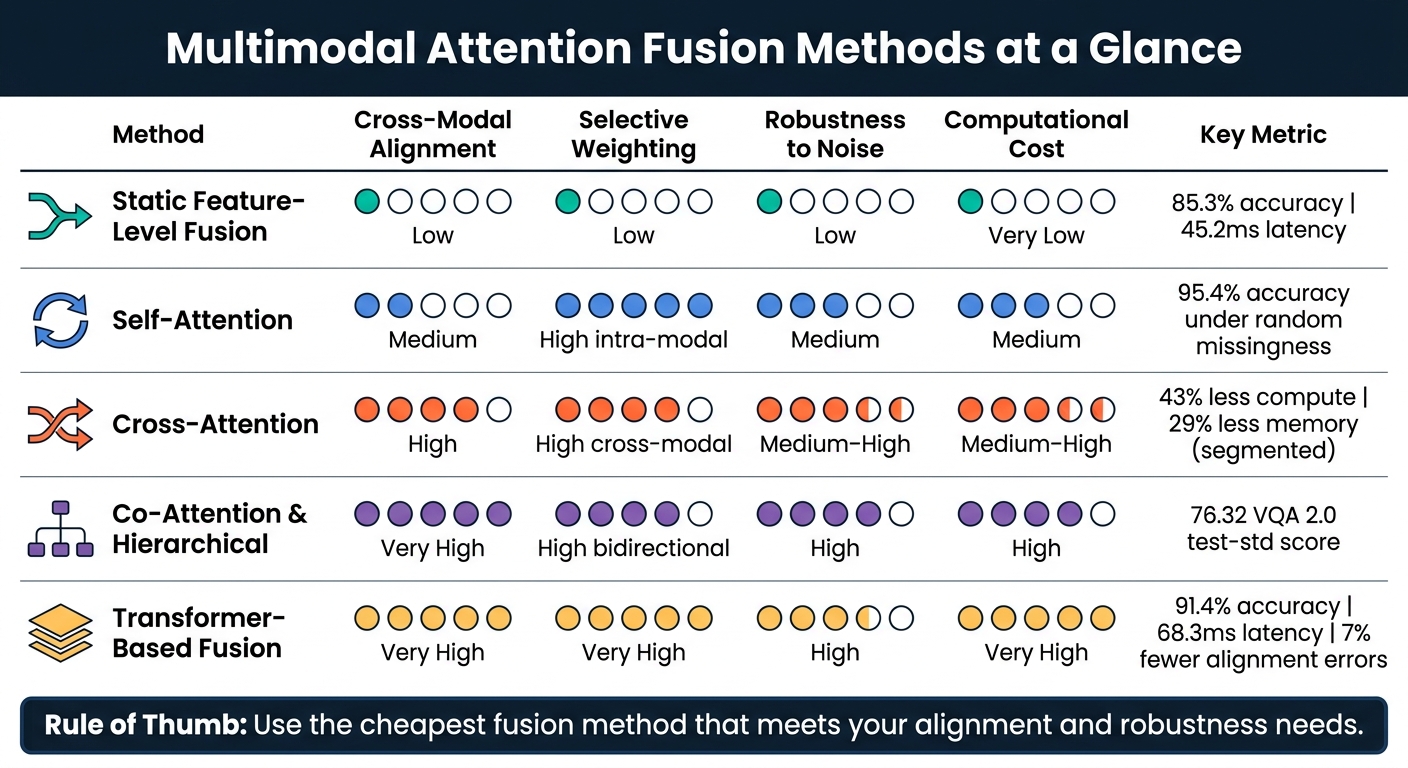
Multimodal Attention Fusion Methods: Performance, Cost & Robustness Compared
Multi-Modality Cross Attention Network for Image and Sentence Matching
sbb-itb-738ac1e
Quick Comparison
| Method | What it does best | Main weakness | Cost |
|---|---|---|---|
| Static fusion | Fast baseline for aligned inputs | Weak weighting and weak missing-input handling | Very low |
| Self-attention | Improves each modality before fusion | No direct cross-modal matching | Medium |
| Cross-attention | Directly links one modality to another | Cost grows with sequence length | Medium-High |
| Co-attention / hierarchical | Two-way and multi-level matching | More tuning, more memory | High |
| Transformer fusion | Deep repeated multimodal interaction | Highest latency and compute load | Very high |
My takeaway: this is less about picking the “best” model and more about matching the method to the job. If your data is clean and time matters, start simple. If your system must deal with cropped images, noisy audio, or partial inputs, attention-based fusion is often worth the extra cost.
That’s the frame for the rest of the article.
1. Static Feature-Level Fusion
Static feature-level fusion, or early fusion, is the most straightforward way to combine multimodal data. It’s the baseline that makes the limits easy to spot: where attention later helps with alignment, per-example weighting, and noise handling. In this setup, each modality has its own encoder – like a CNN for images and a transformer or RNN for text. Those encoders produce fixed-length vectors, which are concatenated into one joint feature vector and then sent to a classifier or shared network. [3][4]
Cross-modal alignment
Because fusion happens at one fixed step right after feature extraction, alignment is fixed and coarse-grained. The model combines features once and doesn’t revisit cross-modal relationships later, so alignment stays coarse. To make this work, the encoders need to be trained with a shared objective so their embeddings are compatible. [2][5]
This setup tends to work best when inputs are already synchronized. If timing drifts or correspondence between modalities shifts, performance can fall apart.
Selective weighting
Plain concatenation does not provide instance-level weighting. In simple terms, the model does not decide, example by example, which modality should matter more. Every feature dimension gets pushed into the fused representation, whether it helps or not.
Downstream layers can still learn fixed reliance patterns across the dataset, but that’s not the same as changing the balance for each input. Teams can only nudge that balance indirectly through normalization, projection layers, or encoder-specific loss weights. That’s blunt control compared with attention, though it can still work when one modality is usually more informative than the others.
Robustness to noisy or missing modalities
Concatenation assumes that all modality vectors are present and useful. If an audio stream is corrupted or an image is missing, that bad input goes straight into the fused representation, and the model has no built-in way to reduce its influence. [7]
That makes static fusion less reliable under missing or corrupted modalities than attention-based methods. Common fixes include:
- Modality dropout during training
- Learned placeholder vectors for missing inputs
- Denoising each modality before feature extraction
Computational cost
After encoding, fusion is usually just concatenation or a linear projection. So from a compute standpoint, it is much cheaper than attention.
In one benchmark, early fusion achieved 85.3% accuracy, a 0.847 F1 score, and 45.2 ms latency, while attention fusion reached 91.4% accuracy, a 0.908 F1 score, and 68.3 ms latency. [6]
That trade-off makes early fusion a practical fit for edge devices, real-time pipelines, and other systems with tight compute budgets.
Early fusion is useful as a baseline because its fixed behavior makes the gains from attention easy to see.
2. Self-Attention
If early fusion is fixed, self-attention makes the weighting adaptive inside each modality. Static fusion treats every feature the same. Self-attention does the opposite: it reweights elements on the fly across word tokens, image patches, audio frames, or sensor readings before building a context-aware representation.
Cross-modal alignment
Self-attention can improve alignment in an indirect but important way. It first builds stronger representations within each modality, which gives the fusion step cleaner inputs to work with. In image-text models, for example, self-attention can organize image regions and word tokens separately before cross-modal fusion happens. [9]
Selective weighting
Because attention weights are computed dynamically, the model can move its focus to the most useful tokens, patches, frames, or features and give less weight to weaker signals. That matters a lot in multimodal data, where signal quality is rarely even.
In a 2024 stress-detection model, bidirectional cross- and intra-modal attention used self-attention to cut noise and redundancy in BVP and EDA signals before cross-modal alignment. [8]
Robustness to noisy or missing modalities
Self-attention can handle incomplete data better than fixed-weight methods because the weights can shift toward the cleanest signal when one modality is noisy or missing. An attention-based method with missing-modality adaptation reached 95.4% accuracy under random missingness conditions. Techniques such as modality masking, modality-specific tokens, and modality dropout can make this work more reliably in practice. [10][11][12]
Computational cost
The tradeoff is cost. Self-attention is expensive because it computes pairwise interactions across elements, and that cost climbs fast as multimodal sequences get longer. To cut the overhead, researchers often use attention bottlenecks, downsampling, sparse attention, and modality-specific pruning. [12][13]
Once each modality has been weighted internally, the next step is to align them across modalities.
3. Cross-Attention
Cross-attention lets one modality look at another. In plain English, queries come from one stream, while keys and values come from a different one. That changes fusion from within-stream cleanup to direct alignment across streams.
Cross-modal alignment
Cross-attention builds on self-attention, but with a twist: instead of matching items inside the same modality, it matches one modality against another. Models like ViLBERT and LXMERT do this with dedicated cross-attention layers, so text tokens can attend to visual tokens and learn fine-grained links between words and image regions.[19][20]
That setup helps when the two feature spaces don’t line up neatly, but the model still has to learn detailed correspondences.
Selective weighting
Cross-attention works by computing pairwise attention scores across modalities. Each query element is compared with all key elements from the other modality, which creates a distribution over what matters most for the current input.
You can see the payoff in audio-visual speech recognition on the LRS3 benchmark. Adding cross-attention to a Transformer-LARGE baseline cut word error rate from 3.75% to 3.50% on clean speech and from 17.22% to 15.90% on noisy speech. When researchers combined cross-attention with extra interaction modules, WER dropped even more, reaching 3.29% (clean) / 15.06% (noisy).[18]
Robustness to noisy or missing modalities
Cross-attention isn’t magic. It can lean too hard on a noisy modality if nothing checks it. To deal with that, newer architectures use gating and reliability-aware weighting, so cleaner signals get more say.
This becomes important when one stream is compressed, corrupted, or partly missing. In cross-modality attention architectures, turning off gating has been shown to cause a 5–6% recall loss and weaker performance under noise.[17] Reliability-aware cross-attention, which reweights channels based on estimated modality quality, also shows steady gains in multimodal physiological stress estimation when some sensor channels are corrupted.[14]
Computational cost
The downside is cost. Cross-attention scales with query length times key length, and that can get expensive fast when multimodal sequences are long. It’s a bit like trying to compare every item in one list with every item in another list.
Segmented attention methods such as SRformer cut this cost by splitting keys and values into smaller groups. That leads to a theoretical 43% drop in computation and 29% drop in memory compared with standard cross-attention.[16] Another practical option is bottleneck fusion, which routes cross-modal attention through a small set of latent tokens. That keeps compute in check and can beat vanilla cross-attention at a lower cost.[7]
The main drawback is still scaling to long multimodal sequences. When both modalities need equal influence, co-attention and hierarchical attention take the interaction a step further.
4. Co-Attention and Hierarchical Attention
Co-attention lets each modality steer the other’s focus. It lines up text with image regions, audio cues, or other modality-specific signals. Put simply, each modality helps decide what matters in the other. Where cross-attention moves in one direction, co-attention works both ways.
Cross-modal alignment
In visual question answering, co-attention links words, phrases, and question structure to image regions. The 2016 Hierarchical Question-Image Co-Attention model handled this at the word, phrase, and question levels [21][25].
The Deep Modular Co-Attention Network (MCAN) took that idea further by stacking modular co-attention blocks. It reached 70.63% overall accuracy on the VQA-v2 test-dev benchmark [23]. A two-way co-attention method posted even higher scores: 75.89 on test-dev and 76.32 on test-std for VQA 2.0 [24].
That matters because co-attention can tighten fine-grained alignment more directly than self-attention or one-way cross-attention. Instead of one stream doing all the looking, both streams keep each other in check.
Selective weighting
Hierarchical attention adds another layer by processing inputs at different levels of detail – words before phrases, frames before clips, patches before regions. This step-by-step setup filters local signals first and then combines them into a global representation.
In a multimodal fusion study for Alzheimer’s-related prediction, adding a global attention mechanism on top of pairwise local attention improved top-1 accuracy by 3.03% compared with a version without the global stage [26].
Robustness to noisy or missing modalities
Because hierarchical designs work in stages, they can handle noise better. If low-level features are messy, higher layers can lean on cleaner signals from another modality or from intact parts of the same one. That’s a practical edge. Multimodal data is often imperfect, and models need some room to recover.
The Hierarchical Cross-Modal Attention Fusion (HCMAF) model used this idea for sentiment analysis. It combined modality-specific encoders, pairwise cross-modal attention, and a trimodal aggregation stage. The model performed competitively on CMU-MOSI and CMU-MOSEI while staying lightweight overall [27].
When deeper interaction is needed, transformer-based fusion extends this pattern with stacked self-attention and cross-attention.
Computational cost
Dense co-attention designs can get expensive fast. The six-layer stacked architecture in DCAN models deeper intra-modal and inter-modal interactions, but it also needs much more memory and training time [22].
Extra scoring and aggregation layers can:
- increase memory use
- slow training
- add inference latency
In practice, that means budgeting more time for tuning and ablation testing. If compute is tight, sparse attention can help cut the load. The trade-off is pretty clear: more depth can improve interaction modeling, but it also pushes up memory use and latency. That’s where transformer-based fusion starts to look like the next step in the comparison.
5. Transformer-Based Multimodal Fusion
Transformer-based fusion brings these attention patterns into one stacked pipeline, so multimodal tokens can interact again and again across layers. That’s the big shift: transformers don’t run attention a single time and stop. They reuse it layer after layer to tighten alignment and clean up the interaction between modalities [33][36]
Cross-modal alignment
Each modality is encoded on its own, projected into a shared space, and then connected through cross-attention across layers. That repeated back-and-forth is what gives transformers an edge over one-pass fusion.
The results show up in the numbers. A video-audio-text transformer (VATT) trained with self-supervised objectives reached 82.1% top-1 accuracy on Kinetics-400 and 83.6% on Kinetics-600 without supervised pre-training [29]. On text-to-video retrieval, a multimodal fusion transformer trained on HowTo100M improved R@10 from 45.2% to 51.3% over earlier baselines using the same backbones [30].
Selective weighting
Attention can shift weight toward the strongest signal, while gating can push down noisy streams. In one MFT study, dynamic weighting cut alignment errors by about 7% and improved robustness under Gaussian noise to 78.4% accuracy, compared with 70.2% for METER and 73.1% for BLIP-2 [34].
Robustness to noisy or missing modalities
Transformer fusion still loses ground when one modality gets worse, so explicit alignment and missing-input handling matter. Wasserstein-based modality alignment improves both accuracy and robustness [35]. Other fixes include modality dropout, learned [MASK] embeddings for absent streams, and prompt-based missing-input handling, which help the model shift attention when one input is gone [31][32].
Computational cost
There’s no way around it: this flexibility costs a lot. Attention scales quadratically with sequence length, so long text, image, and audio inputs can drive up latency and memory use fast. Attention complexity scales as O(T²d) in time and O(T² + Td) in space, where T is sequence length and d is hidden dimension [28].
Teams usually try to control that overhead with:
- sparse attention
- token pruning
- hierarchical tokenization
- mixed-precision training (FP16/bfloat16)
Those trade-offs set up the comparison below: better alignment and stronger robustness often come with higher compute and tuning cost.
How the Five Approaches Compare on Key Performance Measures
The five methods differ most in alignment, weighting, robustness, and cost.
Static feature-level fusion is the simplest option, and in some cases it still performs very well. In multimodal sex classification, it reached an AUC-ROC of about 0.96, beating intermediate and late fusion [38]. But there’s a catch: cross-modal alignment is weak by design, and the model has no built-in way to downweight a corrupted or missing input.
Self-attention improves each modality before fusion. It helps the model focus on the most useful parts within a single input stream. But it does not directly align one modality with another. So it’s better to think of self-attention as a stronger encoder, not a complete fusion method.
Cross-attention moves a step further. It lets one modality attend to another, which means the model can learn direct cross-modal grounding. In one case, a text-image cross-attention model improved F1-score by 3.4 points on MVSA-Multiple [37].
Co-attention and hierarchical attention push this idea further by making alignment bidirectional. Instead of one modality looking at the other, both interact with each other. Hierarchical attention adds staged abstraction on top of that, which can tighten joint representations. The upside is better alignment. The downside is higher compute.
Transformer-based multimodal fusion scales this attention logic across more layers and more interactions. In plain English: it takes the same core idea and applies it more deeply. Cross-modal transformers with uncertainty-aware gating have shown up to an 18% relative improvement in intent classification under severe input corruption compared with naive fusion [15]. That said, attention cost climbs fast as token count grows. Use these models when alignment and tolerance to corrupted inputs matter more than latency.
The table below pulls those trade-offs into one view.
| Approach | Cross-Modal Alignment | Selective Feature Weighting | Robustness to Noise/Missing Inputs | Computational Cost | Interpretability |
|---|---|---|---|---|---|
| Static feature-level fusion | Low | Low | Low | Very low | Low |
| Self-attention (per-modality) | Medium | High (intra-modal) | Medium | Medium | Medium |
| Cross-attention | High | High (cross-modal) | Medium–High | Medium–High | Medium–High |
| Co-attention & hierarchical attention | Very high | High (bidirectional) | High | High | High |
| Transformer-based multimodal fusion | Very high | Very high | High | Very high | Medium |
Self-attention refines one modality. Cross-attention grounds one modality in another.
Pros and Cons of Each Approach
This section turns the comparison into deployment guidance: what each method does best, and what you give up to get it.
The table above shows where the methods differ. This summary turns those differences into day-to-day trade-offs.
Static fusion works best for aligned, low-latency systems. If your inputs already line up and compute is limited, static fusion is a strong fit. It’s simple, fast, and usually easier to ship. The downside is that its weights stay fixed, so it can’t reduce noisy signals or shift based on the sample in front of it. [44][47]
Self-attention works well when long-range structure inside one modality matters. It helps improve the internal representation of each modality, which is useful when sequence relationships carry a lot of meaning. But there’s a catch: it does not directly line up one modality with another. It also gets expensive as sequences get longer because memory and compute grow quadratically. [48]
Cross-attention works well when you need direct cross-modal grounding. It lets one modality attend to another, which makes it useful for tasks where the relationship between inputs matters a lot. The trade-off is higher training and inference cost, a bigger need for paired multimodal data, and the chance of modality bias if one signal starts to dominate learning. [45][47]
Co-attention and hierarchical attention work well for bidirectional, multi-level alignment. These methods are a better fit when information needs to flow both ways and at more than one level. That extra modeling power comes with a price: more architectural complexity, more parameters, a higher chance of overfitting on small datasets, and more tuning work. [1][39][46]
Transformer fusion works well for high-value tasks where alignment and robustness are worth the resource cost. It gives you the most flexible modeling of the group, but it also asks the most from your system. Compute, memory, and data demands are all high. In practice, many teams lean on pre-trained Transformer backbones for high-value use cases and keep simpler fusion methods for lower-stakes or latency-sensitive applications. [40][41][42][43]
The matrix below condenses the choice into strengths and limits.
| Approach | Strengths | Limits |
|---|---|---|
| Static feature-level fusion | Simple, fast, low latency, sample-efficient | Weak fine-grained alignment, no dynamic reweighting, limited interaction modeling |
| Self-attention | Captures long-range intra-modal dependencies, richer representations | Does not directly model cross-modal alignment; quadratic cost at scale |
| Cross-attention | Direct cross-modal grounding, handles asymmetric roles | Higher compute, needs more paired data, can develop modality bias |
| Co-attention & hierarchical attention | Bidirectional alignment, multi-level structure, better interpretability | High complexity, overfitting risk, harder hyperparameter tuning |
| Transformer-based multimodal fusion | Flexible modeling, robust to noisy or shifted inputs | Highest memory use, latency, data needs, and implementation complexity |
Conclusion
Across these five methods, the choice comes down to four things: alignment, robustness, cost, and interpretability. In multimodal matching systems, the best fusion method isn’t the fanciest one. It’s the one that still holds up when inputs are partial, noisy, or changed in some way.
Static feature-level fusion works well for clean, aligned, low-latency data. It’s simple, strong, and a smart place to start. But more complexity doesn’t automatically mean better results. So treat it as a baseline, not the upper limit.
Use self-attention when the internal structure of a single modality matters. It helps build stronger unimodal representations, but it doesn’t directly line up one modality with another.
Use cross-attention when one modality needs to ground another directly. That makes it stronger than self-attention for cross-modal links.
Use co-attention and hierarchical attention when alignment needs to go both ways and happen across multiple levels. That can pay off, but it also brings more complexity.
Transformer-based multimodal fusion is the best fit when accuracy and relational modeling matter more than compute. The tradeoff is plain: it comes with the highest latency, memory use, and engineering cost.
Start with the cheapest method that meets your alignment and robustness needs.
FAQs
Which fusion method should I start with?
This article matters for InCyan’s multimodal fusion approach because it shows how AI can combine signals from images, video, audio, and text into one match score. That makes it possible to spot content even after it has been cropped, compressed, paraphrased, or reused in part.
ScoreDetect is InCyan’s blockchain timestamping tool. It records a cryptographic checksum to create tamper-evident proof of ownership for assets found through multimodal matching, including matches surfaced by InCyan’s Idem.
When is cross-attention better than self-attention?
Cross-attention works better when a model has to link information from different inputs or modes. A common case is matching text to image regions or audio frames.
In multimodal feature extraction, it lets the model focus on the parts of each input that matter most instead of lumping everything together as one big block. That usually leads to better, more stable embeddings.
How do these models handle missing or noisy inputs?
Attention mechanisms help models deal with missing or noisy inputs by putting more weight on the signals that matter most across images, video, audio, and text. That makes multimodal feature extraction more resilient to cropping, compression, and meme-style edits.
In enterprise workflows, InCyan’s AI-driven approach brings together multimodal matching, invisible watermarking, and blockchain-based timestamping to help verify ownership and track unauthorized use, even after major content changes.