If you want to find copied or edited media, file matching alone is not enough. I’d sum it up this way: multimodal similarity works by turning text, images, audio, video, code, and documents into vectors or structured features, lining them up in one shared space, and then scoring how close they are.
Here’s the short version of what matters:
- Raw files can’t be compared directly because text, pixels, waveforms, and frames use different data formats.
- Feature extraction comes first for every modality:
- text and docs → semantic or layout-aware features
- code → AST parsing
- images → vision embeddings
- audio → transcripts plus media signals
- video → frame features plus transcripts
- Cross-modal alignment lets a system compare meaning across file types, not just exact bytes.
- Fusion choice shapes the system:
- early fusion can catch cross-modal links but costs more
- late fusion is easier to scale and easier to inspect
- graph-based hybrid fusion adds traceability for match decisions
- Similarity scoring usually relies on cosine similarity, distance functions, and contrastive learning
- Large-scale search often uses approximate nearest-neighbor retrieval so teams can scan millions of assets with lower latency
- For anti-piracy work, transformed matches matter most: cropped images, clipped audio, re-encoded video, memes, and partial copies
One point stands out to me: the quality of the features usually matters more than exact file matching. If a system can keep signal through edits, compression, overlays, and reposts, it is far more useful for review and enforcement work.
Quick comparison
| Part of the system | What it does | Why it matters |
|---|---|---|
| Feature extraction | Converts each media type into model-ready signals | Makes cross-format comparison possible |
| Cross-modal alignment | Places different modalities in one semantic space | Lets text, image, audio, and video relate to the same idea |
| Fusion | Combines signals from one or more modalities | Affects cost, scale, and traceability |
| Similarity scoring | Measures how close two assets are | Ranks direct, partial, and transformed matches |
| Retrieval | Finds top matches across large libraries | Keeps search usable at enterprise volume |
I’d read the article as a guide to one simple idea: to compare different media types well, you first turn them into comparable features, then score meaning instead of file sameness.
Multimodal Embeddings: Introduction & Use Cases (with Python)
sbb-itb-738ac1e
How multimodal similarity differs from single-modality matching
Single-modality matching works inside one format. Text is compared with text. Images are compared with images. Multimodal similarity is different because it has to bridge formats first.
That’s the core challenge.
Before a system can compare text, images, audio, video, or documents, it needs to turn each one into a form the model can work with. In practice, that means feature extraction comes first.
Why raw data cannot be compared directly
Raw text, pixels, waveforms, and video frames don’t share the same structure. They’re built in completely different ways, so you can’t score them against each other as-is.
A model first converts each modality into structured numerical representations. Once that happens, comparison becomes possible.
The first step is to turn each modality into comparable features.
| Modality | Raw Format | Extraction Method |
|---|---|---|
| Text / Code | Tokens / Source code | Tree-sitter AST parsing [2] |
| Images | Pixels | Vision embedding models [1] |
| Audio | Waveforms | Transcription (e.g., Whisper) [2] |
| Video | Frames | Frame embeddings + transcription [2][1] |
| Docs / PDFs | Formatted text / Layout | Layout-aware semantic extraction [2] |
What cross-modal alignment solves
Once features are extracted, cross-modal alignment maps them into a shared semantic space. In plain English, it helps the system compare meaning instead of getting stuck on file type.
That’s how a system can tell that a caption, an image, and a video clip are connected. The files look different on the surface, but the semantic content points to the same idea.
Cross-modal alignment also helps separate direct matches from model-inferred matches. That distinction can act as a confidence signal for the similarity score [2].
How features are engineered and fused across modalities
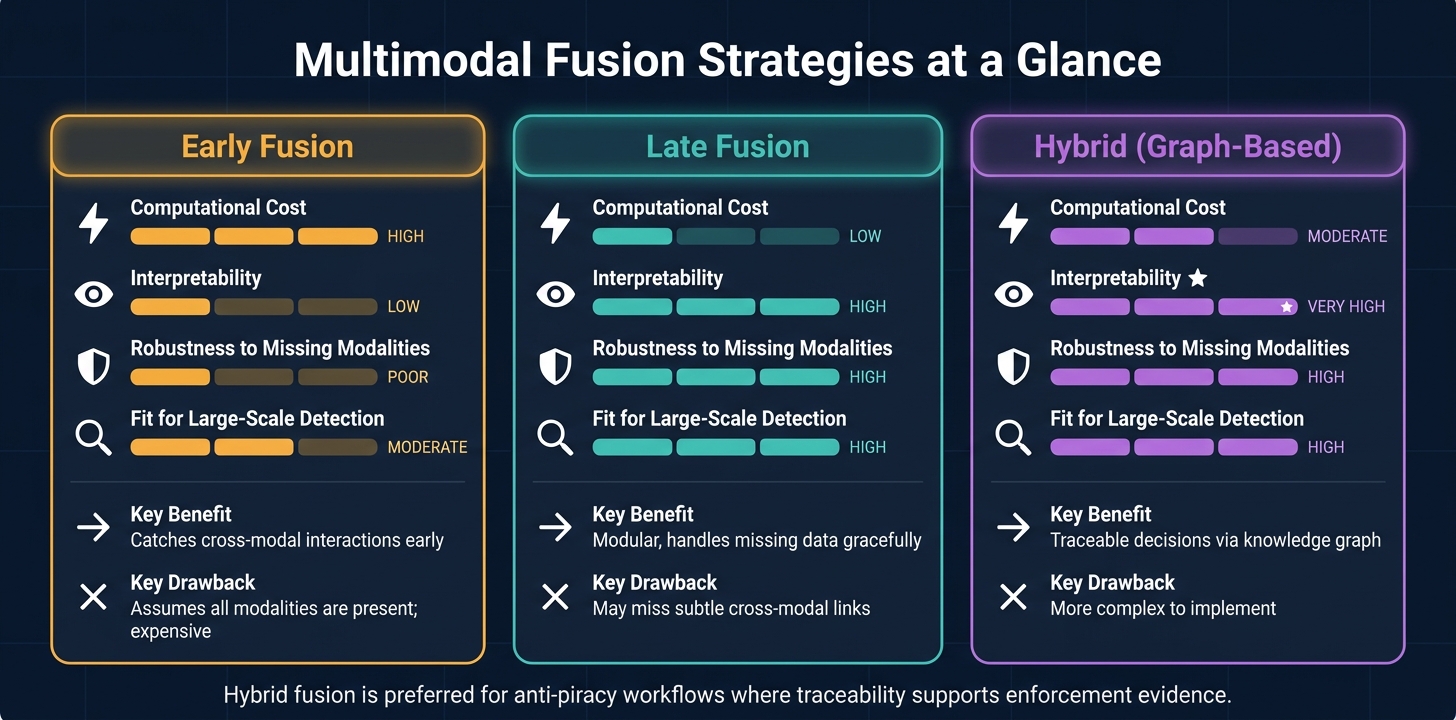
Multimodal Fusion Strategies: Early vs. Late vs. Hybrid Compared
Once each modality is turned into structured features, the next step is to normalize those signals and combine them into something a similarity model can actually use.
Feature extraction for text, images, audio, and video
Text and documents often go through LLM-based semantic passes to pick up meaning, structure, and key concepts. Code is a different story. For code, deterministic AST (Abstract Syntax Tree) parsing with tools like tree-sitter is usually the better fit because it gives you consistent, reproducible structure without depending on a model’s reading of the input [2].
Images can be processed with modern multimodal models that support native visual understanding, so you don’t always need a separate image encoder [1].
Audio and video are often normalized into text transcripts first. Tools like faster-whisper turn speech and audio tracks into transcripts, and those transcripts can then be attached as features alongside the original media [2].
Early fusion, late fusion, and hybrid fusion
After feature extraction, the next decision is how to combine those features.
| Fusion Strategy | Computational Cost | Interpretability | Robustness to Missing Modalities | Fit for Large-Scale Detection |
|---|---|---|---|---|
| Early Fusion | High | Low | Poor | Moderate |
| Late Fusion | Low | High | High | High |
| Hybrid (Graph-Based) | Moderate | Very High | High | High |
Early fusion combines features from all modalities before modeling. That can help the system pick up cross-modal interactions early, but it costs more and assumes every input is present.
Late fusion runs separate models for each modality and combines their output scores at the end. It’s more modular and deals with missing data more gracefully, but it can miss subtler links between modalities.
Hybrid fusion often uses a knowledge graph. Each modality is mapped into a shared structure, and connections are tagged as EXTRACTED or INFERRED. That makes similarity decisions easier to trace [2]. In anti-piracy technology solutions, that traceability matters because it can support enforcement evidence. For rights holders, it preserves a clear path from securing your digital assets to the final match decision.
How modality weighting improves results
Not every modality should have the same weight in every workflow. The weighting should match the domain. In enforcement workflows, it’s common to give more weight to deterministic EXTRACTED links when structural evidence carries more value [2]. That also makes the final score easier to trust.
These fused features then feed into the similarity metrics and learning methods discussed next.
Similarity metrics and learning methods used in multimodal systems
Once features are fused, the system still needs a way to score similarity so it can rank near-duplicates and partial matches.
Cosine similarity, distance measures, and shared embedding spaces
After fusion, systems compare assets with metrics like cosine similarity and learned distance functions inside a shared embedding space. Cosine similarity looks at the angle between two feature vectors, which makes it useful for comparing embeddings even when their size differs.
That matters because not every input is built the same way. Structured inputs can use deterministic features. Visual and audio inputs, by contrast, usually depend on learned embeddings. So the right metric comes down to how those features were built in the first place.
Metric learning and contrastive learning push this idea further. These methods train models to move similar assets closer together in the embedding space and push dissimilar ones farther apart. Contrastive learning has become a standard way to align representations across modalities. Instead of leaning on hand-built rules, it teaches the model what “similar” means from labeled or mined pairs.
Metric learning, contrastive learning, and efficient retrieval
Once the system has similarity scores, retrieval methods decide which matches show up first at enterprise scale. In large systems, retrieval often works from short excerpts to reduce latency and cost. Approximate nearest-neighbor search over shared embedding spaces lets systems scan millions of assets fast without giving up meaningful accuracy.
This is what makes large-scale detection of transformed or partial copies possible. InCyan’s Idem uses multimodal matching across images, video, and audio in content protection workflows. It can detect matches even when assets have been heavily modified, which ties directly to the anti-piracy use cases covered next.
How multimodal similarity is applied in anti-piracy and content protection
Detecting transformed or partial copies at scale
In anti-piracy, similarity signals need to hold up after editing, compression, and reposting. Exact matching breaks down fast once a file changes. A re-encoded video, a cropped image, a clipped audio segment, or a meme with text layered on top may look different at the file level, but it can still carry the same underlying signals.
That’s where semantic feature extraction comes in. It keeps track of those signals across common edits, so teams can spot copies that aren’t exact duplicates. And confidence labels add another layer of help. They give enforcement teams a way to judge how strong the match is before they act.
Where InCyan and ScoreDetect fit in the workflow

InCyan puts those signals to work inside an enforcement flow. Idem handles multimodal matching across images, video, and audio. Tectus adds invisible blind watermarking to images, video, and audio, giving owners proof they can verify without adding any visible mark. ScoreDetect timestamps a SHA-256 checksum on-chain, which creates verifiable proof of ownership without storing the asset. This process demonstrates how blockchain enhances digital watermarking by providing immutable proof of ownership.
Conclusion: Key points for choosing a multimodal approach
The right system depends on one thing above all: how well it deals with transformed content in practice. Look for systems that extract strong features for each modality, combine them cleanly, and score transformed content in a dependable way.
For content protection, finding transformed copies matters more than checking whether two files are exactly the same. Strong feature engineering is what makes that work. It’s also what turns a similarity score into evidence an enforcement team can actually use.
FAQs
How is multimodal similarity different from exact file matching?
Exact file matching looks for identical files or direct copies. Multimodal similarity goes a step further. It compares the actual content across formats and spots meaningful overlap even when a file has been changed.
That means you can find related text, images, audio, or video based on what’s in the file, not just whether the file itself is an exact match.
Which fusion method works best for large-scale content detection?
The original answer misses the topic. It does not cover fusion methods for large-scale content detection.
Instead, it explains OpenAI Presence, an enterprise product used to deploy and manage AI agents across customer-facing and internal workflows.
It also says the product is available through a limited general availability program and that OpenAI engineers and systems integrators support it.
Can multimodal similarity still detect heavily edited or partial copies?
Yes. Multimodal similarity analysis compares content across formats, so it can spot copies even when someone has heavily edited the material or reused only part of it.
In feature engineering, its job is to pick up meaningful patterns that go beyond exact matches. That makes detection more flexible and more reliable.