If image, text, audio, and video stop matching each other, your system can miss stolen content or flag the wrong file. That is the core issue.
I’d sum it up like this: cross-modal attack detection uses AI to compare relationships between formats, not just files one by one. To deal with that risk, I’d look for four things at once: shared embeddings, mismatch checks, edit-resistant matching, and proof records.
Here’s the short version:
- What attackers do: change one format, or pair it with conflicting text, audio, or subtitles
- What AI checks: whether image, text, audio, and video still point to the same meaning
- What helps after edits: matching that still works after cropping, compression, remixing, or short clips
- What backs action later: watermarking and timestamped records
- Why it matters: fewer bad matches, less review pressure, and a cleaner path from detection to takedown
A simple way to think about it: if a video, caption, and soundtrack should match, but one part drifts, that gap becomes a warning. In many systems, even one changed modality out of 2+ linked formats can throw off results. That is why I’d treat this as a workflow problem, not just a model problem.
TUM AI Lecture Series – Detecting Cross-Modal Inconsistency to Defend Against Neural.. (Kate Saenko)
sbb-itb-738ac1e
Quick Comparison
| Layer | What it does | Best for | Main trade-off |
|---|---|---|---|
| Consistency checks | Tests whether formats agree | Caption/image or subtitle/video mismatch | Needs reference mapping |
| Reasoning-based detection | Follows multi-step evasion paths | Chained attacks across formats | More compute and delay |
| Resilient matching | Finds edited copies | Crops, compression, remixing, fragments | Needs reference corpus |
| Watermarking | Adds hidden ownership proof | Proof before content spreads | Not enough by itself |
| Timestamp records | Logs when a version existed to establish ownership | Audit trail and claim support | Works best with other layers |
In other words: I would not rely on one control alone. The article’s main point is simple – match the asset, test whether the formats agree, and keep proof that supports action later.
What Cross-Modal Adversarial Attacks Are
Modern AI content protection systems turn images, text, audio, and video into a shared representation so they can compare content across formats. That means a system can match a video to a caption or connect an image to text, even when the files don’t look related on the surface.
A cross-modal adversarial attack changes one or more modalities on purpose to break matching, retrieval, or verification across another modality. The attacker isn’t just going after one file. They’re going after the relationship between formats. The aim is to slip past ownership checks or piracy detection without making the tampering obvious.
How Cross-Modal Attacks Differ from Single-Format Attacks
A single-format attack is more limited. For example, a filter or compression step can disrupt a single-format fingerprint.
Cross-modal attacks work differently, and that matters. Single-format and cross-modal attacks fail in different ways. Cross-modal attacks target the link between formats, not just one file at a time. A changed image paired with a misleading caption, or a reused video clip paired with conflicting text or audio, creates signals that don’t line up inside the shared representation. That mismatch is the attacker’s signal.
Common Attack Patterns Across Image, Text, Audio, and Video
Common patterns include:
- Cropped or color-shifted images paired with new captions
- Video with conflicting subtitles
- Text or audio that no longer matches the visuals
These patterns show why defenses need to check relationships across formats, not just file integrity.
How AI Detects and Counters Cross-Modal Attacks
Shared Embeddings, Consistency Checks, and Anomaly Detection
AI defense often starts with a shared embedding space. That gives systems one common frame for comparing images, text, audio, and video.
Here’s the simple idea: if those signals point in the same direction, the asset looks normal. If they don’t line up, that gap becomes a warning sign.
AI also separates direct evidence from inferred links. That matters because it helps systems spot suspicious mismatches sooner. When signals diverge, AI flags the asset as suspicious and sends it to deeper analysis. In enterprise workflows, guardrails and escalation rules then route those inconsistent matches to human review.
Once a mismatch shows up, the next job is making sure the matcher can still work after someone tries to hide the problem with edits.
Adversarial Training and Transformation-Resilient Matching
Adversarial training helps matching systems stay accurate after cropping, compression, and other edits. In plain terms, the system learns not to get fooled when a file has been trimmed, recompressed, or altered to look different on the surface.
InCyan’s Idem matches images, video, and audio even after mobile edits, memes, cropping, or compression. Idem still matches modified assets, even after major edits reduce the source material to a small fragment.
Detection by itself isn’t enough. After a match is found, teams also need proof that can back enforcement.
Watermarking and Tamper Evidence Across Modalities
InCyan’s Tectus uses blind watermarking for images, video, and audio that proves ownership without visible marks. That means the proof is there, but it doesn’t need a visible label stamped across the asset.
For text assets, ScoreDetect captures a blockchain timestamps and checksums at publication to create tamper-evident proof without storing the file.
How Evasion-Resistant Content Protection Works in Practice
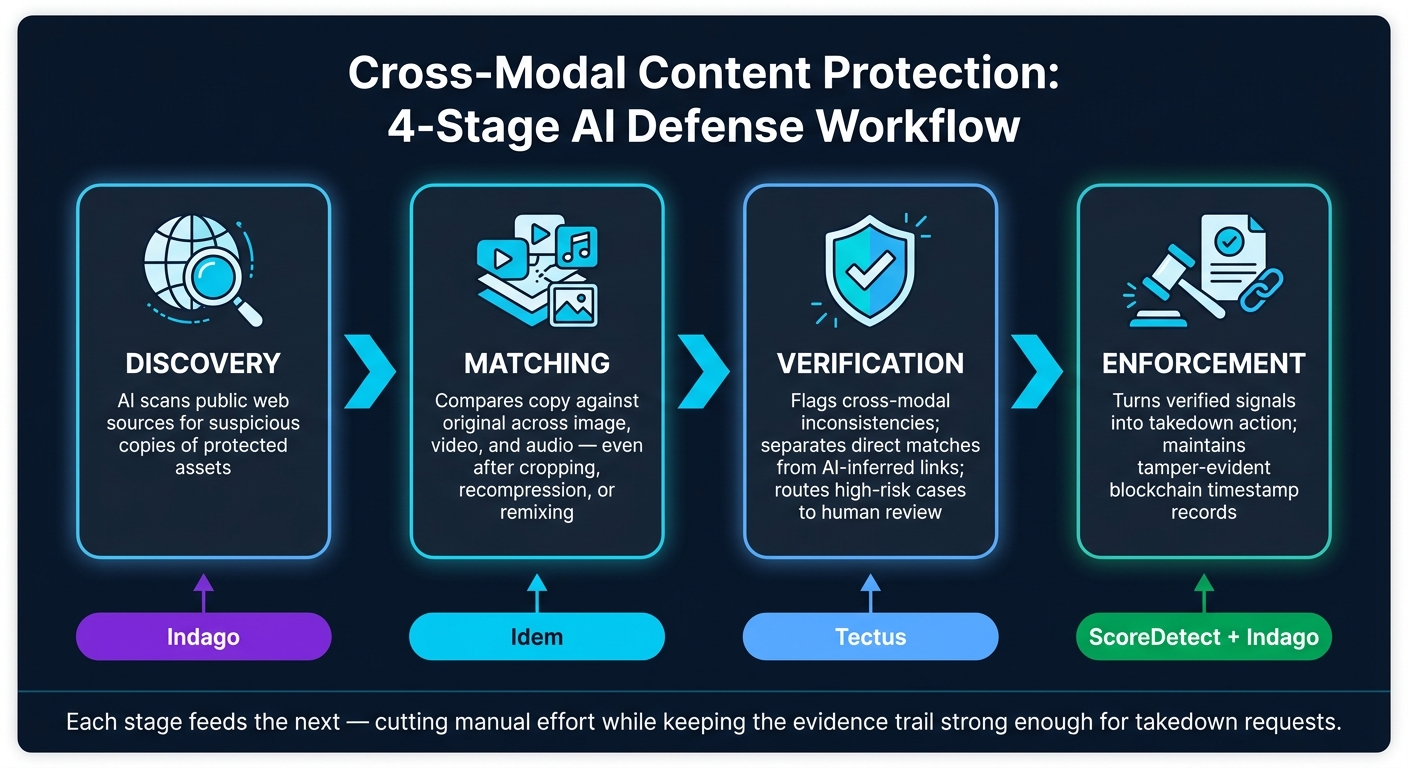
Cross-Modal Content Protection: 4-Stage AI Defense Workflow
From Detection to Enforcement in Enterprise Workflows
Once AI flags a cross-modal mismatch, the next step is simple: turn that signal into action.
In day-to-day enterprise workflows, cross-modal protection usually follows four stages: discovery, matching, verification, and enforcement. Each stage feeds the next. That cuts manual effort and keeps the evidence trail strong enough for takedown requests.
Discovery comes first. AI scans public web sources for suspicious copies of protected assets. When it finds something suspicious, the matching layer compares that copy against the original across image, video, and audio formats. It can still do this when the content has been cropped, recompressed, or remixed.
From there, the system flags cross-modal inconsistencies and separates direct matches from AI-inferred links. That matters because reviewers can quickly see what the system found outright and what it connected through reasoning.
A good setup uses AI for the first pass, then sends high-risk cases to human review. That way, teams move faster without losing the evidence needed for takedown action.
Where InCyan Products Fit: Idem, Tectus, Indago, and ScoreDetect

InCyan lines up each stage with a specific tool.
| Product | Workflow Stage | Core Capability |
|---|---|---|
| Indago | Discovery / Enforcement | Search enforcement that removes unauthorized listings fast |
| Idem | Matching | Multimodal identification across image, video, and audio, even after heavy transformations |
| Tectus | Verification | Invisible blind watermarking for images, video, and audio |
| ScoreDetect | Records | Blockchain timestamping that creates a tamper-evident record |
Taken together, these tools connect detection, proof, and enforcement in a single workflow.
Cross-Modal Defense Methods Compared
Each method deals with a different weak spot in cross-modal matching. After detection and enforcement, the next step is picking the defense layer that matches the attack pattern. Use the layer that fits the threat, then stack methods when one layer isn’t enough.
| Defense Method | Strength | Limitation | Best Use |
|---|---|---|---|
| Semantic Consistency Checks | High accuracy at identifying context mismatches across modalities [1] | Needs a mapped reference set first [1] | Verifying whether a text description accurately represents a video or image |
| Reasoning-Based Detection | Handles multi-step attack chains [2] | Higher compute cost and latency [2] | Detecting sophisticated, long-horizon evasion attempts that span multiple modalities |
| Resilient Multimodal Matching | Finds transformed copies after cropping, compression, or remixing | Works best with a maintained reference corpus | Finding transformed copies of protected images, video, or audio at scale |
| Invisible Watermarking | Provides invisible proof of ownership without affecting the user experience | Best used as a preventive layer, not as a standalone enforcement method | Establishing ownership before content is widely distributed |
| Blockchain Timestamping | Creates a tamper-evident record of when a version of the content existed | Works best alongside detection and watermarking for enforcement | Building an audit trail for ownership claims and takedown evidence |
When Each Method Works Best
The pattern in the table is pretty clear: each method covers a different kind of attack. There isn’t one tool that handles everything.
Semantic checks are best when the problem is meaning. If the text says one thing but the image or video shows something else, this layer helps catch that mismatch. Resilient matching is the better fit when someone edits the asset itself through cropping, compression, or remixing and tries to slip past detection.
Watermarking helps earlier in the process. It gives you proof of ownership before a file spreads across platforms. Content authenticity verification tools like blockchain timestamps help from the record-keeping side by showing when a given version existed. On their own, those two methods don’t do the whole job, but they add support when you need to back up ownership claims or takedown actions.
Reasoning-based detection comes into play when the attack isn’t simple. If someone strings together a multi-step evasion path across text, image, audio, or video, this method can follow that chain better than lighter checks, even if it costs more in compute and response time [2].
Conclusion: What Businesses Should Take Away
Cross-modal attacks go after the link between different content types, not just one file on its own. That’s the part that makes them tougher to spot.
The practical response is a layered defense. AI helps close the gap with multimodal matching and consistency checks, but detection works best when it’s paired with tamper-evident ownership records.
Key Points to Remember
Strong defense stacks resilient matching, consistency checks, invisible watermarking and blockchain records, and timestamped records. No single control stops every attack pattern. A layered setup is stronger than any one method on its own.
In enterprise workflows, that approach also needs tools that handle detection, proof, and enforcement together. InCyan‘s tools cover matching, watermarking, enforcement, and blockchain timestamping in one workflow, with ScoreDetect adding tamper-evident ownership records through blockchain timestamping.
FAQs
How do cross-modal attacks fool AI systems?
Cross-modal attacks trick AI systems by taking advantage of the links they make between different kinds of content, like text, images, audio, and video.
The attack works by slipping misleading changes into one modality, which then causes the system to make the wrong match, misclassify something, or make a bad decision across modalities.
What is a shared embedding in simple terms?
A shared embedding is a common mathematical space where different kinds of content – such as text, images, or audio – are turned into comparable representations.
That lets AI measure how closely related items are across formats. In practice, this helps with content matching and with spotting cross-modal attacks.
Why are watermarking and timestamps both needed?
Watermarking and timestamps do different jobs, so you may need both.
A timestamp helps prove when content existed. Watermarking helps connect that content to its source or owner. Used together, they give you stronger proof and better protection.