If someone changes a track by just a little – like a +1 semitone shift or a 1.05x speed edit – basic detection can miss it. That is the core problem.
I’d sum it up like this: AI is better for scanning huge audio libraries fast, and people are better for checking the hard cases. The article makes that clear across four points: accuracy, speed, scale, and proof.
Here’s the short version:
- Pitch and speed edits are common ways to hide copied audio
- Older matching systems can fail on these edits
- AI can catch many altered files at scale
- Manual review is still needed for disputes, short clips, remixes, and legal review to provide forensic audio proof of ownership.
- The best setup is a mixed workflow: AI first, human review second
A few numbers stand out:
- CNN-LSTM models have reported about 90%–95% accuracy on benchmark tests for manipulated audio
- Content ID handled 98% of YouTube copyright and neighboring rights claims in 2017
- At the same time, some rights holders have said altered uses still slip past platform detection in large numbers
- Some systems, like PANAKO, can also estimate the edit itself, such as a pitch shift or speed factor
The AI Music Surveillance Era Has Started
sbb-itb-738ac1e
Quick Comparison
| Criteria | AI Detection | Manual Detection |
|---|---|---|
| Accuracy on common edits | Strong on routine pitch/speed changes | Good for file-by-file checking |
| Speed | Near real-time | Slow |
| Scale | Works across large catalogs | Hard to do in bulk |
| Consistency | Same rules each time | Can vary by reviewer |
| Hard edge cases | May struggle with unauthorized sampling, layered edits, or legal gray areas | Better for context and judgment |
| Proof for action | Good for flagging | Better for documented review |
Or put another way: AI finds likely matches. People decide what those matches mean.
If you manage music, podcasts, audiobooks, courses, or voice assets, that’s the main takeaway I’d keep in mind while reading the rest of the piece.
AI-Based Detection
How AI identifies pitch-shifted and speed-altered audio
AI can spot edited audio by pulling out stable signals from the sound itself. It looks at patterns in pitch, rhythm, and timbre from spectrogram-based fingerprints, then checks those patterns against a reference catalog.
Modern systems lean on deep neural networks, including CNNs and hybrid CNN-LSTM models, trained on both clean and edited audio. That matters because the models learn to hold up against common editing moves, such as:
- ±3–6% speed changes
- Semitone pitch shifts
- MP3 compression
In practice, this lets the system recognize a track even after someone has tried to disguise it. CNN-LSTM models have reached 90–95% accuracy on benchmark datasets for manipulated audio detection.[5]
Some tools go a step further and estimate how the audio was changed. The PANAKO acoustic fingerprinting system can find the match and estimate the pitch or speed shift.[1][2] For rights holders, that extra detail can help a lot. If a system can show a track was changed by +2 semitones or a 1.05× speed factor, the case is often easier to support.
InCyan‘s Idem is built for this kind of hard-to-hide matching. It can detect content ownership even when only 10% of the original asset remains. If confidence drops or the edit is pushed too far, the file usually gets sent to a human reviewer.
Where AI performs well and where human review is still needed
These models do their best work on routine edits. Once you move into disputed or heavily altered files, the weak spots start to show.
At scale, AI has a plain edge. Google reported that 98% of YouTube copyright and neighboring rights claims in 2017 were processed through Content ID instead of manual notices.[3][4] But volume isn’t the same as perfect coverage. Universal Music Publishing Group has estimated that Content ID fails to identify upward of 40% of uses of its compositions on YouTube, especially when the content has been altered.[4] That’s a big miss rate.
This is where people still come in. Human review matters most in cases like:
- Remixes that may qualify as fair use
- Partial matches on short clips
- Licensing situations with extra legal complexity
In those cases, AI works best as a fast first pass. It flags files, reports similarity scores, and estimates the edits. After that, legal or rights management teams make the call. That’s still the safest path for edge cases and disputed claims.
Manual Detection
What human reviewers look for in altered audio
Manual detection follows a forensic checklist: critical listening, waveform inspection, spectrogram review, metadata analysis, and side-by-side comparison against a verified reference file. In most cases, that happens after AI marks a file as suspicious.[7][8][10]
The first clues usually come from what reviewers hear. Pitch-shifted vocals can sound unnaturally high when pushed up, or oddly slow and heavy when pushed down, even with a small change. A shifted musical key is another warning sign. If a track sits consistently higher or lower than the official release, that stands out. Reviewers also listen for timing drift, where parts feel rushed or a little off-beat compared to known BPM values. Then there are artifact patterns such as warbling, phasing, or blurred transients, which often come from common time-stretch tools.[8][10]
Visual review adds a second check. In a spectrogram, pitch-shifted audio tends to show harmonic structures moved in a clear up-or-down pattern along the frequency axis. Time-stretched audio can show denser event patterns along the time axis, or repetition marks left by some time-stretch software. In waveform views, a 5% speed-up leads to slightly tighter transient spacing and a shorter total runtime, even when the overall sequence still looks alike.[8][11]
Metadata is easy to miss, but it matters. A duration mismatch, an unusual sample rate, or a re-encoded bitrate can point to reprocessing used to slip altered uploads through. On its own, metadata may not prove much. Paired with listening notes and spectrogram evidence, though, it makes the case much stronger.[6][7][9]
For final confirmation, reviewers line up both files in a DAW and compare them directly. Phase inversion can help settle it fast: identical files cancel to near silence, while pitch or speed changes leave residual audio.[7][10]
So manual review works best as a verification step, not as a first-line filter for huge volumes of audio.
The limits of manual review at scale
Manual review can work well on single files. At catalog scale, though, it bogs down fast. A full forensic pass – listening, waveform inspection, spectrogram analysis, metadata checks, and reference comparison – can take a lot of time for each file.
There’s also the human factor. Fatigue makes missed matches and false positives more likely. And consistency can slip. Even trained analysts may disagree on small pitch shifts or subtle tempo changes, which is exactly the kind of edit meant to dodge detection. One reviewer may treat a slight pitch shift as worth action; another may wave it through. That creates uneven enforcement and makes catalog-wide policy harder to apply. Research on weakly pitch-shifted voice found that a CNN could detect shifts of less than ±4 semitones – changes that can be hard to catch by ear alone.[12]
That’s why manual review fits high-value or disputed cases far better than first-pass screening for large catalogs. The tradeoff sets up the next comparison: AI versus manual review.
AI vs. Manual Detection: A Direct Comparison
A side-by-side view makes the tradeoffs a lot easier to see.
| Dimension | AI-Based Detection | Manual Detection |
|---|---|---|
| Detection principle | Uses audio fingerprints and learned embeddings to compare suspected files against a reference catalog. | Relies on critical listening plus waveform/spectral inspection, metadata, and context. |
| Pitch shifting | Strong in specialized systems, but performance varies; some methods degrade sharply on pitch-shifted audio. | Human listeners can often recognize familiar content despite moderate pitch changes, but consistency drops under batch review. |
| Speed changes | Generally handles tempo and time-scale changes well, and some systems are designed for this. | Obvious speed changes are noticeable, but subtle time-stretching is hard to quantify reliably. |
| Review time | Near-real-time scanning and batch processing. | Slow and labor-intensive. |
| Scalability | High; suited for large catalogs and continuous monitoring. | Low; practical only for a limited number of flagged files. |
| Consistency | High when models and thresholds are fixed. | Varies by reviewer and workload. |
| Reliability under common transformations | Strong on common single edits; weaker on combined transformations. | Can handle contextual edge cases, but fatigue and subtle manipulations reduce reliability. |
| Cost per item | Low marginal cost vs. high labor cost. | Higher labor cost per item. |
| Evidentiary value | Screening evidence, but usually needs human validation before enforcement. | Stronger for formal investigations because it can be documented, explained, and cross-checked. |
| Best use case | Broad catalog monitoring, platform-scale scanning, and initial infringement flagging. | Escalated investigations, legal support, and ambiguous cases. |
The gap becomes most important when you move from screening to enforcement.
Here’s the plain-English version: AI is great at checking a lot of files fast. Human review is better when the stakes go up and you need a record you can explain, defend, and check again later.
Pitch shift and speed change also create different problems. They’re not the same kind of evasion. An AI system might catch one with little trouble and miss the other, so the method you use should match the type of manipulation involved.[13]
AI gives you technical signals. Human review turns those signals into something you can act on with more confidence. Blockchain timestamping can also help support ownership claims by recording a verifiable checksum without storing the file itself.
Choosing the right method for your catalog size and use case
For large catalogs, the best approach is usually a split workflow: use AI for first-pass monitoring, then send escalated cases, disputes, and enforcement calls to human reviewers.
Put another way:
- Use AI for breadth
- Use manual review for defensibility
How much weight you give each one should depend on your catalog size and your legal risk. In practice, the strongest setup combines both, which the next section covers.
Detection Workflow and Conclusion
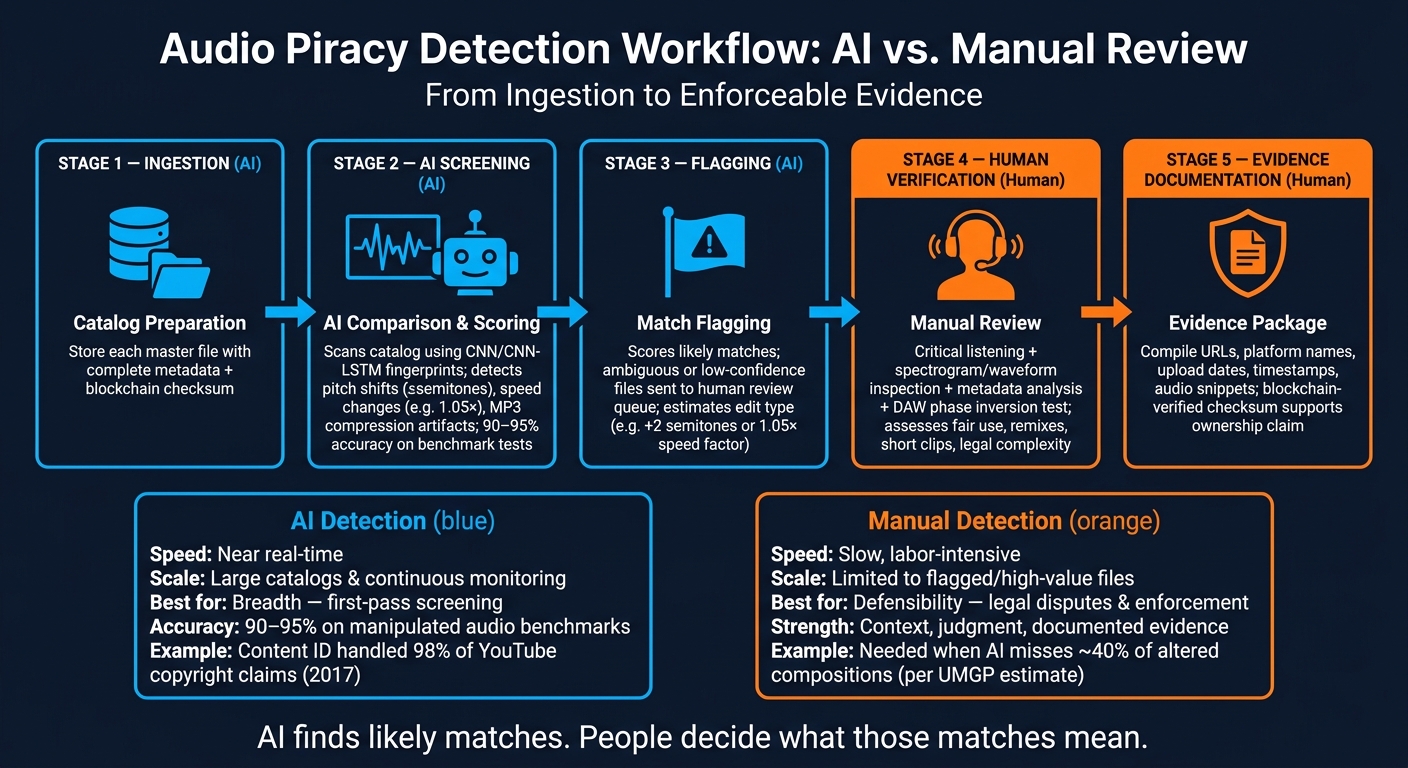
Audio Piracy Detection Workflow: AI + Human Review
A combined workflow for monitoring and verification
A practical altered-audio detection workflow usually moves through five stages: ingestion, comparison, flagging, verification, and evidence documentation. The big issue isn’t just scanning files. It’s showing how that process goes from an initial hit to proof you can stand behind.
It starts with catalog preparation, followed by AI screening, and then human verification. Each master should be stored with complete metadata and a blockchain checksum. From there, AI scans the catalog, scores likely matches, and sends only ambiguous files to a review queue. Human reviewers then confirm pitch or tempo changes, assess fair use or other legal defenses, and document the match.
The evidence package should include:
- URLs
- Platform names
- Upload dates
- Timestamps
- Audio snippets
For pitch- and speed-shifted audio, the aim isn’t just finding a match. It’s documenting that match in a clear way. AI handles speed and scale. Human review handles accuracy and defensibility. Together, they turn detection into evidence.
FAQs
Can AI detect multiple edits at once?
Yes. Unlike manual review, which is slow and often misses edited content, AI-driven detection can spot multiple changes in the same audio file.
It does this by analyzing traits like frequency patterns and harmonic structures. That helps it stay effective even when the audio has been altered with pitch shifts, time stretching, or compression.
ScoreDetect, a product of InCyan, backs this up with AI-based watermarking, multimodal matching through InCyan’s Idem, and blockchain timestamping for proof of ownership.
When should humans review flagged audio?
Humans should review any audio that gets flagged when AI spots possible pitch or speed changes. That matters because AI can still match audio even after edits like time stretching, pitch shifting, or compression.
How? It relies on digital fingerprints built from core semantic and spectral features, including harmonic patterns and mel-spectrograms. In plain English, it looks at the deeper makeup of the sound instead of just its surface form.
ScoreDetect, a product of InCyan, can help with this step by anchoring a cryptographic checksum on the blockchain. That gives you verifiable proof of ownership.
What proof is needed before takedown?
Before you file a takedown, you need proof you can verify that the content matches your original asset. That part matters. If you can’t show a clear match, the process gets shaky fast.
AI-based fingerprinting works better than manual detection because it can still spot audio even after pitch shifts, time stretching, and compression. In plain terms, it can detect a match even when someone has tried to alter the file to hide where it came from.
For stronger proof, experts suggest using fingerprinting alongside invisible watermarking and blockchain timestamping. ScoreDetect, a product of InCyan, records tamper-proof content checksums on the blockchain to help verify ownership and provenance.