If you need to prove ISP blocking compliance, not just spot network trouble, BlockWatch is the top pick in this review. I looked at 6 tools and weighed them on 4 factors: compliance accuracy, evidence quality, coverage/cadence, and alerts.
Here’s the short version:
- BlockWatch: best for order-specific compliance checks and legal proof
- Cisco ThousandEyes: best for network path and outage diagnosis
- RIPE Atlas: best free option for open probe data
- OONI: best for censorship research and open measurement
- Kentik: best for traffic analytics and network visibility
- Blocked.org.uk: best for UK-only filtering and over-blocking checks
This review is not about the deepest network tool. It is about a simpler question: can you show that an ISP complied with a named blocking order over time? In this test, evidence and repeat checks mattered more than raw telemetry.
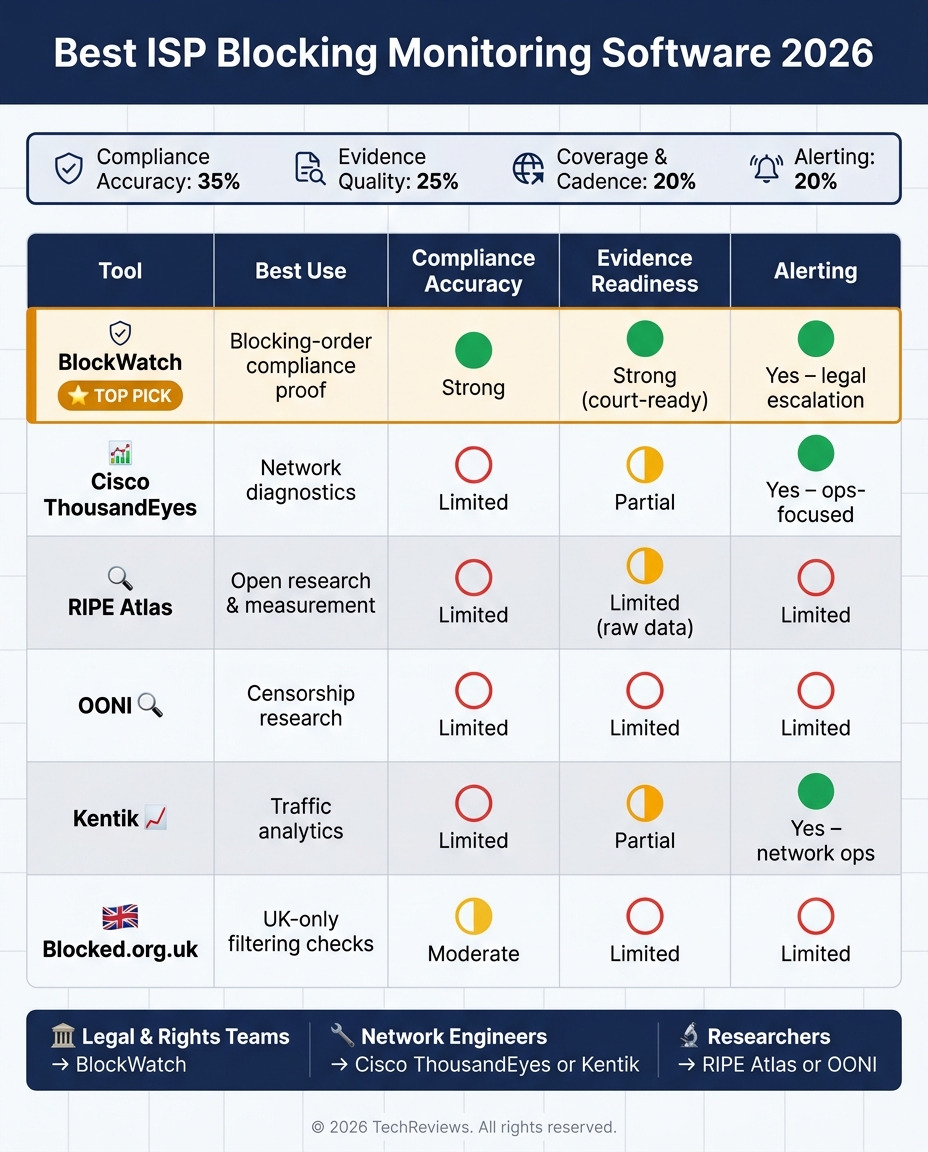
Best ISP Blocking Monitoring Software 2026: Side-by-Side Comparison
Quick Comparison
| Tool | Best Use | Main Strength | Main Gap |
|---|---|---|---|
| BlockWatch | Blocking-order compliance | Order-based checks, repeated verification, court-ready reporting | Not for general network monitoring |
| Cisco ThousandEyes | Network diagnostics | Path tracing and outage analysis | Weak fit for legal proof |
| RIPE Atlas | Research and raw measurement | Time-stamped probe data | Manual work to turn data into a case file |
| OONI | Censorship research | Open testing method across DNS, TCP/IP, and HTTP | No legal evidence workflow |
| Kentik | Traffic and peering analysis | Flow and routing visibility | Does not tie findings to court orders |
| Blocked.org.uk | UK filtering checks | UK ISP and parental-filter checks | Narrow scope and limited reporting |
A few numbers stand out right away: the scoring model gave 35% weight to compliance accuracy, 25% to evidence, and 20% each to coverage/cadence and alerting. That weighting shaped the ranking.
So if you’re a legal, policy, or rights team, I’d start with the tool built for proof. If you’re an engineer, researcher, or UK site owner, one of the other five may fit better.
sbb-itb-738ac1e
1. BlockWatch
Our Pick · Built for blocking-order compliance checks
BlockWatch is made to verify blocking-order compliance and keep evidence on hand for disputes. Here’s how it stacks up on the points that matter most: accuracy, evidence, coverage, and escalation.
Compliance Determination Accuracy
BlockWatch tests DNS, IP, HTTP, and HTTPS, then runs a non-blocking control check to cut false positives caused by normal outages. That gives teams a cleaner way to tell the difference between a real block and a site simply being down. The platform also reports partial and full block status, which helps show when an ISP has blocked one access method but left another open.
Evidence and Audit Readiness
Results are time-stamped and kept in court-ready reports for disputes, renewals, and enforcement follow-up.
Coverage, Cadence, and Alerting
BlockWatch monitors compliance across multiple ISPs and mobile operators, then continues checking after the deadline. That narrow focus is the tradeoff. Alerts go straight to legal and compliance teams.
Limitations: BlockWatch is built for blocking-order compliance. It is not a general network observability platform.
| Best for | Rights holders, legal teams, broadcasters, and industry bodies |
| Pricing | Contact for pricing |
| Skip this if | You need general network performance monitoring instead of compliance checks against a specific court order |
2. Cisco ThousandEyes
Strong network diagnostics, limited compliance evidence
Cisco ThousandEyes sits on the network-diagnostics side of the line, not the compliance-evidence side.
It does a strong job with path tracing and outage diagnosis. If DNS, HTTP, or HTTPS traffic starts failing, ThousandEyes can help engineers see where the break happens and narrow down the cause. That makes it useful for troubleshooting reachability issues across networks.
But that’s a different job from proving blocking-order compliance.
ThousandEyes was built for diagnostics, not court-ready proof. It doesn’t tie probes to a specific blocking order, deadline, and evidence chain. And its output isn’t packaged for filings, renewals, or disputes. So while it can show where traffic failed, it’s a weak fit when the issue is whether an ISP stayed compliant over time.
This tool makes the most sense for NOC teams, SREs, CDN operators, and enterprise IT staff working through service-path issues.
| Best for | Network and IT teams diagnosing their own service paths |
| Pricing | Contact Cisco for pricing |
| Skip this if | You need compliance evidence for a specific blocking order |
3. RIPE NCC / RIPE Atlas
Open measurement network with clear data, but not a compliance tool
Compared with paid diagnostic platforms, RIPE Atlas is the clearest open option for measurement. It runs on a global mesh of probes that records time-stamped DNS response patterns and validation failures [1].
RIPE Atlas can show that a domain returned NXDOMAIN or SERVFAIL from a specific probe at a specific time [1]. That’s useful. But it doesn’t come with managed alerting, escalation, or a compliance workflow [1]. And that’s the gap: raw probe data is not the same as a workflow you can use for legal proof.
Your team still has to read the probe results, keep the evidence, and turn the findings into something fit for a court filing, dispute, or internal review. So while RIPE Atlas works well for measurement, it doesn’t prove ongoing compliance over time on its own.
| Best for | Researchers, academics, and open-measurement teams |
| Pricing | Free |
| Skip this if | You need managed alerting, escalation, and audit-ready compliance reports |
4. OONI
Strong open-research methodology, but not built for legal proceedings
Like RIPE Atlas, OONI gives you raw measurement data, not managed compliance evidence. It measures DNS tampering, TCP/IP blocking, and HTTP interference through an open methodology and open data set, which makes it useful for reproducible censorship research.
That matters if your goal is research. You can inspect the data, repeat tests, and study how blocking works in practice. For researchers and academic teams, that’s a big part of the appeal.
But OONI is not built for managed compliance monitoring. It does not map probes to a blocking order, track deadlines, preserve chain of custody, or produce audit-ready reports. So it can’t support the full chain this article focuses on: order, target list, deadline, repeated probes, control tests, evidence preservation, and audit report.
There’s another gap too. OONI does not provide reports packaged for specific legal proceedings. If a legal team needs forensic-ready evidence for court filings, OONI isn’t the right fit. Its strength is documenting interference. It does not close the evidence loop for legal use.
OONI fits researchers, activists, and academic teams studying censorship and blocking methods. It does not fit teams that need a commercial SLA, dedicated support, or proceeding-ready reports.
| Best for | Researchers, activists, and academic organizations studying censorship and blocking methodology |
| Pricing | Free |
| Skip this if | You need a commercial SLA, dedicated support, or compliance reports formatted for a specific legal proceeding |
| </table> |
5. Kentik
Strong network observability, but built for engineers – not legal teams
Kentik sits in the same camp as other network-operations tools on this list. It tracks traffic across the network and monitors peering behavior using telemetry like NetFlow, sFlow, IPFIX, BGP, SNMP, and streaming data. For NOC teams, traffic engineers, and peering groups running high-volume infrastructure, that means a clear view of what’s moving through the network and where it’s going.
It can spot blocked-content patterns, reachability loss, and upstream blackholing. That’s useful when you’re trying to figure out what happened on the network. But there’s a big gap between seeing network behavior and proving compliance with a specific blocking order.
Kentik can help with the investigation. What it can’t do is give you the evidence trail this article ranks against: the order, the target list, the deadline, repeated probes, control tests, and an audit-ready report.
So Kentik earns its place here for one reason: it shows network behavior. It does not prove order compliance.
| Best for | Network operations teams needing traffic analytics and flow visibility |
| Pricing | Contact for pricing |
| Skip this if | You need proof of compliance with a specific blocking order, not network optimization data |
If your focus is UK-specific blocking oversight instead of broad traffic analytics, the next tool is a closer fit.
6. Blocked.org.uk
UK-only checker for over-blocking and narrow compliance checks
For UK-only enforcement, the job here is much more specific: Blocked.org.uk checks whether a URL or domain is blocked by major UK ISPs.
Its coverage centers on BT, Sky, Virgin Media, TalkTalk, EE, and Three. Where it stands out is over-blocking. In plain English, that means it can spot cases where harmless sites, such as charities or small businesses, get flagged by ISP parental filters by mistake. If you’re a UK site owner or run a non-profit and think your content is being filtered when it shouldn’t be, that’s where this tool fits.
It can also help you check UK court-order blocks and parental-filter blocks. The trade-off is simple: its scope is narrow. It’s built for UK filtering checks, not broad enforcement work across many networks or regions. So in the comparison below, this is the UK-only choice.
| Best for | UK site owners and non-profits checking whether their content is being incorrectly filtered by UK ISPs |
| Pricing | Not specified |
| Skip this if | You need broader ISP coverage, stronger automation, or court-ready reporting |
How All 6 Tools Compare Across Key Decision Factors
These four factors, weighted 35/25/20/20, show whether a tool can prove compliance, not just show that something connects or fails to connect. The first factor is compliance accuracy.
Compliance Determination Accuracy
This is the core test: can the tool tie a specific block to a named order and check DNS, HTTP, IP, and HTTPS behavior with control tests?
| Tool | Maps to a Named Blocking Order | Tests DNS, HTTP, IP & HTTPS | Uses Independent Control Comparisons | Verdict |
|---|---|---|---|---|
| BlockWatch | Strong | Full | Yes | Purpose-built for blocking-order compliance |
| Cisco ThousandEyes | Limited | Partial | Limited | Network visibility, not order compliance |
| RIPE Atlas | Limited | Partial | Partial | Good measurement data, not order-mapped |
| OONI | Limited | Broad | Yes | Open measurement, not legal workflows |
| Kentik | Limited | Partial | Limited | Network analytics, not compliance proof |
| Blocked.org.uk | Moderate | Partial | Limited | UK-focused, narrow scope |
That matters because finding a block is one thing. Showing which order it matches, and proving how the network behaved across test types, is what turns a check into something you can rely on.
Accuracy alone doesn’t help much if you can’t keep the proof.
Evidence and Audit Readiness
A useful compliance report needs to record who, what, when, where, plus before-and-after results in a format you can run again the same way.
| Tool | Chain of Custody | Repeatable Methodology | Reporting Suitable for Court Filings | Verdict |
|---|---|---|---|---|
| BlockWatch | Strong | Strong | Strong | Best fit for evidence |
| Cisco ThousandEyes | Partial | Strong | Limited | Operational reporting, not legal evidence |
| RIPE Atlas | Limited | Strong | Limited | Raw measurement data |
| OONI | Limited | Strong | Limited | Open research reporting |
| Kentik | Partial | Strong | Limited | Network analytics focus |
| Blocked.org.uk | Limited | Limited | Limited | Narrower reporting scope |
In plain English: some tools are good at measurement, but not at preserving evidence in a form that stands up in audits or court filings. That’s a big gap if your team needs more than an ops dashboard.
Proof also depends on how often the system checks again.
Coverage and Monitoring Cadence
Compliance monitoring has to run often enough to catch changes between check windows. Repeated checks across many ISPs are what separate compliance monitoring from a one-time spot test.
| Tool | Multi-ISP Coverage | Mobile Coverage | Automated Re-checks | Cadence Control |
|---|---|---|---|---|
| BlockWatch | Broad | Yes | Yes | Yes |
| Cisco ThousandEyes | Broad in enterprise environments | Limited | Yes | Yes |
| RIPE Atlas | Broad community coverage | Limited | Possible with scripting | Limited |
| OONI | Broad community coverage | Partial | Community-driven | Limited |
| Kentik | Broad data coverage | Partial | Yes | Yes |
| Blocked.org.uk | UK-focused | No | Limited | Limited |
This is where the differences get pretty clear. Some platforms offer broad visibility, but only in certain settings. Others can check across many networks, yet need manual scripting or community activity to keep tests running.
Then there’s the last piece: how fast the lapse gets to the team that needs to act.
Alerting and Escalation
If compliance slips, the right team has to know fast enough to do something about it.
| Tool | Automated Alerts | Escalation Workflow | Trigger Thresholds | Verdict |
|---|---|---|---|---|
| BlockWatch | Yes | Yes | Yes | Best fit for fast compliance escalation |
| Cisco ThousandEyes | Yes | Limited | Yes | Strong alerting, geared to network operations |
| RIPE Atlas | Limited | Limited | Limited | Better for data collection than escalation |
| OONI | Limited | Limited | Limited | Better for measurement than response workflows |
| Kentik | Yes | Limited | Yes | Strong monitoring, less focused on legal escalation |
| Blocked.org.uk | Limited | Limited | Limited | Narrower alerting capability |
A tool can be good at spotting a problem and still fall short when it’s time to route that issue to legal, compliance, or policy teams. That’s the line between monitoring and action.
The next section turns these comparisons into a simple choose-by-use-case guide.
Pros, Cons, and Which Tool Fits Your Situation
Here’s the fastest way to compare the six tools. The table below turns the scoring into a simple fit guide.
| Tool | Pros | Cons | Best Match |
|---|---|---|---|
| BlockWatch | Multi-layer testing across DNS, IP, HTTP, and HTTPS; independent control comparisons | Not a general-purpose network measurement platform | Legal teams and rights holders needing court-ready compliance proof |
| Cisco ThousandEyes | Deep path visibility; enterprise deployment; strong alerting | Not built around blocking orders or legal evidence output | Network engineers monitoring their own infrastructure performance |
| RIPE NCC / RIPE Atlas | Community-run measurement network; broad coverage; strong for research | Raw probe data requires manual interpretation; no managed alerting or litigation-ready reporting | Researchers and academics studying network behavior |
| OONI | Specialist censorship-measurement methodology; broad test coverage; strong open-data reputation | No commercial SLA; reports not packaged for specific legal proceedings | Censorship researchers and digital-rights groups |
| Kentik | Strong traffic analytics; automated monitoring | Built for operating your own network, not proving a third party’s compliance with a court order | Traffic and capacity teams |
| Blocked.org.uk | UK-specific expertise; useful for UK-only enforcement | Coverage limited to UK ISPs; no multi-jurisdiction support | UK-focused teams with a single-jurisdiction scope |
That’s why fit matters more than raw visibility. If your goal is compliance proof, you need repeatable, order-specific testing, not just broad network data.
Use the summary below to find the closest match for your team:
- Choose BlockWatch if you need to prove a named ISP complied with a specific blocking order and want reports that hold up in a renewal hearing or dispute.
- Choose Cisco ThousandEyes if your team manages enterprise network infrastructure and needs deep path visibility.
- Choose RIPE NCC / RIPE Atlas if you’re running independent academic or policy research and can work with raw probe data.
- Choose OONI if your work is open-measurement research and you don’t need a commercial SLA.
- Choose Kentik if you’re a network operator focused on traffic analytics and capacity management.
- Choose Blocked.org.uk if your enforcement scope is strictly limited to UK ISPs.
FAQs
What does ISP blocking compliance actually mean?
It comes down to one simple question: Can someone verify, on their own, that an ISP is following a blocking order?
Most general monitoring sources can’t answer that by themselves.
They might track DNS, web uptime, DDoS activity, or system observability. That’s useful in its own lane. But it’s not the same as producing court-ready evidence that shows whether an ISP is complying with a blocking order.
Why isn’t general network monitoring enough?
General network monitoring can tell you if a link is online. But that alone won’t prove whether an ISP followed a specific blocking order.
Compliance verification needs court-ready evidence. That means matching the order to the right targets, ASNs, and deadlines; running DNS, HTTP, IP, and HTTPS tests against control results; and keeping an auditable record that can hold up in court.
How often should blocking compliance be rechecked?
The sources provided don’t say how often blocking compliance should be checked again. They also don’t review ISP blocking monitoring software, BlockWatch, or tools used to verify compliance and evidence for ISP blocking orders.
The closest material touches on general DNS monitoring for uptime and security alerts, along with separate content about compliance management that isn’t tied to ISP blocking.